Poaching is the most argued-about move in doubles pickleball. One player calls it smart, aggressive team play. The other three people on the court call it theft.
The truth is narrower than both camps admit. Poaching is a genuine weapon when the situation and the partnership support it, and a partnership-killer when they do not.
This guide draws the line precisely: what a poach actually is, the five situations where it wins points, the four where it costs you, the calls that keep partners safe, and the counter that punishes reckless poachers.
Key Takeaways
- A poach crosses the centerline. It means taking a ball clearly on your partner’s side of the court — different from an Erne, which goes around the kitchen, and different from simply taking a middle ball.
- Poach the middle with your forehand on weak or high balls. That is where the math favors the poacher: the strongest wing on the most attackable ball.
- Planned poaches work; surprise poaches usually do not. Signals, calls, and pre-point agreements turn a risky interception into a team play.
- In casual rec play, stealing your partner’s shots is widely considered selfish. Your partner came to hit balls and improve — the score does not matter enough to deny them that.
- Commit to a winner or a forcing shot. Every poach leaves half the court open behind you, so a soft poach is worse than no poach at all.
- “Mine” outranks everything. If your partner calls the ball, abort the poach immediately — even mid-step.
What Poaching Actually Is
A poach is when you leave your half of the court, cross the centerline, and hit a ball that was headed to your partner’s side.
It happens at the kitchen line most often, but it can happen anywhere. A poach is defined by whose ball it was, not by where you were standing when you hit it.
The word comes from tennis, where the net player crosses to intercept a return aimed at their partner. In pickleball it means the same thing: intercepting a ball on your partner’s side of the court.
Poaching is not an Erne. An Erne goes outside the sideline and around the kitchen to volley a ball beside the net post. A poach stays on the court and crosses the middle. Keep the two separate in your head.
It is also not simply taking a middle ball. Middle balls live in the shared zone between partners, and someone has to hit them. A poach takes a ball that was clearly your partner’s — past the midline, on their side.
That distinction is the whole debate. Taking a shared ball is teamwork. Taking your partner’s ball is a decision that needs a reason and, ideally, permission.
The Middle Is the Poacher’s Playground
Most poaches begin at the center of the court. A ball drifts toward the middle, one partner crosses a step or two, and the stronger wing takes it. The geometry is simple: the middle is the shortest path to offense for both teams.
This connects directly to middle-court ownership. The “respect the X” framework — which we break down fully in who should take the middle in pickleball — assigns middle balls by forehand strength and court position.
A poach extends that same logic one step further, across the centerline. The forehand-in-the-middle principle does not stop at an imaginary line; it just gets riskier past it, because the ball now belongs to someone else.
That is why communication matters so much more for poaches than for middle balls. Middle balls are contested by rule of thumb, and both players expect the contest. Poached balls belonged to your partner until you decided otherwise.
A forehand covering the middle is the most efficient poaching setup in the sport. It reaches farther, sets up earlier, and finishes harder than a backhand reaching across the body ever will.
When Poaching Is Smart
Poaching earns its reputation in five specific situations. Each one shares the same three traits: the poacher has a clear advantage on the ball, the interception has a high chance of winning or damaging the point, and the partner is prepared for it.
1. Your Forehand Owns the Middle
When a ball comes to the center and you hold a forehand on it, crossing one step to take it is usually the highest-percentage play available.
The forehand generates more pace and control than your partner’s backhand reaching for the same ball. This is the poach nobody at any level should argue with.
The condition is balance. A poach that leaves you lunging and off-balance turns a forehand advantage into a desperation swing. Cross early, set your feet, and hit from a stable base.
This is also the poach that scales down to every skill level. Even in casual rec play, a forehand taking a middle ball reads as teamwork, not theft — because everyone can see it was the better shot.
2. A Weak Ball or Pop-Up Begs to Be Punished
When an opponent pops a ball up near the middle of the court, the team that attacks it first usually wins the point. Hesitation hands the initiative back.
If that sitting ball is closer to your partner’s side but your angle, position, or readiness is better, poaching the put-away is smart — provided poaching is an understood part of your partnership.
The non-negotiable part is the finish. A poach must produce a winner or a forcing shot. A soft poach that comes back is worse than no poach at all, because it also leaves your half of the court empty.
Read the height honestly. A ball above net height is an invitation. A ball at your shoelaces is a trap — poaching low balls usually produces the weak reply you were trying to avoid.
3. Your Partner Is Pulled Wide and Exposed
When an opponent drags your partner far outside the sideline, the middle of the court and the open space behind you become the danger zones.
Sliding across to poach the next ball protects your partner and compresses the court the opponents can attack. This is coverage, not theft, and good partners do it instinctively.
The rotation only works if your partner recovers toward the middle as you cross instead of freezing wide. Agree on this movement before the match so nobody is surprised mid-rally.
This is the most useful poach in recreational play. It defends your team rather than padding your highlight reel, which is why even strict no-poaching partnerships usually allow it.
4. The Planned Third-Shot Poach
On your serve, the net player can plan to poach the opponent’s third shot. A hand signal behind the back before the serve — one finger for stay, two for poach — keeps the plan hidden from the opponents.
The sequence runs like this: the returner hits their return, your partner plays the third shot, and you cross to intercept it, usually with a forehand volley aimed at the open court or the returner’s feet.
The critical half of this play is not the poach — it is your partner’s job afterward. They must slide across and cover the court you abandoned.
Drill the rotation until it is automatic. A poach without the cover is just an open court donation.
Save this play for meaningful moments. A planned poach used twice a game stays surprising. Used every point, it becomes the pattern your opponents are waiting for.
5. Your Partner Invited You
Some partnerships run hot. Your partner says “take anything in the middle” or calls “yours” on a ball they cannot quite reach. That is a standing invitation to poach, and it changes everything.
An invitation turns a risky interception into a planned play. It removes the social cost completely, because your partner has already opted in to your aggression.
Invitations are earned, not assumed. Players who poach well, finish points, and cover afterward get invited to poach more. Players who poach badly get quietly benched by their own partner.
Notice the pattern across all five situations: the best poaches are the ones your partner saw coming. Anticipation is what separates a team play from a solo act.
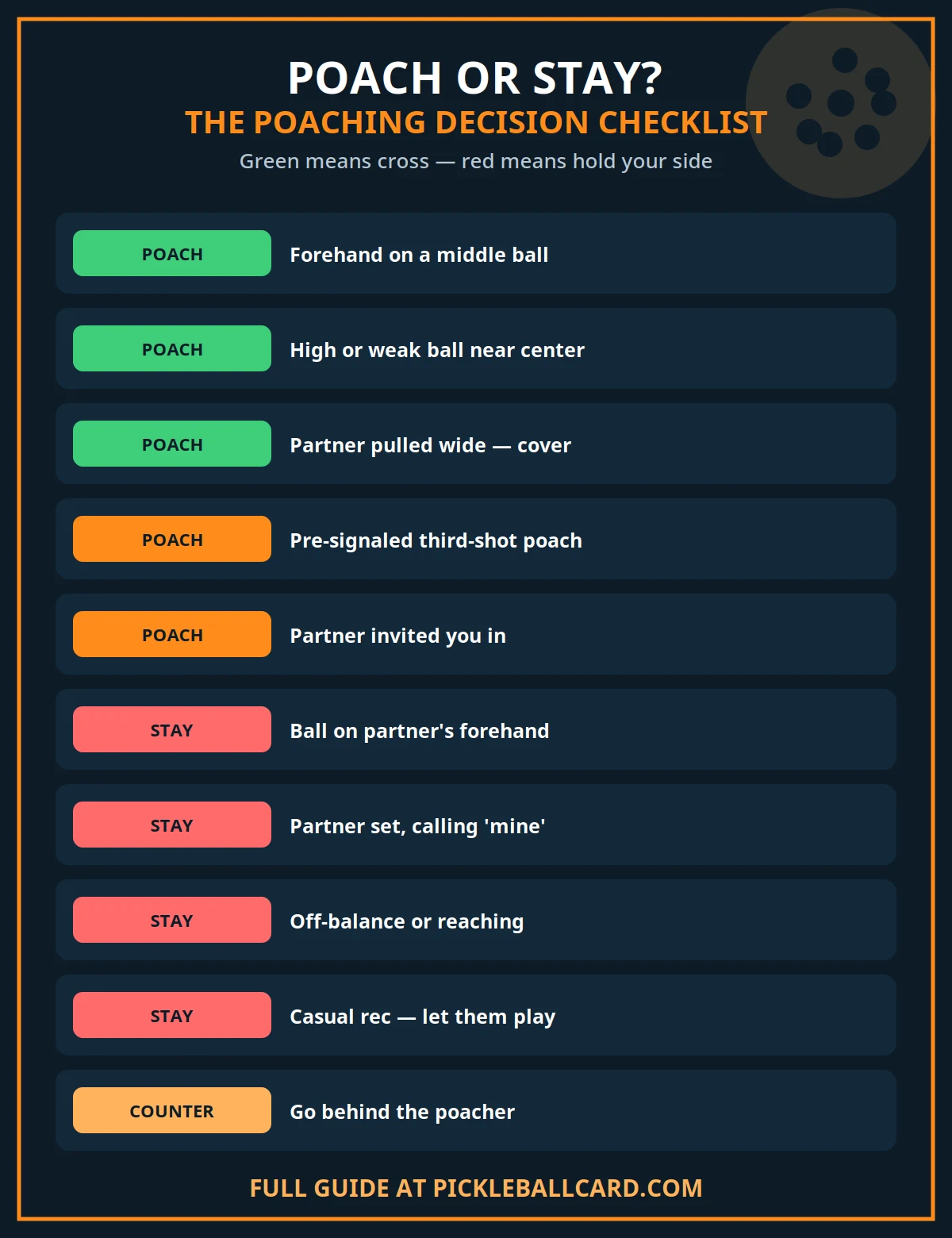
The Poach-vs-Stay Decision Table
Run every temptation through this table before your feet move. If the row says stay, it says stay.
| Situation | Verdict | Why |
|---|---|---|
| Ball at the center, your forehand is on it | POACH | Highest-percentage shot on the court; reads as teamwork at every level |
| High or weak ball sitting near the middle | POACH | Attack it before the opponents recover — but commit to a forcing shot |
| Partner pulled wide off the court | POACH / SLIDE | Coverage, not theft — protect the middle and shrink the opponents’ targets |
| Pre-signaled poach on the third shot | POACH | Planned with your partner, who shifts to cover your side |
| Partner explicitly invited you (“take the middle”) | POACH | Consent removes the risk — the partnership already agreed |
| Ball clearly on your partner’s forehand side | STAY | Their forehand was already the best available shot; you add nothing |
| Partner is set, balanced, and calling “mine” | STAY | The call outranks the plan — abort immediately, even mid-step |
| You are off-balance, lunging, or reaching | STAY | A poach from a bad position produces the weak reply you wanted to prevent |
| Casual rec play with a weaker partner | STAY | Let them hit — development reps matter more than the point |
| You want the highlight, not the percentage | STAY | If the motive is the reel, the shot selection is already wrong |
When Poaching Is Selfish
Every selfish poach fails the same test: it takes a ball your partner could have hit well, for reasons that serve the poacher more than the team. Four versions of it show up constantly.
1. You Abandon Your Side for a Hero Shot
Crossing three steps to smack a ball your partner was already set up to hit is not strategy. It is impatience with better marketing.
Every poach opens court behind you. If your interception is not a winner or a forcing shot, the opponents get that open half for free — and your partner gets to watch it happen.
Ask yourself before crossing: am I taking this ball because I am the better option, or because I am bored? Honest answers prevent most bad poaches.
The double damage is worth naming: when the hero poach misses — into the net or long — the team loses a point your partner might have won. You stole the shot and the outcome.
2. You Cut Off Your Partner’s Forehand
The worst poach in the game is reaching across to take a ball your partner was about to crush with their forehand.
You gain nothing, because their forehand was already the best shot available on that ball. All you have done is put both players on the same half of the court.
Forehands are territorial. They belong to the player standing on that side of the court unless a prior agreement says otherwise. Respect the wing.
This one also corrodes trust fastest. A partner who watches their best shot get stolen stops setting up for the next one — and your team gets worse, not better.
3. You Poach Everything in Casual Rec Play
In open play and casual rec games, your partner came to hit balls, get exercise, and improve. Poaching their shots to win points nobody will remember denies them exactly that.
This is the situation most players mean when they call poaching selfish. The score does not matter; the repetitions do. Every ball you take is a rep your partner does not get.
The coverage exception still applies: if your partner is pulled completely off the court, sliding across to protect the middle is good partnering, not poaching. Everyone recognizes the difference.
Calibrate to the room. Tournament play, league matches with defined roles, and rec games with peers who poach right back are different contexts with different norms. Read which one you are in.
4. You Never Discussed It With Your Partner
An unannounced poach is a surprise, and surprises at the kitchen line cause collisions, whiffed balls, and arguments that last longer than the rally.
The first time you poach with a new partner should never be mid-rally. Mention it during warm-up: “I like to poach middle balls with my forehand — are you okay with that?”
Ten seconds of agreement prevents ten minutes of tension. Partnerships run on consent, and poaching without it is the fastest way to spend yours.
Communication Systems That Make Poaching Work
Every good poaching team runs a communication system. The specific signals matter less than the consistency — pick a system and use it on every single point.
The Three Calls: “Mine,” “Yours,” “Switch”
“Mine” claims the ball. It should be loud, early, and final. When your partner calls “mine,” you abort your poach immediately — even if you are already mid-step.
“Yours” (or “you”) hands the ball off. Use it when a ball drifts toward you but your partner has the better play, or when you want them to know you are deliberately not crossing.
“Switch” announces a poach or a side change as it happens. Call it while you are moving, not after — your partner needs the warning in time to cover the side you vacated.
Short beats clever. Single-syllable calls survive the speed of the kitchen line, where rallies are decided in fractions of a second. Full sentences do not.
The Pre-Point Plan: Signals and the Ten-Second Chat
Before your serve, the net player can flash a hand signal behind the back: one finger for stay, two for poach. Keep the hand low and hidden so the opponents cannot read it.
Between points, spend ten seconds setting the plan out loud: “I’m poaching the third if it sits up,” or “you take the middle, I’ve got the line.” Quiet teams guess; talking teams know.
Signals work best with regular partners who have memorized the code. With a pickup partner, the ten-second chat does the same job with zero memorization required.
One more habit: confirm the plan was received. A nod, a “got it,” a tap of paddles — anything that closes the loop. An unconfirmed signal is just a gesture.
Pre-Point Communication Checklist
Run this checklist before the first serve of every match. It takes thirty seconds and prevents the misunderstandings that ruin partnerships.
- We agreed who takes middle balls — forehand priority, no guessing.
- Poaching is explicitly ON or OFF for this match.
- Hand signals are set (stay vs. poach) — or we use the ten-second chat instead.
- “Mine” always outranks any plan, and both players know it.
- After a poach, the partner covers the open side — drilled, not hoped for.
- In rec play, we poach only for coverage — never to steal a partner’s ball for a winner.
- If the plan is not working, we adjust between games — no silent frustration.
The Counter: How to Punish a Reckless Poacher
Poaching is a bet. The poacher bets their interception ends the point. When it does not, half the court stands empty — and prepared opponents collect on that bet.
Go Behind the Poacher
When you see an opponent cross the centerline to poach, hit behind them into the space they abandoned. The angle is short, the court is wide open, and the poacher cannot recover in time.
You do not need pace for this shot. A soft, angled dink behind the crossing player wins the point more reliably than a hard drive hit straight at them.
You can even set the trap deliberately. Feed the poacher’s partner a tempting ball near the middle and wait for the cross — patient dinking builds exactly these invitations, then punishes the answer.
Make the poacher pay twice and the poaching usually stops. Nobody keeps crossing when every cross costs a point.
When Your Own Partner Poaches Without Warning
Do not fight them for the ball. Two paddles on one ball ends worse than one paddle on the wrong half. Pull back, cover the open court as best you can, and finish the point.
Talk after the point, not during it. “I had that one — call it next time” fixes the problem. A mid-rally argument guarantees you lose the point and the mood.
If it keeps happening, reset the agreement between games. Be specific about what you want: “no crossing past the centerline unless you call it first.” A partner who will not discuss it is telling you everything about the partnership.
Drills to Practice Poaching Timing
Poaching is timing and trust, not courage. These three drills build the read, the cross, and the recovery — in that order.
1. The Signal-and-Switch Drill
One player serves while the net partner signals poach or stay behind the back, then the pair plays out the third shot. The focus is the partner’s slide to cover the vacated side — not the poach itself.
Run it ten times per side, alternating signals. The poach is the easy half of this drill. The cover is the part that wins matches.
2. The Pop-Up Punish
A feeder pops balls up around the middle from the baseline. The net team alternates poaching with the forehand and finishing the point outright.
Score it strictly: only poaches that end the point or force a weak reply count. A soft poach that comes back is a failure — it teaches the finish-or-don’t-cross standard.
3. The Cover-and-Recover Rotation
One player is deliberately pulled wide by angled feeds. The partner slides across to cover the middle, poaching anything attackable, then both players recover to their home positions before the next feed.
This teaches the most useful poach in recreational play: the coverage poach that protects a partner, never the highlight poach that steals their ball.
Frequently Asked Questions
Is poaching legal in pickleball?
Yes — nothing in the rules forbids crossing the centerline, because the centerline is imaginary and has no faults attached to it.
The poacher must still obey the non-volley zone rules: USA Pickleball’s Official Rulebook (Section 9) prohibits volleying while any part of the body is touching the non-volley zone. That matters when a poach carries you diagonally across the kitchen.
What is the difference between poaching and an Erne?
A poach crosses the middle of the court to take a ball on your partner’s side. An Erne leaves the court entirely, going around the sideline past the kitchen to volley beside the net post.
They are different shots with different setups, risks, and rules to respect.
Should you poach in recreational play?
It depends on the context and your partner. Poaching for coverage — sliding across when your partner is pulled wide — is welcome everywhere.
Poaching to steal hittable balls from your partner in casual open play is widely considered selfish, because it costs them reps. When in doubt, ask your partner before the game, not after the poach.
What should I do if my partner poaches my shots every game?
First, never fight them for the ball mid-rally — pull back and cover. Then address it between games with a specific request, such as “call it before you cross the centerline.”
Most chronic poachers do not realize how often they do it. If the behavior continues after a direct conversation, the problem is the partnership, not the tactic.
What is the best call to stop a poach?
“Mine” — loud and early. It is the universal claim call in doubles, and it outranks any pre-point plan or signal. A trustworthy partner aborts the poach the instant they hear it, even mid-step. If yours does not, revisit the agreement off the court.
Does poaching work in mixed doubles?
Yes, with the same rules and one extra consideration: partnerships often have an agreed coverage pattern, such as the stronger net player taking more middle.
Poach inside that agreement and it is devastating. Poach outside it and the trust cost is higher, because mixed partnerships lean harder on defined roles. The ten-second chat before the match matters most here.
The Bottom Line
Poach with a plan, a call, and a partner who agreed. Poach the middle with your forehand, punish the pop-ups, cover the partner who gets pulled wide, and finish everything you start.
Skip the hero poaches, the stolen forehands, and the rec-game stat-padding. The best poachers in pickleball are the ones whose partners ask them to do it again.

Shoaib is the publisher of Pickleball Card. He oversees the site’s guides to pickleball rules, ratings, strategy and gear, all researched from primary sources — the USA Pickleball Rulebook, DUPR and manufacturer documentation — and updated as the game changes.