The overhead smash is the most satisfying shot in pickleball. A high ball floats up, you move under it, and the rally ends with one clean swing.
It is also one of the most wasted shots in the game. Players rush it, hit it off balance, or swing so hard that the ball sails long.
This guide fixes that. You will learn how to read the high ball, move to it safely, set up correctly, and choose placement over raw power.
Key Takeaways
- Read the lob early, turn sideways, and move under the ball with small shuffle steps.
- Never backpedal blindly. Turn, shuffle, and keep your eyes on the ball at all times.
- Contact the ball above and slightly in front of your hitting shoulder for a clean downward strike.
- Aim for big targets, especially at the feet and down the middle, rather than swinging at full power.
- Smash only when the ball is high and you are balanced. Otherwise, place it or drop it back.
- Recover to a ready position after every smash, because a good opponent may return it.
- Short, focused drills build a reliable smash faster than endless full-power practice swings.
What Is an Overhead Smash in Pickleball?
An overhead smash is a hard, downward shot hit from above shoulder height. It is usually played against a lob, a high return, or a ball that pops up.
The official rulebook defines the overhead slam as a hard overhand shot. That simple definition hides a lot of technique, timing, and judgment.
Most smashes happen in doubles, when one team lobs and the other team attacks. The smashing team holds the advantage, but only if the shot is controlled.
A smash is not a serve, and it is not a groundstroke. It borrows its motion from throwing a ball, with the paddle acting as an extension of your arm.
Reading the Lob and the High Ball
Every good smash starts before the swing. It starts with the read. The sooner you judge the height, depth, and direction of the ball, the easier the shot becomes.
Watch your opponent’s paddle at contact. An open paddle face and an upward swing usually mean a lob is coming, not a drive.
Watch the ball as soon as it leaves the paddle. A steep, floating arc means you have time. A flat, fast ball means you must react at once.
Three Early Reads That Save the Point
First, judge depth. A short lob lands near the kitchen line and is easy to attack. A deep lob pushes you toward the baseline and demands more care.
Second, judge direction. Balls over your hitting shoulder are the easiest to smash. Balls over your non-hitting shoulder need a quick adjustment or a switch of hands in doubles.
Third, judge height. A ball that will peak above your head is a smashing ball. A ball that peaks at shoulder height is usually better placed than smashed.
Call the ball early in doubles. A loud, clear call such as “Mine!” prevents hesitation and stops both partners from chasing the same ball.
For a full breakdown of the shot you are attacking, read our guide to the Pickleball Lob Shot and how it is built.
Footwork and Positioning: Move Under the Ball
Footwork makes or breaks the overhead smash. The best swing in the world cannot rescue a player who arrives late, leaning backward, and off balance.
Your goal is simple: arrive early, stand balanced, and hit the ball from a stable base. Everything else follows from that position.
Turn Sideways First
Turn your body sideways as soon as you read a lob. Your non-hitting shoulder should point toward the net, and your feet should align with the flight of the ball.
The sideways turn opens your hitting shoulder, loads your body like a coiled spring, and lets you track the ball without twisting your neck.
Players who stay square to the net often reach across their body. That reach costs power, accuracy, and balance in equal measure.
Shuffle, Do Not Backpedal
Move with small, quick shuffle steps or a crossover step. Keep your feet under your hips and your weight on the balls of your feet.
Never run backward with your back to the ball. Backpedaling blindly is how players trip, collide with partners, and lose sight of the ball entirely.
If the lob goes deep, turn and shuffle back while watching the ball over your shoulder. If it goes very deep, let it bounce and reset instead.
Get Under the Ball, Then Stop
Position yourself so the ball will drop just in front of your hitting shoulder. That spot gives you a full, natural swing without reaching.
Stop your feet before you swing. A moving player cannot control contact height, paddle angle, or direction with any consistency.
A small adjustment step at the last moment is fine. A full sprint through contact is not. Arrive, settle, and then swing.
Good footwork starts before the lob arrives. Our guide to the Pickleball Split Step explains the small hop that keeps you ready to move in any direction.
Paddle Preparation: Set Early, Stay Relaxed
Raise your paddle early, while you are still moving into position. A late paddle preparation forces a rushed, arm-only swing.
Take the paddle back and up, with the paddle head above your hand and the face slightly open. Think of a throwing motion, not a tennis serve wind-up.
Keep your grip relaxed and your wrist loose. A tight grip locks the wrist, slows the paddle head, and sends the ball anywhere but your target.
Your non-hitting hand plays a real role here. Point it at the ball to help track its flight, then pull it down as you swing.
That pointing arm is also your balance aid. It keeps your shoulders level and stops your body from spinning open too early.
Contact Point: High and Slightly in Front
The ideal contact point is above your head and slightly in front of your hitting shoulder. From there, you can strike down into the court with control.
Contact too far behind you forces an upward or flat swing. The ball then floats long or pops up for an easy counterattack.
Contact too low turns the smash into a drive. It may still win the point, but it gives your opponents far more time to react.
Reach up to meet the ball at its highest comfortable point. Do not jump unless you must, because a jump adds timing risk and landing trouble.
If the ball is already falling past shoulder height when you arrive, change your plan. Place it firmly or drop it back, and live to attack the next ball.
The Swing and Follow-Through
The swing should be compact, fast, and smooth. Start with your shoulder and upper body, let the arm follow, and snap the wrist through contact.
Lead with the edge of the paddle, then rotate the face through the ball. This throwing action generates paddle-head speed without a wild, looping swing.
Strike down and through the ball, aiming into the court rather than at the net. A slightly closed paddle face at contact keeps the ball down.
Follow through across your body and down toward your opposite hip. A full follow-through keeps the swing smooth and prevents a jerky, arm-only hit.
Do not stop your swing at contact. A checked swing often leaves the ball sitting up, which is the worst possible outcome from a smash.
Aiming: Placement Beats Pure Power
Most recreational players overhit the overhead smash. They aim for a highlight, swing at full power, and watch the ball sail long or into the net.
Placement wins more points than power. A well-placed smash at moderate pace is far harder to return than a wild blast that misses.
Aim for large, high-percentage targets. The middle of the court, the feet of your opponents, and the open space behind a retreating player are all excellent choices.
Hitting at the feet is especially effective. A ball landing at an opponent’s feet forces an upward, defensive reply or no reply at all.
Down the middle works well in doubles. It can create confusion between partners, and neither player can attack it comfortably.
When to Smash, Place, or Drop
Not every high ball deserves a full smash. The right choice depends on the height of the ball and where you are standing when you reach it.
Use this decision table before you commit to a swing. It keeps you honest about which balls are true attacking chances.
| Ball height and your position | Best choice | Why it works |
|---|---|---|
| High ball, balanced, near the kitchen line | Full smash | You can strike down steeply into a big target. |
| High ball, balanced, at midcourt | Firm placed smash | Power at about three-quarter pace keeps the ball in play. |
| Medium ball, off balance or on the move | Place it at the feet | A controlled placement beats a wild swing from a poor base. |
| Deep ball near the baseline | Drop or reset | A smash from deep court usually sails long or sits up. |
| Ball falling below shoulder height | Drive or drop | The downward angle is gone, so attack with placement instead. |
When in doubt, choose the safer shot. A placed ball keeps you in the rally, while a missed smash hands the point away for free.
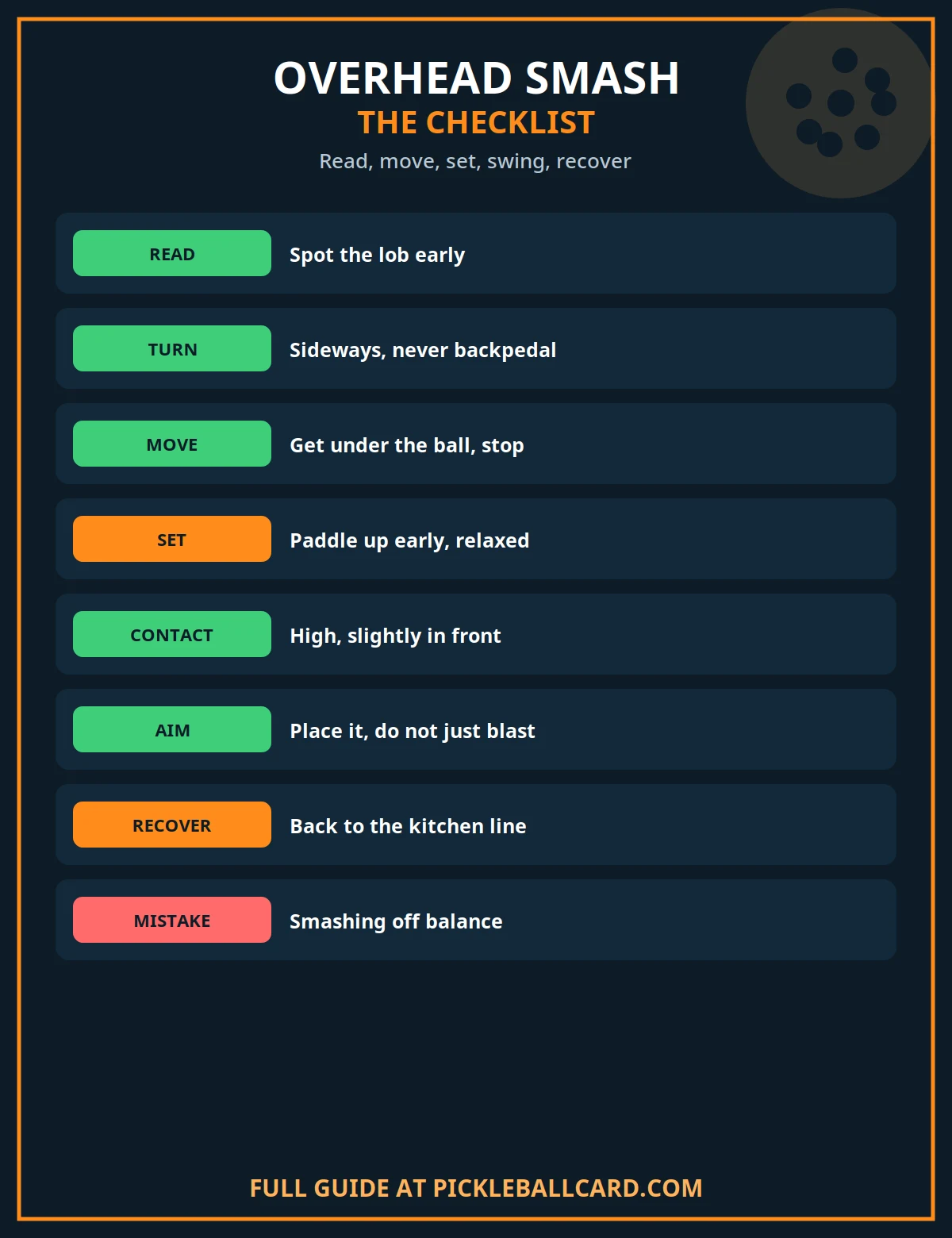
Overhead Smash Checklist
Run through this checklist during practice until each step feels automatic. Then use it as a quick self-check between games.
- Read the lob early from the opponent’s paddle face and swing path.
- Call the ball loudly in doubles so both partners know who takes it.
- Turn sideways and point your non-hitting shoulder toward the net.
- Shuffle under the ball with small steps, and never backpedal blindly.
- Stop your feet and settle your balance before you start the swing.
- Raise the paddle early, with a relaxed grip and a loose wrist.
- Contact the ball above and slightly in front of your hitting shoulder.
- Aim at the feet or down the middle, not at the smallest corner.
- Follow through across your body and recover to a ready position.
Defending Against the Smash: A Brief Word
Understanding defense makes your own smash better, because it shows you what a prepared opponent will do with a poor smash.
Against a smash, the defender should split step, stay low, and hold the paddle up in front of the body. The goal is a block, not a counterattack.
Blocking the ball back low, especially into the kitchen, can turn defense into a new rally. Trying to win the point outright from a smash usually fails.
That is why your smash targets matter so much. A smash hit straight at a ready opponent comes back. A smash hit at the feet usually does not.
Common Overhead Smash Mistakes
Most smash errors come from a handful of repeatable faults. Fix one at a time, and your consistency will climb quickly.
Hitting Off Balance
Smashing while still moving backward or sideways is the most common error. The paddle face wobbles, the timing slips, and the ball sprays wide or long.
The fix is patience. Arrive, stop, and swing. If you cannot stop in time, place the ball instead of smashing it.
Overhitting Every Ball
Full-power swings feel strong but destroy accuracy. The ball travels farther, the margin for error shrinks, and small timing mistakes become big misses.
Practice at three-quarter pace until you can place ten smashes in a row. Then add pace gradually, without losing placement.
Smashing From Too Deep
A smash from the baseline looks brave and usually ends badly. The distance is long, the angle is flat, and the net becomes a real obstacle.
From deep court, reset with a drop or a drive. Save the smash for balls you can attack from midcourt or closer.
Contacting the Ball Too Late
Letting the ball drop behind you turns a downward smash into an upward push. The result is often a soft ball your opponents attack.
Move earlier and trust your read. If the ball still gets behind you, step aside and let your partner take it when possible.
Forgetting to Recover
Players often admire their smash instead of preparing for the return. A blocked return then lands in open court while they stand still.
Recover at once. Return to a ready stance, paddle up, and expect the next ball. A smash is one shot, not the end of the rally.
Smashing at the Net Player Every Time
Repeatedly targeting the same opponent teaches them your pattern. They will adjust, block better, and eventually punish your predictability.
Vary your targets and your pace. A slower, well-placed smash often wins more points than a faster, predictable one.
Drills to Build a Reliable Overhead Smash
Drills work best when they isolate one skill at a time. Start slow, build consistency, and only then add pace or pressure.
Drill 1: Lob and Smash Rally
One partner lobs gently from the kitchen line while the other practices the full routine: read, turn, shuffle, stop, and smash at the feet.
Keep the pace moderate and count consecutive successful smashes. Aim for ten in a row before either player increases the pace.
Drill 2: Placement Targets
Place two cones or towels on the court: one down the middle and one at the feet of a target zone. Smash ten balls, alternating between the two targets.
Score only balls that land in a target zone. This drill teaches placement discipline far better than open-court smashing ever will.
Drill 3: Deep Lob Decisions
Have your partner mix short lobs and deep lobs. Smash the short ones, and reset the deep ones with a drop or a controlled drive.
This drill builds judgment, which is the skill most players skip. Good decisions turn a wild smasher into a reliable attacker.
Drill 4: Smash and Recover
After every smash, sprint back to a ready position at the kitchen line before the next ball is fed. No admiring the shot is allowed.
This drill links the smash to the next shot, which is where real matches are won. A smash plus recovery beats a smash plus standing still.
When a lob beats your smash, the other side of the rally matters too. Our guide to How to Defend the Lob in Pickleball explains reading, positioning and resets from the defender’s side.
Rules to Remember: The Kitchen Line
The non-volley zone, known as the kitchen, shapes every overhead. You may not volley a ball, including a smash, while standing in the kitchen or on its lines.
Momentum matters too. If your follow-through carries you into the kitchen after a volley, that is a fault even if the ball is already dead.
The safe habit is simple. Smash from behind the kitchen line, keep your feet clear of it, and only step in after a ball has bounced.
For the authoritative wording, see the Official USA Pickleball Rulebook published by USA Pickleball, which governs the non-volley zone and fault rules.
Frequently Asked Questions
What is the best grip for an overhead smash in pickleball?
Use your normal forehand grip, usually a continental or mild eastern grip. Avoid changing grips mid-rally, because a late grip change ruins timing and paddle control.
Keep the grip pressure relaxed, around a four out of ten. A loose grip lets the wrist snap naturally and keeps the paddle head fast through contact.
Should I let the ball bounce before smashing it?
Usually, no. Hitting the ball out of the air gives you a higher contact point and a steeper downward angle, which makes the smash harder to return.
Let it bounce only when you are out of position, the ball is very deep, or the bounce gives you a cleaner, more balanced strike.
Why does my overhead smash keep going into the net?
The most common cause is contacting the ball too low or too far behind you. Both faults flatten the swing and send the ball into the net tape.
Move under the ball earlier, contact it above and in front of your shoulder, and aim down into the court rather than across it.
Why does my overhead smash keep going long?
Going long usually means too much power, an open paddle face, or a smash attempted from too deep in the court. Any one of these shrinks your margin.
Reduce your swing to three-quarter pace, close the paddle face slightly, and choose a bigger target such as the middle of the court.
Can I smash a ball while standing in the kitchen?
No, not as a volley. Volleying from inside the non-volley zone, or touching its lines while volleying, is a fault under the official rules.
You may hit a ball from the kitchen only after it has bounced. Step back out, or wait for the bounce, before attacking a high ball.
How do I smash in doubles without colliding with my partner?
Call the ball early and clearly, and agree in advance who covers lobs over the middle. The player facing the ball usually takes it.
The other partner should move aside and prepare for the next shot, not crowd the smasher or reach across for the same ball.
Final Thoughts: Smash Smart, Not Just Hard
A great overhead smash is built from small, repeatable habits. Read early, move safely, set up calmly, and aim with intent.
Practice placement before power, and let the full-power smash earn its place in your game. When it does, it will be a weapon, not a gamble.
Start with the lob-and-smash rally drill, add the placement targets, and track your consistency over two weeks. The results will show up in your matches.

Shoaib is the publisher of Pickleball Card. He oversees the site’s guides to pickleball rules, ratings, strategy and gear, all researched from primary sources — the USA Pickleball Rulebook, DUPR and manufacturer documentation — and updated as the game changes.