When JOOLA arrived in pickleball, the Hyperion took the headlines — but the Solaire was the other half of that first wave: a fiberglass-faced spin paddle built for everyday players.
It holds a pick in our best control paddles guide, and this review documents it properly.
Pickleballcard does not lab-test paddles. JOOLA publishes no current spec sheet for this model, so the data box below says so plainly, and the review is built on the design JOOLA itself documented for it.
Key Takeaways
- Fiberglass Abrasion Surface — FAS — is the headline: a textured fiberglass face JOOLA designed to bite the ball for spin.
- Under it, JOOLA’s Response polypropylene honeycomb core and the HyperFoam edge wall from the same first-generation family.
- A ridged, anti-slip grip treatment aimed at sweaty-hand control — a small detail players genuinely remember this paddle for.
- JOOLA publishes no current numeric specifications for the Solaire, so its box below is honest about every field.
- Best for spin-and-control players who prefer fiberglass feel over the carbon era that followed.
The Short Answer
The Solaire is the spin-friendly, standard-feeling half of JOOLA’s first generation: texture for the ball, a forgiving edge wall, and a grip that stays put.
It was never the flagship — it was the accessible one. That is still its honest place, and for the right player it is enough.
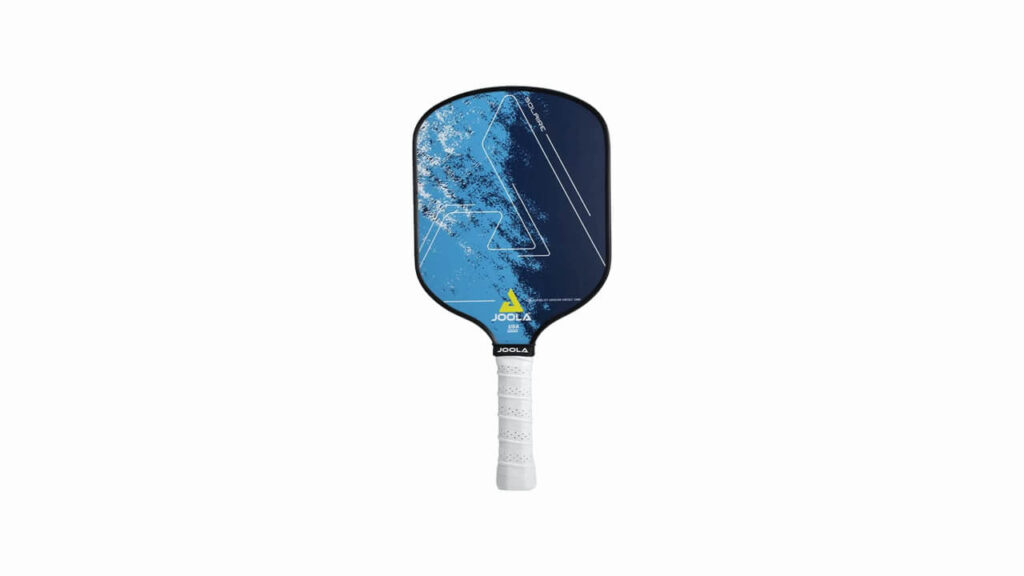
Specifications (Manufacturer-Published)
| Face material | Not published by JOOLA |
| Core | Not published by JOOLA |
| Thickness | Not published by JOOLA |
| Average weight | Not published by JOOLA |
| Grip length | Not published by JOOLA |
| Grip circumference | Not published by JOOLA |
| Shape / length × width | Not published by JOOLA |
| USA Pickleball approved | Not published by JOOLA |
JOOLA’s current site leads with its newer lines, and no numeric table for the Solaire is published there today.
What JOOLA did publish for this model is its design vocabulary — FAS, the Response core, HyperFoam, the ridge grip. Those documented elements are what this review examines.
Buy If
- You want spin from the face — our control guide credits the Fiberglass Abrasion Surface (FAS) with adding bite and control on the ball.
- Sweaty hands are an issue: the guide highlights its anti-slip ridge grip for control during play.
- You like fiberglass feel — livelier and more communicative than the thick carbon builds that followed it.
Pass If
- You shop by verified numbers — JOOLA publishes no current spec sheet for this model to compare.
- You want the modern JOOLA flagship experience — that is the Perseus generation, not this first wave.
- You want a widebody’s forgiveness or an elongated lever — the Solaire is a standard-profile paddle.
The Design, Piece By Piece
Fiberglass Abrasion Surface (FAS)
Most fiberglass faces are smooth. JOOLA built the Solaire’s with an abrasion texture — FAS — so the surface grips the ball at contact.
The purpose is spin with control: topspin drives that dip, slices that stay low, serves with shape on them.
It is a different route to spin than raw carbon’s etched grit — a textured composite rather than an exposed weave — and it gives the paddle its character.
Response Core And HyperFoam Edge Wall
JOOLA’s description pairs the face with its Response polypropylene honeycomb core — the all-round core of that first JOOLA family.
Around the core sits the HyperFoam edge wall, foam injected into the perimeter channel to steady the paddle on off-center contact.
Our control guide’s summary singles that edge wall out: edge hits that would die on lesser paddles stay playable.
The Ridge Grip
The Solaire’s handle carries an anti-slip ridge treatment, designed to keep the grip indexed in a sweating hand.
Small thing, real thing: grip slip is a quiet cause of mishits in summer play, and this is one of the few paddles of its era to address it directly.
Who It Suits
Spin-and-control players on a human budget of attention — players who want texture and touch without studying a spec sheet — are the audience.
It also suits fiberglass loyalists: players who tried the carbon era and came back for the livelier, more talkative response.
And outdoor summer players will appreciate the grip treatment more than most spec-sheet numbers.
Who Should Skip It
Players who want JOOLA’s current best should start with the Hyperion CFS, reviewed here, and the generations that followed it.
Specification-led buyers have nothing official to hold onto with the Solaire, and that alone will rule it out for some — fairly.
Power-first players, finally, will find more pace in the dedicated builds in our power guide.
Approval Status
The Solaire was sold as a USAPA-approved tournament paddle in its era — our control guide notes the approval — but JOOLA publishes no current statement for the model.
So the honest guidance is the check itself: confirm the exact model on USA Pickleball’s current approved paddle list before a sanctioned event.
How It Compares
Against its sibling, the Hyperion CFS 16: carbon against fiberglass, elongated against standard, flagship against accessible. The family resemblance is the edge wall and the era.
Against the Diadem Warrior in the same control guide, reviewed here, the Solaire is the lighter-touch, spin-first option next to a 19mm stability build.
Both comparisons flatter it in one way: the Solaire knew exactly what it was for.
Frequently Asked Questions
What is JOOLA’s Fiberglass Abrasion Surface?
FAS is JOOLA’s textured fiberglass face, used on the Solaire: an abrasion finish that grips the ball at contact to add spin and control.
It is a different spin route from raw carbon’s etched texture — a treated composite surface rather than an exposed carbon weave.
What is the difference between the Solaire and the Hyperion?
Generation role and build. The Hyperion CFS is the elongated carbon flagship of JOOLA’s first wave, with published specifications and a full review on this site.
The Solaire is the standard-profile fiberglass sibling — spin from FAS, a Response core, and no current factory spec sheet.
Is the JOOLA Solaire approved for tournaments?
It was sold as USAPA approved in its era, but JOOLA publishes no current approval statement for the model. Check the exact paddle on USA Pickleball’s current approved list before a sanctioned event, because lists are maintained over time.
Why does JOOLA not publish the Solaire’s specifications?
JOOLA’s current site focuses on its newer lines, and no numeric sheet for the Solaire is published there today. Rather than fill the table with retailer figures, our data box marks each field honestly and the review documents the design JOOLA itself described.
Is the Solaire still worth buying?
For its player, yes: if you want fiberglass feel, face texture for spin, and a grip that stays put — and you do not need a factory spec sheet — it remains a coherent, enjoyable paddle.
If you want current-generation carbon and published numbers, JOOLA’s newer lines are the honest recommendation.
Conclusion
The Solaire is a well-aimed paddle from JOOLA’s first wave: texture for spin, foam in the edges, ridges on the grip, and no pretensions beyond that.
Documented honestly — design yes, invented numbers no — it still earns its place in the control guide.

Shoaib is the publisher of Pickleball Card. He oversees the site’s guides to pickleball rules, ratings, strategy and gear, all researched from primary sources — the USA Pickleball Rulebook, DUPR and manufacturer documentation — and updated as the game changes.