• Skip to primary navigation
  • Skip to main content
  • Skip to primary sidebar

Pickleballcard

All About Pickleball Gears

  • About Pickleball
    • How To Play Pickleball
    • Pickleball Rules
    • Pickleball Kitchen Rules
    • Serving Rules
    • Pickleball Ratings
    • Pickleball Tips
    • Pickleball History
  • Pickleball Shoes
    • Best Pickleball Shoes
    • Best Pickleball Shoes For Men
    • Best Pickleball Shoes For Women
  • Pickleball Paddles
    • Best Pickleball Paddles
    • Elongated Pickleball Paddles
    • Graphite Pickleball Paddles
    • Onix Pickleball Paddles
    • Pickleball Paddles for Women
    • Pickleball Paddles For Spin
  • Vs
    • Pickleball Vs Tennis
    • Paddle Tennis Vs Pickleball
    • Indoor Vs Outdoor Pickleball

Pickleball Rules | How Pickleball Is Played?

October 23, 2026 by Sadaf Awan Leave a Comment

Pickleball Rules

Pickleball is a popular game that is a unique combination of both tennis and badminton. It is played on the court, which most commonly resembles the badminton court. Whereas this court is lined with a tennis court net.

It comprises a perforated ball, which slowly moves over the tennis court. Regarding complete analysis, pickleball is referred to as a type of paddle game that is easy to learn. This game is gaining unbelievable popularity in Europe and Asia simultaneously.

Like badminton, tennis, or other games, pickleball also comprises a standard rule book. This rule book helps beginners get a featural overview of the game very quickly, but what are beginner pickleball rules?

Here is a complete guide for your interest to provide you with a featural or rule-based analysis for pickleball. We will try to cover the most common and general pickleball instructions impressions so that if you are interested in pickleball, it would be helpful for your beginner’s experience.

Let’s Take A Look On Pickleball Single & Double Scoring Rules:

Rules Of The Game: Pickleball

Pickleball is played in two halves. You can play it as a single; if not, the double partners can perform it out of both team powers, most commonly. Playing as a double or team also has more benefits as it provides chances for the player to participate in the game equally and have a more precise eye over the target.

From the court’s perspective, there can be no difference or discrimination between single and doubles. Pickleball rules singles, and pickleball rules doubles also do not vary much. Some of the most popular pickleball court rules are explained next.

1. Serve – Pickleball Serving Rules

The rules for playing pickleball begin by throwing the ball over the court, and the foot of the layer must be behind the baseline. At the same time, the foot should not stick with the court or baseline until the ball strikes the targeted position. Moreover, the service approach for the layers in the game must be underhand.

Pickleball Serving Rule, Pickleball Rules

It is authenticated in the diagonal or cross court with only one attempt. But you will have only one shot to pass the ball. In this attempt, your ball should reach the required portion of the service court. This portion is termed as “let” in the court.

2. Scoring – Pickleball Scoring Rules

The Pickleball rule of scoring is also very significant. You can only score points if you are a service team member; both get equal chances to balance the scoring board. But the first chance drops into the side of the serving team.

Pickleball Scoring Rule, Pickleball Rules

If you play the singles, you can only score up to 11 and win from the two-score perspective. On the other hand, when you are playing a tournament or professional court matches, the scoring table might exceed 15 or sometimes 21. At the same time, the winning chance remains point 2.

3. Pickleball Double Bouncing Rule

In pickleball, the bouncing of all is very crucial for both the serving and receiving teams. The ball is served over the court to maintain this bouncing, and the receiver team waits for its bouncing before returning.

Pickleball Double Bouncing Rule, Pickleball Rules

On the other hand, the serving team also waits for the same bouncing on its return arrival from the receiver side. In addition, bouncing is considered mandatory and significant only for the first two runs.

Afterward, you can go to your serving action without waiting for the bouncing. Being the player, you can easily pass on the volley action without the bouncing aspects.

4. Volley – Pickleball Volley Rules

Volley actions for the pickleball rules are only allowed outside the court “kitchen area.” This area is precisely aligned with the volleys. They are inside the court up to almost 7 feet. It lies on both sides of the pickleball net.

The ball is not destined to be considered in action out of this volley region. Outside of this, in the non-volley areas, all will present the images on the net, which is unreliable.

Pickleball Volley Section, Pickleball Rules

Moreover, stepping out of a 7-feet area is considered a fault. This fault does ask for a penalty. Thus, you can be in the on-volley regions without treating the ball. Otherwise, it will be the fault for covering.

5. Line Calls – Pickleball Line Rules

The line calls are crucial in pickleball rules as they provide information about which line of the court falls within the boundary lines. The ball can contact all the lines freely, but it should lie inside the volley regions.

Pickleball Line Call Rule

Apart from this, all the other outside lines are nothing more than the fault committed. The flaws can be at the time when;

  1. When the server passes the ball, it does not lie in the receiving court.
  2. The ball passes over the court or volley without any bouncing factor.
  3. When all falls out of the bounding regions.
  4. When you serve the ball from the non-volley areas.
  5. I first two-run the double bouncing off the ball before it returns to the server or reaches the receiver.
  6. When the player touches the net by anything mistakenly, this anything might be his hand, clothes, or even paddle.
  7. When the player violates any of the rules of pickleball doubles or singles.
  8. When the ball is in the action and hits the other players or anything related to the player.

People Also Ask

How To Decide On The Serving Team For The Run?

The decision to serve tea is based on the coin toss. The one or the team that won the toss first has the power to decide. Either they would play on the serving side or the receiving side. Thus, the choice depends upon the choice of the winning team.

What Is The Double Bounce Rule In Pickleball?

While playing pickleball, when the ball is served, the receiving team must let it bounce before returning, and the serving team also must let it bounce before returning; thus, two bounces, which is called the double bounce rule in pickleball. After bouncing on each team’s court, both teams can play it off the bounce or volley the ball.

How Long Is A Pickleball Game?

The average pickleball game usually lasts between 15 to 25 minutes, the average amount of time required to reach 11 points or the required points for the pickleball.

What Is The Non-Volley Zone In Pickleball?

There is a court area within 7 feet on both sides of the pickleball court where volleying is prohibited, called a non-volley zone or kitchen in pickleball. You can not stand or touch the kitchen line while volleying the ball. The term kitchen is borrowed from shuffleboard, where there is a kitchen area; if players land, they face a 10-point deduction.

How Many Points Do You Need To Win Pickleball?

11 points play the Pickleball game and usually wins by 2 points, while the tournament game is played from 15 to 21 points and wins by 2 points.

What Are The Three 3 Key Things You Should Focus On In Pickleball?

If you want to improve your pickleball game and enhance your skill level, focus on drill, practice, and play. Continuous practice and drill are very important to becoming a pro player in pickleball.

The 2026 Rulebook: What Actually Changed

USA Pickleball’s 2026 rulebook is an update, not a rewrite — the game you know is intact — but four changes matter to regular players. Rally scoring lost its “freeze”: at game point, either team can now score the winner, not only the serving team. The volley serve wording was tightened so the underhand motion and low contact point must be clearly legal, and spin was clarified — paddle-applied spin is fine, spinning the ball with your fingers before contact is not. Line calls must now be made promptly, not after conferring with a partner, and spectators may not be consulted on calls. The rulebook was also fully renumbered, so rule citations in older articles (including some on this site) may point to numbers that have moved. The detailed guides on this site are being updated to match: see the serving rules, rally scoring and kitchen rules.

The Other Legal Serve: The Drop Serve

Most players learn only the volley serve, hit straight from the hand. The rulebook also allows a drop serve, and the two are judged by different standards.

For a drop serve, you release the ball and let it bounce before striking it. The underhand motion, waist-height contact and paddle-position rules of the volley serve do not apply.

The limits are about the drop itself: the ball must be released, not thrown down or bounced with force. After the bounce, you may hit it in almost any style.

It suits beginners, players returning from shoulder trouble, and anyone whose volley serve draws fault calls. Our full guide to the drop serve breaks down the technique.

Conclusion

We present a comprehensive and general overview of basic pickleball rules for beginners. The pickleball court rules are crucial because pickleball is getting more popular daily. So, to compensate for the understanding needs, it is better to go through its simple pickleball rules perspective.

You can spend good hours in pickleball singles with your friends in your free time. Not only this, various organizations arrange professional pickleball tournaments seeking its popularity.


Other Related Posts:
  • Pickleball History
  • Pickleball Tips
  • Pickleball Ratings Chart
  • Best Shoes For Pickleball
  • Tennis Vs Pickleball


Take the Rules With You

Print our free two-page Pickleball Rules Cheat Sheet (PDF) and keep it in your bag: court dimensions, the serve, scoring, the kitchen, faults and line calls on two pages.

It is the whole game at a glance, from the team behind the free rating estimator and round robin generator.

Author Profile Picture Of Sadaf Awan
Sadaf Awan

Sadaf Awan writes Pickleball Card’s footwear and gear guides. With a background in biology, she looks at shoes the practical way players feel them — fit, support, cushioning, grip and how a shoe holds up on hard courts. She compares manufacturer specs with how each model is built, and flags when a guide is research-based rather than hands-on.

Filed Under: About Pickleball

Pickleball Court Dimensions | How Big Is A Pickleball Court?

October 23, 2026 by Sadaf Awan Leave a Comment

Pickleball Court Dimensions

Every one of us is familiar with the action of pickleball. Its court most likely resembles the tennis court. Apart from this similarity, it provides an exceptional pickleball playing experience.

To be proficient in the game, you must have all the subordinate factors perfect. One of these critical subordinated pickleball factors is its court dimensions. When the court is not set correctly, the papers will be unable to serve or score appropriately.

To get accurate pickleball court dimensions, here we are providing an overview of this information so that you can have a general overview overall, including its court measurements. To get the final consideration from the court, look at the following broad perspectives.

General Pickleball Court Dimensional Area

Various websites can give you a general estimation of the court perspective for pickleball. This property or measurement is deduced after the authentication of the USA Pickleball Association. It is also termed to be known as USAPA.

The most critical measurement for the pickleball court dimensions is 20 X 44 feet. This measurement is significant as per the availability of the area, which can be sharpened for the general pickleball activity. At the same time, the pickleball court layout varies from indoor to outdoor pickleball activities.

Pickleball Court Dimension
Diagram Of Pickleball Court

Moreover, the pickleball court’s size is double that of the badminton court. One who is familiar with badminton action might get the usual estimations. Whereas this court is double in length while playing action, it gets sliced into two halves. Each half is lined with boundary aspects of almost 22 feet in size. This separation is specifically worthy due to the court line areas.

The kitchen separation for the players, court sides, and line segments are all part of the courts and fall inside the court regions. It is not a complex perspective to understand. The plus point in the dimensional court area is its familiarity with other ports, including the tennis or badminton court.

Pickleball Court Dimensions In Meters

The USAPA estimated and deduced the court dimension for pickleball in meters rather than feet. Because it is a worthy SI unit to meet international needs, in meters, the standard pickleball court size will likely be 10 X 19.5 meters.

The smaller pickleball court dimensions get lower to 9.1 X 18.2 meters. Apart from all this, when the dimension of the court for the actual playing line is concerned, it would ideally be around 6.1 X 13.4 meters.

Alternative Pickleball Court Dimensions

The USA Pickleball Association also provides dimensions for pickleball courts for additional situations like wheelchair pickleball.

Alternative Pickleball Court Dimensions

Pickleball Court Dimensions Vs Tennis Court

Here’s a table outlining the key court differences between pickleball and tennis:

Aspect Pickleball Tennis
Court Size 20 feet wide, 44 feet long Singles: 27 feet wide, 78 feet long; Doubles: 36 feet wide, 78 feet long
Net Height 34 inches (center) to 36 inches (posts) 36 inches (center) to 42 inches (posts)
Court Surface Typically hard court (asphalt, concrete) Various surfaces, including clay, grass, hard court, carpet
Court Lines Baseline, sidelines, non-volley zone line, centerline Baseline, service box, center service line
Non-Volley Zone (Kitchen) 7-foot zone on each side of the net No equivalent in tennis
Court Markings Specific markings for serving, non-volley zone, and kitchen area Service boxes, center service line, deuce and ad courts (for doubles)

These are the key differences in court characteristics between pickleball and tennis.

How To Set Up A Pickleball Court?

Pickleball Court, How To Setup Pickleball Court

Setting up the pickleball court is not a challenging consideration. It would help if you considered certain aspects to begin the setting process. At first;

  • The Pickleball court should be set over an area that is 30 feet in width along 60 feet in length. This area will quickly cover the 20 X 44 fee minimum dimensions of the court compared to this. For larger court bisection, you can extend it up to 34 feet in width, whereas 64 feet in length.
  • When you arrange your court area per measurement, it will ensure more recreational bindings for you because this is the ideal size that will let you enjoy your pickleball experience excellently.

What Lines Does A Pickleball Court Have?

A pickleball court has specific lines that define the boundaries and various zones of play. Here are the pickleball court lines you would typically find on a standard court:

  • Sidelines – The side boundary lines of the court, running perpendicular to the pickleball net.
  • Centerline – The line dividing the court into two halves.
  • Baseline – The back boundary line of the court, running parallel to the net.
  • Kitchen Line – Parallel lines 7 feet away along the net on both sides of the court.

These lines should be 2 inches wide, and white creates a high contrast, ensuring fair play and adherence to the rules of the game.

Where Can You Put The Pickleball Court?

There are various suggestions available as per the size and dimensions are known. Deciding a precise area, you can draw court lines over the place to have a fun-based court experience.

  • You can most commonly relocate the badminton or tennis court for pickleball activity because the tennis court can be used for multi-purpose activities. You can use simple pickleball court lines over it with a bit of alteration.
  • You can also go to the school parking area because it is wide enough to compensate for the pickleball experience. You can use any paint to draw pickleball court lines over the place.
  • Moreover, your home’s driveway could be the best option available if you are not finding any space.
  • You can also go for a street with a blind edge. Paint the lines according to the dimensions provided in the above content.

Apart from all the options provided next, if you require an incredible sport or growth horizon, you might go for constructing a permanent court in a defined area.

People Also Ask

What Are The Dimensions Of A Standard Pickleball Court?

The standard size of a pickleball court is 44 feet long and 20 feet wide. The pickleball court is the same as the two badminton courts.

Can You Play Pickleball On A Tennis Court?

Yes, you can play pickleball on a tennis court by doing some modifications. You can fit four pickleball courts on a standard tennis court.

What Is The Cheapest Way To Build A Pickleball Court?

There are various ways to build a court, but creating a pickleball court with concrete slabs is the cheapest among them. The concrete surface is smooth, budget-friendly, and durable. It will cost you 5$ per square foot. It is also a widely used pickleball court surface in the world.

Is A Pickleball Court The Same Size As A Badminton Court?

No, a pickleball court is the same size as a double badminton court. A pickleball court is 44 feet long and 20 feet wide, which is exactly equal to a double badminton court. You can play pickleball on a badminton court but there are some modifications needed for that.

What Is A Pickleball Court Made Of?

Different materials are used in making pickleball courts like Asphalt, concrete, and turf. However the most reliable, faster, lower initial cost, and crack resistance material is asphalt. It also offers non-slip performance, excellent bounce for pickleball, and minimum wear. The thickness of asphalt varies from 3-8 inches but shouldn’t be less than 2″.

How Much Total Space Does a Court Need?

The playing court is 20 by 44 feet, but nobody should build or mark exactly that and stop. Players need room behind the baselines to serve and run down lobs.

Allow at least 30 by 60 feet of total space for a home court. If you have it, 34 by 64 feet is the comfortable footprint recommended for a permanent backyard court.

That extra space is not decoration: the runback behind each baseline is where deep serves are returned from. Squeezing it invites collisions with fences, walls and parked cars.

Planning a temporary setup instead? Our guide to setting up a temporary court uses the same footprint, and the backyard court guide covers permanent builds.

The Final Verdict

There are various easy-to-ponder options available to help you out in terms of pickleball court dimensions or indoor pickleball court dimensions. You can get an idea about its dimensions from the official website of USAPA.

By mere vesting, you would get a precise idea and knowledge about the court and all its related perspectives. Furthermore, for a general outlook, we try to cover the factor of pickleball court dimensions in a very comprehensive way for your keen understanding.


Other Related Posts:
  • Pickleball Scoring Rules
  • Pickleball Rating Chart
  • Pickleball History Timeline
  • Best Pickleball Shoes For Men & Women
  • Pickleball Vs Tennis
  • Backyard Pickleball Court Dimensions


Author Profile Picture Of Sadaf Awan
Sadaf Awan

Sadaf Awan writes Pickleball Card’s footwear and gear guides. With a background in biology, she looks at shoes the practical way players feel them — fit, support, cushioning, grip and how a shoe holds up on hard courts. She compares manufacturer specs with how each model is built, and flags when a guide is research-based rather than hands-on.

Filed Under: About Pickleball

Wheelchair Pickleball | Different Rules For Wheelchair Pickleball

October 23, 2026 by Jeena Noven Leave a Comment

Here is all you need to know about wheelchair pickleball in order to avail the opportunity if you are suffering from physical injury.

There is no limitation to playing your favorite game, pickleball, even when you are disabled or unable to move. Wheelchair pickleball helps people to fully enjoy the game by following certain rules. If you are the one who is suffering from a physical injury or body disability but wants to play pickleball then you are at the right spot.

Wheelchair pickleball games have their own specific pickleball rules, and by following those rules, people can adaptive play like a pro. In this article, I will tell you all about wheelchair pickleball so that you can challenge your abilities despite your physical situation. Wheelchair activities never disappoint and provide opportunities for the disabled to take part in different games.

Wheelchair Pickleball

People with disabilities are going through a tough part of their lives. They face many challenges and suffer a lot. They are also limited to performing certain activities, which may give them feelings of frustration and failure. Well, when it comes to games, wheelchair pickleball gives hope to people who are in wheelchairs because of physical impairment.

How to Play Wheelchair Pickleball
Wheelchair Pickleball

Wheelchair athletes take full advantage of the wheelchair and show their ability to perform better. Pickleball for disabled allows disabled users to balance, show their skills, and become confident enough to conquer their dreams. Disabled people sit in wheelchairs and show their talents to the world. Some people do face several problems during the game but special adaptive pickleball rules are being developed for wheelchair pickleball players to prevent occurring problems.

Wheelchair pickleball players have a standing partner who supports and plays with them. Well, in this article, I will tell you the rules of wheelchair pickleball so that you can play the game comfortably and smoothly. Read the article if you are interested to know everything regarding the para pickleball game and its official pickleball rules.

Rules Of Wheelchair Pickleball

The rules of wheelchair pickleball are quite similar to the standing pickleball game, but for wheelchair singles and doubles, both players are allowed to play simultaneously. The game can be played indoors and outdoors, and the total game points are 11. In order to win the game, the players need to score 2 extra points.The ball should not go outside the boundaries, and a wheelchair player is allowed two bounces before returning the ball. The ball cannot go on the zero valley zone outside the land. The winning score should be 11, 15, or 21. Most of the players try to score 21, which is when the winning team is announced.

The rule for the wheelchair is that the wheels should not extend over the assigned boundary. Also, the players need to make sure that their wheelchairs do not come in contact with the zone. Crossing the boundary to a certain degree will deduct the score of the player.

The standing player controls the upper shots, while the non-volley zone shots are in the hands of the wheelchair player. Most of the baseline shots are being fitted by the wheelchair player. Also, wheelchair players should make sure that they remain in the serving area of the court.

Mixed Pickleball Rules

The rules of pickleball are quite different for all the participants. The standing players do not follow the rules for wheelchair participants, and similarly, the rules for standing players are not implemented for wheelchair participants. All the standing players will follow the same rules, and wheelchair participants will follow similar rules. Half-court will be used for pickleball when the match is between a standing player and a wheelchair player, and each player has to follow the assigned wheelchair pickleball rules.

Pickleball Court Size

Most of the pickleball courts are large, i.e., 44 feet long and 20 feet wide. For standing as well as wheelchair pickleball games, the same sized court is almost used. Wheelchair pickleball requires a slightly larger court so that they can easily move around without clashing with each other.

The wheelchair pickleball area is about 74 feet in length and 44 feet in width, which provides a smooth game and prevents any serious injuries. Maintaining a proper distance between wheelchair players is very important during the game. Pickleball court size varies between standing and wheelchair games because of the game requirements.

Wheelchair Pickleball Tournament

The first wheelchair pickleball tournament was conducted in 2019 at Myrtle Beach Sports Center in South Carolina, with six to eight pickleball players. All pickleball players were excited and enjoyed the event. Here are the following pickleball clubs where wheelchair pickleball is played,

  • Adaptive Pickleball
  • Berrytown Recreation Center
  • New York City Parks and Recreation
  • NorthEast Passage
  • Palm Beach Garden’s Recreation
  • Paralyzed Veterans of America Events
  • Military Adaptive Court Sports

Sports Wheelchair

Sports wheelchairs are highly specialized chairs that are used by disabled people in many different games. Well, Sports wheelchairs are designed in a way that they support the player during the game and prevent falling. These wheelchairs are made up of a material, which is light in weight to be easily carried and controlled.

The player can easily adjust the sports adaptive wheelchair according to their comfort level. The sports wheelchair has a wide footrest so that players can keep their feet on it for a longer period without feeling tired. The overall weight of the sports wheelchair is light. Sports wheelchairs can be a unique pickleball gift for disabled players.

People Also Ask

Can You Play Pickleball In A Wheelchair?

Yes, you can play pickleball in a wheelchair easily if you are suffering from any physical disability or injury.

What Sports Can Wheelchair People Play Other Than Pickleball?

Other than wheelchair pickleball, people also play badminton, baseball, football, hockey, racing, tennis, bowling, and table tennis in wheelchairs.

What Is The Most Popular Sport For Disabled People?

Wheelchair pickleball is one of the most famous games that is being played nowadays by many different disabled players.

Is Pickleball Safe For Seniors?

Yes, pickleball is safe and good for senior citizens as it reduces blood pressure and improves cardiovascular health. It is a great sport for workout and recreation at the same time. The pickleball suits all ages, including women, men, and children.

The Two-Bounce Allowance: Wheelchair Play’s Signature Rule

One rule defines wheelchair pickleball more than any other: a wheelchair player may let the ball bounce twice before returning it, instead of the single bounce in the standing game. The second bounce can land anywhere on the playing surface, and it is what makes deep lobs and wide balls reachable from the chair. The wheelchair itself counts as part of the player’s body, so its wheels follow the same non-volley zone rules as a standing player’s feet — a wheel touching the kitchen during a volley is a fault, exactly as explained in our kitchen rules guide.

The Kitchen in a Wheelchair: It Is About the Big Wheels

Section 25 of the USA Pickleball rulebook adapts the non-volley zone for wheelchair play, and the key is which wheels touch it. The wheelchair counts as part of the player’s body.

The front, smaller wheels and the rear stabilizing wheels may touch the kitchen at any time. The large rear wheels are the ones the rule watches.

Volley while a large rear wheel touches the zone, or touches anything in contact with it, and it is a fault. Momentum that carries a rear wheel in after a volley is a fault too.

After any contact with the zone, both large rear wheels must be fully back on the playing surface outside it before the next volley. The same section recommends a 44-by-74-foot playing area for wheelchair play.

Conclusion

Coming to an end, and I hope that you have received detailed information regarding wheelchair pickleball. Wheelchair pickleball is a great sports opportunity for all the disabled people out there who love playing sports and have a sportsman spirit. Disabled people should not lose their confidence and explore the opportunities available to them.

Pickleball provides a great opportunity for those who are not able to stand on their own. Now, you can play pickleball by sitting in the adaptive wheelchair, which will support you throughout the game. The official rules for wheelchair pickleball are quite easy, which helps the player to play excitingly.


Other Related Posts:
  • Best Pickleball Paddles
  • Best Pickleball Shoes
  • Pickleball Skill Level
  • Pickleball Vs Paddle Tennis
  • How To Play Pickleball On Tennis Court?
  • Pickleball Practice Wall For Drills


Jeena Noven, Pickleballcard Author
Jeena Noven

Jeena Noven is one of Pickleball Card’s main writers for rules, ratings and everyday play. She focuses on the questions players actually argue about on court — scoring, faults, ratings and match situations — and checks each answer against the current USA Pickleball rulebook before it goes live. Her guides are written for real club players: clear first, technical when it matters, and updated when the rules change.

Filed Under: About Pickleball

Fix These 5 Pickleball Dinking Mistakes To Become A Pro

October 23, 2026 by Jeena Noven Leave a Comment

Take a look at these most common pickleball dinking mistakes. It will help you understand what not to do while dinking in pickleball.

Dinking in pickleball is not hard, but it isn’t easy either. This is a tricky shot since it needs a lot of control, and you cannot afford even minor mistakes. You might make one of the most common pickleball mistakes if you wonder why you can’t hit a perfect dink shot every time. So, take a look at these most common pickleball dinking mistakes. It will help you understand what not to do while dinking in pickleball.

Pickleball Dinking Mistakes

Dinking In Pickleball

1. Doing Less Equals More

The ultimate goal of a pickleball dink shot is to make the ball land in the opponent’s kitchen zone. The kitchen area is a small space, only 7 feet from the pickleball net. So, you need a lot of control to make it happen. Unlike groundstrokes, you don’t need to move your body too much. You can’t stay flat-footed, but doing a lot of footwork is not advised. Stay on the non-volley zone line and take short lateral steps to reach the ball that is out of your reach.

2. Use Shoulder Not Wrist

Overpowering is probably the biggest mistake most people make while hitting dinks in pickleball. It is a controlled soft shot. The best dink in pickleball is that it lands close to the net in the opponent’s court. Slightly extra power can make it land farther from the net, making it easier for your opponent to return it how they want. When you lift the ball, the lift should come from the shoulders, not the wrist.

3. Wrong Shot Choice

Dinking pickleball is part of both offensive and defensive strategies. So, it is crucial to choose the right shot to get the best results. It is easy to hit a ball out of the air (without a bounce) while dinking. This is called volley. A groundstroke is when you hit the ball after it has bounced. Hitting the ball out of the air is easy but not effective every time. It makes the pickleball ball land farther and adds speed.

On the defensive side, you must aim halfway into the non-volley zone. If your opponent is hitting at your feet, it is advised to take a lateral step back and then return the ball with a groundstroke. A groundstroke is less powerful and lands close to the net. In this way, you can make it hard for your opponent to return it, as it requires a very steep angle. A well-controlled volley is the best option if you want to hit the opponent’s feet.

4. Never Lose Patience

Be patient. A dink rally can be much longer than other rallies. You need to pick up momentum and hold onto it. Stick to your pickleball dinking strategy and wait for your opponent to make a mistake. It may take longer than expected, but you must wait to win a point.

5. Hold The Paddle Correctly

You need to hold the paddle with a soft grip. A hard grip can lead to backspin and overpowering. Also, you must keep the paddle in front of you with an open face. You will lose power control if your pickleball paddle is not in front of your body. A poorly controlled short will land away from the net, allowing your opponent to hit it back with the best angle and control.

People Also Ask

How Do You Improve Your Dinking In Pickleball?

Here are a few pickleball dinking tips to improve dink in pickleball:

  • Get under the pickleball and gently lift through the pick wall.
  • Always use your shoulders and not your wrist to avoid overpowering the strike.
  • Always hold the line and hold your paddle with a soft grip.
  • Always hit the ball with an open-face paddle in front of your body.

Why Is Dinking Important In Pickleball?

Dinking is important in pickleball, as it is used in offensive and defensive strategies. You may not choose it as an attacking weapon, but if your opponent dinks, you must know how to dink to survive in the game and save some points. Also, you can make your shots unattackable by striking perfect dinks.

How Is The Dink Used In Pickleball?

A dink shot in pickleball is a soft and well-controlled shot that is hit on a bounce from the kitchen line and intended to land within the non-volley zone of the opponent’s court. To hit a dink shot, position yourself on the non-volley zone line, get under the ball, and gently lift through the ball. Make contact with the pickleball out in front of your body. Lift the ball with the shoulder, not the wrist, to avoid overpowering the shot.

What Is Dinking In Pickleball?

Dink is a well-controlled soft shot hit from the non-volley zone that arcs over the net and lands within the kitchen zone of the opponent’s court. It could be straight across or diagonally cross-court.

What Is The First Rule Of Dinking In Pickleball?

The first rule of drinking in pickleball in dinking is to acquire the accuracy to hit the ball in the opponent’s court, where it is difficult for your opponent to attack. It must be low and close to the net, which your competitor can’t reach.

The Mistake Nobody Lists: Dinking From a Statue Stance

Watch struggling dinkers and their feet barely move: they plant themselves at the kitchen line and reach for everything, so every contact happens at a different distance and height — and the misses follow. Good dinkers do the opposite. They shuffle in small steps so the ball arrives in the same window every time: out front, around knee to thigh height, with the paddle steady. Then, between shots, they recover — split-step, paddle up, weight balanced — instead of admiring the last dink. If your dinks are inconsistent despite sound technique, film your feet before you change your stroke; the fix is usually movement, not mechanics. The movement patterns are covered in our pickleball drills, and the contact window connects directly to what a dink shot is.

Fix Them in This Order

Five mistakes is a lot to think about mid-rally, so fix them in sequence. Each one makes the next easier, and one focused week per step is a fair pace.

Start with patience and shot choice: most dinks are lost by attacking balls that should simply be returned. Then rebuild the stroke around the shoulder, not the wrist, so the paddle face stays quiet.

Grip and stance come last because they fine-tune a motion that already works. The wall and partner drills in our pickleball drills guide fit each step.

For the attacking side of the same rallies, see our dinking strategies and the shots index.

Conclusion

Finally, I suggest you practice a lot before you dink. You cannot master any shot until you practice it in real pickleball court conditions. Try to practice pickleball dinking drills with someone good at dinking and try to figure out your mistakes.


Other Related Posts:
  • Top Rated Pickleball Shoes
  • What Is Wheelchair Pickleball?
  • Pickleball Terms
  • Pickleball Scoring Explained
  • Graphite Vs Fiberglass Pickleball Paddle


Jeena Noven, Pickleballcard Author
Jeena Noven

Jeena Noven is one of Pickleball Card’s main writers for rules, ratings and everyday play. She focuses on the questions players actually argue about on court — scoring, faults, ratings and match situations — and checks each answer against the current USA Pickleball rulebook before it goes live. Her guides are written for real club players: clear first, technical when it matters, and updated when the rules change.

Filed Under: About Pickleball

When to Replace a Pickleball Paddle: 7 Signs and 3 Home Tests

October 22, 2026 by shoaib

Your paddle has not snapped in half. It just does not play like the paddle you bought — and that quiet decline is exactly how most paddles end.

Paddles rarely die in one moment. The core fatigues, the face smooths out, and your usual shots start needing unusual swings to land.

This guide separates the three failures players confuse — dead spots, core crush and delamination — and gives you simple home tests before you spend anything.

Key Takeaways

  • Condition beats age. There is no expiry date on a paddle. Replace on evidence — changed sound, feel, rebound or face texture — not on the calendar alone.
  • A dead spot is a symptom, not a diagnosis. It describes an area that returns the ball weakly or unpredictably. Core crush or delamination may be the cause underneath.
  • Core crush loses power; delamination can add it. A crushed core feels dull and dead. A delaminated paddle can turn trampoline-hot — and that also means replace it.
  • Test before you buy. The tap test, bounce test and thumb-press test take two minutes and confirm whether the change is real and repeatable.
  • Some wear is not a death sentence. A worn grip is replaced, a dirty face is cleaned, and a loose edge guard tape is maintenance — not a new paddle.

How Long Does a Pickleball Paddle Actually Last?

There is no single lifespan, because hours and intensity wear a paddle, not birthdays. The same model ages very differently in different players’ bags.

As a broad guide, heavy competitive players often replace paddles within months of hard use. Regular club players commonly get a year or more from one paddle.

Casual weekly players can get several seasons from a quality paddle, especially one stored indoors and kept out of heat and damp.

Treat those ranges as context only. A paddle that passes every test below is not worn out, whatever its age. A failing six-month-old paddle is.

Our companion explainer on how long pickleball paddles last covers lifespan by player type in depth. This post is about the decision: keep, maintain, warranty or replace.

The Three Failures Players Confuse

Dead Spots — the Symptom

A dead spot is an area of the face that returns the ball differently — weaker, lower or less predictably than the areas around it.

The term describes what you feel, not what failed inside. A dead spot can come from core damage, a face separation, or simple localised wear.

One mishit proves nothing. A dead spot counts when the same zone misbehaves on the bounce test and again on court, session after session.

Core Crush — the Core Collapses

Core crush, or core crushing, is the collapse or breakdown of the core inside the paddle. The honeycomb structure no longer holds its rigidity under impact.

Manufacturer Selkirk describes it plainly: the paddle compresses too far when you hit the ball, so drives lose pop and volleys feel dull.

It happens two ways. Some cores are weakened during manufacturing, under high heat and pressure. Others degrade gradually through repeated hard play.

Core crush is subtle compared with delamination. There is no meter for it — players diagnose it with the tap, bounce and press tests below.

Delamination — the Layers Separate

Delamination is separation between bonded layers: the face lifting away from the core, or bonds inside a thermoformed frame letting go.

Its signature is often the opposite of core crush. A separated face can act like a trampoline, adding power the paddle never had when new.

That extra power is a failure, not a gift. The paddle no longer performs as approved, and it should come out of sanctioned play immediately.

Visible clues include bubbling or raised areas on the face, a peeling edge guard, and a hollow change in sound at one contact point.

Problem What it is How it feels Action
Dead spot A symptom — one zone responds weakly or unevenly Clean contact produces a weak, unpredictable ball Test it — then diagnose the cause below
Core crush Honeycomb core cells collapse or break down Dull sound, lost pop, mushy or uneven sweet spot Replace — check warranty first
Delamination Face or internal layers separate from the core Hollow sound, bubbling, sudden trampoline power Replace now — do not use in sanctioned play
Worn face texture Grit and texture smooth out with play Less spin — drives and serves dip less Replace when lost spin changes your results
Worn grip Grip tape smooths, loosens or gets slippery Paddle twists; you grip harder to control it Regrip — maintenance, not replacement
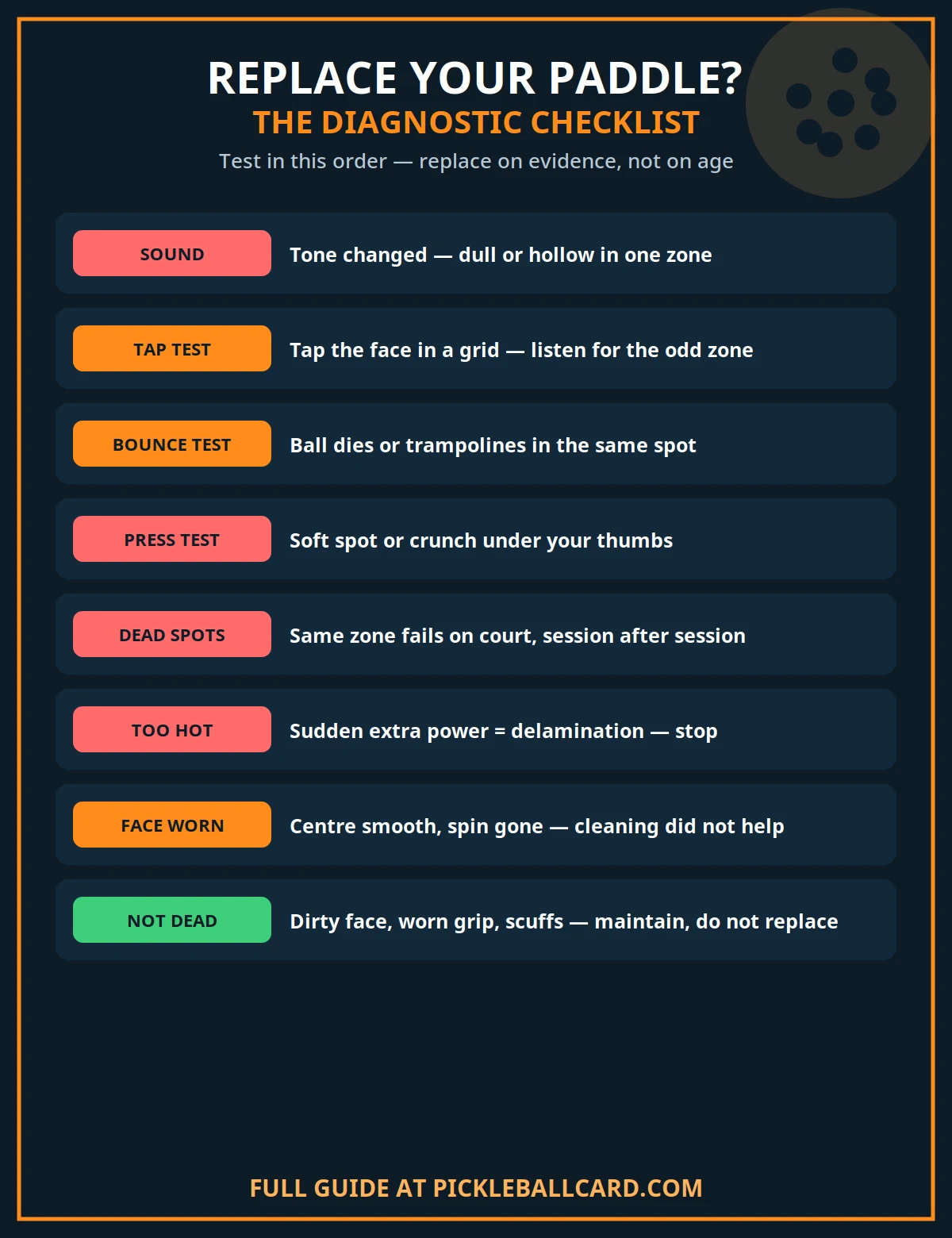
Checklist of when to replace a pickleball paddle: changed sound, repeating dead spots, lost or sudden extra power, worn face texture and visible damage, with the tap, bounce and press tests
When to replace a paddle — the seven signs and three home tests in one checklist.

Seven Signs It Is Time to Replace Your Paddle

  1. The sound changed. A firm, even note became dull, hollow or different in one zone. Sound is usually the first honest evidence of internal change.
  2. Dead spots repeat. The same area fails the bounce test and then fails you on court. Repeatability is what separates damage from a bad day.
  3. Your normal shots fall short. Drives and serves need visibly bigger swings for their old depth. Over-swinging to compensate is the classic core-fatigue pattern.
  4. Or your shots suddenly fly long. New, unexplained power with a trampoline feel points to delamination. Treat hotter as broken, not as broken in.
  5. The face lost its bite. The centre feels smooth and shiny compared with the edges, and your topspin no longer dips the ball as it did.
  6. You can see structural damage. Cracks, bubbling, a soft spot under your thumb, a separating edge guard, or a loose handle are all stop-and-replace evidence.
  7. You are changing your game around it. Gripping tighter, avoiding your backhand side, or skipping shots you trust — the paddle is now coaching you, badly.

Three Home Tests That Take Two Minutes

1. The Tap Test

Tap a pen or your knuckle across the whole face in a grid, centre and edges. A healthy paddle answers with a firm, consistent tone throughout.

Listen for a zone that sounds dull, hollow or muted compared with the rest. Mark it mentally — the next two tests check the same spot.

2. The Bounce Test

Hold the paddle still and drop a ball onto different zones of the face from the same height. Rebound height and sound should be broadly even.

A zone where the ball dies, or one where it trampolines noticeably higher, has changed internally. Repeat it twice before you trust the result.

3. The Press and Crunch Test

Press both thumbs firmly into the centre of the face and work outward. The face should feel evenly backed by the core everywhere you press.

A soft, springy patch, a crunching sound, or a spot that gives more than its neighbours signals core collapse or a face that has separated.

Finish with a court test: hit controlled drives, blocks and dinks with this paddle, then with a borrowed fresh one. A clear difference settles the question.

What Does Not Mean Your Paddle Is Dead

  • A dirty face. Ball residue and court dust kill grip temporarily. Clean it properly first — our guide to how to clean your pickleball paddle shows the safe method — then retest.
  • A worn grip. A smooth or loose grip is replaced in ten minutes with a new grip or overgrip. It is the cheapest fix in the sport.
  • Cosmetic scratches and edge scuffs. Scraped edge guards and marked faces look rough but often play perfectly. Judge by the tests, not by appearance.
  • One bad session. Wind, a different ball, cold weather and tired legs all change how a paddle seems to play. Evidence must repeat across sessions.
  • Wanting a different paddle. A healthy paddle that no longer fits your improving game is an upgrade decision, not a replacement need. Be honest about which one it is.

Check the Warranty Before You Buy Anything

Core crush and delamination are often treated as defects, not wear, especially early in a paddle’s life. Many brands cover them — check before you pay twice.

Find your proof of purchase and the brand’s warranty terms. Note when the sound or feel changed, and photograph any bubbling, cracks or separation.

Contact the manufacturer with that evidence and your test results. A clear tap-test description and a photo are worth more than a long complaint.

If the paddle is approved for tournament play, do not keep using a delaminated one while you wait. Borrow or use a backup for sanctioned matches.

Make the Next Paddle Last Longer

  • Keep it out of heat. A hot car boot weakens adhesives and materials. Store the paddle indoors, dry, at normal room temperature.
  • Protect the edge. Edge guard tape absorbs the scrapes that would otherwise chip the guard and open the way to moisture and separation.
  • Do not tap it on the court. Paddle taps against posts, fences and the ground are small impacts that add up inside the core.
  • Rotate if you play daily. Two paddles used in rotation each take half the impacts. Heavy users extend both playing lives this way.
  • Retest monthly. One tap test a month catches change early, while a warranty claim is still simple and your game has not adapted around it.

When replacement day does come, choose the successor by fit, not fashion. Our guide on how to choose a pickleball paddle covers weight, grip, shape and construction — including the thermoformed builds explained in our companion post.

Bring your old paddle to the demo if you can. Hitting the failing paddle and a fresh candidate back to back is the clearest comparison you will ever get.

Pay attention to your stock shots, not your highlight shots. Blocks, resets and third-shot drops reveal a paddle’s honesty far faster than one big drive does.

Replacement vs Upgrade: Making the Call Honestly

Replacement restores the performance you lost. An upgrade changes the performance you have. Confusing the two is how players spend money without solving the problem.

If your tests show internal failure, replace first — ideally like for like, or close to it. You already know that paddle’s weight, shape and feel.

Change models only when the old fit was also wrong. A new shape, weight or construction at the same time hides whether the fix actually worked.

If your paddle passes every test but bores you, that is an upgrade. Own that decision, demo properly, and keep the healthy paddle as your backup.

A sound backup matters. When a main paddle fails mid-season, a trusted spare keeps you playing while a warranty claim or delivery takes its time.

What to Do With the Old Paddle

A delaminated or core-crushed paddle should not be sold or passed on as a playing paddle. Its failure is internal, and the next player inherits it blind.

A merely worn paddle — faded spin, honest cosmetic wear, sound structure — can serve as a loaner for friends who want to try the game.

Label it honestly either way. Loaner, practice-wall paddle, or retirement are all fine endings. A silent hand-off of a failing paddle is not.

Keep your proof of purchase for the new paddle from day one. The next warranty conversation, whenever it comes, starts with that receipt.

Frequently Asked Questions

How often should I replace my pickleball paddle?

When the tests say so, not on a schedule. Heavy competitors may see decline within months; casual weekly players can play the same paddle for years.

What is the difference between a dead spot and core crush?

A dead spot is the symptom you feel — one zone returning the ball weakly. Core crush is one possible cause: the honeycomb core inside that zone has collapsed.

Is a hotter paddle a sign of delamination?

It can be. A separated face can trampoline and add power the paddle never had. Sudden extra power plus a hollow sound means stop and contact the manufacturer.

Can I keep playing with a delaminated paddle in rec play?

You should not. It no longer performs as designed or approved, it will keep separating, and a failing face is unpredictable for everyone on the court.

Does a worn-out paddle cause arm pain?

It can contribute. Players compensate for a dead paddle by swinging harder and gripping tighter, and manufacturer guidance notes that overcompensating can change mechanics over time.

Is a smooth paddle face enough reason to replace it?

Only if the lost texture changes your shots. If your spin has genuinely faded and cleaning does not restore it, the face has worn out its useful life.

The Bottom Line

Replace your paddle on evidence: a changed sound, a repeating dead spot, lost or suddenly gained power, a smoothed-out face, or visible structural damage.

Run the tap, bounce and press tests, clean and regrip first, and check the warranty before you buy. That order saves money and settles arguments.

A fresh paddle should feel like your old one did when it was new — predictable. Predictability, not novelty, is what you are actually buying.

Sources: Selkirk, What is core crushing in pickleball? (core-crush definition, tap / bounce / crunch tests, replacement ranges); USA Pickleball, The Evolution of Pickleball Paddle Technology.

This guide is original; no competitor content is linked or reproduced.

shoaib
shoaib

Shoaib is the publisher of Pickleball Card. He oversees the site’s guides to pickleball rules, ratings, strategy and gear, all researched from primary sources — the USA Pickleball Rulebook, DUPR and manufacturer documentation — and updated as the game changes.

pickleballcard.com

Filed Under: About Pickleball

  • « Go to Previous Page
  • Page 1
  • Interim pages omitted …
  • Page 5
  • Page 6
  • Page 7
  • Page 8
  • Page 9
  • Interim pages omitted …
  • Page 19
  • Go to Next Page »

Latest Posts

  • Raw Carbon Fiber Pickleball Paddles Explained
  • Pickleball Court Surfaces Explained: Acrylic, Asphalt, Concrete, And More
  • How To Organize A Round Robin In Pickleball
  • What Is The PPA Tour? The Professional Pickleball Tour Explained
  • The Mental Game of Pickleball: Focus, Confidence and Composure
  • Let Serve in Pickleball: What Happens When the Serve Hits the Net
  • Overhead Smash in Pickleball: How to Hit It
  • Forehand Drive in Pickleball: Power and Consistency
  • Common Pickleball Injuries and How to Prevent Them
  • Pickleball Tournament Formats Explained
  • About
  • Privacy Policy
  • Terms And Conditions
  • Affiliate Disclosure

COPYRIGHT © 2026 · Pickleballcard.COM, ALL RIGHTS RESERVED.

PICKLEBALLCARD.COM IS A PARTICIPANT IN THE AMAZON SERVICES LLC ASSOCIATES PROGRAM, AN AFFILIATE ADVERTISING PROGRAM DESIGNED TO PROVIDE A MEANS FOR SITES TO EARN ADVERTISING FEES BY ADVERTISING AND LINKING TO AMAZON.COM. AMAZON, THE AMAZON LOGO, AMAZONSUPPLY, AND THE AMAZONSUPPLY LOGO ARE TRADEMARKS OF AMAZON.COM, INC. OR ITS AFFILIATES. AS AN AMAZON ASSOCIATE WE EARN AFFILIATE COMMISSIONS FROM QUALIFYING PURCHASES.