• Skip to primary navigation
  • Skip to main content
  • Skip to primary sidebar

Pickleballcard

All About Pickleball Gears

  • About Pickleball
    • How To Play Pickleball
    • Pickleball Rules
    • Pickleball Kitchen Rules
    • Serving Rules
    • Pickleball Ratings
    • Pickleball Tips
    • Pickleball History
  • Pickleball Shoes
    • Best Pickleball Shoes
    • Best Pickleball Shoes For Men
    • Best Pickleball Shoes For Women
  • Pickleball Paddles
    • Best Pickleball Paddles
    • Elongated Pickleball Paddles
    • Graphite Pickleball Paddles
    • Onix Pickleball Paddles
    • Pickleball Paddles for Women
    • Pickleball Paddles For Spin
  • Vs
    • Pickleball Vs Tennis
    • Paddle Tennis Vs Pickleball
    • Indoor Vs Outdoor Pickleball

Pickleball Poaching: When to Poach — and When It’s Selfish

October 23, 2026 by shoaib

Poaching is the most argued-about move in doubles pickleball. One player calls it smart, aggressive team play. The other three people on the court call it theft.

The truth is narrower than both camps admit. Poaching is a genuine weapon when the situation and the partnership support it, and a partnership-killer when they do not.

This guide draws the line precisely: what a poach actually is, the five situations where it wins points, the four where it costs you, the calls that keep partners safe, and the counter that punishes reckless poachers.

Key Takeaways

  • A poach crosses the centerline. It means taking a ball clearly on your partner’s side of the court — different from an Erne, which goes around the kitchen, and different from simply taking a middle ball.
  • Poach the middle with your forehand on weak or high balls. That is where the math favors the poacher: the strongest wing on the most attackable ball.
  • Planned poaches work; surprise poaches usually do not. Signals, calls, and pre-point agreements turn a risky interception into a team play.
  • In casual rec play, stealing your partner’s shots is widely considered selfish. Your partner came to hit balls and improve — the score does not matter enough to deny them that.
  • Commit to a winner or a forcing shot. Every poach leaves half the court open behind you, so a soft poach is worse than no poach at all.
  • “Mine” outranks everything. If your partner calls the ball, abort the poach immediately — even mid-step.

What Poaching Actually Is

A poach is when you leave your half of the court, cross the centerline, and hit a ball that was headed to your partner’s side.

It happens at the kitchen line most often, but it can happen anywhere. A poach is defined by whose ball it was, not by where you were standing when you hit it.

The word comes from tennis, where the net player crosses to intercept a return aimed at their partner. In pickleball it means the same thing: intercepting a ball on your partner’s side of the court.

Poaching is not an Erne. An Erne goes outside the sideline and around the kitchen to volley a ball beside the net post. A poach stays on the court and crosses the middle. Keep the two separate in your head.

It is also not simply taking a middle ball. Middle balls live in the shared zone between partners, and someone has to hit them. A poach takes a ball that was clearly your partner’s — past the midline, on their side.

That distinction is the whole debate. Taking a shared ball is teamwork. Taking your partner’s ball is a decision that needs a reason and, ideally, permission.

The Middle Is the Poacher’s Playground

Most poaches begin at the center of the court. A ball drifts toward the middle, one partner crosses a step or two, and the stronger wing takes it. The geometry is simple: the middle is the shortest path to offense for both teams.

This connects directly to middle-court ownership. The “respect the X” framework — which we break down fully in who should take the middle in pickleball — assigns middle balls by forehand strength and court position.

A poach extends that same logic one step further, across the centerline. The forehand-in-the-middle principle does not stop at an imaginary line; it just gets riskier past it, because the ball now belongs to someone else.

That is why communication matters so much more for poaches than for middle balls. Middle balls are contested by rule of thumb, and both players expect the contest. Poached balls belonged to your partner until you decided otherwise.

A forehand covering the middle is the most efficient poaching setup in the sport. It reaches farther, sets up earlier, and finishes harder than a backhand reaching across the body ever will.

When Poaching Is Smart

Poaching earns its reputation in five specific situations. Each one shares the same three traits: the poacher has a clear advantage on the ball, the interception has a high chance of winning or damaging the point, and the partner is prepared for it.

1. Your Forehand Owns the Middle

When a ball comes to the center and you hold a forehand on it, crossing one step to take it is usually the highest-percentage play available.

The forehand generates more pace and control than your partner’s backhand reaching for the same ball. This is the poach nobody at any level should argue with.

The condition is balance. A poach that leaves you lunging and off-balance turns a forehand advantage into a desperation swing. Cross early, set your feet, and hit from a stable base.

This is also the poach that scales down to every skill level. Even in casual rec play, a forehand taking a middle ball reads as teamwork, not theft — because everyone can see it was the better shot.

2. A Weak Ball or Pop-Up Begs to Be Punished

When an opponent pops a ball up near the middle of the court, the team that attacks it first usually wins the point. Hesitation hands the initiative back.

If that sitting ball is closer to your partner’s side but your angle, position, or readiness is better, poaching the put-away is smart — provided poaching is an understood part of your partnership.

The non-negotiable part is the finish. A poach must produce a winner or a forcing shot. A soft poach that comes back is worse than no poach at all, because it also leaves your half of the court empty.

Read the height honestly. A ball above net height is an invitation. A ball at your shoelaces is a trap — poaching low balls usually produces the weak reply you were trying to avoid.

3. Your Partner Is Pulled Wide and Exposed

When an opponent drags your partner far outside the sideline, the middle of the court and the open space behind you become the danger zones.

Sliding across to poach the next ball protects your partner and compresses the court the opponents can attack. This is coverage, not theft, and good partners do it instinctively.

The rotation only works if your partner recovers toward the middle as you cross instead of freezing wide. Agree on this movement before the match so nobody is surprised mid-rally.

This is the most useful poach in recreational play. It defends your team rather than padding your highlight reel, which is why even strict no-poaching partnerships usually allow it.

4. The Planned Third-Shot Poach

On your serve, the net player can plan to poach the opponent’s third shot. A hand signal behind the back before the serve — one finger for stay, two for poach — keeps the plan hidden from the opponents.

The sequence runs like this: the returner hits their return, your partner plays the third shot, and you cross to intercept it, usually with a forehand volley aimed at the open court or the returner’s feet.

The critical half of this play is not the poach — it is your partner’s job afterward. They must slide across and cover the court you abandoned.

Drill the rotation until it is automatic. A poach without the cover is just an open court donation.

Save this play for meaningful moments. A planned poach used twice a game stays surprising. Used every point, it becomes the pattern your opponents are waiting for.

5. Your Partner Invited You

Some partnerships run hot. Your partner says “take anything in the middle” or calls “yours” on a ball they cannot quite reach. That is a standing invitation to poach, and it changes everything.

An invitation turns a risky interception into a planned play. It removes the social cost completely, because your partner has already opted in to your aggression.

Invitations are earned, not assumed. Players who poach well, finish points, and cover afterward get invited to poach more. Players who poach badly get quietly benched by their own partner.

Notice the pattern across all five situations: the best poaches are the ones your partner saw coming. Anticipation is what separates a team play from a solo act.

The Poach-vs-Stay Decision Table

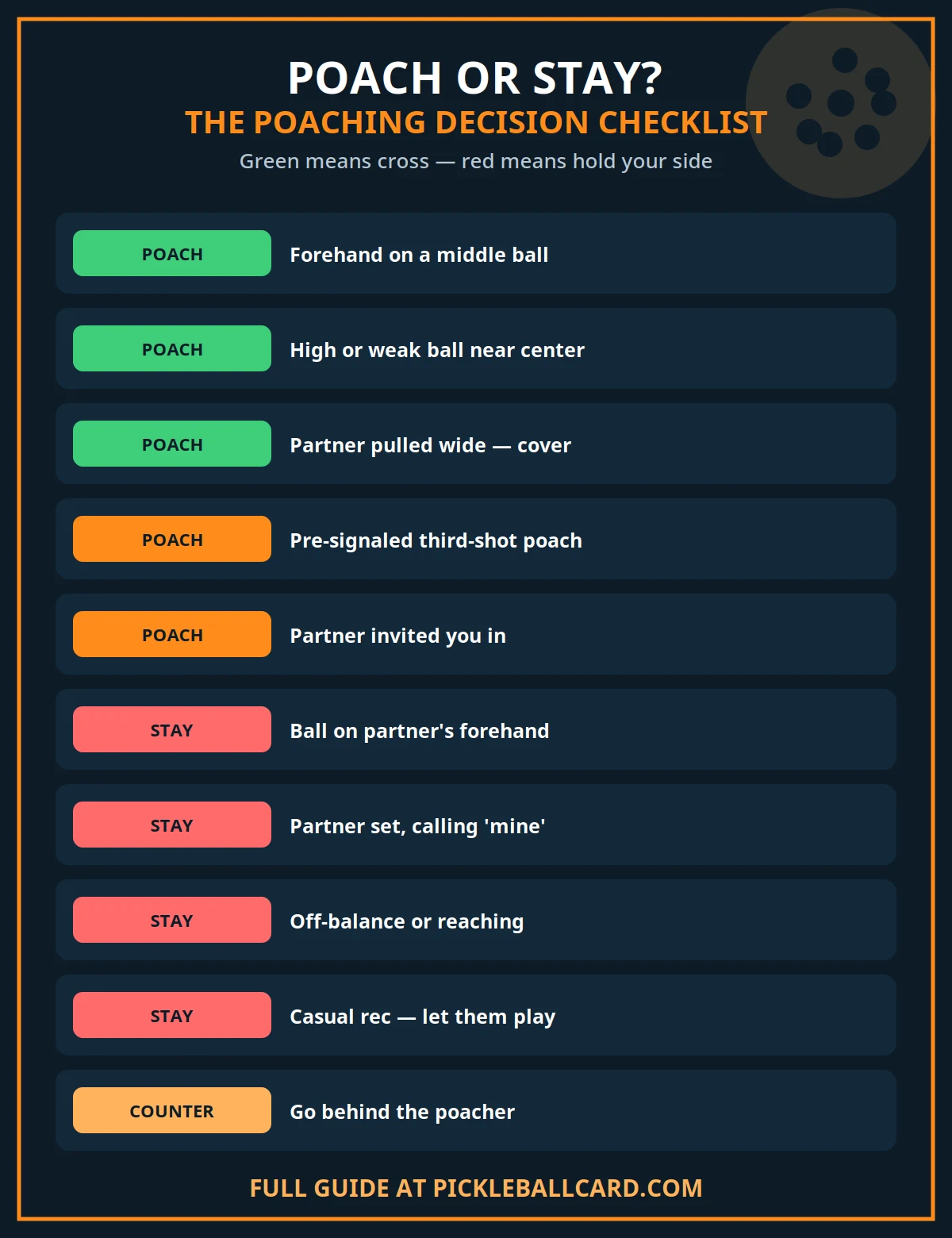
Run every temptation through this table before your feet move. If the row says stay, it says stay.

Situation Verdict Why
Ball at the center, your forehand is on it POACH Highest-percentage shot on the court; reads as teamwork at every level
High or weak ball sitting near the middle POACH Attack it before the opponents recover — but commit to a forcing shot
Partner pulled wide off the court POACH / SLIDE Coverage, not theft — protect the middle and shrink the opponents’ targets
Pre-signaled poach on the third shot POACH Planned with your partner, who shifts to cover your side
Partner explicitly invited you (“take the middle”) POACH Consent removes the risk — the partnership already agreed
Ball clearly on your partner’s forehand side STAY Their forehand was already the best available shot; you add nothing
Partner is set, balanced, and calling “mine” STAY The call outranks the plan — abort immediately, even mid-step
You are off-balance, lunging, or reaching STAY A poach from a bad position produces the weak reply you wanted to prevent
Casual rec play with a weaker partner STAY Let them hit — development reps matter more than the point
You want the highlight, not the percentage STAY If the motive is the reel, the shot selection is already wrong
Pickleball poaching checklist

When Poaching Is Selfish

Every selfish poach fails the same test: it takes a ball your partner could have hit well, for reasons that serve the poacher more than the team. Four versions of it show up constantly.

1. You Abandon Your Side for a Hero Shot

Crossing three steps to smack a ball your partner was already set up to hit is not strategy. It is impatience with better marketing.

Every poach opens court behind you. If your interception is not a winner or a forcing shot, the opponents get that open half for free — and your partner gets to watch it happen.

Ask yourself before crossing: am I taking this ball because I am the better option, or because I am bored? Honest answers prevent most bad poaches.

The double damage is worth naming: when the hero poach misses — into the net or long — the team loses a point your partner might have won. You stole the shot and the outcome.

2. You Cut Off Your Partner’s Forehand

The worst poach in the game is reaching across to take a ball your partner was about to crush with their forehand.

You gain nothing, because their forehand was already the best shot available on that ball. All you have done is put both players on the same half of the court.

Forehands are territorial. They belong to the player standing on that side of the court unless a prior agreement says otherwise. Respect the wing.

This one also corrodes trust fastest. A partner who watches their best shot get stolen stops setting up for the next one — and your team gets worse, not better.

3. You Poach Everything in Casual Rec Play

In open play and casual rec games, your partner came to hit balls, get exercise, and improve. Poaching their shots to win points nobody will remember denies them exactly that.

This is the situation most players mean when they call poaching selfish. The score does not matter; the repetitions do. Every ball you take is a rep your partner does not get.

The coverage exception still applies: if your partner is pulled completely off the court, sliding across to protect the middle is good partnering, not poaching. Everyone recognizes the difference.

Calibrate to the room. Tournament play, league matches with defined roles, and rec games with peers who poach right back are different contexts with different norms. Read which one you are in.

4. You Never Discussed It With Your Partner

An unannounced poach is a surprise, and surprises at the kitchen line cause collisions, whiffed balls, and arguments that last longer than the rally.

The first time you poach with a new partner should never be mid-rally. Mention it during warm-up: “I like to poach middle balls with my forehand — are you okay with that?”

Ten seconds of agreement prevents ten minutes of tension. Partnerships run on consent, and poaching without it is the fastest way to spend yours.

Communication Systems That Make Poaching Work

Every good poaching team runs a communication system. The specific signals matter less than the consistency — pick a system and use it on every single point.

The Three Calls: “Mine,” “Yours,” “Switch”

“Mine” claims the ball. It should be loud, early, and final. When your partner calls “mine,” you abort your poach immediately — even if you are already mid-step.

“Yours” (or “you”) hands the ball off. Use it when a ball drifts toward you but your partner has the better play, or when you want them to know you are deliberately not crossing.

“Switch” announces a poach or a side change as it happens. Call it while you are moving, not after — your partner needs the warning in time to cover the side you vacated.

Short beats clever. Single-syllable calls survive the speed of the kitchen line, where rallies are decided in fractions of a second. Full sentences do not.

The Pre-Point Plan: Signals and the Ten-Second Chat

Before your serve, the net player can flash a hand signal behind the back: one finger for stay, two for poach. Keep the hand low and hidden so the opponents cannot read it.

Between points, spend ten seconds setting the plan out loud: “I’m poaching the third if it sits up,” or “you take the middle, I’ve got the line.” Quiet teams guess; talking teams know.

Signals work best with regular partners who have memorized the code. With a pickup partner, the ten-second chat does the same job with zero memorization required.

One more habit: confirm the plan was received. A nod, a “got it,” a tap of paddles — anything that closes the loop. An unconfirmed signal is just a gesture.

Pre-Point Communication Checklist

Run this checklist before the first serve of every match. It takes thirty seconds and prevents the misunderstandings that ruin partnerships.

  • We agreed who takes middle balls — forehand priority, no guessing.
  • Poaching is explicitly ON or OFF for this match.
  • Hand signals are set (stay vs. poach) — or we use the ten-second chat instead.
  • “Mine” always outranks any plan, and both players know it.
  • After a poach, the partner covers the open side — drilled, not hoped for.
  • In rec play, we poach only for coverage — never to steal a partner’s ball for a winner.
  • If the plan is not working, we adjust between games — no silent frustration.

The Counter: How to Punish a Reckless Poacher

Poaching is a bet. The poacher bets their interception ends the point. When it does not, half the court stands empty — and prepared opponents collect on that bet.

Go Behind the Poacher

When you see an opponent cross the centerline to poach, hit behind them into the space they abandoned. The angle is short, the court is wide open, and the poacher cannot recover in time.

You do not need pace for this shot. A soft, angled dink behind the crossing player wins the point more reliably than a hard drive hit straight at them.

You can even set the trap deliberately. Feed the poacher’s partner a tempting ball near the middle and wait for the cross — patient dinking builds exactly these invitations, then punishes the answer.

Make the poacher pay twice and the poaching usually stops. Nobody keeps crossing when every cross costs a point.

When Your Own Partner Poaches Without Warning

Do not fight them for the ball. Two paddles on one ball ends worse than one paddle on the wrong half. Pull back, cover the open court as best you can, and finish the point.

Talk after the point, not during it. “I had that one — call it next time” fixes the problem. A mid-rally argument guarantees you lose the point and the mood.

If it keeps happening, reset the agreement between games. Be specific about what you want: “no crossing past the centerline unless you call it first.” A partner who will not discuss it is telling you everything about the partnership.

Drills to Practice Poaching Timing

Poaching is timing and trust, not courage. These three drills build the read, the cross, and the recovery — in that order.

1. The Signal-and-Switch Drill

One player serves while the net partner signals poach or stay behind the back, then the pair plays out the third shot. The focus is the partner’s slide to cover the vacated side — not the poach itself.

Run it ten times per side, alternating signals. The poach is the easy half of this drill. The cover is the part that wins matches.

2. The Pop-Up Punish

A feeder pops balls up around the middle from the baseline. The net team alternates poaching with the forehand and finishing the point outright.

Score it strictly: only poaches that end the point or force a weak reply count. A soft poach that comes back is a failure — it teaches the finish-or-don’t-cross standard.

3. The Cover-and-Recover Rotation

One player is deliberately pulled wide by angled feeds. The partner slides across to cover the middle, poaching anything attackable, then both players recover to their home positions before the next feed.

This teaches the most useful poach in recreational play: the coverage poach that protects a partner, never the highlight poach that steals their ball.

Frequently Asked Questions

Is poaching legal in pickleball?

Yes — nothing in the rules forbids crossing the centerline, because the centerline is imaginary and has no faults attached to it.

The poacher must still obey the non-volley zone rules: USA Pickleball’s Official Rulebook (Section 9) prohibits volleying while any part of the body is touching the non-volley zone. That matters when a poach carries you diagonally across the kitchen.

What is the difference between poaching and an Erne?

A poach crosses the middle of the court to take a ball on your partner’s side. An Erne leaves the court entirely, going around the sideline past the kitchen to volley beside the net post.

They are different shots with different setups, risks, and rules to respect.

Should you poach in recreational play?

It depends on the context and your partner. Poaching for coverage — sliding across when your partner is pulled wide — is welcome everywhere.

Poaching to steal hittable balls from your partner in casual open play is widely considered selfish, because it costs them reps. When in doubt, ask your partner before the game, not after the poach.

What should I do if my partner poaches my shots every game?

First, never fight them for the ball mid-rally — pull back and cover. Then address it between games with a specific request, such as “call it before you cross the centerline.”

Most chronic poachers do not realize how often they do it. If the behavior continues after a direct conversation, the problem is the partnership, not the tactic.

What is the best call to stop a poach?

“Mine” — loud and early. It is the universal claim call in doubles, and it outranks any pre-point plan or signal. A trustworthy partner aborts the poach the instant they hear it, even mid-step. If yours does not, revisit the agreement off the court.

Does poaching work in mixed doubles?

Yes, with the same rules and one extra consideration: partnerships often have an agreed coverage pattern, such as the stronger net player taking more middle.

Poach inside that agreement and it is devastating. Poach outside it and the trust cost is higher, because mixed partnerships lean harder on defined roles. The ten-second chat before the match matters most here.

The Bottom Line

Poach with a plan, a call, and a partner who agreed. Poach the middle with your forehand, punish the pop-ups, cover the partner who gets pulled wide, and finish everything you start.

Skip the hero poaches, the stolen forehands, and the rec-game stat-padding. The best poachers in pickleball are the ones whose partners ask them to do it again.

shoaib
shoaib

Shoaib is the publisher of Pickleball Card. He oversees the site’s guides to pickleball rules, ratings, strategy and gear, all researched from primary sources — the USA Pickleball Rulebook, DUPR and manufacturer documentation — and updated as the game changes.
pickleballcard.com

Filed Under: About Pickleball

How Does Pickleball Open Play Work? Guide 2026

October 23, 2026 by shoaib

You show up with a paddle, no partner and no plan. An hour later you are finishing your third game, paired with people you met at the gate. That is the whole promise of open play.

It is the default way recreational pickleball is organized across the United States. Public courts, rec centers, churches and clubs all run it. Yet the unwritten system — racks, stacks, rotations — baffles first-timers.

This guide explains exactly how pickleball open play works: what it is, how the paddle-rack queue works step by step, every common rotation format, the etiquette regulars expect, and how a beginner joins without the awkwardness.

Key Takeaways

  • Open play means show up solo and rotate in. No partner, reservation or team is required. You queue up and get matched with whoever else is waiting.
  • The paddle rack is the queue. Paddles sit in arrival order, usually left to right and top to bottom. Your paddle — not your body — holds your place in line.
  • Rotation depends on crowd size. Quiet sessions let games run long; busy sessions use 4-on/4-off so everyone cycles through. Always ask what the rotation is.
  • You do not need to be good to join. Beginner-friendly courts and skill-level racks exist specifically so new players get games at their level.
  • Etiquette matters more than skill. Calling the score loudly, mixing partners, playing down with beginners and keeping pace are what get you invited back.

What Is Open Play in Pickleball?

Open play is a session format where courts are open to whoever shows up, and players rotate through games with changing partners and opponents. Nobody books a court; everyone shares.

The session is usually run by a facility, club or park system. Posted hours say “open play” for a block of time — say, 9 a.m. to noon — and players arrive and leave freely within it.

There are no assigned teams and typically no referees. Games are self-officiated, and the rotation system — not a schedule — decides who plays next. That is what makes it social and what makes it efficient.

It is also the main on-ramp to the sport. Most players learned the game, found their playing partners and earned their level entirely inside open play sessions, not in lessons.

Open Play vs Drop-In vs Reserved Courts

Three terms get mixed up at the front desk. They describe different things, and knowing the difference tells you what you are walking into.

Term What it means What to expect
Open play Scheduled session where everyone rotates through shared courts A queue system runs during set hours; partners and opponents change
Drop-in Often the same as open play, sometimes with a fee Pay at the desk or show a membership; then join the same rotation
Reserved court You book one court for your group at a set time Your four stay together; no one rotates in on you

Some facilities label open play sessions by level: beginner, intermediate or advanced open play. That is not gatekeeping — it is how players get even games instead of blowouts.

Who Open Play Is For

Everyone, genuinely. Sessions exist for brand-new players, for social regulars who play five mornings a week, and for competitive players sharpening their doubles.

Beginners do best at dedicated beginner open play or on courts marked for newer players. The level is matched, the pace is slower, and mistakes are expected rather than punished.

Strong players do best where the session is strong. A 4.0 player who joins beginner open play for easy wins helps nobody and annoys everybody. Match your session to your level.

How the Paddle-Rack Queue Works, Step by Step

The paddle rack is a row of slots — a plastic bin, a wall rack or just a stretch of fence — where waiting players park their paddles in arrival order. First paddle in line plays next.

The logic is simple: when all courts are full, your paddle waits in line instead of you standing around. As games finish, the next paddles in line go on. Fair, visible and self-running.

  1. Find the rack when you arrive. It sits near the courts or the gate, sometimes on a bench or table. If you cannot spot one, ask: “Where do paddles go?”
  2. Read the order direction. Most racks run left to right, top to bottom, but not all. Watch which end new paddles join before you place yours.
  3. Place your paddle last in line. Add it to the end — the far right or the bottom slot. Never move anyone else’s paddle or insert yours ahead.
  4. Mark your paddle first. Many paddles look identical. Put your name on yours with tape or a marker so nobody mistakes it for theirs in the line.
  5. Stay nearby and watch the games. When a game ends, players coming off will call out “open court” or “next four,” and the next paddles in line are up.
  6. Be ready when your paddles are called. Grab your gear, water and balls and head to the empty court promptly. The line moves on your pace.
  7. After your game, go to the end of the line. Whether you won or lost, your next game starts at the back of the queue. Nobody keeps a spot.

Some racks use a slider, a marker ball or a clip to show which paddle is up next, which removes all doubt. Others just trust the left-to-right order. Both work if everyone respects them.

What If There Is No Rack?

Informal courts still queue — paddles line up on a bench, a table or the ground in arrival order. The system is identical; only the furniture is different.

When in doubt, announce yourself. “I am new here — how does the rotation work?” Regulars will tell you the house version, because every venue has small local variations.

The Best First Question to Ask

Ask this before your paddle ever touches the rack: “What is the rotation today?” The answer tells you everything — how many come on, whether winners stay, and how long you will wait.

That one question also marks you as someone who respects the system. Regulars notice, and it buys you goodwill that lasts your whole session.

The Main Rotation Formats, Compared

Rotation formats answer one question: when a game ends, who stays and who leaves? The answer changes with crowd size, competitiveness and venue rules. Here is the full landscape.

Format How it works Best for Watch out for
4-on / 4-off All four players leave when the game ends; the next four paddles go on Very busy sessions with a long wait line Partners split up unless the venue allows paired paddles
Winners stay The winning team stays; the losing team leaves and two new players enter Smaller or moderately busy groups One strong team can hold the court for a long time
Winners stay and split Winners stay but swap partners; two new players join, one per team Social sessions and mixed levels Do not refuse to split — it breaks the format
2-on / 2-off Two players leave and two enter; which two depends on local rules Small groups where everyone knows each other The order can get fuzzy without someone managing it
Challenge court Winners stay until beaten; challengers enter in queue order Competitive sessions and confident players Beginners can wait a long time — watch a game first
Skill-level courts Separate racks or courts for beginner, intermediate and advanced Large mixed-skill sessions Check how the session defines each level before you pick a queue

4-On / 4-Off: The Busiest-Session Format

When the wait line is long, fairness means speed. Everyone plays one game to 11 and comes off, and the next four go straight on. No team holds a court.

This is the format that gives the most players the most games per hour. If you arrive mid-morning on a Saturday at a packed park, this is almost certainly what you will find.

Partners rarely stay together under 4-on/4-off, because the next four paddles in line decide the teams. Some venues let two paddles stack together as a pair — accepted for a few games, not all session.

Winners Stay (and the Two-or-Three Cap)

In smaller groups the winners stay on and the next two players from the queue take on the losers’ side. It rewards winning and keeps the games continuous.

Most sessions cap how long winners can stay — usually two or three consecutive games — then they step off so others get a turn. The cap is what keeps it friendly rather than territorial.

This format suits moderately busy sessions where the queue is short enough that losing teams are not waiting forty minutes for a rematch.

Winners Stay and Split: The Social Format

The winners remain on court but separate, each taking a new partner from the incoming players. Skill spreads around instead of concentrating on one side.

This is the friendliest competitive format. It breaks up cliques, balances lopsided games and makes mixing partners the default rather than the exception.

If you refuse to split with your partner in a split-winners session, you are not protecting your game — you are breaking the rotation everyone else is following. Find a challenge court or a reserved hour instead.

Challenge Courts: The Competitive Lane

Large facilities often set one or two courts aside as challenge courts. Winners stay until someone beats them, and the challengers queue in order. It is the local leaderboard made physical.

The level here runs higher than the rest of the session. If you are not sure you match the speed, watch one game before stacking your paddle. Nobody judges the watching; everyone judges the unprepared.

Challenge courts absorb the competitive players so the regular open-play courts stay social. Both lanes need each other — the session works because they are separate.

Skill-Level Courts and Racks

Big sessions divide courts — or even separate paddle racks — by level. Beginners get their own rotation, intermediates theirs, advanced theirs. Everyone gets even games.

Level labels vary wildly between venues. One park’s “intermediate” is another’s advanced. Ask how the session defines each tier, or watch a few rallies before choosing your queue.

When you are between levels, start at the lower one for a session or two. Earning your way up is respected; camping down to dominate is not.

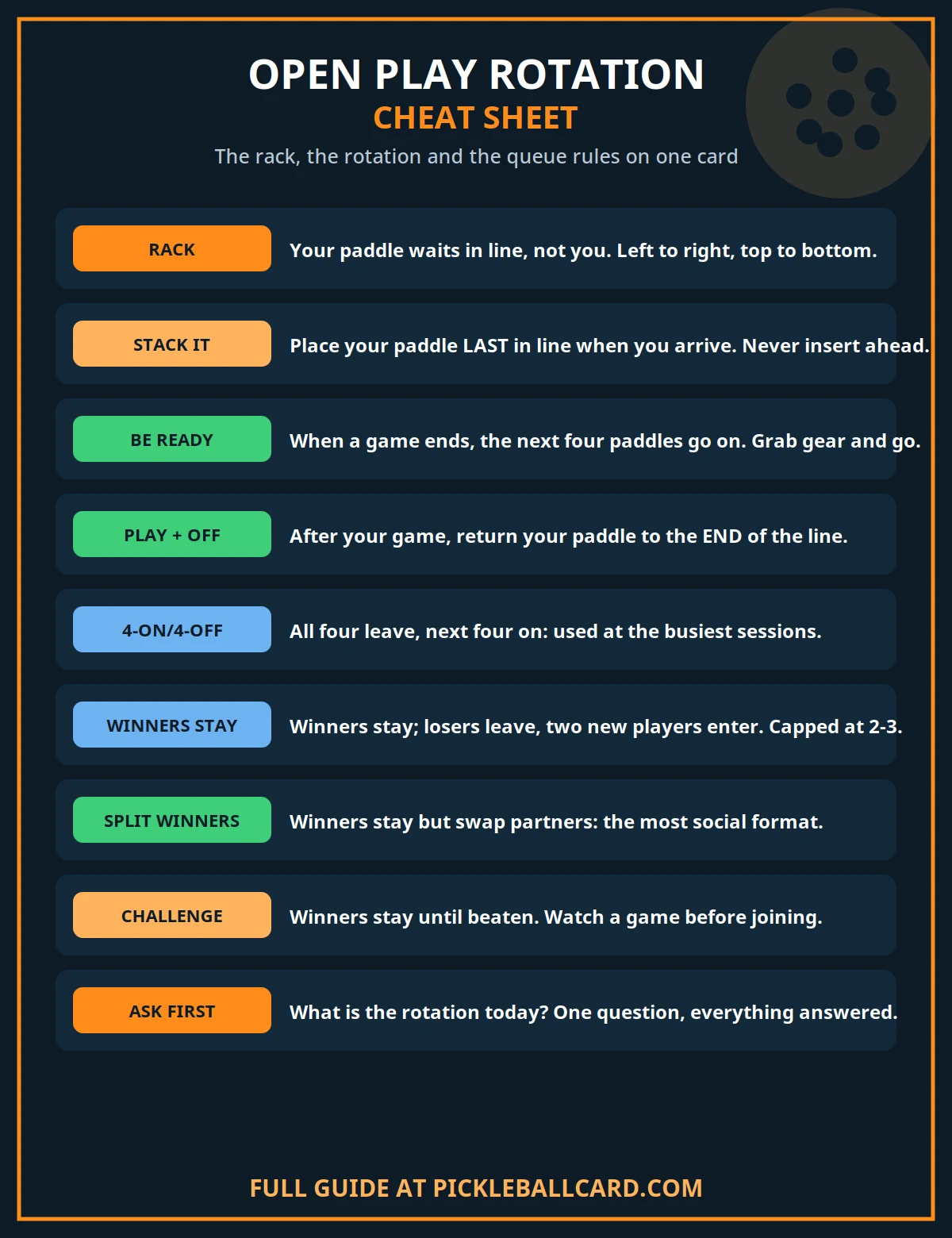
Cheat sheet for pickleball open play rotations: 4-on 4-off, winners stay, winners stay and split, 2-on 2-off, challenge courts and skill-level courts
Open play rotations at a glance — every format, how it works and when it is used.

Your First-Visit Checklist

  • Paddle. Any legal paddle works — nobody inspects your gear at the gate. Loaner paddles are common at beginner sessions, so ask if you do not own one yet.
  • Court shoes. Tennis or pickleball shoes with lateral support. Running shoes roll ankles on hard cuts, and some indoor venues require non-marking soles.
  • Water. More than you think. Sessions run two to three hours in the sun, and most courts have no fountain nearby.
  • A ball or two. Facilities provide most balls, but bringing your own is good form — balls crack constantly and everyone appreciates a fresh one.
  • Sun and sweat gear. Hat, sunglasses and a towel for outdoor summer sessions. A change of shirt turns a sweaty stop into a second wind.
  • Your name on your paddle. Tape or marker. It is the simplest etiquette on this list and the one beginners most often skip.
  • Arrival time with intent. Arrive near the session start, not at peak hour. Early sessions are emptier, calmer and friendlier to new faces.
  • Ten minutes of observation. Before your first game, watch the rack, the rotation and the warm-ups. You will learn the local system faster watching than reading.
  • An introduction. Say you are new and ask how things run here. Regulars who would never correct a stranger will happily coach a newcomer.
  • Warm-up readiness. When your paddles are called, go. Keep your pre-game warm-up to two or three minutes so the queue keeps moving.

Open-Play Etiquette That Gets You Invited Back

Etiquette in open play is not decoration. It is the operating system the whole rotation runs on. Our full guide to pickleball etiquette and the unwritten rules covers the sport broadly; this is the open-play edition.

Call the Score Loudly, Every Point

There are no referees, so the server calls the score before every serve — loud enough that all four players and the sideline hear it. Silent scoring breeds disputes.

Calling the score is also how partners stay synced on which server it is. A loud, clear call prevents the “whose serve is it?” stoppage that slows every game.

When in Doubt, Call It In

Line calls belong to the receiving side, and the honest rule is simple: if you did not clearly see the ball land out, it was in. Generosity is the currency of rec play.

Arguing a line call you barely saw buys nothing and costs everything. The players around you remember how you handled it long after they forget the score.

Mix Partners — Do Not Build Fortresses

Open play’s whole point is playing with different people. Splitting up and mixing partners keeps games balanced, builds the community and improves your own game faster than any private practice.

Arriving as a pair is fine; refusing to ever separate is not. If you only want to play with your partner, that is what reserved courts and private hours are for.

Play Down Gracefully

You will inevitably face someone well below your level. Do not smash at them. Work your soft game — dinks, drops, resets — and keep rallies alive instead of ending them.

The player you crush today remembers it next month. The player you lifted up with a patient, competitive game remembers that too — and tells everyone.

Keep the Pace

Short warm-ups, prompt court changes and quick games are the grease in the system. When people are waiting, five-minute warm-ups and slow resets between points are a quiet theft of everyone’s court time.

Between games, clear the court fast. Retrieve your paddle, your bag and your water in one motion, because the next four are already waiting at the gate.

Safety Calls Come First

Call “ball on court” the instant a stray ball enters another game. Everyone stops, retrieves it and resumes. Chasing a ball across an active court without a call is how ankles and collisions happen.

Never reach onto another court to grab your ball while their rally is live. Wait for their point to end, then ask. Ten seconds of patience beats any injury.

What to Bring to Open Play

The gear list is short: paddle, proper court shoes, water and sun protection. Rec play asks for almost nothing expensive — one of the reasons the sport spread so fast.

What matters more than gear is what you bring socially. Arrive early, introduce yourself to whoever is at the rack, and ask a regular how today’s rotation runs.

Beginners should also bring realistic expectations. Your first games will feel fast and chaotic. Give it three sessions before you judge anything — the fog clears quickly.

If you have never played at all, learn the basic rules before your first session. Our guide to how to play pickleball covers scoring, serving and the kitchen so your first game is not a rules lesson.

Peak Hours: What Changes When Courts Are Packed

Morning and evening sessions are the rush hours. More players than courts means the rotation tightens: 4-on/4-off, shorter games, and warm-ups measured in minutes.

Games themselves may shrink. Some sessions play to 9 or even 7 when the queue is long, instead of the standard 11, win by 2. The facility or the group sets it — check before you start.

Wait times stretch, too. A ten-minute queue at 9 a.m. can be twenty-five by 10:30. If your schedule is flexible, the mid-session lull is the sweetest court time in the building.

Fairness norms get stricter at peak. Lingering on a court after your game, replaying disputed games or skipping the queue will get you corrected fast. At quiet times the same infractions get a shrug.

How a Beginner Joins, Without the Awkwardness

Walk up to the courts during posted open play hours — not mid-game, but between games, at the gate or near the rack. Stand where waiting players stand, not on a playing surface.

Say it plainly: “Hi, I am new — how does the rotation work here?” That sentence does three things at once: introduces you, signals respect for the system, and invites help.

Stack your paddle at the end of the line like everyone else. Then watch one full rotation before your turn. You will see exactly how teams form, how games end and where you go after.

When your turn comes, introduce yourself to your three partners-in-a-game: “First time here, go easy on the explanations.” Players love a beginner who asks for help — they hate a beginner who pretends they do not need it.

Play to learn, not to win. Position, paddle readiness and calling the score matter more than winners in your first sessions. The wins come on their own soon enough.

If you catch the bug and start entering events, our guide to your first pickleball tournament covers what to expect, what to bring and how tournament play differs from open play.

Finding Open Play Sessions Near You

The fastest route is the official one. USA Pickleball maintains a Places to Play court finder with verified locations across the country, including posted open play schedules.

Municipal rec centers are the other backbone. Most publish “drop-in pickleball” hours on their websites, often indoor in winter and outdoor in summer. A phone call confirms the schedule before you drive over.

Local clubs and churches run some of the best beginner sessions anywhere, usually with loaner paddles and patient regulars. Search your town plus “pickleball club” or ask at any sporting goods counter.

Session-finder apps are how regulars coordinate. The popular ones let hosts post sessions (“Intermediate open play, 9 a.m. at Central Park”) and show sign-up counts before you leave home — useful for gauging how busy a session will be.

Check the posted rules wherever you land. Hours, fees, indoor balls versus outdoor balls, and the rotation format are all local decisions, and the regulars enforce them.

Frequently Asked Questions

Do I need a partner for open play?

No — showing up solo is the norm, not the exception. The rotation pairs you with whoever else is waiting. Open play exists precisely so that nobody needs to arrange a game first.

What if I have never played and the courts look advanced?

Do not stack into the fast group. Look for beginner open play hours or a beginner-designated court or rack, and watch a game first. Starting at your level is how every regular started.

How long do I wait between games?

It depends on players versus courts. Quiet sessions mean almost no wait; packed peak sessions can mean fifteen to thirty minutes. Arriving near the session start keeps waits shortest.

Can I bring a friend and always play with them?

For a few games, usually yes — stacking two paddles together is widely accepted. For the whole session, no. Open play expects mixing, so protect the friendship and still rotate in with others.

What happens if my team keeps winning?

Depends on the format. In winners-stay systems there is usually a cap of two or three consecutive games before you step off. In 4-on/4-off everyone leaves after one game, winners included.

Is open play free?

Public parks are usually free. Rec centers charge a drop-in fee or require a membership, and clubs charge dues. The session-finder app, the rec center website or a quick call will tell you before you go.

The Bottom Line

Open play is pickleball’s social engine: show up, stack your paddle, ask the rotation, and play whoever is there. The system looks chaotic from the parking lot and runs like clockwork from the gate.

Everything that confuses beginners has a simple answer. The rack is the queue. The rotation matches the crowd. The etiquette is generosity. And the one question that opens every door is “how does it work here?”

Now the only hard part is the drive there. Everything after the first game takes care of itself.

Sources: USA Pickleball, Places to Play — Find Pickleball Courts Near You (official court finder with open play schedules); USA Pickleball, Official USA Pickleball Rulebook (game format, scoring and self-officiated play).

This guide is original; no competitor content is linked or reproduced.

shoaib
shoaib

Shoaib is the publisher of Pickleball Card. He oversees the site’s guides to pickleball rules, ratings, strategy and gear, all researched from primary sources — the USA Pickleball Rulebook, DUPR and manufacturer documentation — and updated as the game changes.

pickleballcard.com

Filed Under: About Pickleball

Best Pickleball Tips & Tricks | Pickleball Techniques

October 23, 2026 by Sadaf Awan Leave a Comment

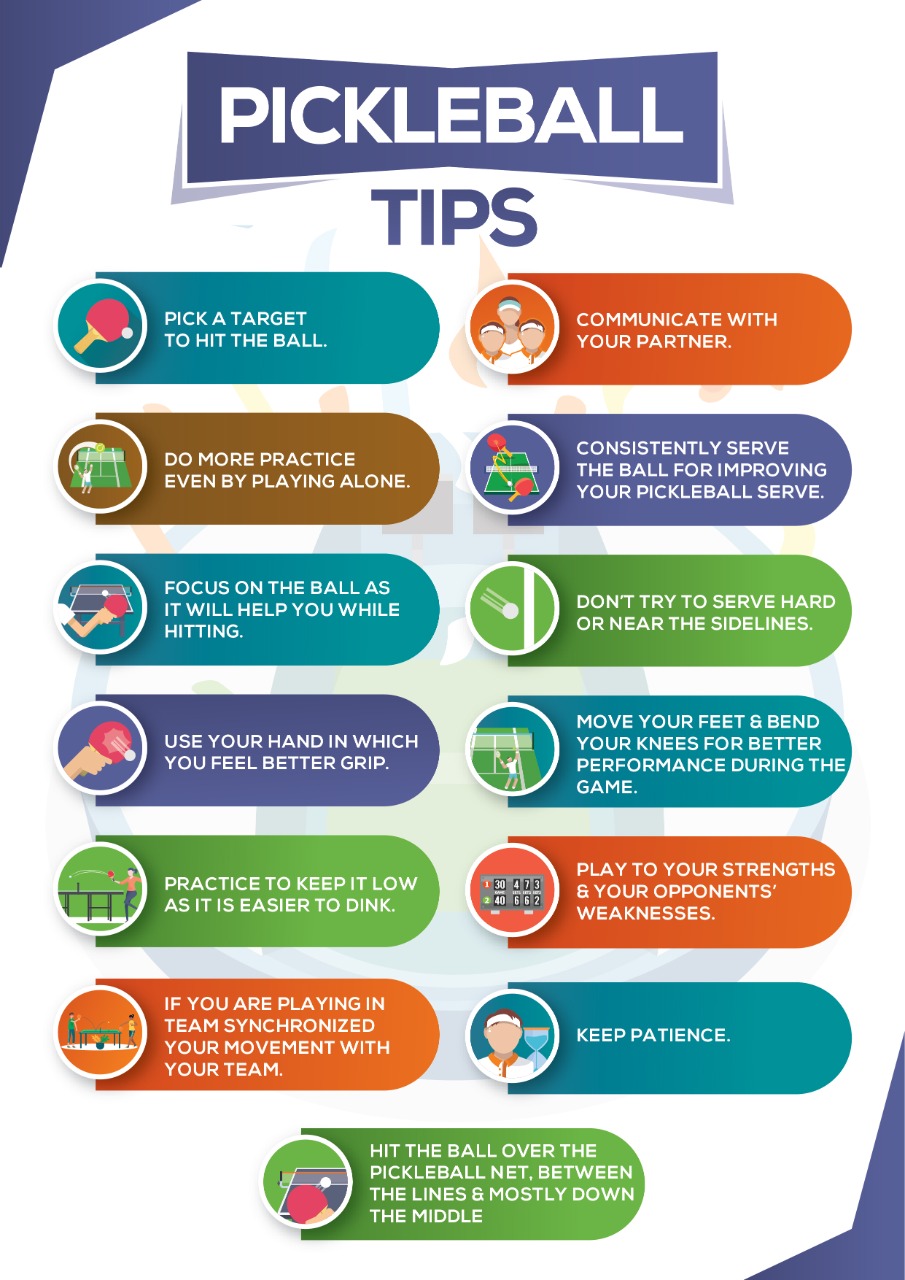
Pickleball Tips To Win The Game

Pickleball is not only a physical game but also a mental game. This blog will break down pickleball techniques and advice to help you succeed. Whether you are playing singles or doubles, pickleball tips and tricks are important.

For the consistent execution of different pickleball shots, having good technique and excellent fundamentals are essential. Here are some pickleball suggestions for pickleball techniques that will offer you the best chance of executing effective shots.

Pickleball Tips, Pickleball Strategy
Some Pickleball Tips For Beginners

1. Quickly Head To The Kitchen

In the kitchen, the line is where you want to be on the pickleball tips for advanced players’ court to be most successful. It increases shot angles and puts pressure on your opponents. There is a catch that you want to enter the zone safely.

While walking toward the kitchen and seeing your opponent preparing to hit, halt your forward motion and get ready to block their shot. Returning a shot like this is considerably simpler than correctly placing a shot while running. Instead, return the ball and move forward swiftly.

We all have made the error of racing to the kitchen in a blind panic only to have a dish smashed directly at us. As you move forward, keep an eye on where the ball is going and where your opponents are.

2. Keeping Your Attackers At Back

Holding them back while you wait in line in the kitchen significantly disadvantages your competitors. They need to cover a lot more court space and face the challenging job of trying to make a deftly placed drop shot in the kitchen to buy themselves some extra time.

Keep your opponents back by putting the ball at their feet if one or both cannot reach the kitchen line. One of the trickiest shots to return is hit at your feet, and there is a big chance you will make them miss. With one exception, I will say that it is usually a good idea to hit your opponent closest to you with an overhead opportunity. However, they are less likely to return your overhead since they have less time to react.

3. Put In Your Serves

Hitting an ace with an extreme power serve to the baseline or a tricky spin serve is satisfying. However, it is not a winning technique if you hit half of your serves into the net or out of bounds.

Here are helpful pickleball serve tips to get better at serving:

  • Try hitting under your belly button
  • Learn foot placement on your serve
  • Learn how to hold the paddle
  • Keep calm yourself
  • Find different pickleball targets and aims
  • Use your shoulders for a swing
  • Wear good and comfortable shoes
  • Serve with power by using your legs and core
  • Always keep mixing your serves
  • Keep practicing pickleball serve

You lose the chance to score points when you do not make your server. By playing shrewder and serving more consistently, you can defeat opponents who are more skilled than you. Get your serves in and allow your opponents’ errors.

Not winning the point on the serve is your objective. Your objective should be to apply the right amount of pressure on your adversary to prevent an easy return shot. To challenge your opponent, try placing the ball deep in the court or aiming for their backhand; just be careful and maintain the ball in play. It doesn’t require a lot.

4. Learn How To Drop Your Third Shot

The term “third shot drop” is probably familiar if you have played pickleball tips for intermediate players at any time. The third shot drop is one of the fundamental pickleball tips and should be in the arsenal of every severe pickleball player, even though it isn’t your only choice.

Although the third shot drop is frequently discussed, and for a good reason, you can make a drop shot any time during a match. It is an excellent alternative if you find yourself out of place and need to “reset” the point and get back into position.

While practicing your drop shot, just be ready to swallow a few smashes. It takes practice to master one of the pickleball’s trickiest shots. It pays off greatly when you start to get it down, so keep your eye on the prize and don’t get discouraged.

Random Pickleball Tips For Serving Advice

1. Avoid Playing With The Best Player

If you plan to play pickleball while traveling and will be out of town, get in touch with the regional ambassador a few weeks beforehand. They can recommend venues and times suitable for your particular skill level. During recreational play, avoid playing pickleball and keep away from the most outstanding player on the opposing team since they want to participate, too!

2. Understand When You Are Attacking Or Defending

In a pickleball point, the team with the lead may shift highly quickly. You can go on the attack at any time, controlling the point and applying pressure on your opponents. However, the situation can change quickly, and you can find yourself battling to keep the ball in play and the point alive.

A typical error players of all skill levels make is pressing the attack when they should be playing more defensively or playing easy shots to their opponents when pushing their advantage.

In the first situation, the player gives up the upper hand and lets their rivals advance closer to the kitchen. In the second, the player intentionally works against them, positioning them for the ideal smash chance.

3. It Is Essential To Communicate

At first, talking to your partner may not seem like any tangible advantage. For example, how can communication aid your desire to score more points and win more games?

Just recall all the times you missed a shot because you were sure your partner would receive it, only to have the ball drop in your area and discover that your companion had the same idea. Or how about going after a ball you believed was yours and colliding paddles with your partner, sending the ball into the net?

All of us have gone through it. You will lose points for failing to communicate, which could be the deciding factor in a tight game.

4. Imagine It

Do not just dink around the kitchen for the sake of drinking when playing the soft game. There are two fundamental causes of our dinking. The earlier of the two is more crucial. Giving your opponents highballs is not a good idea. It’s okay if you’re still trying to keep your dinks low and unreachable. Select a pickleball drill partner and continue to practice.

However, pay attention after you believe your dink placement is relatively regular. Utilizing your dink placements, force your opponents to move. Many players make the error of dinking directly at their opponents as if they were playing a game of catch. If you can get them to proceed, you have a better chance of forcing them to pop up a ball or hit it into the goal.

Pickleball Tips For Intermediate Players

Give your paddle line of sight on the ball at all times, regardless of where it is on the court. This is one of the most excellent pieces of pickleball tips for intermediate players. Constantly monitor the ball with your paddle, even if it isn’t being hit to you and your partner is getting the majority of the shots.

Beginner-level mistakes like launching a serve or returning of serve into the net are not committed by intermediate players. Intermediate players do not accept unforced mistakes. Making it more difficult for the serving team to reach the kitchen line is what you achieve by hitting a deep baseline hugging return of serve. The return team has a significant advantage the longer the serving team takes to reach the pickleball net.

You are showing the appropriate amount of in-game focus that both intermediate and professional-level players require by being completely aware of whose serve it is and what the score is. Recreational players frequently overlook who served first and who is in the lead. That is acceptable for leisure play. It has a light tone, with the primary goal being to have fun.

Yet, the degree of competition and, as a result, the level of concentration increases when you play with intermediate players. Intermediate players have a high level of in-game focus, so they automatically recognize the score and whose service it is.

Pickleball Tips For Advanced Players

As an advanced pickleball player, you have already honed your basic pickleball skills. But I’m sharing some advanced strategies and tips for playing pickleball that will help you take your game to the next level. Top players, including Ben Johns and Collin Johns, use these most actionable pickleball tips for advanced players.

If you want to dominate the pickleball match, you have to master the third shot drop. The third shot drop involves a soft, controlled stroke that sends the pickleball ball just over the net and lands it gently in the opposite player’s kitchen.

To get an edge on your opponent, you have to develop a deceptive dinking game. Keep changing the pace, angle, and placement of your dinking, as this will keep guessing your opponent and will get you more opportunities for you to attack.

One more thing that is included in the 5.0 pickleball strategy is to keep changing your pickleball positions. Improve your pickleball backhand shots and start targeting your opponent’s backhand, as most pickleball players have stronger forehand strokes than backhand strokes.

Frequently Asked Questions

What Are The Three 3 Key Things You Should Focus On In Pickleball?

I want you to commit to doing three things the next time you practice or play: picking a target, paying attention to the ball, and visualizing yourself hitting three balls. Your shots will be steadier and more accurate; I guarantee it.

What Is The Most Challenging Thing To Do In Pickleball?

Keeping the pickleball low is one of the most challenging pickleball skills to master while still over the net. As a result, your opponents will be unable to take the initiative with an aggressive shot if your pickleball is low.

What Is The Most Important Shot In Pickleball?

The most crucial shot in pickleball to perfect is the third shot drop. To play advanced pickleball, you must learn this shot. On the third shot, many points are lost. Players have a lot of pressure when attempting to make this shot, which is why.

Are You Allowed To Switch Hands In Pickleball?

The greater reach made possible by swapping hands is the only method for players with limited mobility to get the paddle on the ball. By switching hands, you can confuse opponents attempting to hit you on your weak side with forehands on both sides.

Should A Pickleball Player Call The Line On Their Partner’s Side?

Making the line call is the responsibility of the player or team on the side of the pickleball court where the pickleball landed. If a player or team could see the line call, they should make the call.

How To Get Better At Pickleball?

There are three keys you should practice to get better at pickleball, which is drill, practice, and play. First of all, learn basic pickleball rules. If you want to improve your skill level, you must spend time drilling and practicing your game.

How To Hit A Pickleball?

There are different ways to hit a pickleball including creating a topspin by snapping your wrist up while contacting with the ball. This will force the ball to rotate rapidly, and your opponent will find it difficult to return the shot. The second way is to increase the speed and spin of the ball while hitting the sweet spot. This will generate more speed and power.

How Long To Get Good At Pickleball?

Getting good at pickleball depends on various factors, like your current skill level, the amount of time you dedicate to practice, and the quality of coaching you receive. Generally, with consistent practice of a few hours per week, you can become proficient in 6 months to a year. However, mastering the sport may take several years.

What Are Some Pickleball Tips For Seniors?

For seniors playing pickleball, focus on pickleball trick shots rather than power, as this conserves energy and reduces strain. Ensure you have comfortable, supportive footwear to maintain balance and prevent injuries. Also, engage in moderate warm-up exercises before games to keep muscles flexible, and always listen to your body’s signals, resting when needed to prevent overexertion.

Give Every Shot a Margin: Aim Inside the Lines

Most recreational points are lost, not won — the ball finds the net or sails past a line. So stop aiming at the lines. Pick targets a paddle-length inside them: serves to the middle of the service box, returns deep but not on the baseline, dinks toward the centre of the kitchen. A smaller margin is only worth it when you are balanced and set; on the run, take the big target every time. This habit cuts unforced errors immediately, and it pairs with the practice in our pickleball drills and the fundamentals in how to play pickleball.

Where to Go Next, by Level

Tips only help if they match your level. Here is where each kind of player should go next on this site.

Newer players: master the shots themselves first. The shots index explains every shot in the game and how to hit it, one family at a time.

Improvers: positioning and shot choice now matter more than technique. The strategy guides cover doubles systems, poaching decisions and when to speed the ball up.

Advanced players: drill with intent. The drills guide structures practice around third shots, resets and hands battles rather than casual rallying.

Conclusion

These pickleball tips can give you a head start in the correct direction as you work to improve your game. I would like to hear your opinions.


Related Pickleball Posts To Read:
  • Pickleball Rules To Follow
  • Pickleball History
  • Top Pickleball Shoes
  • Tennis Vs Pickleball
  • Best Pickleball Nets


Author Profile Picture Of Sadaf Awan
Sadaf Awan

Sadaf Awan writes Pickleball Card’s footwear and gear guides. With a background in biology, she looks at shoes the practical way players feel them — fit, support, cushioning, grip and how a shoe holds up on hard courts. She compares manufacturer specs with how each model is built, and flags when a guide is research-based rather than hands-on.

Filed Under: About Pickleball

Serving Rules In Pickleball | How To Serve In Pickleball?

October 23, 2026 by Sadaf Awan Leave a Comment

Serving Rules In Pickleball

Pickleball has its recognition on its own. Those familiar with its playing activity might know its rules and regulations significantly. It might be difficult for beginners to understand the scoring and serving factors.

They are not tough to get in, but the players find it hard because they are at fault and accept it. Slow and steady, they reach out when they are skillful in the playing action and efficient enough to keep an eye on serving and scoring points.

To provide you with a thorough understanding in a very comprehensive way, here we are going to elaborate on Serving Rules in Pickleball. So before featuring the playing action, you might be familiar with the serving rules.

Pickleball Serving Rules

These rules will be beneficial for making you proficient in professional playing activities. To cover most of the aspects regarding serving rules in pickleball for beginners, let’s find out the details below;

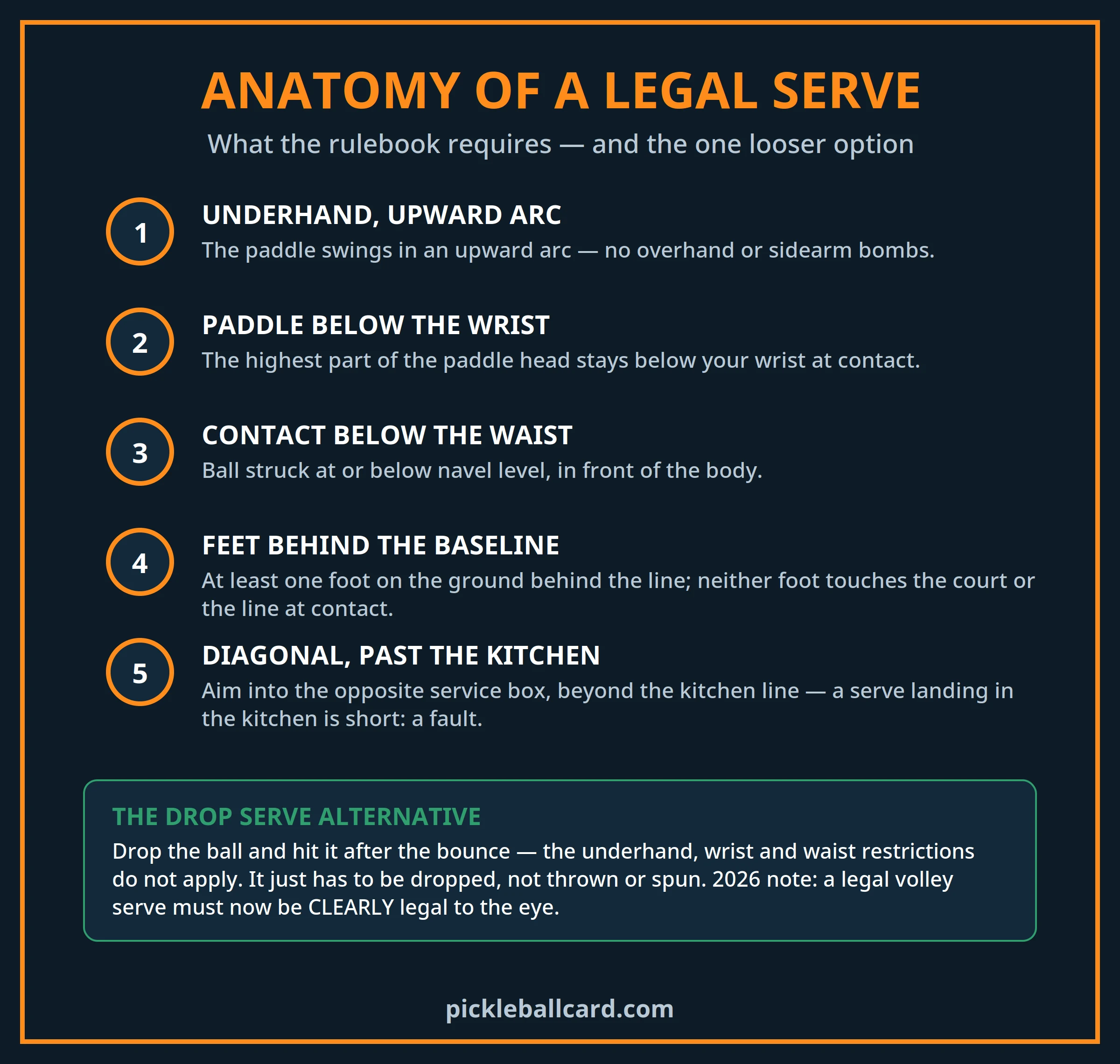
Anatomy of a legal pickleball serve: underhand arc, paddle below the wrist, contact below the waist
The five requirements of a legal volley serve — plus the drop serve alternative.

How to Serve in Pickleball?

The serving rule in pickleball is unique from other games, requiring keen precision and accuracy to pass it over. To serve the ball;

  • The layer must accompany the correct position. The team member will decide the player’s position on the court for service, whether they are playing as a single or double. Moreover, the player also gets the position per the scoring points on the board. One side with more points over the table is called the chance to serve first.
  • The next task is all the scores. You, the player, must call the pickleball score before serving the ball. It is essential. Otherwise, it will be counted as a fault.
  • Once the score is called out, calm down and take a deep breath. T is significant before shooting a free throw. It also helps you to maintain your serving angle.
  • Regarding free throws, it is never allowed to drop the ball harshly. Also, please do not throw it up to wing it entirely; refer it to the opposite side with full support and confidence.
  • Afterward, the next task is the paddle movement. Swing your paddle stick under the head. Make contact between the paddle and ball, so both are straight in front of your body.
  • This swig is the ultimate point when the ball will move ahead apart from you. It should have a smooth but strong flow towards the opposite side.
  • They will swing it back toward you once it reaches the opponent’s side. The whole process takes seconds or more if you are proficient.
  • You might be quicker and more active enough to deal with the situation without stressing yourself.

This is the complete serving process. But this process differentiates between the single and double serving of the players. In a single serving, both sides have only one player. They are playing individually. But then dual perspective has a team strength and plays togetherly to cope with the serving.

Pickleball Single Serving Rules

The singles serving rule is a crucial point to get into for understanding. In this rule, every player on the server points the ball until the side loses one point on the scoreboard. To fulfill the turns, players switch positions after every serving.

Moreover, before serving the ball, have a call-out score. Moreover, you will benefit from the right side of your score points even in the number. But the serving will be from the left side of the issues are odd in numbers.

Pickleball Doubles Serving Rules

As in doubles, a completely manageable team exists on both sides, and players are not lying individually. So, every player on the serving side can legally pickleball serve the ball before passing the serving opportunity to the opponent team.

The serving begins from the right side of the side, always for serving rules in pickleball doubles. The ball starts passing to the players from the right side downward. In this way, each team player gets an equal chance to respond to the serving.

It is a bit difficult to understand the player because every player on the team is lined with different standing positions and has a different responding attitude. It isn’t straightforward to decide which layer goes first. So, the best way to get a comprehensive understanding is to seek the guidance of a pro player.

Pickleball Serve Rules

Apart from the rule justification, there are different types of serves. These types are beneficial in deciding the working of the players. Moreover, this factor will limit the confusion about the pickleball doubles serving rules. Through these types of recognition, a satisfactory answer will be found for Who will start serving.

Types of Servers

Serving is one of the essential horizons of playing pickleball because the scoring board activity depends upon the serving activity. At the same time, the whole of the serving instinct depends upon the server.

From deeper analysis, we find that there are three major types of service.

  • High Soft Serve

The high-soft serve is the point at which you hit a high circular segment, specifically into the court side of the opponent. This service can be utilized at any level, from fledgling to 5.0. For more detailed depth, you can research pickleball levels.

It is very versatile, and you will find a ton of assortment with this service, making it extraordinary for changing the game’s speed. Also, with this, you can keep your rival under stress. You can point your high-delicate service to the back or front of the service region. This can be utilized and helpful to put your rival in action, get them out of position, and set up your next shot.

  • Power Serve

The power serve has a low, quick, and more profound impact on the opponent’s court. To stir it up, you can go for the front head corner. The front head corner is also striking; you can directly power strike the serve onto your opponent. The power serves are more powerful to pull off than the high-soft serve. But still, it is a fundamental service if you want to improve your game in terms of being a beginner.

  • Soft Angle Serve

The soft-angle serve is the last one of the three fundamental serves. This type is the mixture of the other two types and is used to stir up the game’s work. This shot drops or serves the ball close to the kitchen line and the sideline.

Indeed, the bouncing would take the ball beyond the court. The soft-angle serve is the most troublesome of the three fundamental serves because the objective is to hold back nothing but power.

The double-bounce rule is always worth considering to keep all these services in angle and compensate for the discrimination in serving. The government implies that;

Double-Bouncing Rule

This rule is very significant and has vital importance in pickleball. It tends to balance the neutrality of the ball over the court for both sides. This bouncing rule is specially lined with the pickleball drop serve governments.

According to this, the ball serving from the server’s side and the opposite side must be a groundstroke. This ground stroke will keep the whole game in precise action. Moreover, during this ground stroke, the ball must bounce once before returning to the opponent.

In this way, the passage and return cycle continues until one scores a point. Once the return is completed, the player can volley the ball. You must heat the ball before turning it to the ground in the volley zone. But if the ground bouncing continues without restriction, it will not be counted as a volley. The empire will consider its groundstroke throughout.

Pickleball Drop Serve Rules

Apart from the discussion above, you must remember the three rules to serving in pickleball; it will help you do justice with your gaming action.

  • The pickleball serving must comprise only upward motion stunts on average rule discussion level.
  • While serving the ball, the paddle movement should be aligned. It makes contact with your ball right below your waist level.
  • To maintain this position, hold the paddle so that the head of the paddle is already in the line below your waist level.

Rather than having a lot of chances, you will be allowed to shoot the ball for once. This is the legal pickleball serving implementation for the overall consideration.

People Also Ask

What Is The Two-Shot Rule In Pickleball?

When the ball is served, the receiving team must let it bounce before returning, and the serving team must let it bounce before returning; thus, it becomes two bounces or two shots in pickleball.

What Is The No Volley Zone In Pickleball?

Along the pickleball net, the 7-foot area on both sides of the court is called a non-volley zone or pickleball kitchen zone. Volleying is prohibited within the kitchen or non-volley zone.

What Is The Starting Score Of A Doubles Pickleball Game?

The starting score of a pickleball double is Zero, Zero, Two. This means the receiving team will get a serve when the serving team commits a fault. These numbers will apply for that service turn only.

When Do You Switch Sides In Pickleball?

After the first game, the players will switch sides. If time is short, the game is played for up to 15 points. In serving, the first serve is made from the right side, but after the first score, the players switch their sides, and the server initiates the next serve from the left side.

How To Serve In Pickleball For Beginners?

As a beginner pickleball player, you must learn 3 basic serving rules. First, You can’t touch the baseline. Second, you must hit the ball by the following volley or drop serve conditions. Third, you should hit the quadrant diagonal by never landing in a non-volley zone.

Does The Ball Have To Bounce In Pickleball?

No, the ball doesn’t have to bounce in pickleball. In pickleball, you have to hit the ball in the air before letting it bounce, called a volley. You should be careful while volleying and keep your feet behind from the non-volley zone.

Who Serves First In Pickleball Doubles?

In pickleball doubles, either of two losers serves first or two winners serve first, but the first serve must take place from the right-hand side. After the first serve, the receiving team will continue to serve, until they make a fault. The team that serves to start the game will only get one serve.

How Do You Determine Which Side Serves First In Pickleball?

Players on the right side of the court serve first to the opposite side in pickleball. After scoring a point, players move to the left side of the court. This applies to both singles and doubles pickleball.

What Changed in the 2026 Serving Rules

The 2026 USA Pickleball rulebook tightened how the volley serve is judged. The serve has always had to be an underhand motion with the paddle below the wrist and contact below the waist — the updated wording now stresses that this must be clearly the case, which gives referees (and honest opponents) a firmer basis for calling a borderline serve. Spin got clarified too: spin imparted by the paddle at contact is fine, but spinning the ball with your fingers before contact to add extra rotation is not. If your serve lives near the line on either rule, the safe fix is the drop serve: bounce the ball and hit it after the bounce, with none of the volley-serve restrictions applying. It has been fully legal for years and remains the most repeatable serve for developing players. See also how scoring works in rally scoring and the full how to play pickleball guide.

Serve Faults at a Glance

Most serve arguments come down to six checks. Run them in order and nearly every disputed serve settles itself.

Check Verdict
Volley serve struck above waist level Fault
Paddle head above the wrist at contact, volley serve Fault
A foot on or inside the baseline as you strike Fault
Serve lands in the non-volley zone, or on its line Fault
Serve lands in the wrong service box Fault
First server faults in doubles Serve passes to the second server — not a retry

The drop serve removes the first two rows entirely, which is why it suits players whose volley serve keeps getting called. Our drop serve guide explains the trade-off.

Conclusion

Serving rules in Pickleball always ask for practice by the players. It won’t allow you to go for the same shot repeatedly. Once you get the essential drop serve rule, playing on the serving side would be elementary.


Other Related Posts:
  • Pickleball Tips
  • Pickleball History
  • Best Shoes For Pickleball
  • Different Terminology Of Pickleball
  • Portable Vs Permanent Pickleball Net


Author Profile Picture Of Sadaf Awan
Sadaf Awan

Sadaf Awan writes Pickleball Card’s footwear and gear guides. With a background in biology, she looks at shoes the practical way players feel them — fit, support, cushioning, grip and how a shoe holds up on hard courts. She compares manufacturer specs with how each model is built, and flags when a guide is research-based rather than hands-on.

Filed Under: About Pickleball

How To Set Up A Temporary Pickleball Court?

October 23, 2026 by Jeena Noven Leave a Comment

Do you want to set up your own pickle court? In this guide, I’ll be sharing the simplest way to set up a temporary pickleball court.

Pickleball courts can be set up on any flat, hard surface, from a hockey rink to a basketball court and pavement to a driveway. However, since pickleball looks quite similar to tennis, it is mostly set up on the existing tennis courts. You can easily convert a tennis court or any other hard surface to a pickle court by adding temporary lines and nets. In this guide, I’ll be sharing the simplest way to set up a portable pickleball court.

Setup A Temporary Pickleball Court
An Outdoor Temporary Pickleball Court

How To Set Up A Temporary Pickleball Court?

To set up a temporary pickleball court, you must know the dimensions and layout of the single or doubles pickleball court. So let’s begin with,

How Big Is A Pickleball Court?

The Pickleball court layout for singles and doubles is the same. The dimensions of the standard pickleball court are 44 feet x 20 feet. This is almost equal to a doubles badminton court. These dimensions also include the line. Also, the pickleball court does not include the double alleys. Double alleys are the important part of the tennis court that runs through the court and are perpendicular to the nets.

The court is set up in a rectangular pattern with 44 feet sidelines and 20 feet baselines. Then, there is a centerline that is drawn from the midpoint of the baseline.The line drawn 7 feet from the net, parallel to it, is the non-volley zone line; the centerline runs from that line to the baseline, parallel to the sidelines. The non-volley zone line separates the volley and non-volley zones of the court. The pickleball net height at the sidelines is 36 inches, and at the centerline, it is 34 inches.

What Do You Need For Building Temporary Pickleball Court?

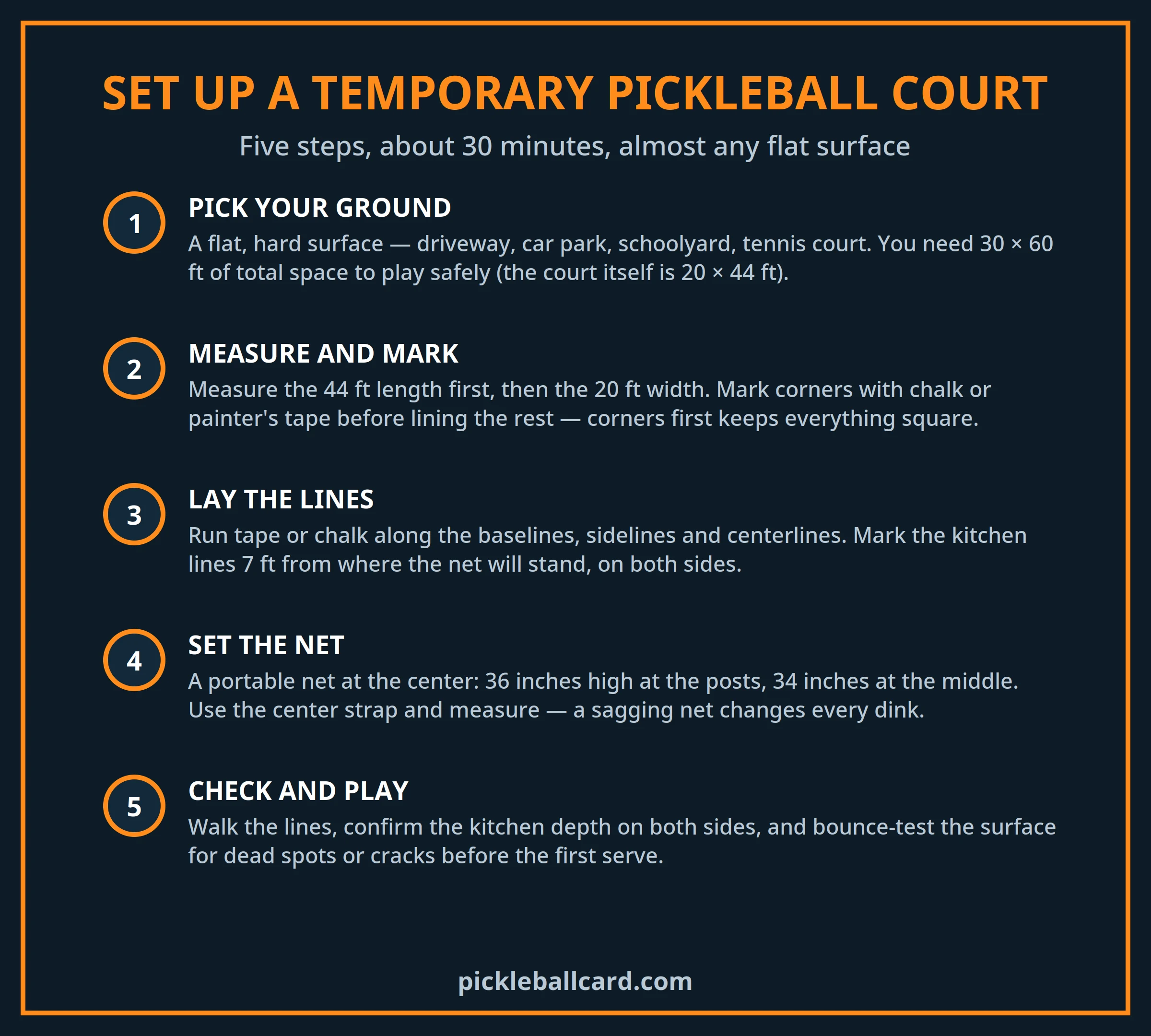
Five steps to set up a temporary pickleball court with correct dimensions and net height
Set up a temporary court in five steps.

The material and tools you need to build a pickleball court depend upon where and for how long you are going to set up a mini pickleball court. Most people set up a pickleball court indoors. However, there is nothing wrong if you want to set it up outdoors. But, it is crucial to find a good playing surface. For indoors, it is advised to use tape to mark temporary pickleball court lines. Here are the best options to consider:

How To Build A Temporary Indoor Pickleball Court?

Multi-Surface Pianter’s Tape

If you want to set up a court on a clean and hard surface like a gymnasium, you can use high-grip painter’s tape.

Court Line Marker Kit

Court line marking kits are one of the easiest ways to set up a temporary pickle court. You can order a pickleball-court marking kit. It will come with pre-measured strips for a pickle court layout. These strips are non-skid but move with heavy use. If you want to remove the court layout after one or two games, this is the best option. Many brands like Ecco Walker and Falken Sports have introduced their pickleball court marking kits. They come in highly visible colors, making them ideal for indoor setups.

Vinyl-Tape And Electric-Black Tape

Vinyl tapes are available in highly visible shades like bright orange. These high-strength tapes can be used to mark the temporary court lines in indoor setups. These tapes last longer than the marking kit strips and painter tapes. Electric black tape leaves no residue and comes off easily. Therefore, it is also a good option to mark the court layout in temporary setups.

How To Build A Temporary Outdoor Pickleball Court?

Sidewalk Chalks

Sidewalk chalk is the best way to draw the court lines. It is a good option as these chalks can be used on all types of temporary pickleball court surfaces. You can use this chalk on rough driveways and also on relatively smooth tennis courts. These temporary pickleball lines stay visible for up to many weeks but can be easily washed away by rain.

Crayons

You can use crayon colors to mark the court lines. Crayons are slightly more expensive than chalk and work great for all types of pavements. Crayons last longer than sidewalk chalks.

Contractor’s Chalks

If you are not on a budget and want to set up a pickleball court on which you can play for a few weeks, a contractor’s chalk is the best option. The chalks are not easily washed away by rain. It is advised to use this chalk in light colors, as dark colors can be a little hard to wash away.

Marking Tapes And Marking Kits

You can also use high-strength marking tapes and court marking kits to set up a temporary pickleball court outdoors. However, you should go with the option if the surface is smooth and clean, as tapes may not stick to hard surfaces.

Pickleball Nets For Setting Up Temporary Court

Though you can make your own net with PVC pipes and net, it is advised to buy Portable nets. A pickleball net measures 22 feet in width. It is 36 inches high at the sides and 34 inches at the center. You can find multiple options under $100 on Amazon and eBay.

Steps To Set Up A Temporary Pickleball Court

  • Make sure the surface on which you want to build a temporary court is clean. It will help you draw neat and long-lasting lines.
  • In the first step, you need to install the net. It should be in the middle of the space that you want to cover for court.
  • Once the net is installed, you need to draw the baselines. The baseline is 22 feet from each side of the net. Make your baselines exactly parallel to the net. You need to keep the lines exactly straight.
  • Now it’s time to draw the sidelines. Sidelines are simply the straight lines that join the left and right end paint of both baselines. These pickleball lines should be perpendicular to the net and baseline, and you need to keep them as straight as possible.
  • Now, draw the non-volley zone kitchen line. These are the temporary pickleball court lines marked parallel to the net and baseline, and they are 7 feet from the net on both sides.
  • Then, mark the center line. The center line connects the midpoint of the baseline to the midpoint of the non-volley zone line. Your court is all set up to play pickleball.

People Also Ask

Can You Make Your Own Pickleball Court?

Yes, you can make your own pickleball court on any flat surface, like a driveway, gym, or sports court. You can use contractor’s chalk, portable nets, paint, and court marking kits to set up your own pickle court.

Can You Make A Mini Pickleball Court?

The standard pickleball court size is 44×20 feet. This is the minimum size requirement for a pickleball court.

How To Play Pickleball On A Tennis Court?

First of all, convert the pickleball court into a pickleball court and move the tennis net position 34″ in the middle. After that, Choose a different color for both pickleball and tennis courts, like blue for pickleball and green for tennis. Now, the court is ready to be used for both pickleball and tennis.

How Much Space Do You Need For A Pickleball Court?

A pickleball court has a standard size of 20′ x 44′, but you’ll need an area that’s 30 by 60 to have an appropriate perimeter. This is an 1800 square feet area. This is the minimum playing surface area according to The minimum playing surface required by the USA Pickleball Association.

How To Build A Backyard Pickleball Court?

For this purpose, determine the space required for a pickleball court. Now, choose the surface material for building a pickleball court. Concrete is my favorite material for that. Now, do proper fencing, including boundary, walls, and net space. After that, equip your court with proper lights.

The Lines Are 20 by 44 — The Space You Actually Need Is Bigger

The taped lines only mark the playing court. For the game itself you also need room to serve behind the baseline, chase a lob and swing without meeting a fence, a parked car or the garage door. Allow at least 30 by 60 feet of total space for a home setup, and 34 by 64 feet if you have it — the same overall footprint recommended for a permanent backyard court. Measure the whole area before you measure the court lines, because a court that fits on paper can still leave your serve standing in the flowerbed.

The 10-Minute Setup Checklist

Work through this list in order and a temporary court is right the first time, not after the first argument.

  1. Measure the whole space first: 30 by 60 feet minimum, 34 by 64 if you have it.
  2. Mark the playing court inside it: 20 by 44 feet, baselines first.
  3. Add the non-volley zones: a line 7 feet from the net on each side.
  4. Split each end with a centreline between the service boxes.
  5. Set the net: 36 inches at the sidelines, 34 inches at the centre strap.
  6. Walk the surface for cracks, stones and wet patches before the first serve.
  7. Keep spare tape or chalk courtside — temporary lines always need one repair.

For the full specification behind every number here, see our pickleball court dimensions guide.

Conclusion

I’m hopeful that this guide will help you grab the best ideas to set up a temporary pickleball court. If you are doing it for the first time, it is advised to use court masking kits as they come in pre-measured and pre-cut strips.


Other Related Posts:
  • How To Play Pickleball On Grass?
  • Pickleball Skill Level Chart
  • Top Rated Pickleball Shoes
  • Pickleball Vs Tennis Court
  • Why Pickleball Is So Popular?


Jeena Noven, Pickleballcard Author
Jeena Noven

Jeena Noven is one of Pickleball Card’s main writers for rules, ratings and everyday play. She focuses on the questions players actually argue about on court — scoring, faults, ratings and match situations — and checks each answer against the current USA Pickleball rulebook before it goes live. Her guides are written for real club players: clear first, technical when it matters, and updated when the rules change.

Filed Under: About Pickleball

  • « Go to Previous Page
  • Page 1
  • Interim pages omitted …
  • Page 3
  • Page 4
  • Page 5
  • Page 6
  • Page 7
  • Interim pages omitted …
  • Page 19
  • Go to Next Page »

Latest Posts

  • Raw Carbon Fiber Pickleball Paddles Explained
  • Pickleball Court Surfaces Explained: Acrylic, Asphalt, Concrete, And More
  • How To Organize A Round Robin In Pickleball
  • What Is The PPA Tour? The Professional Pickleball Tour Explained
  • The Mental Game of Pickleball: Focus, Confidence and Composure
  • Let Serve in Pickleball: What Happens When the Serve Hits the Net
  • Overhead Smash in Pickleball: How to Hit It
  • Forehand Drive in Pickleball: Power and Consistency
  • Common Pickleball Injuries and How to Prevent Them
  • Pickleball Tournament Formats Explained
  • About
  • Privacy Policy
  • Terms And Conditions
  • Affiliate Disclosure

COPYRIGHT © 2026 · Pickleballcard.COM, ALL RIGHTS RESERVED.

PICKLEBALLCARD.COM IS A PARTICIPANT IN THE AMAZON SERVICES LLC ASSOCIATES PROGRAM, AN AFFILIATE ADVERTISING PROGRAM DESIGNED TO PROVIDE A MEANS FOR SITES TO EARN ADVERTISING FEES BY ADVERTISING AND LINKING TO AMAZON.COM. AMAZON, THE AMAZON LOGO, AMAZONSUPPLY, AND THE AMAZONSUPPLY LOGO ARE TRADEMARKS OF AMAZON.COM, INC. OR ITS AFFILIATES. AS AN AMAZON ASSOCIATE WE EARN AFFILIATE COMMISSIONS FROM QUALIFYING PURCHASES.