• Skip to primary navigation
  • Skip to main content
  • Skip to primary sidebar

Pickleballcard

All About Pickleball Gears

  • About Pickleball
    • How To Play Pickleball
    • Pickleball Rules
    • Pickleball Kitchen Rules
    • Serving Rules
    • Pickleball Ratings
    • Pickleball Tips
    • Pickleball History
  • Pickleball Shoes
    • Best Pickleball Shoes
    • Best Pickleball Shoes For Men
    • Best Pickleball Shoes For Women
  • Pickleball Paddles
    • Best Pickleball Paddles
    • Elongated Pickleball Paddles
    • Graphite Pickleball Paddles
    • Onix Pickleball Paddles
    • Pickleball Paddles for Women
    • Pickleball Paddles For Spin
  • Vs
    • Pickleball Vs Tennis
    • Paddle Tennis Vs Pickleball
    • Indoor Vs Outdoor Pickleball

Pickleball Doubles Rules Explained

October 26, 2026 by shoaib

Pickleball doubles is the version most players meet first. Two players cover each side of the court, share the serve, and share the decisions. That shared format changes only a few rules, but those few rules cause most of the confusion for new players.

This guide explains pickleball doubles rules in plain language, using the current USA Pickleball Official Rulebook as the source. Where doubles differs from singles, it says so directly. Where the rules are identical, it says that too.

Key Takeaways

  • Doubles uses the same court, ball, net, and basic faults as singles.
  • Only the serving team can score in standard side-out scoring.
  • Doubles scores are called as three numbers, not two.
  • Every game starts at 0-0-2, because the first serving team gets only one server.
  • After that start, each team gets two servers before a side-out.
  • The two-bounce rule and the non-volley zone apply in doubles exactly as in singles.
  • A server switches service courts after every point the serving team wins.
  • Either partner may make calls, especially line calls, in doubles.

Court and Positions in Doubles

Doubles is played on a court 20 feet wide and 44 feet long. That is the same court used for singles. The net divides the court, and each side has a non-volley zone.

The non-volley zone extends 7 feet from the net on each side. It is often called the kitchen. The service courts sit behind that zone, split by a centerline.

Each team has two players, one on each side of the centerline at the start of a rally. Positions are not frozen for the whole rally, though. Players move freely once the ball is in play.

At the moment of the serve, only the server and the receiver have fixed roles. The server stands behind the baseline. The receiver stands in the correct diagonal service court.

The non-serving partner and the non-receiving partner may stand anywhere on their own side. In practice, most partners stand near the baseline or near the kitchen line, ready for the next shot.

Who Serves First and Who Receives

The team that wins the opening choice serves first, subject to the format being used. The first server of the game starts from the right-hand service court.

The receiver is the opponent standing diagonally opposite the server. That player must return the serve after it bounces. The other receiver waits for the next shot.

Serving Rules and Serving Rotation

The serve starts every rally in doubles. It must be hit underhand, from behind the baseline, diagonally into the opposite service court. A serve that lands short, in the kitchen, or outside the correct court is a fault.

For a volley serve, the paddle contacts the ball below the waist. The arm moves in an upward arc, and the paddle head stays below the highest part of the wrist. These three points keep the serve underhand.

At contact, at least one foot must be on the playing surface behind the baseline. Neither foot may touch the baseline, the court, or the area outside the imaginary sideline and centerline extensions.

The full score must be called before the server hits the serve. The server must then serve within 10 seconds after the score call is complete. Serving early or late can be a fault.

Only one serve attempt is allowed per server in a rally. There is no second serve in pickleball, unlike tennis. A faulted serve ends that server’s turn.

For a fuller overview of the shared rules, see the pickleball rules guide. It covers the court, equipment, and faults that apply to both formats.

The 0-0-2 Start Exception

Every doubles game starts with the score called as 0-0-2. That third number is the server number. It tells everyone that the first serving team is already on its second server.

In effect, the first serving team gets only one server at the start of the game. If that server faults, the serve passes to the other team at once. There is no Server 1 turn for the opening team.

This exception exists to balance the game. Without it, the team serving first would get a longer opening turn than the team receiving first. The 0-0-2 start removes that advantage.

New players often call the opening score 0-0-1 by mistake. That mistake matters, because it changes who serves next. Always start a doubles game at 0-0-2.

How the Rotation Works After the Start

After the opening sequence, each team gets two servers before a side-out. Server 1 serves until that player faults. The serve then passes to the partner, who becomes Server 2.

Server 2 serves until that player faults. At that point, the side-out is complete, and the serve passes to the other team. The other team then starts with its own Server 1.

The first serve of every side-out comes from the right-hand service court. That rule holds no matter which player is serving. The serving team’s starting side is always the right side after a side-out.

When the serving team wins a point, the server switches service courts. The same server keeps serving, but from the other side. This switch continues after every point the serving team wins.

When the serving team loses a rally, no point is scored. The serve moves to the partner, or to the other team if Server 2 has faulted. The score itself does not change on a lost rally.

A Worked Rotation Example

Imagine Team A serves first at 0-0-2. Team A wins the rally, so the score becomes 1-0-2. The same server switches to the left court and serves again.

Team A then loses a rally. The serve passes to Team B, because Team A has already used its only opening server. Team B now serves at 0-1-1, from the right court.

Team B’s Server 2 serves at 2-1-2. If Server 2 faults, the side-out is complete. Team A takes the serve back, starting at 1-2-1 from the right court.

Scoring in Doubles

Standard doubles uses side-out scoring. Only the serving team can score a point, and only by winning a rally while serving. A receiving team that wins a rally gains the serve, not a point.

Most games are played to 11 points, and the winning team must lead by at least 2 points. If the score reaches 10-10, play continues until one team leads by two. Longer game targets may be used in some formats.

The doubles score is called as three numbers before each serve. The first number is the serving team’s score. The second number is the receiving team’s score. The third number is the server number, 1 or 2.

For example, a call of 5-3-1 means the serving team has 5 points, the receiving team has 3 points, and the server is Server 1. A call of 5-3-2 means the same scores, but Server 2 is serving.

The score must not be called until the server and receiver are in position, or should be in position. All players should be ready, or should be ready, before the call begins.

For a step-by-step scoring walkthrough, see how to score in pickleball. It explains the three-number call with further examples.

Scoring Examples

Score Called What It Means What Happens Next
0-0-2 Game start, first team serving Opening server serves once only
4-2-1 Serving team leads, Server 1 Server 1 keeps serving after a point
4-2-2 Same scores, Server 2 Side-out follows a Server 2 fault
10-9-1 Serving team one point from winning Game ends only with a two-point lead
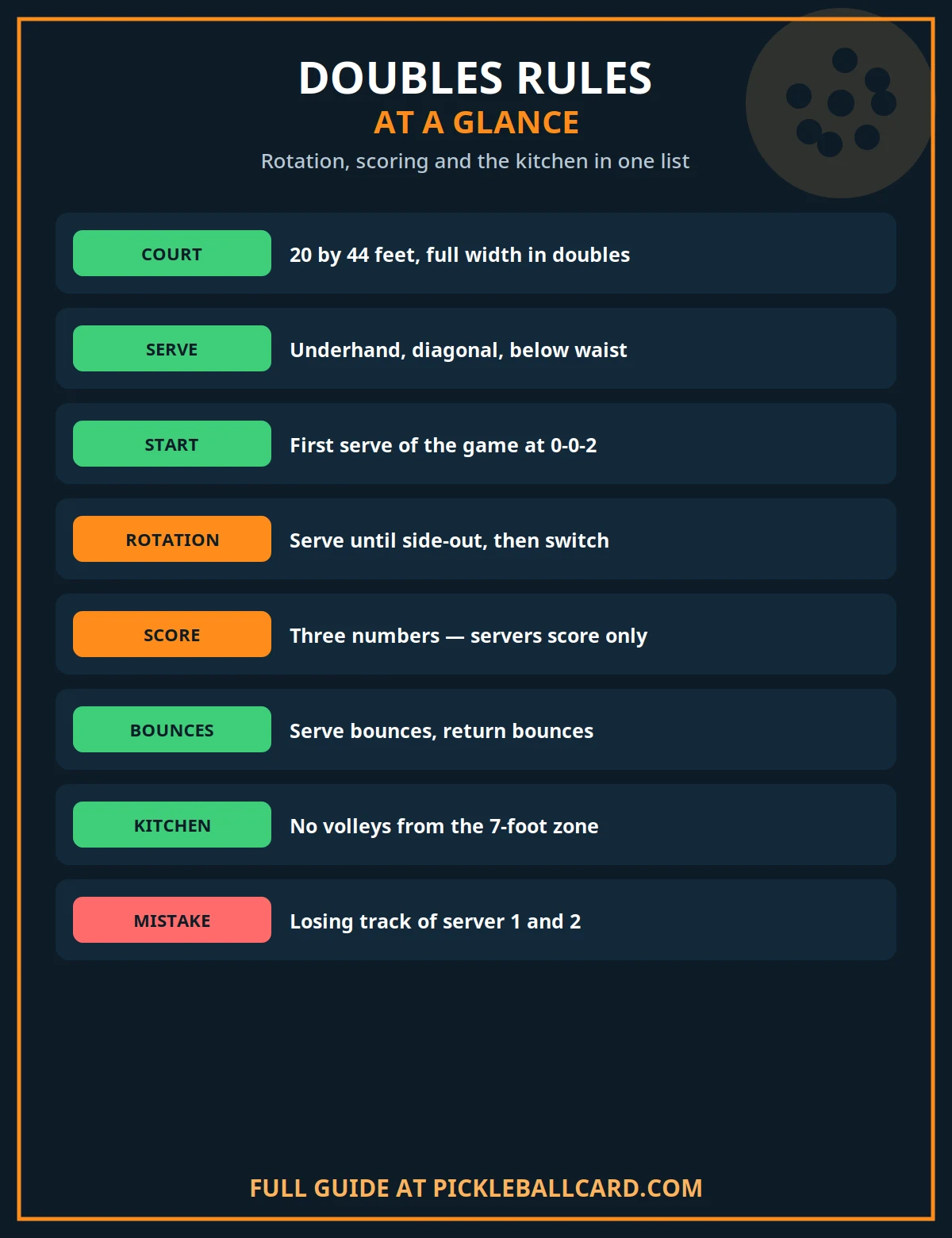
Doubles Rules At a Glance
Serving rotation, the 0-0-2 start, three-number scoring, the two-bounce rule, and the kitchen — the five doubles rules to check before your first game.

The Two-Bounce Rule in Doubles

The two-bounce rule applies in doubles exactly as it applies in singles. After the serve, the receiving team must let the ball bounce before returning it. That is the first required bounce.

The serving team must then let the return bounce before hitting its next shot. That is the second required bounce. Only after both bounces may either team volley.

This rule stops the serving team from rushing the net and volleying the return. It also stops the receiving team from volleying the serve. Both teams must play one groundstroke first.

A common error is volleying the return of serve as the serving team. That is a fault, even if the shot would have won the rally. Wait for the bounce, then play the ball.

After the two bounces are complete, either team may volley or play the ball after a bounce. The choice depends on the ball’s height, speed, and position on the court.

The Non-Volley Zone and Kitchen in Doubles

The non-volley zone, or kitchen, extends 7 feet from the net on each side. A player may not volley while touching the zone or its lines. That rule is the same in doubles and singles.

A volley means hitting the ball before it bounces. If any part of the player, or anything the player is wearing or carrying, touches the kitchen during a volley, it is a fault.

Momentum matters too. If a player volleys and then falls, steps, or is carried into the kitchen, it is still a fault. This holds even if the ball is already dead before the player touches the zone.

A ball that bounces in the kitchen may be played from inside the kitchen. That is how dinking works. Players step in, play a soft shot after the bounce, and step back out.

In doubles, both partners must watch the kitchen line. A partner who steps in during a volley creates a fault for the team, even if the other partner hit the ball cleanly. Communication helps here.

The kitchen line itself counts as part of the kitchen. On a serve, a ball landing on the kitchen line is short and a fault. During a rally, other shots landing on that line are treated as in.

Faults and Line Calls

A fault ends the rally at once. In doubles, a fault by the serving team loses the serve or completes a side-out. A fault by the receiving team gives a point to the serving team.

Volleying from the kitchen, volleying before the two-bounce rule is satisfied, and serving before the score call is complete are all faults. So is striking the ball twice, or catching the ball.

Line calls decide whether a ball is in or out. A ball that touches any court line is in, with one clear exception. A serve that touches the non-volley zone line is a fault.

For all other shots, a ball touching a line is in, even if only part of the ball touches the line. A ball is out only when it lands completely outside the court lines.

Players call lines on their own side of the court. In doubles, either partner may make a call, especially a line call. Partners should agree quickly and clearly.

If one partner calls a ball out and the other calls it in, doubt exists. In doubles, that doubt means the team’s call is in. Partners should not argue the point after the call is made.

Calls should be made promptly. A late call can look like a second chance, and it invites dispute. Call out clearly, or let play continue as if the ball is in.

Switching Sides and Partner Positioning Basics

In doubles, the server switches service courts after every point the serving team wins. That is the most frequent side switch in a game. It keeps the server’s position tied to the team’s score.

The starting server for each team sets a pattern for the game. When that team’s score is even, the starting server is on the right side. When the score is odd, the starting server is on the left side.

This pattern helps players check their positions. If the score and the starting server’s side do not match, someone is standing in the wrong place. Stop, check the score, and reset before serving.

Partners do not need to stay on fixed sides between rallies. After a rally ends, partners may return to the sides that match the score. That reset prevents confusion on the next serve.

Teams also switch ends of the court between games in a match, following the format in use. Recreational games may skip a formal end change, but tournament formats usually include one. Check the format before the match starts.

At the baseline, the non-serving partner should stay back until the two-bounce rule is complete. Rushing forward early leaves that player exposed to a deep return at the feet.

Common Doubles-Rules Mistakes

  • Starting the game at 0-0-1 instead of 0-0-2.
  • Calling a side-out after Server 1 faults, instead of passing to Server 2.
  • Scoring a point as the receiving team, rather than only gaining the serve.
  • Volleying the serve, or volleying the return before it bounces.
  • Volleying while standing on the kitchen line, or falling into the kitchen after a volley.
  • Serving from the wrong service court after a point, instead of switching sides.
  • Serving before the full score is called, or waiting too long after the call.
  • Calling a ball out when it touched the line, except for a serve on the kitchen line.
  • Letting one partner overrule the other on a shared line call.
  • Forgetting that the first serve after a side-out always comes from the right court.

A simple fix is to say the full three-number score before every serve. That habit alone catches wrong-server errors, wrong-side errors, and score errors before the rally starts.

How Doubles Rules Differ From Singles

Most pickleball rules are identical in doubles and singles. The court, the ball, the kitchen, the two-bounce rule, and the fault rules do not change. The differences sit in serving, scoring calls, and calls.

Singles has one player per side, so there is no partner rotation. Doubles has two servers per team, except at the start. That single difference drives most of the extra rules.

For a direct comparison of the singles format, see the pickleball singles rules guide. It explains the two-number score call and the even-and-odd serving sides.

Feature Doubles Singles
Players per side Two One
Score call Three numbers Two numbers
Game start call 0-0-2 0-0
Servers per side-out Two, except at game start One
Side-out trigger Two faults by serving team One fault by server
Who can score Serving team only Server only
Two-bounce rule Applies Applies
Kitchen rule Applies Applies
Line calls Either partner may call Server or receiver calls own side

Before You Serve Checklist

  • Check that the server is in the correct service court for the score.
  • Check that the receiver is ready in the diagonal court.
  • Call the full three-number score, including the server number.
  • Wait for the call to finish, then serve within 10 seconds.
  • Serve underhand, from behind the baseline, into the diagonal court.
  • Let the return bounce before playing the third shot.
  • Stay out of the kitchen when volleying, including on momentum.
  • Switch service courts after each point the serving team wins.
  • Pass the serve to your partner after Server 1 faults, not to the other team.
  • Call a side-out only after Server 2 faults, except at game start.

Frequently Asked Questions

What is the score at the start of a doubles game?

The score is called as 0-0-2. The first two numbers are the teams’ scores, both zero. The third number shows that the opening team is already on Server 2.

How many serves does each team get in doubles?

Each team normally gets two serves before a side-out. Server 1 serves until faulting, then Server 2 serves until faulting. The opening team is the exception, with one server only.

Can only the serving team score in doubles?

Yes, in standard side-out scoring, only the serving team can score. The receiving team wins the serve by winning a rally, but it does not win a point.

Does the two-bounce rule apply in doubles?

Yes, the two-bounce rule applies in doubles. The receiver must let the serve bounce, and the server’s team must let the return bounce. After those two bounces, volleys are allowed.

Can you stand in the kitchen in doubles?

Yes, you may stand in the kitchen when you are not volleying. The rule only bans volleying while touching the kitchen or its lines. A bounced ball may be played from inside the kitchen.

Who makes line calls in doubles?

Either partner may make calls, especially line calls. Each team calls lines on its own side of the court. Prompt, clear calls keep rallies fair and disputes rare.

Final Thoughts

Pickleball doubles rules reward one habit above all others: call the full score, every time. That habit tracks the server number, the side, and the rotation without extra effort.

When a rule is unclear during a game, check the official source. The USA Pickleball Official Rulebook is the definitive guide, and the 2026 USA Pickleball Official Rulebook PDF gives the full text for players, referees, and organizers.

shoaib
shoaib

Shoaib is the publisher of Pickleball Card. He oversees the site’s guides to pickleball rules, ratings, strategy and gear, all researched from primary sources — the USA Pickleball Rulebook, DUPR and manufacturer documentation — and updated as the game changes.
pickleballcard.com

Filed Under: About Pickleball

What Is DUPR? How It Works & How to Get Yours

October 26, 2026 by shoaib

Someone at open play asks for your number, and they do not mean your phone number. They mean your DUPR. In pickleball today, that single number is how players, clubs, leagues, and tournaments judge competitive level at a glance.

This guide explains what DUPR is, how the rating is actually calculated, and how you can get your own. It also answers the question every new player asks next: what counts as a good rating?

Key Takeaways

  • DUPR stands for Dynamic Universal Pickleball Rating, a match-based rating on a scale from 2.000 to 8.000.
  • New players start as NR, meaning Not Rated, until a recorded match result gives them a first rating.
  • Your rating moves on performance against expectation, not on wins and losses alone.
  • Club and tournament results carry more weight than self-posted recreational games.
  • Singles and doubles have separate ratings, each with its own Reliability Score.
  • A Reliability Score from 1 to 100 percent shows how established your rating is, with 60 percent marking a reliable rating.
  • One recorded match can produce a first rating, while roughly 10 to 20 results give a much more accurate picture.
  • Level bands on the scale are general guidance, not official cutoffs, and a good rating depends on your goals.

What Is DUPR?

DUPR is a rating system that estimates your current pickleball skill level from real match results. It is not a self-assessment, a coach’s guess, or a lifetime achievement award. It is a number that changes as you play.

The name spells out the idea. Dynamic means the rating updates when new results arrive. Universal means one shared scale applies across clubs, regions, ages, and genders. The rating itself is the estimate of competitive strength.

DUPR is run by the DUPR organisation, and it is the official rating of the Professional Pickleball Association and Major League Pickleball. It is also used across USA Pickleball events, which is why it has become the default language of level in organised play.

That reach matters for ordinary players too. When a club runs a level-gated open play session, or a tournament sets division cutoffs, DUPR is usually the standard used. For a wider overview of how ratings fit together, see our guide to pickleball ratings.

What DUPR Is Not

DUPR is not a ranking list. Two players can share a similar rating without ever having played each other, and the number alone does not say who would win a particular match on a particular day.

It is also not a measure of effort, sportsmanship, or potential. A player returning from injury, or one who only plays doubles, may hold a number that understates their best game. The rating reflects recorded results, nothing more.

How the DUPR Rating Works

DUPR starts from your last rating and updates it after each recorded result. The system compares the expected outcome of a match, based on the ratings involved, with the actual outcome. The gap between expectation and reality is what moves your number.

DUPR itself describes four factors that shape every update. Understanding those four factors explains almost every surprising movement you will ever see in your rating, including drops after wins.

1. Performance Against Expectation

This is the most important factor. Before a match, DUPR calculates an expected score from the ratings of the players or teams involved. After the match, it compares that expected score with the actual score.

Beat expectation and your rating rises. Fall short of expectation and it falls, even if you won the game. A narrow win in a match you were expected to dominate can therefore cost you a little ground.

The reverse also applies. A close loss against a much stronger opponent can lift your rating, because you performed better than the system expected. This is why win-loss record alone never tells the full DUPR story.

2. Type of Match

Not all matches carry equal weight. A club or tournament result influences your rating more than a self-posted recreational game. Verified, organised play gives the system more reliable data about where you stand.

Self-posted games still count, but their impact is smaller. That design choice protects the system from casual or unverified scores swamping results from structured competition.

3. Match Recency

Recent matches matter more than older ones. If your game has genuinely improved, that improvement shows up faster because recent results carry greater weight in the calculation.

The same principle softens old form. A poor stretch from months ago has less pull on your current rating than it did immediately after it happened. Your rating is meant to describe your current level, not your history.

4. Match Volume

The more matches on your record, the more stable and accurate your rating becomes. Early on, when your history is thin, a single result can shift your rating noticeably.

As you log more matches, each individual result has a smaller relative impact. Your rating settles into a more precise reflection of your level, and one surprising result stops swinging it wildly.

This is the strongest practical reason to play rated events regularly. More data means a steadier number, and a steadier number means fairer placement for everyone in your group.

For the full official explanation, read how DUPR explains its own calculation, which sets out these four factors in DUPR’s own words.

The Reliability Score

Every DUPR profile carries a second number: the Reliability Score. It is a percentage from 1 to 100 that shows how reliably your rating represents your current skill level.

Reliability is not skill. A 4.1 at 25 percent reliability and a 4.1 at 90 percent reliability are very different claims, even though the headline number matches. The second player has far more evidence behind the number.

DUPR calculates reliability from factors including how many matches you have played, the source of those matches, and the variety of partners and opponents over the last 6 to 12 months. Club and verified results build reliability faster than self-posted games.

A Reliability Score of at least 60 percent marks a reliable rating. Clubs often use that threshold for event eligibility, and DUPR uses reliability for ranking lists, so it is worth treating as a goal in its own right.

Reliability rises as you add matches, and it falls after an extended period without play. It updates weekly, on Tuesdays, so a match played midweek may not move your reliability figure until the following Tuesday.

Singles vs Doubles Ratings

DUPR gives you separate ratings for singles and doubles. Your doubles rating says nothing official about your singles game, and your singles rating says nothing official about your doubles game.

That separation exists because the formats demand different skills. Singles rewards court coverage, fitness, and passing shots. Doubles rewards teamwork, kitchen play, positioning, and communication with a partner.

Many players hold ratings that differ by a wide margin between formats. A strong doubles player who rarely plays singles may carry a modest singles rating, or none at all, and that is entirely normal.

Each format also has its own Reliability Score. You can hold a reliable doubles rating and a thin, low-reliability singles rating at the same time, if most of your recorded play is doubles.

How to Get Your First DUPR Rating

Getting started is free and simpler than most new players expect. One recorded match result is enough to produce a first rating, though that first number will move a lot until more results arrive.

Follow these steps in order, and check for an existing profile before creating a new one. Duplicate profiles split your results and slow everything down.

Step 1: Search for an Existing Profile

If you have ever played a tournament, league, or club event that reports results, you may already have a profile. Search for your name on the official DUPR platform before signing up.

Claiming an existing profile preserves your history. Creating a second profile by mistake means your old results sit elsewhere, and merging accounts later is an avoidable hassle.

Step 2: Create Your Account

If no profile exists, create a free account through the DUPR app or website. Use one email address consistently, since your account is tied to it.

Step 3: Join a Club or League

Join a local DUPR club, or enter a league or ladder that reports results automatically. This is the easiest route to verified results, because the organiser submits scores for you.

Ask before you join whether results are submitted to DUPR, and in which format. A fun weekly session that never reports scores will not build your rating, however competitive it feels.

Step 4: Log Verified Matches

Play matches, then make sure the results reach DUPR. Club, league, and tournament results usually arrive automatically through the organiser or event platform.

For casual games, you can self-report a result in the app, and the other players confirm it. Self-reported games count, but remember they carry less weight than verified, organised results.

Step 5: Build Toward a Reliable Rating

Keep playing and logging results. DUPR’s own guidance suggests that roughly 10 to 20 match results give a much more accurate rating than a single early result.

Mix up partners and opponents where you can. Variety strengthens your Reliability Score, because results against a wide field say more than repeated games against the same two people.

An alternative route exists for players who want a starting number without match history: a coach-assessed rating from a credentialed DUPR coach. This suits players entering a tournament soon, or anyone who wants a professional benchmark first.

What Counts, and What Does Not

Club matches, league games, ladder sessions, and tournaments that report to DUPR all count. Self-reported games with confirmed scores count too, at lower weight. Coach-assessed ratings provide a verified starting point.

Unrecorded casual games do not count, no matter how competitive they were. Practice drills, lessons, and social rallies with no recorded score also leave no trace on your rating.

Playing in a tournament is the fastest way to gather verified results in one weekend. If that step feels daunting, read our guide to your first pickleball tournament before you sign up.

What Is a Good DUPR Rating?

There is no single number that counts as good. A good rating is one that places you in fair, enjoyable games and opens the doors you actually want, whether those are social sessions or competitive divisions.

Start with the scale itself. DUPR runs from 2.000 to 8.000, and new players begin as NR. DUPR groups that range broadly into novice, intermediate, advanced, and professional territory, but the finer bands below are general guidance only.

They are not official cutoffs. No organiser is bound to them, and DUPR itself does not publish them as division rules. Use them to understand where you sit, not as a verdict on your game.

DUPR Range General Level What It Usually Looks Like
Below 3.000 Developing Learning fundamentals, building consistency, rallying with patience
3.000 to 3.499 Recreational Steady rallies, basic strategy, comfortable in social play
3.500 to 3.999 Strong recreational Consistent shots, kitchen play, regular league and ladder play
4.000 to 4.499 Advanced Controlled aggression, third shots, competitive tournament divisions
4.500 to 4.999 Highly competitive Top club and regional play, sharp execution under pressure
5.000 and above Elite and professional Pro and semi-pro competition, exceptional consistency and tactics

A Good Rating at Recreational Level

At recreational level, a good rating is simply an honest one. A 3.5 with solid reliability will get you into balanced games far more reliably than an inflated 4.0 built on a handful of results.

Most regular club players sit somewhere in the 3.0 to 4.0 range. If your rating lands there with decent reliability, you are in the heart of recreational pickleball, with plenty of fair games available.

A Good Rating at Competitive Level

Competitive players need a rating that matches the divisions they want to enter. A 4.5 opens strong tournament brackets, while a 4.0 opens a different, still demanding set of divisions.

At this level, reliability matters as much as the number. Tournament directors and clubs trust a well-evidenced 4.2 far more than a thin 4.6, and some events set reliability thresholds for entry.

How to Improve Your Rating Honestly

The honest route is also the only route that lasts. Play more verified matches, against varied opponents, at or slightly above your current level, and let the results follow your improvement.

Target the skills that lose you points in real matches. For most players between 3.0 and 4.0, that means serve returns, third shots, dinking patience, and kitchen positioning, not highlight-reel winners.

Play with partners near your level in doubles. A large gap between partners muddies the data, because the system cannot easily separate each player’s contribution to the result.

Good Rating Checklist

  • Your rating comes from recent, verified results, not a single old match.
  • Your Reliability Score is at least 60 percent, marking a reliable rating.
  • Your rating matches the level of games you actually enjoy playing.
  • You have results in the format you quote, singles or doubles.
  • Your recent results reflect your current game, not last year’s form.
  • You are improving skills, not hunting for easy opponents to inflate the number.
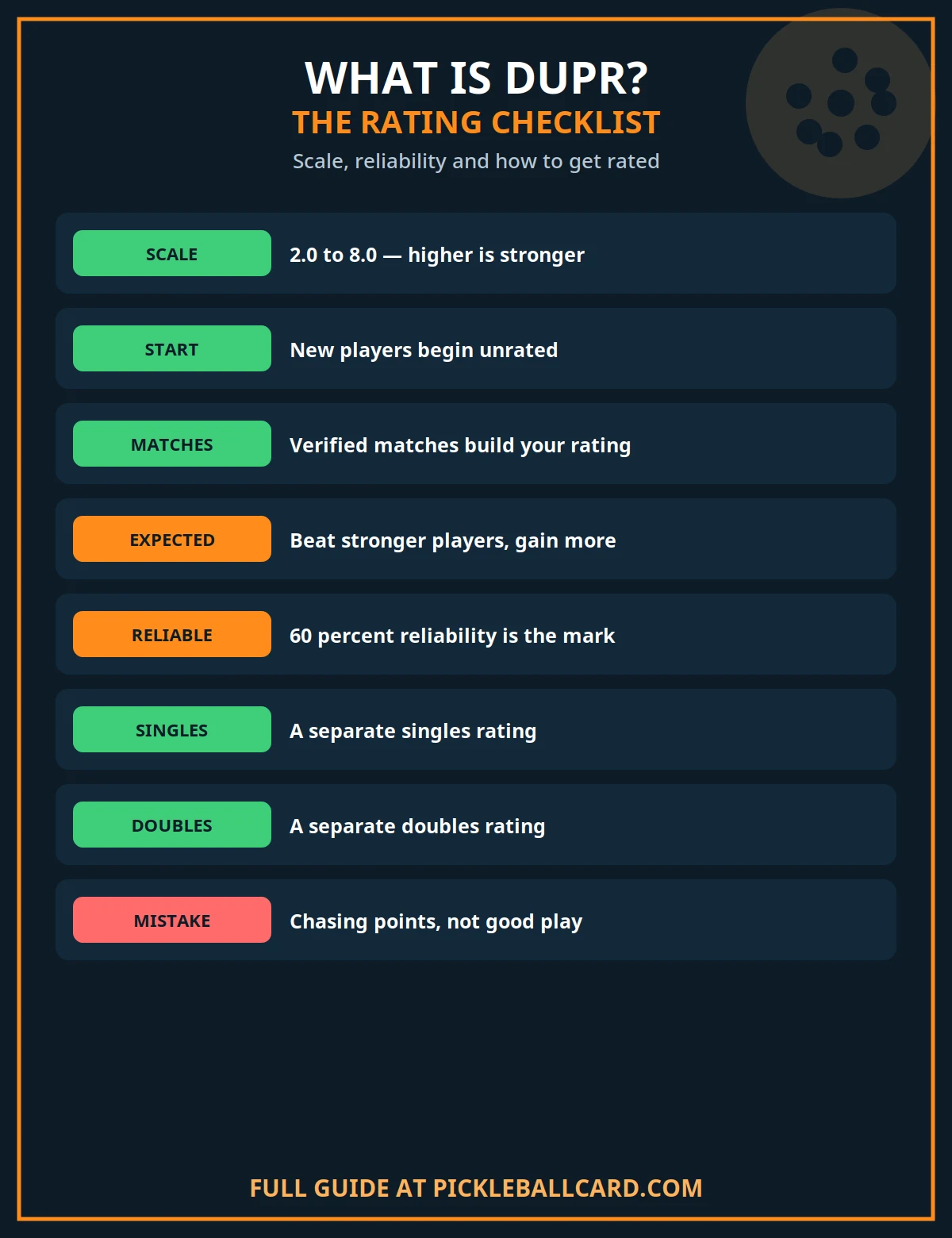
DUPR Rating Scale Checklist
Find your band on the 2.000 to 8.000 scale, check what that level usually looks like, and see the next step to climb.

Common Misunderstandings About DUPR

The most common surprise is a rating drop after a win. That happens when you win by less than expected, as explained under performance against expectation above.

Our dedicated guide covers this in full, including worked examples of how expectation shapes the outcome. Read why your DUPR rating can drop after a win if this has happened to you.

Another misunderstanding is treating reliability as skill. A low Reliability Score does not mean you are a weak player. It means the system has too little evidence to be confident about your rating yet.

Finally, some players believe only tournament results matter. Club, league, and confirmed self-reported games all feed the system, even though verified organised results carry the most weight.

DUPR vs Self-Rating and Skill Levels

Self-rating asks you to place yourself on a familiar scale, often from 2.5 to 5.0, based on a skills checklist. It is quick, free, and useful for a first social session, but it depends entirely on your own judgement.

That judgement is often generous. Players tend to rate themselves by their best shots, not their average rally, and two clubs can apply the same checklist very differently. Self-ratings therefore vary widely between groups.

DUPR replaces opinion with evidence. Two players with the same DUPR in different cities have at least been measured by the same system, even if their playing styles differ completely.

Think of the two as complements. Self-rating says where you believe you belong. DUPR says where your recorded results place you. When they disagree, trust the results, then work on closing the gap.

Frequently Asked Questions

Is DUPR free?

Yes. Creating a standard DUPR account and receiving a rating from recorded results is free. Clubs, leagues, tournaments, and optional services may charge their own separate fees.

How long does it take to get a DUPR rating?

One recorded match result can produce a first rating. Expect that early number to move quickly, and allow roughly 10 to 20 results before treating it as a settled picture.

Can my DUPR go down if I keep winning?

Yes, if you win by less than the system expected. DUPR judges performance against expectation, so a narrow win over a much weaker opponent can lower your rating slightly.

Do I need separate ratings for singles and doubles?

You do not need both, but DUPR tracks them separately. Play the format you care about, and quote the matching number when someone asks.

What Reliability Score should I aim for?

Aim for at least 60 percent, which DUPR treats as a reliable rating. Build it with regular verified matches against a variety of opponents.

Should I worry if my rating drops?

A small drop after one match is normal, especially early on. Look at the trend across recent results and your Reliability Score before worrying about a single movement.

Getting Started With DUPR

DUPR works best when you treat it as a tool, not a verdict. Get rated, build reliability with regular verified play, and use the number to find games that challenge you fairly.

Check your profile on the official DUPR site, join a club that reports results, and give your rating time to settle. The number will follow your game, if you let it.

shoaib
shoaib

Shoaib is the publisher of Pickleball Card. He oversees the site’s guides to pickleball rules, ratings, strategy and gear, all researched from primary sources — the USA Pickleball Rulebook, DUPR and manufacturer documentation — and updated as the game changes.
pickleballcard.com

Filed Under: About Pickleball

What Is Pickleball? The Complete Beginner’s Guide

October 26, 2026 by shoaib

Pickleball is a paddle sport played on a badminton-sized court with a perforated plastic ball and a low net. It blends elements of tennis, badminton, and table tennis — and it is the easiest racket sport a complete beginner can pick up and enjoy on day one.

That is the short answer. The full answer covers where the game came from, what you need to play, the rules that make it different, and how to start.

If you have heard the name everywhere but never held a paddle, this guide is your starting point.

Pickleball is played as singles (one against one) or doubles (two against two), indoors or outdoors, by players of every age. Games are usually played to 11 points, and you must win by two.

Once you know the basics here, the next step is our step-by-step guide to how to play pickleball, which walks through your first game point by point.

Key Takeaways

  • Pickleball is a paddle sport on a 20-by-44-foot court, played with a perforated plastic ball over a net 36 inches high at the sides and 34 inches at the center.
  • It was invented in 1965 on Bainbridge Island, Washington, by Joel Pritchard, Bill Bell, and Barney McCallum.
  • The game’s signature rules are the two-bounce rule, the non-volley zone (“the kitchen”), and underhand serving.
  • Only the serving side can score points, and games are usually played to 11, win by two.
  • All you need to start is a paddle, a ball, court shoes, and a court — most beginners can rally within their first session.
  • Pickleball’s small court and slower ball make it far more accessible than tennis, while still rewarding skill at the highest levels.

What Is Pickleball? The Definition

Pickleball is a paddle sport in which players hit a perforated plastic ball over a net, aiming to land it where the opponent cannot return it.

It is played on a court 20 feet wide and 44 feet long — the same size as a doubles badminton court — with a net 36 inches high at the sidelines and 34 inches at the center.

The paddle is solid, larger than a table tennis paddle and smaller than a tennis racket, with no strings. The ball is light, hollow plastic with holes punched through it, which slows it down and keeps rallies under control.

That combination — a small court, a slow ball, and a solid paddle — is why the game is so accessible. You do not need to cover a huge court or generate enormous power. Placement, patience, and soft touch matter as much as athleticism.

Pickleball vs Tennis vs Badminton vs Table Tennis

Pickleball borrows from all three of its parent sports. From tennis it takes the net, the court layout, and the idea of groundstrokes and volleys. From badminton it takes the court size and the fast, close-to-the-net exchanges.

From table tennis it takes the solid paddle and the emphasis on spin and touch.

The differences matter too. The court is a quarter the size of a tennis court, so rallies last longer and movement demands are lower. The ball travels slower than a tennis ball, so beginners can track it.

And the underhand serve removes the hardest skill in tennis from the equation entirely.

A Brief History of Pickleball

Pickleball was invented in the summer of 1965 on Bainbridge Island, Washington. Joel Pritchard, a congressman, and his friends Bill Bell and Barney McCallum wanted a game their families could play together.

They improvised on Pritchard’s badminton court: they lowered the net, used plywood paddles, and batted a perforated plastic ball back and forth.

The game caught on with neighbors, then across the Pacific Northwest. The first permanent court followed, the first tournament was held in 1976 in Tukwila, Washington, and the first rulebook arrived with the formation of the USA Pickleball Association in 1984.

From there, growth was steady and then explosive. Pickleball spread to all 50 states, into schools and community centers, and then internationally. Today it is played in parks, gyms, and dedicated facilities around the world, by millions of players — and it remains one of the fastest-growing sports in the United States.

Where Does the Name Come From?

There are two stories, and both are told by the founders’ families. One says the game was named after the Pritchards’ dog, Pickles, who chased the ball.

The other says it comes from the “pickle boat” in rowing — a crew made up of leftover rowers — because the game itself was made from leftover equipment of other sports.

Either way, the name stuck, and it is now one of the most recognizable in sport.

The Court, Explained

A pickleball court is 20 feet wide and 44 feet long, with lines 2 inches wide.

The most important feature is the non-volley zone, universally known as “the kitchen”: a 7-foot zone on each side of the net where you may not volley the ball (hit it out of the air) while standing in it.

The court is divided by a centerline into left and right service courts. The baseline is the back line, and the sidelines run the length of the court.

In doubles, the full 20-foot width is in play. In singles, recreational games generally use the same sidelines, with the centerline marking the service boxes.

The Kitchen: The Rule That Defines the Game

The kitchen exists to prevent players from standing at the net and smashing every ball. You can step into the kitchen to hit a ball after it bounces, but you cannot volley from inside it, and your momentum cannot carry you into it after a volley.

This single rule creates the soft game — the dinking rallies at the net — that makes pickleball unique. For the full rule, read our guide to pickleball kitchen rules (linked from our rules hub).

The Basic Rules of Pickleball

You can learn the full rules from the USA Pickleball Official Rulebook, but these are the essentials every beginner needs:

Serving

The serve must be underhand, with the paddle below the waist, and hit diagonally into the opponent’s service court. The serve must clear the kitchen — it cannot land in the non-volley zone.

Only one serve attempt is allowed (except in the case of a let, where the ball touches the net and lands in). The server continues serving until their side loses a rally.

The Two-Bounce Rule

Each side must let the ball bounce once before volleying: the receiver must let the serve bounce, and the server must let the return bounce. After those two bounces, players may volley or let the ball bounce — their choice.

This rule stops the serving team from rushing the net and volleying the return immediately. It is the reason every rally starts with a serve, a return, and a third shot.

Scoring

Only the serving side can score points. Games are usually played to 11 points, and a team must win by at least two points. Some games are played to 15 or 21 in tournaments.

In doubles, each player on the serving team gets a turn to serve (except at the very start of the game), and the score is called as three numbers: serving team’s score, receiving team’s score, and the server number (1 or 2).

Faults

A fault ends the rally. Common faults include hitting the ball out of bounds, into the net, volleying from inside the kitchen, or violating the two-bounce rule. The full list is covered in our rules hub.

For the complete ruleset, start with our pickleball rules hub, which links to every detailed rule guide on this site.

Equipment You Need to Start

Starting pickleball takes very little gear, and most of it can be borrowed for a first session:

Item What to look for as a beginner
Paddle A mid-weight (7.5–8.5 oz) composite or wood paddle with a comfortable grip. Do not buy a professional paddle yet.
Ball Outdoor balls have smaller, harder holes; indoor balls have larger, softer holes. Match the ball to where you play.
Shoes Court shoes with lateral support — not running shoes, which are built for forward motion and roll on side steps.
Court Public parks, community centers, and gyms increasingly offer courts. Many offer free beginner sessions.
Net Portable nets make any flat surface a court. Permanent courts are appearing in parks everywhere.

That is genuinely all you need. Fancy paddles, specialized bags, and training aids can wait until you know you love the game — which, for most people, takes about one session.

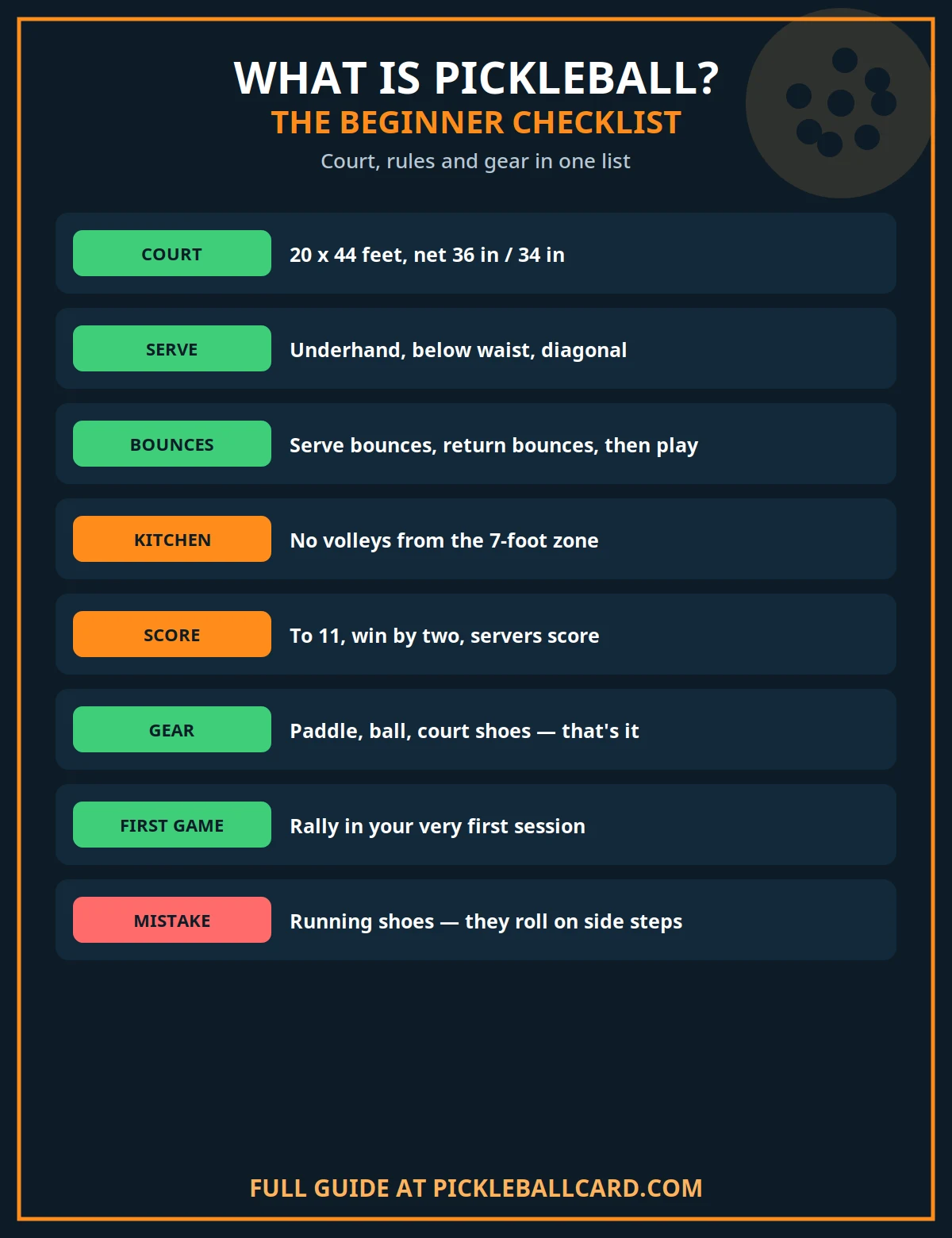
What Is Pickleball Checklist

The Beginner’s First-Game Checklist

Use this checklist for your first time on court:

  1. Learn the serve: underhand, below the waist, diagonal, and clear of the kitchen.
  2. Remember the two bounces: let the serve bounce, let the return bounce, then play freely.
  3. Stay out of the kitchen on volleys: you can step in after a bounce, never to volley.
  4. Call the score: server’s score, receiver’s score, server number — before every serve.
  5. Get to the kitchen line: after the return, advance with your partner. The line is where points are won.
  6. Keep the ball low: low balls are hard to attack; high balls get put away.
  7. Have fun: pickleball’s social side is the point. Rotate partners, laugh at the mishits, stay for the next game.

A Sample Rally, Point by Point

Here is a typical beginner doubles rally, shot by shot. Team A serves from the right service court, underhand and diagonal. The score is called: 0-0-2 (the second server serves first at the start of a game).

Team B’s receiver lets the serve bounce, then returns it deep down the middle. Team A must let the return bounce too — that is the two-bounce rule — then hits a third shot: a soft drop that lands in Team B’s kitchen.

Team B steps in after the bounce and dinks it back. The teams trade dinks until Team A lifts a ball slightly high. Team B volleys it softly at Team A’s feet, Team A cannot return it, and Team B wins the rally — but scores no point, because they were not serving.

Team B now serves, and the cycle repeats. That is the whole game: serve, return, third shot, kitchen rally, and a result. Everything else is refinement.

Why Is Pickleball So Popular?

Four reasons explain the boom. First, it is easy to learn: a beginner can rally within minutes, where tennis takes weeks. Second, it is social: doubles is the default, games are short, and players rotate constantly.

Third, it is gentle on the body relative to other racket sports: the court is small, the ball is slow, and the rallies reward placement over power.

Fourth, it is cheap: public courts are often free, and a starter paddle costs less than a dinner out.

Those four reasons compound. Easy to learn means friends join. Social means players stay. Gentle means all ages play together. Cheap means nobody is priced out.

Formats: Singles, Doubles, and Mixed Doubles

Doubles is the most common format: two players per side, the full court in play, and teamwork at the center of every point. Mixed doubles — one man and one woman per side in competition, or any mixed pairing socially — is the most popular competitive format of all.

Singles is one against one on the same court. It is faster, more physical, and more demanding on movement, and it rewards groundstrokes and passing shots over the soft kitchen game.

Other formats include skinny singles (played on half the court, a great training game), round robins (rotating partners across many short games), and wheelchair pickleball, which follows adapted rules.

Our guide to pickleball terminology defines every term you will hear on court, from “dink” to “erne” to “kitchen.”

Frequently Asked Questions

What is pickleball in simple terms?

Pickleball is a paddle sport played on a small court with a perforated plastic ball. Two or four players hit the ball over a low net, trying to land it where the opponent cannot return it. Games go to 11 points, win by two.

Is pickleball easy for beginners?

Yes — it is one of the easiest racket sports to learn. The court is small, the ball is slow, and the underhand serve removes the hardest skill in tennis. Most beginners rally in their first session.

What do you need to play pickleball?

A paddle, a ball, court shoes, and access to a court. Beginners should start with a mid-weight paddle and match the ball type (indoor or outdoor) to where they play.

How is pickleball different from tennis?

The court is much smaller, the paddle is solid rather than strung, the ball is slower and perforated, the serve is underhand, and the kitchen rule creates a soft net game that tennis does not have.

How long does a pickleball game take?

A game to 11 points usually takes 15–25 minutes, depending on the players. Most sessions run several games with rotating partners.

Can kids play pickleball?

Absolutely. The small court and light equipment suit young players, and many schools now teach pickleball in physical education. See our guide to pickleball for kids for age-specific advice.

Is pickleball good exercise?

Yes. A session of doubles provides moderate aerobic activity, balance work, and quick lateral movement — and because games are social and fun, players tend to play longer than they would exercise otherwise.

Final Word

Pickleball is a simple game with surprising depth. The basics take an afternoon to learn; the strategy takes years to master. That combination — instant fun, lasting challenge — is why it has grown from a Bainbridge Island backyard into a global sport.

Your next step is simple: find a court, borrow a paddle, and play a game. Then come back and learn the rules in depth, the shots one by one, and the strategy that turns a fun rally into a won point.

The rules in this guide follow the USA Pickleball Official Rulebook. When you are ready for your first full game, our how to play pickleball guide takes you there point by point.

shoaib
shoaib

Shoaib is the publisher of Pickleball Card. He oversees the site’s guides to pickleball rules, ratings, strategy and gear, all researched from primary sources — the USA Pickleball Rulebook, DUPR and manufacturer documentation — and updated as the game changes.
pickleballcard.com

Filed Under: About Pickleball

When to Speed Up in Pickleball: Triggers, Targets, and Counters

October 25, 2026 by shoaib

Every dink rally ends the same way: someone decides the soft game is over. That decision — the speed-up — is the most exciting and most misplayed moment in modern pickleball.

To speed up in pickleball is to suddenly attack from a dink rally: take a ball your opponent expects you to dink back softly, and drive it hard instead, usually at their body or into open court.

The rally shifts in an instant from a slow exchange to a fast hands battle.

Done right, a speed-up wins points outright or forces a weak reply you can finish. Done wrong, it hands your opponent a ball they can counterattack — and you become the target of the next speed-up.

This guide covers when to speed up, how to execute it, where to aim, and — just as important — how to counter a speed-up when one comes at you.

It builds on our guides to pickleball dinking strategies and how to beat bangers in pickleball.

Key Takeaways

  • A speed-up is a deliberate tempo change from a dink rally: a sudden, controlled attack, usually at the kitchen line.
  • The golden rule: only speed up balls at or above net height. Speeding up a low ball pops it up and invites a counterattack.
  • The best triggers are a high dink, a short ball, an off-balance opponent, or a predictable pattern you have set up over several dinks.
  • Aim at the body — paddle-side hip and shoulder — or into open court. Avoid the opponent’s paddle in ready position.
  • Disguise matters: keep the same compact motion as your dinks, with no big backswing to warn your opponent.
  • To counter a speed-up, block softly with a compact paddle, reset into the kitchen, and never swing big at a fast ball.

What Is a Speed-Up in Pickleball?

A speed-up is an attacking shot played from within a soft rally. You and your opponent are dinking — soft, controlled shots that arc just over the net and land in the kitchen — when you suddenly drive a ball with pace instead.

The speed-up is not simply hitting hard. It is a calculated acceleration at a moment your opponent does not expect, aimed at a target they cannot defend in time.

USA Pickleball’s own coaching material defines the speed-up the same way: a sudden change of pace from the kitchen designed to catch an opponent off guard.

Speed-ups happen mostly at the kitchen line, where the distance is short and reaction time is minimal. They can also happen from mid-court, but the kitchen speed-up is the one that defines the modern game.

Speed-Up vs Drive vs Slam

A drive is a hard groundstroke, usually from the baseline or mid-court. A slam is an overhead putaway of a high ball. A speed-up is different from both: it comes out of a soft rally, from a compact motion, and its weapon is surprise as much as pace.

That distinction matters for the counter. You defend a drive by blocking; you defend a speed-up the same way, but you have far less time, because you were expecting a dink.

Why Speed-Ups Define the Modern Game

Watch professional pickleball and you will see the pattern: long dink rallies punctuated by sudden speed-ups and the hands battles that follow. The team that speeds up first usually wins the exchange, because the first attacker forces the defender to react.

Recreational players copy the pros’ aggression but skip the patience. The result is speed-ups on low balls, from bad positions, with big swings — all of which lose points. Patience first, then speed.

When to Speed Up: The Triggers

Speed up only when the ball and the situation justify it. These are the triggers that make a speed-up a good decision rather than a gamble.

1. The Ball Is at or Above Net Height

This is the golden rule. A ball at or above net height can be driven downward into the court. A ball below net height must be lifted, and a lifted ball is a ball your opponent can attack.

Judge height at contact, not at its peak. A dink that peaks above the net but drops below it by the time you hit it is a low ball. Wait for the next one.

2. Your Opponent Is Off Balance or Out of Position

An opponent who is still moving, reaching, or recovering from the previous shot cannot defend a speed-up well. If you see them leaning, stretched wide, or late to the line, that is your window.

Creating this situation is a skill: dink wide to pull them out of position, then speed up through the space they vacated.

3. You Have Set Up a Pattern

The best speed-ups are earned over several dinks. Dink cross-court three or four times, establish a rhythm, then change direction and speed on the fourth or fifth ball. Your opponent, grooved into the pattern, reacts late.

Random speed-ups on the first dink rarely work. Patterned speed-ups work constantly.

4. The Ball Sits Up Short

A dink that lands short and bounces up is an invitation. Step in, keep your motion compact, and drive it at the body or into open court. Short balls give you time; use it to place, not to wind up.

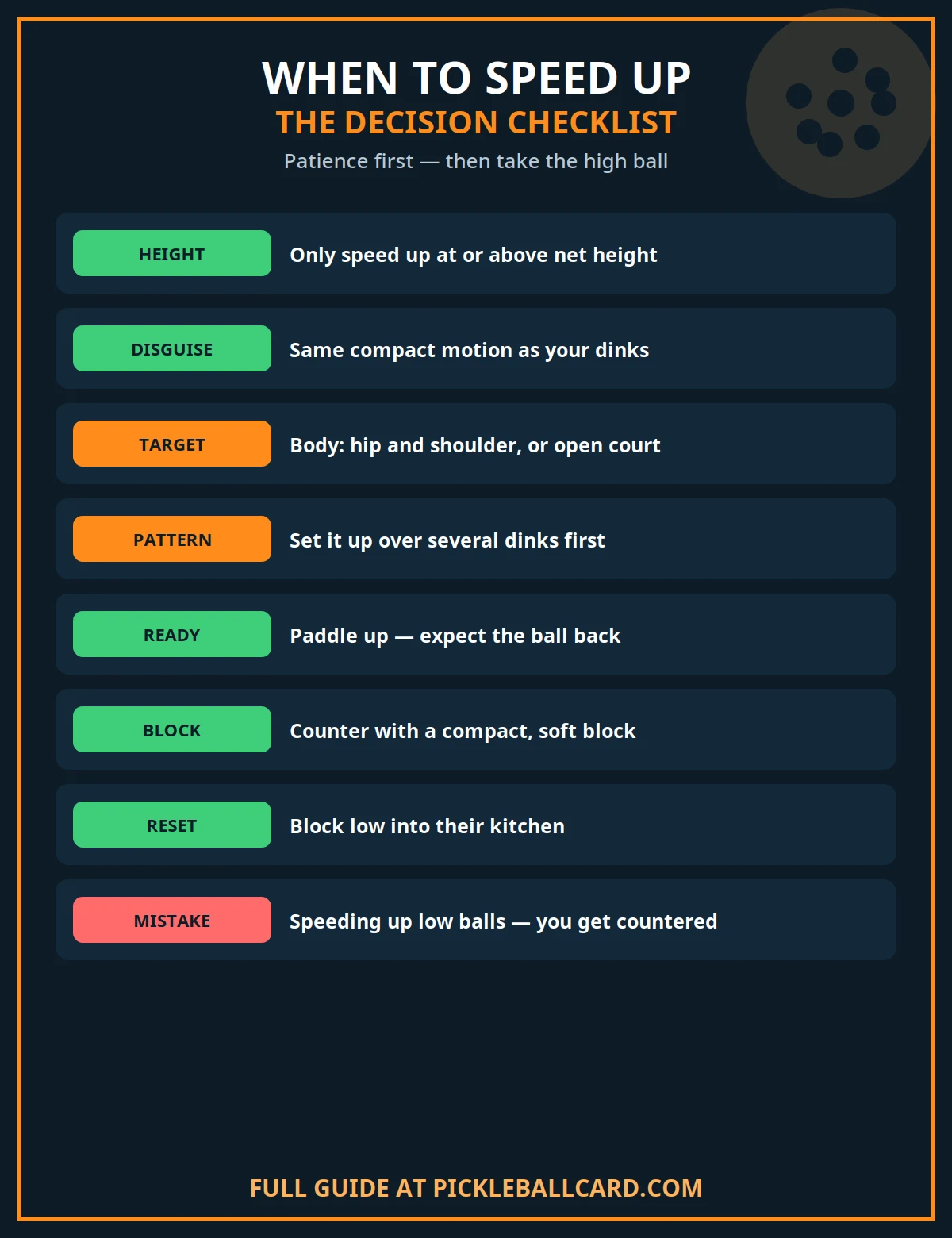
When to Speed Up in Pickleball Checklist

The Speed-Up Decision Table

What you see Decision Why
Ball above net height, opponent set Speed up at the body You can drive down; the body is the hardest target to defend
Ball above net height, opponent moving Speed up into open court Movement plus pace leaves no defense
Ball below net height Keep dinking A lifted ball becomes their attack
Ball at your feet or behind you Reset or block You have no attacking position; survive the ball
Opponent expecting it (you just sped up) Dink instead — change the pattern A predicted speed-up gets countered
High ball, partner in position to finish Speed up to set up, not to win Your speed-up creates the pop-up your partner finishes

How to Execute a Speed-Up

Execution is about disguise and compactness. The best speed-ups look like dinks until the last instant.

Keep the Same Motion as Your Dinks

Do not take a big backswing. A big wind-up tells your opponent exactly what is coming and gives them time to prepare. Keep your paddle in the same ready position you use for dinks, then accelerate forward with a short, punchy motion.

Think of it as a dink with pace, not a drive. The swing is short, the contact is out in front, and the follow-through is compact.

Use Your Body, Not Just Your Arm

Step into the ball and rotate your shoulders slightly. Body weight behind a compact swing produces more pace with less effort than an arm-only swing, and it keeps the ball under control.

Aim at the Body or the Open Court

The two best targets are the opponent’s paddle-side hip and shoulder — the spots that produce the jammed “chicken wing” defense — and the open court away from their paddle.

Our guide to defending body shots explains exactly why those targets are so hard to handle.

Avoid hitting directly at a set opponent’s paddle. A ball at the paddle in ready position is a ball they can block back at you with interest.

Speed Up, Then Get Ready

A speed-up is the start of a hands battle, not the end of the point. After you speed up, keep your paddle up and expect the ball back. Players who admire their speed-up get hit by the counter.

Speed-Ups in Doubles vs Singles

In doubles, a speed-up is a team weapon. Your speed-up creates a pop-up or a weak block that your partner finishes. Communicate before speeding up in doubles: your partner needs to know a hands battle is coming so their paddle is up too.

Doubles speed-ups also have a second target: the seam between opponents. A ball driven at the middle forces a decision about who takes it, and hesitation at the kitchen is fatal.

In singles, the speed-up is riskier. There is no partner to finish a pop-up or cover a counterattack, and a failed speed-up leaves the whole court open. Singles players should speed up only on clearly high, short balls, and should aim for outright winners or forced errors rather than sustained hands battles.

The rule of thumb: in doubles, speed up to create. In singles, speed up to finish.

When NOT to Speed Up

Knowing when to hold back is what separates good attackers from reckless ones:

  1. Low balls: anything below net height at contact. Lift it and you lose.
  2. When you are off balance: reaching, moving backward, or stretched wide. Get set first.
  3. Every ball: speeding up constantly makes you predictable. Opponents start waiting for it.
  4. When your partner is out of position: a counterattack will go at them, not you.
  5. Out of frustration: speeding up because you are bored of dinking is how rallies are donated.

How to Counter a Speed-Up

Sooner or later, a speed-up comes at you. The counter decides whether you lose the point or win it back.

1. Keep Your Paddle Up and Out Front

Countering starts before the speed-up arrives. A paddle held at chest height, out in front of your body, is already in blocking position. A paddle hanging at your waist is not.

2. Block, Don’t Swing

When a fast ball arrives, do not take a swing at it. Hold a firm but relaxed paddle in its path and let the ball’s pace do the work. A short block, angled down into the kitchen, turns their attack into your reset.

Big swings at fast balls produce pop-ups. Pop-ups produce putaways. The block is the whole defense.

3. Soften Your Hands

Loosen your grip slightly at contact so the paddle absorbs pace instead of reflecting it. A soft block drops into the kitchen; a rigid block rebounds high and long.

4. Reset Into the Kitchen

Aim your block to land softly in the opponent’s kitchen, near their feet. A low reset forces them to hit up on the next ball, which ends their attack and restarts the dink rally on your terms.

5. Counterattack Only the High Ball

Sometimes the speed-up comes at you high and soft enough to re-attack. If the ball arrives above net height and you are set, drive it back at the attacker’s body or feet.

If it arrives low or fast, block it. The same golden rule applies in reverse.

For the full blocking system, read our guide to pickleball dinking mistakes — several of them are exactly the errors that make speed-ups against you work.

Speed-Up Drills

Drill 1: The Height Gate

Dink with a partner, but you may only speed up balls that arrive above net height. Mark the net height on a post with tape if it helps. This drill builds the height discipline that most players lack.

Drill 2: Three Dinks, Then Decide

Play kitchen rallies where neither player may speed up before the third dink. This forces pattern-building and patience, and it teaches you to recognize the set-up ball.

Drill 3: Block and Reset Relay

One player speeds up every ball; the other may only block and reset. Switch roles every five minutes. The blocker learns the compact defense; the attacker learns which speed-ups actually work against a set defender.

Frequently Asked Questions

When should you speed up in pickleball?

When the ball arrives at or above net height, your opponent is off balance or out of position, or you have set up a pattern over several dinks. Never speed up a ball below net height.

What is the difference between a speed-up and a drive?

A speed-up comes out of a soft dink rally with a compact motion and relies on surprise. A drive is a hard groundstroke, usually from farther back, with a fuller swing.

Where should you aim a speed-up?

At the opponent’s paddle-side hip or shoulder, or into open court away from their paddle. Avoid hitting directly at a set opponent’s paddle.

How do you defend against a speed-up?

Keep your paddle up, block with a compact motion and soft hands, and reset the ball low into the kitchen. Do not swing big at a fast ball.

Should beginners learn speed-ups?

Learn the dink rally first, then the block and reset. Once you can hold a rally and defend pace, add the speed-up — starting with high, short balls only.

Is speeding up rude in recreational play?

No, it is a normal part of the game. In casual games with beginners, use it sparingly and avoid targeting the body repeatedly. In competitive play, it is expected.

Final Word

The speed-up is a decision, not a reflex. The players who win with it are the ones who wait for the right ball, disguise the shot, aim at a real target, and stay ready for what comes back.

Practice the patience first. Dink until the high ball comes, then take it — compact, placed, and ready for the hands battle that follows. And when the speed-up comes at you, block it soft, reset it low, and make the attacker play one more ball.

USA Pickleball’s coaching explainer on what a speed-up is and the Official Rulebook are the authorities behind the definitions used here.

shoaib
shoaib

Shoaib is the publisher of Pickleball Card. He oversees the site’s guides to pickleball rules, ratings, strategy and gear, all researched from primary sources — the USA Pickleball Rulebook, DUPR and manufacturer documentation — and updated as the game changes.

pickleballcard.com

Filed Under: About Pickleball

What Is the Fourth Shot in Pickleball? The Returning Team’s Reply

October 25, 2026 by shoaib

Most players can name the third shot. Few can name the fourth. That is strange, because the fourth shot decides whether the returning team keeps the advantage they earned with a good return — or hands the kitchen straight back.

The fourth shot in pickleball is the returning team’s reply to the serving team’s third shot. The serve, the return, and the third shot have already happened.

Now the returning team must answer, usually from near the kitchen line, against a ball designed to push them back.

Get the fourth shot right and your pair holds the line, neutralizes the serve team’s attack, and turns defense into offense. Get it wrong and you pop the ball up, get driven at, or retreat to the baseline you just fought to leave.

This guide explains what the fourth shot is, the two choices it presents — attack or concede — and how to decide between them. It is the direct sequel to our guides on the third shot drop and third shot drop vs drive.

Key Takeaways

  • The fourth shot is the returning team’s first shot after the third shot — usually a volley, block, or reset at or near the kitchen line.
  • Its job is to neutralize the third shot and hold the kitchen, not to win the point outright.
  • Attack the fourth shot when the third shot sits up high, short, or soft — drive it at the server’s feet or into open court.
  • Concede the fourth shot when the third shot is low, hard, or well placed — block or reset it softly into the kitchen and stay in the point.
  • The most common fourth-shot error is attacking a low ball, which produces pop-ups and counterattacks.
  • Position beats power: a pair already at the line handles fourth shots far better than a pair still moving forward.

What Is the Fourth Shot in Pickleball?

Count the shots in a rally. Shot one is the serve. Shot two is the return of serve. Shot three is the serving team’s next shot — usually a drop, a drive, or a lob.

Shot four is the returning team’s answer to that third shot.

The fourth shot usually arrives while the returning team is at or approaching the kitchen line. The returning team has the advantage of position: they were never required to stay back, so they can reach the line first.

The fourth shot is how they defend that advantage.

It is rarely a spectacular shot. Most fourth shots are blocks, volleys, dinks, or resets. Their quality is measured by what they prevent — a lost kitchen, a pop-up, a retreat — rather than what they win.

Why the Fourth Shot Is Overlooked

Coaching spends far more time on the third shot than the fourth, because the third shot is the serving team’s problem to solve. The fourth shot feels like a reaction, not a decision.

That framing is wrong. The fourth shot is a decision, and it is often the harder one: the returning team must read the third shot’s height, pace, and placement in a fraction of a second and choose between attacking and resetting.

Fourth Shot vs Fifth Shot

The fifth shot is the serving team’s reply to the fourth shot, and it completes the opening sequence. A common plan at higher levels is “drive the third, drop the fifth” — attack first, then soften the next ball into the kitchen.

Understanding the fourth shot helps you understand the fifth. When your fourth shot is a good reset, the serving team’s fifth shot arrives as a dink, not a drive. When your fourth shot pops up, the fifth shot arrives as a putaway.

The Two Choices: Attack or Concede

Every fourth shot presents the same choice. Attack it, or concede it. Attacking means driving, volleying aggressively, or speeding the ball up. Conceding means blocking, resetting, or dinking it softly back into the kitchen.

Neither choice is always right. The correct choice depends on the ball in front of you, and players who default to one choice lose points to players who read the ball.

When to Attack the Fourth Shot

Attack when the third shot gives you something to attack. The triggers are clear: the ball sits above net height, it lands short in the court, it arrives slowly, or the server is still moving forward and off balance.

Attack with placement, not power. Drive at the server’s feet as they approach, or into the open court away from their partner. A placed attack forces a weak fifth shot; a wild attack forces a counterattack against you.

When to Concede the Fourth Shot

Concede when the third shot is good. A low, hard drive at your feet, a well-placed drop that dies in the kitchen, or a ball that arrives while you are still moving forward are all balls to reset, not attack.

Conceding is not losing. A soft reset into the kitchen neutralizes the server’s attack, keeps your pair at the line, and turns the rally into a dink exchange — which is exactly where the returning team wants to be.

The reset is a core skill in its own right. Our guide to the pickleball reset shot covers the technique in full.

The Decision in One Sentence

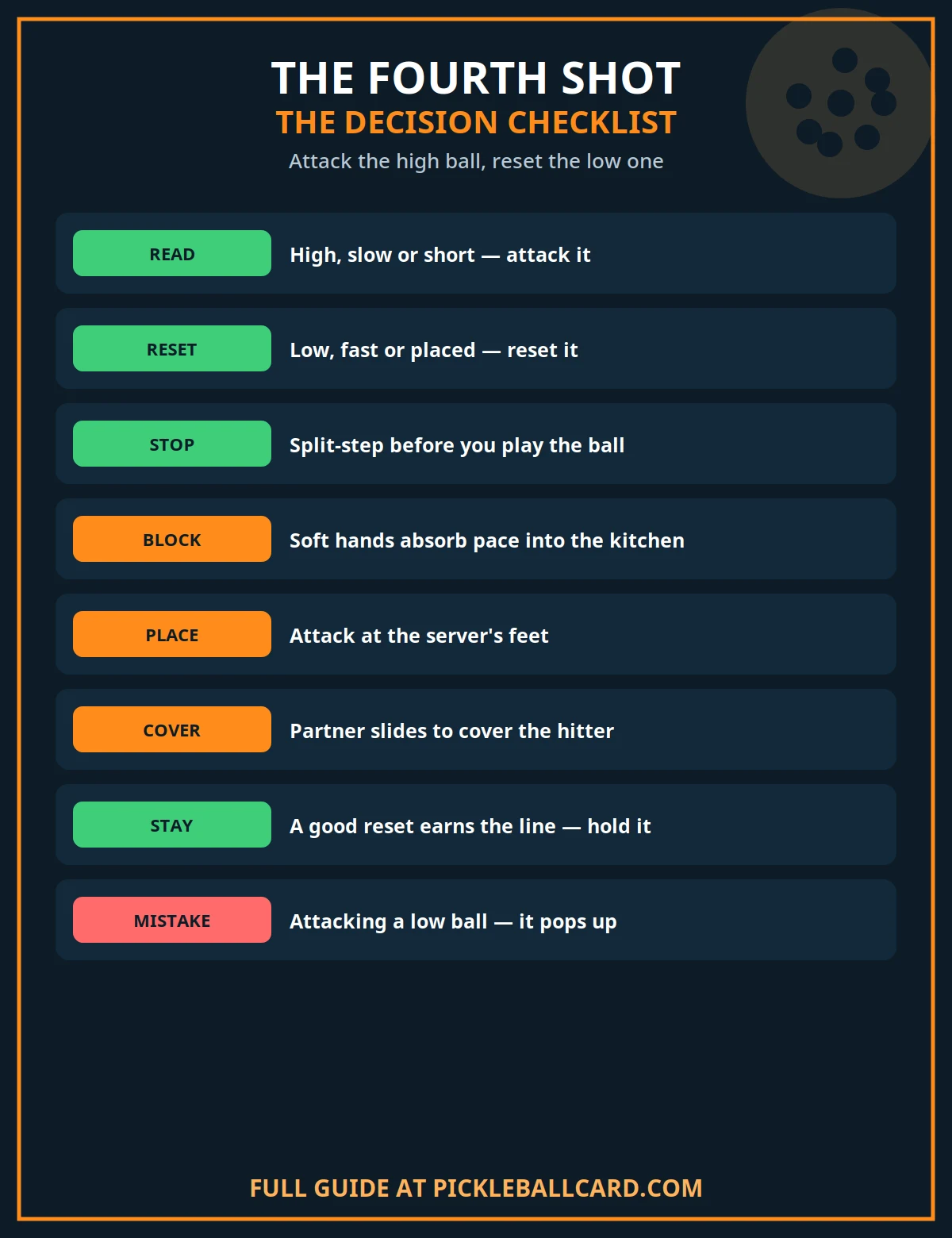
High, slow, or short: attack. Low, fast, or well placed: reset. When in doubt, reset — a reset keeps you in the point, while a failed attack usually ends it.

What Is the Fourth Shot in Pickleball Checklist

The Fourth Shot Decision Table

Read the third shot, then choose:

Third shot you receive Fourth shot answer Why
High drop that sits up Attack — drive at the server’s feet The ball is in your strike zone and the server is moving
Short, slow drive Attack — volley into open court You have time and an open target
Low, hard drive at your feet Concede — soft block into the kitchen Attacking a low ball pops it up
Deep, well-placed drop Concede — dink it back low The ball is doing its job; reset and start the dink rally
Third-shot lob over your head Concede — drop back, let it bounce, reset Attacking a lob overhead from the line is low percentage
Third shot while you are still moving Concede — block and stop Moving feet cannot attack; stop first, then play

Fourth Shot Technique

Technique follows the decision. Attacking fourth shots need a compact swing and a clear target. Conceding fourth shots need soft hands and a low trajectory.

The Attacking Fourth: Compact and Placed

Keep the backswing short. At the kitchen line there is no time for a full swing, and a short swing keeps the ball down. Contact the ball out in front, with the paddle face slightly closed, and drive through the ball toward your target.

Aim low. The best attacking fourth shots land at the server’s feet or skid into the kitchen. A high attack gives the server a ball they can counter.

The Reset Fourth: Absorb and Drop

Loosen your grip at contact and let the paddle absorb the third shot’s pace. Angle the paddle face slightly open and guide the ball down into the opponent’s kitchen, near their feet.

The reset’s goal is a ball the server must hit upward. A reset that lands high is just a delayed attack against you. Practice soft hands until your resets die in the kitchen.

Footwork: Stop Before You Hit

The most underrated fourth-shot skill is stopping. Players who hit while still moving forward mishit constantly. Split-step as the server hits the third shot, plant, then play the fourth.

If you are caught moving, concede the ball. A block hit from a planted stance beats an attack hit on the run every time.

Fourth Shots in Doubles vs Singles

In doubles, the fourth shot is usually played by the partner who is not facing the third shot directly — the player with the better angle or the shorter distance to the ball. Partners must call it early.

In singles, the fourth shot is simpler and harder: you play every ball yourself, and the third shot often comes as a drive you must block or pass.

The same decision applies — attack the high ball, reset the low one — but there is no partner to cover a mistake.

Singles players should study the fourth shot through the lens of court coverage: a reset that buys time to recover to the middle is worth more than an attack that leaves the court open.

The Opening Sequence, Shot by Shot

The fourth shot only makes sense inside the full opening sequence. Here is how the first five shots typically flow in doubles:

Shot one, the serve, goes deep to push the returner back. Shot two, the return, goes deep down the middle to buy time. Shot three is the server’s answer — a drop to approach the net, a drive to pressure, or occasionally a lob.

Shot four is yours: neutralize that third shot and hold the line. Shot five is the server’s reply to your fourth — and its difficulty depends entirely on your fourth shot’s quality.

Notice the pattern: every shot in the sequence exists to win position, not to win the point. Points at the kitchen come later, after both teams are established. Players who try to win the point on shot three or four usually lose the position battle instead.

When you watch better players, watch their fourth shots specifically. You will see almost no highlight-reel winners — and almost no errors. That consistency is the skill.

Common Fourth Shot Mistakes

  1. Attacking every third shot: the fastest way to lose the kitchen advantage. Low drives are not invitations.
  2. Popping up the reset: a stiff grip turns a block into a pop-up, and pop-ups get put away.
  3. Hitting on the move: advancing through the fourth shot instead of stopping to play it.
  4. No partner communication: both players going for the same fourth shot, or neither going for it.
  5. Retreating after a good reset: a reset earns you the line — stay there instead of drifting back.
  6. Forgetting the fifth shot: a fourth shot that sets up an easy fifth shot for the server is a bad fourth shot, even if it stays in.

Drills for a Better Fourth Shot

Drill 1: Attack or Reset Call

Have a partner feed third shots of mixed height and pace. Before each ball, call “attack” or “reset” as soon as you read it, then play the shot you called. This trains the read, which is the real skill.

Drill 2: The Reset Rally

Play rallies where the returning team may only reset the fourth shot — no attacks allowed. Learn how much pressure a good reset alone can absorb.

Drill 3: The Punishment Game

Play normal points, but any fourth shot attacked from below net height loses the point immediately, even if it lands in. This breaks the habit of attacking low balls fast.

Frequently Asked Questions

What is the fourth shot in pickleball?

It is the returning team’s reply to the serving team’s third shot — the fourth shot of the rally, usually played at or near the kitchen line as a volley, block, dink, or reset.

Should you attack or reset the fourth shot?

Attack high, slow, or short third shots. Reset low, fast, or well-placed ones. When unsure, reset — a reset keeps you in the point, while a failed attack usually ends it.

Who hits the fourth shot in doubles?

Whichever partner has the better angle on the third shot, decided by an early call. The partner who does not hit it slides to cover the court the hitter vacates.

Is the fourth shot always a volley?

No. It can be a volley, a block, a dink, or a groundstroke after a bounce. The shot type follows the third shot: high balls get volleyed, low balls get blocked or dinked.

How is the fourth shot different from the third shot?

The third shot is the serving team’s problem — getting to the kitchen against a deep return. The fourth shot is the returning team’s problem — holding the kitchen against the third shot. Both are transition shots, played by opposite teams.

What if the third shot is a lob?

Drop back, let it bounce, and reset it softly into the kitchen or deep to the server’s backhand. Do not try to attack a good lob overhead from the kitchen line.

Final Word

The fourth shot is where returning teams win or lose the opening sequence. It is not glamorous, but it is decisive: a good fourth shot holds the kitchen, and holding the kitchen wins rallies.

Learn the read first. High, slow, or short means attack. Low, fast, or well placed means reset. Then practice the reset until it is automatic, because most fourth shots are resets — and most points are lost by players who refuse to play them.

The shot rules behind every decision here come from the USA Pickleball Official Rulebook. Next, study the other half of the opening sequence in our third shot drop vs drive guide.

shoaib
shoaib

Shoaib is the publisher of Pickleball Card. He oversees the site’s guides to pickleball rules, ratings, strategy and gear, all researched from primary sources — the USA Pickleball Rulebook, DUPR and manufacturer documentation — and updated as the game changes.

pickleballcard.com

Filed Under: About Pickleball

  • « Go to Previous Page
  • Page 1
  • Page 2
  • Page 3
  • Page 4
  • Page 5
  • Interim pages omitted …
  • Page 19
  • Go to Next Page »

Latest Posts

  • Raw Carbon Fiber Pickleball Paddles Explained
  • Pickleball Court Surfaces Explained: Acrylic, Asphalt, Concrete, And More
  • How To Organize A Round Robin In Pickleball
  • What Is The PPA Tour? The Professional Pickleball Tour Explained
  • The Mental Game of Pickleball: Focus, Confidence and Composure
  • Let Serve in Pickleball: What Happens When the Serve Hits the Net
  • Overhead Smash in Pickleball: How to Hit It
  • Forehand Drive in Pickleball: Power and Consistency
  • Common Pickleball Injuries and How to Prevent Them
  • Pickleball Tournament Formats Explained
  • About
  • Privacy Policy
  • Terms And Conditions
  • Affiliate Disclosure

COPYRIGHT © 2026 · Pickleballcard.COM, ALL RIGHTS RESERVED.

PICKLEBALLCARD.COM IS A PARTICIPANT IN THE AMAZON SERVICES LLC ASSOCIATES PROGRAM, AN AFFILIATE ADVERTISING PROGRAM DESIGNED TO PROVIDE A MEANS FOR SITES TO EARN ADVERTISING FEES BY ADVERTISING AND LINKING TO AMAZON.COM. AMAZON, THE AMAZON LOGO, AMAZONSUPPLY, AND THE AMAZONSUPPLY LOGO ARE TRADEMARKS OF AMAZON.COM, INC. OR ITS AFFILIATES. AS AN AMAZON ASSOCIATE WE EARN AFFILIATE COMMISSIONS FROM QUALIFYING PURCHASES.