The forehand drive is the shot that turns a neutral rally into pressure. It is a firm, flat-to-slightly-topsin groundstroke hit from the forehand side, usually from the baseline or midcourt, with the goal of pushing opponents back or forcing a weak reply.
Many players chase power by swinging harder with the arm. That approach produces errors, sore shoulders, and drives that sail long. Real drive power comes from the legs, hip rotation, and a repeatable swing path, with the arm guiding rather than muscling the ball.
This guide breaks the forehand drive into teachable parts: grip, stance, swing path, contact point, and follow-through. It also covers when to drive instead of dropping or dinking, the mistakes that ruin consistency, and drills that make the shot hold up in matches.
Key Takeaways
- Power comes from the legs and hip rotation, not from swinging harder with the arm.
- Use an eastern or mild semi-western grip, with a relaxed hand and a firm wrist at contact.
- Contact the ball in front of your body, between knee and waist height, whenever possible.
- Keep the backswing compact and the swing path smooth, finishing toward your target.
- Drive when the ball sits up and you are balanced; drop or dink when it stays low.
- Consistency is built by repeating the same setup, not by changing your swing every rally.
What Is a Forehand Drive in Pickleball?
A drive is a groundstroke, meaning the ball bounces before you hit it. That distinction matters because the two-bounce rule shapes the early part of every rally, and the non-volley zone rules shape what you can do near the net.
Unlike a dink, which is soft and played at the net, a drive travels with pace and depth. Unlike a lob, which arcs high to buy time, a drive stays flatter and aims to keep opponents pinned behind the baseline.
The drive is most often a third shot, a return of serve, or a passing shot. In each case the goal is the same: hit through the ball with control, land it deep, and take time away from your opponents.
Your forehand is usually your stronger side, which is why drives tend to come from it. If you are still deciding which side to favor in different situations, our forehand vs backhand in pickleball comparison explains the strengths and limits of each side.
The Forehand Drive Grip
Start with the eastern forehand grip, the standard choice for a drive. Hold the paddle as if you were shaking hands with it, with the V between your thumb and index finger resting on the top bevel of the handle.
The eastern grip keeps the paddle face naturally square to the target at contact. That makes it easier to drive the ball flat and deep without fighting the paddle angle.
Players who want a little more topspin can rotate the hand slightly toward a mild semi-western grip.
How Tight Should You Hold the Paddle?
Hold the paddle firmly enough that it does not twist at contact, but loosely enough that your wrist stays free during the swing. A death grip locks the wrist, slows the swing, and sends shock into the forearm.
Think of a grip pressure of about four out of ten during preparation, rising briefly to six or seven at contact. The squeeze happens at the ball, not during the whole swing.
Check Your Grip Before Every Session
Grips drift without players noticing, especially after switching between forehand and backhand shots. Before you drill, set the eastern grip deliberately and hit ten easy drives to confirm the face angle.
If drives keep sailing long, check the grip first. A hand that has rotated too far under the handle opens the face and launches the ball. A hand rotated too far over it closes the face and drives the ball into the net.
Stance and Ready Position
Good drives start before the ball arrives. From the ready position, stand with feet shoulder-width apart, knees bent, weight on the balls of your feet, paddle in front of your body.
As the ball comes to your forehand side, turn sideways. Your non-dominant shoulder points roughly toward the net, and your weight loads onto the back foot. This sideways unit turn is what lets your hips unwind into the shot.
Step toward the ball with your front foot as you swing. The step does two jobs at once: it moves your weight forward into the shot, and it positions your body so contact happens in front of you rather than beside you.
The Swing Path, Step by Step
The forehand drive swing has four phases: preparation, backswing, forward swing with contact, and follow-through. Keeping each phase compact is what makes the shot repeatable under pressure.
Phase 1: Preparation and Unit Turn
Turn your shoulders and hips together as soon as you read the ball to your forehand side. Keep both hands on the paddle during the turn, which keeps the swing short and the paddle face stable.
Your paddle should drop slightly below the expected contact height during preparation. Starting low makes the low-to-high swing path natural, and it stops you from chopping down on the ball.
Phase 2: A Compact Backswing
Take the paddle back only as far as you need to generate pace. For most drives, the paddle head stops roughly beside or just behind your back hip, not wrapped far behind your body.
A long backswing feels powerful but costs time and balance. Against faster balls, it leaves you late and jammed. A compact backswing lets you meet the ball out front, which is where control lives.
Phase 3: Forward Swing and Contact
Unwind your hips first, then your shoulders, then let the arm and paddle follow. This sequence is the kinetic chain: big muscles fire first, and the smaller ones finish the job.
Swing from low to high through the ball, with the paddle moving toward your target. The swing should feel smooth and unhurried, even when you are hitting firmly. Rushing the forward swing usually means the hips never fired at all.
Phase 4: Follow-Through and Recovery
Finish with the paddle pointing toward your target, roughly at shoulder height, with your chest facing the net. A full follow-through is not decoration; it is evidence that you swung through the ball instead of stopping at it.
After the finish, recover immediately. Return to a balanced ready position, paddle in front, and watch your opponents. Drives that win points still require you to be ready for the next ball.
Where Power Really Comes From
Power in a forehand drive starts at the ground. Bent knees let you push upward and forward as you swing, and that leg drive feeds directly into hip rotation. Players who stand tall and arm the ball give up their biggest power source.
Hip rotation is the engine. When your hips unwind from the sideways loaded position toward the net, your shoulders and arm are carried along for free. The arm adds the final snap of pace, but it should never be the main source.
Weight transfer ties it together. Load onto the back foot during preparation, then shift onto the front foot through contact. If your weight is still on the back foot when you hit, the ball will float or fall short.
- Legs: bend your knees, push through the ground, and drive your weight forward.
- Hips: rotate from the sideways position toward the net as the swing begins.
- Core: keep the trunk firm so rotation transfers cleanly from hips to shoulders.
- Shoulders and arm: let them follow the rotation, guiding the paddle to the target.
Contact Point and Paddle Face
The ideal contact point is in front of your body, slightly ahead of your front foot, between knee and waist height. Hitting out front lets you see the ball onto the paddle and direct it with the full swing behind it.
When contact drifts too close to your body, you lose power and direction. When it drifts too far in front, you reach and lose balance. Small footwork adjustments matter more than big swing changes for fixing contact problems.
Keep the paddle face square to slightly closed at contact for a flat drive. A face that is too open sends the ball long.
A face that is too closed sends it into the net. If your drives are consistently long or short, check the face angle before changing anything else.
When to Drive, Drop, or Dink
Choosing the right shot matters as much as hitting it well. The decision usually comes down to three things: the height of the ball, your balance, and where your opponents are standing.
Drive when the ball bounces up into your strike zone and you are set and balanced. Drop when the ball stays low, you are moving, or your opponents are already at the net waiting to attack.
Dink when everyone is at the net and the rally is a patience contest.
| Situation | Best Shot | Why |
|---|---|---|
| Ball bounces up, you are balanced | Drive | You can hit through the ball with control and depth. |
| Ball stays low at your feet | Drop | A drive from low contact usually sails long or nets. |
| Opponents are back, you are at midcourt | Drive | Depth pushes them further back and opens the court. |
| Opponents are set at the net | Drop or dink | A drive into set opponents comes back faster than it left. |
| You are stretched or off balance | Drop or reset | Power without balance produces errors, not winners. |
| All four players are at the net | Dink | Soft, low shots keep you safe until an attackable ball appears. |
The rules also shape this choice. Under the USA Pickleball official rules, the ball must bounce before it can be volleyed in the non-volley zone.
That zone extends seven feet from the net on each side. A drive from behind that zone is a groundstroke, so it is legal from anywhere once the ball has bounced.
Common Forehand Drive Mistakes
Most drive problems come from a small set of repeatable errors. Fixing one of these usually improves several symptoms at once, so work through them in order rather than rebuilding your whole swing.
Mistake 1: Swinging Only With the Arm
An arm-only swing feels fast but produces little real pace and no consistency. If your drives lack depth despite hard swings, your hips and legs are not involved. Practice shadow swings with the paddle held lightly, focusing on hip rotation.
Mistake 2: A Backswing That Is Too Big
Wrapping the paddle far behind your body looks powerful and plays late. Against any ball with pace, a big backswing means contact happens beside you instead of in front. Shorten the backswing until contact is consistently out front.
Mistake 3: Hitting Late or Too Close to the Body
Late contact turns drives into defensive blocks. The fix is footwork, not a faster arm: move sooner, take a smaller adjustment step, and meet the ball ahead of your front foot.
Mistake 4: Stopping the Follow-Through
Players who stop the paddle at contact decelerate through the ball, which costs pace and direction. Finish every practice drive toward the target, even on easy balls, so the full swing becomes automatic.
Mistake 5: Driving Every Ball
The drive is tempting, but driving low balls, balls hit while stretched, or balls against set net players hands opponents easy attacks. Patience is part of drive technique: the best drive is often the one you wait one ball to hit.
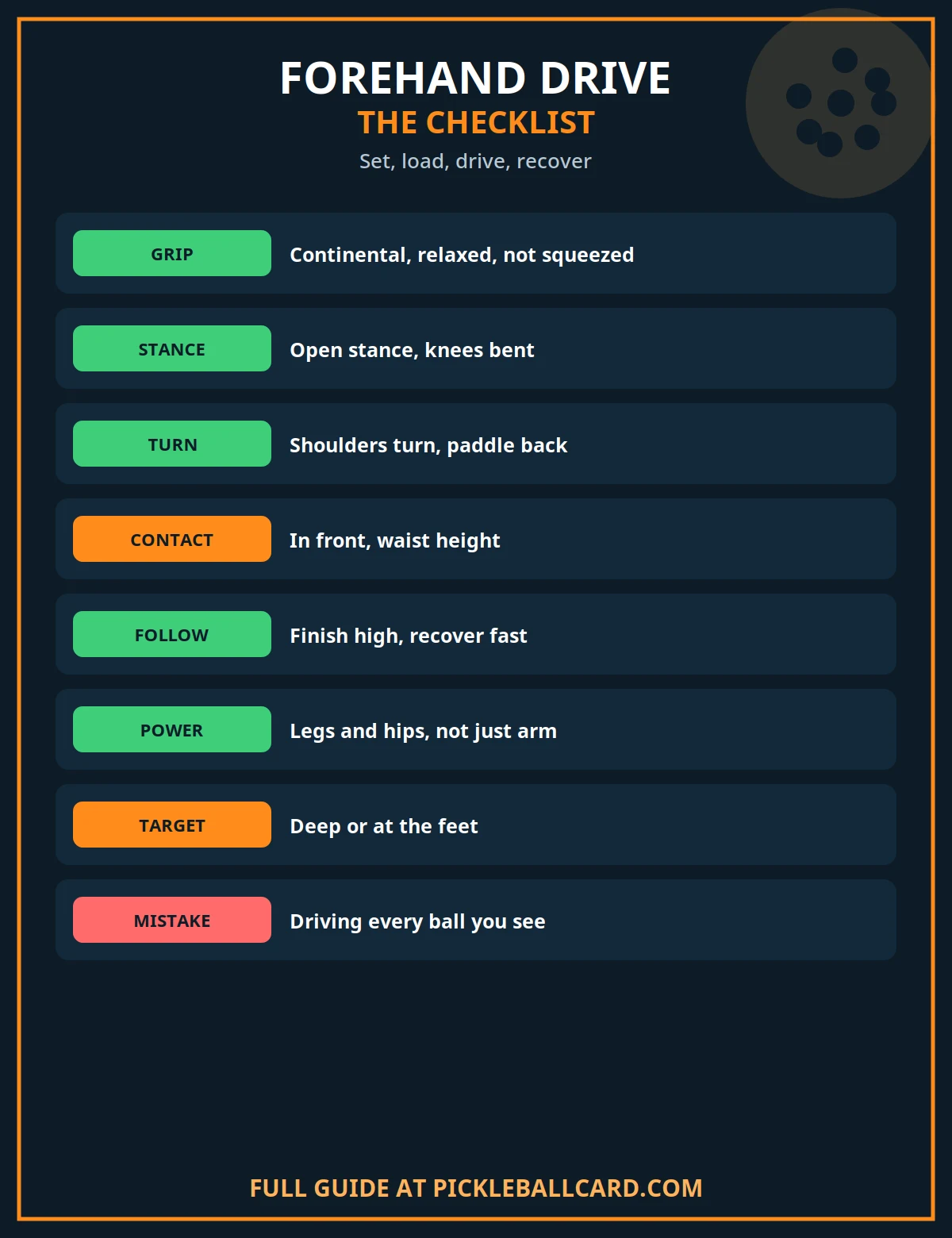
Forehand Drive Checklist
Run through this checklist during warm-ups until it becomes automatic. If a drive goes wrong in a match, walk through the list to find the missing step instead of guessing.
- Set the eastern grip deliberately, with a relaxed hand and firm wrist at contact.
- Turn sideways early, loading your weight onto the back foot.
- Keep the backswing compact, with the paddle below contact height.
- Step toward the target with your front foot as the swing begins.
- Fire hips first, then shoulders, letting the arm follow the rotation.
- Meet the ball in front of your body, between knee and waist height.
- Finish toward the target at shoulder height, then recover to ready position.
- Drive only when balanced and the ball sits up; drop or dink otherwise.
Drills That Build a Reliable Drive
Drills work best when they isolate one part of the shot. Practice the pieces separately first, then combine them in rally drills that look like real match situations.
Drill 1: Shadow Swings With Hip Rotation
Without a ball, practice the full swing in slow motion, focusing on the sequence: legs, hips, shoulders, arm. Do twenty repetitions before hitting a ball.
This drill builds the kinetic chain without the pressure of timing a moving ball. If the shadow swing feels arm-heavy, slow down until the hips clearly lead the motion.
Drill 2: Deep Target Driving
Stand at the baseline with a partner feeding balls to your forehand. Aim each drive at a deep target zone near the baseline, alternating crosscourt and down the line.
Score yourself on depth, not pace. Ten drives that land deep with moderate pace beat five winners and five errors. Consistency at depth is what makes drives tactically useful.
Drill 3: Drive, Then Recover
Hit a forehand drive, then immediately return to the ready position and split step before the next feed arrives. This drill trains the habit that most players skip: recovery after a good shot.
Drill 4: Low Ball Discipline
Have a partner feed a mix of high and low balls. Drive only the balls that bounce into your strike zone, and drop the low ones. This drill trains the judgment that separates good drivers from reckless ones.
Drive Variations and Spin
Most drives are fairly flat, but a small amount of topspin helps the ball dip into the court and lets you swing a little harder with less risk of going long. The spin comes from the low-to-high swing path, not from a separate wrist flick.
Keep spin as a variation, not the main event. A drive with a slight topspin finish is still a drive; if spin becomes the focus, the shot turns into a different stroke with different timing.
Our guide on how to add topspin in pickleball covers the spin mechanics in full.
Two other variations are worth knowing. A drive aimed at the backhand side often draws a weaker reply. And a drive hit with slightly later contact can work as a passing shot when an opponent approaches the net.
When the ball comes to your backhand side instead, the decision changes. A two-handed backhand in pickleball gives many players more stability on that side, especially against fast balls at the body.
Target Selection and Placement
Depth beats pace. A drive that lands within a few feet of the baseline forces opponents to hit from deep positions, where their replies are weaker and their angles are smaller.
Crosscourt drives are the safer default because the court is longer diagonally and the net is lower in the middle. Down-the-line drives are riskier but more rewarding.
Aim at the weaker opponent or the open space, not at the strongest defender. In doubles, a drive at the feet of the player who just moved, or into the gap between partners, causes more trouble than a hard drive straight at a set player.
Frequently Asked Questions
What grip should I use for a forehand drive in pickleball?
Use the eastern forehand grip as your default. It keeps the paddle face square at contact, which makes flat, deep drives easier to control.
Players who want more topspin can rotate slightly toward a mild semi-western grip. Avoid extreme grips until the basic drive is consistent.
Why does my forehand drive keep going long?
Drives go long when the paddle face is too open at contact, the swing path is too flat, or the ball is hit late. Check the grip and face angle first.
Adding a slightly more low-to-high swing path also helps, since it brings the ball down into the court. Slow the swing down until depth is under control.
How do I add more power without losing consistency?
Add power through your legs and hip rotation, not through a bigger arm swing. Bend your knees, load the back foot, and unwind the hips into the shot.
Keep the backswing compact and the swing smooth. Most players gain pace simply by meeting the ball further in front.
Should I drive or drop on the third shot?
Drive when the return sits up and you are balanced. Drop when the return stays low, you are moving, or your opponents are already set at the net.
The third shot decision is situational, not a fixed rule. Let the height of the ball and your balance decide, rally by rally.
What is the ideal contact point for a forehand drive?
Contact the ball in front of your body, slightly ahead of your front foot, between knee and waist height. This position gives you the full swing behind the ball.
If contact keeps happening beside your body, move your feet sooner and shorten your backswing. Footwork fixes contact more reliably than swing changes.
How can I practice the forehand drive on my own?
Practice shadow swings against a wall, focusing on hip rotation and a full follow-through. Wall rallies also work well for grooving contact out front.
Set a deep target zone and score yourself on depth over ten or twenty balls. Solo practice builds the repeatable swing that match pressure tests.
Putting the Forehand Drive Together
A reliable forehand drive is not one perfect swing. It is the same good swing, repeated: eastern grip, sideways turn, compact backswing, hip-led forward swing, contact out front, and a full finish toward the target.
Practice the pieces, then practice the decision of when to use them. A player who drives the right balls, with repeatable mechanics, will beat a harder hitter who drives everything.

Shoaib is the publisher of Pickleball Card. He oversees the site’s guides to pickleball rules, ratings, strategy and gear, all researched from primary sources — the USA Pickleball Rulebook, DUPR and manufacturer documentation — and updated as the game changes.