There is a moment in every pickleball player’s development when swinging harder stops working. Your drives feel strong off the paddle, but they land a foot past the baseline, again and again. The answer is not less power. It is topspin.
Topspin is forward rotation on the ball. It pulls the shot downward as it travels, so the ball clears the net with margin and still drops inside the court. That is why advanced players can swing at full speed without spraying balls long.
This guide teaches the complete topspin mechanic from the ground up. You will learn the five-step swing checklist, how topspin changes the flight and bounce of the ball, how to use it on drives, drops, serves, and dinks, and the drills that make it automatic.
Key Takeaways
- Topspin comes from brushing up the back of the ball with a low-to-high swing path and a slightly closed paddle face.
- The spin makes the ball dip over the net and kick higher off the bounce, so you can swing harder and still keep the ball in.
- Start with the paddle head below the ball, make contact out in front around knee to waist height, and finish high.
- Close the paddle face slightly before you swing up. Swinging up with an open face is what pops the ball skyward.
- The same mechanic works on drives, third shot drops, serves, and rolling dinks. Only the size of the swing changes.
- Add pace only after the brush feels reliable. Most topspin errors come from swinging hard before the spin is consistent.
What Topspin Actually Is (and Why It Matters)
Topspin means the top of the ball is rotating forward, toward your opponent, as it flies. You create it by moving the paddle upward across the back of the ball at contact, so the ball rolls forward off the paddle face.
Physicists call the force behind this the Magnus effect. For a player, the translation is simple: a topspin ball curves downward in flight instead of floating. That downward curve is the entire reason topspin exists as a technique.
That curve buys you margin for error. With a flat shot, clearing the net by a comfortable height usually means the ball lands long. With topspin, you can clear the net comfortably and watch the ball dive back down inside the baseline.
It also changes what happens after the bounce. A topspin ball jumps up higher and faster off the court than a flat ball, arriving at your opponent’s paddle at an awkward height. That is why topspin shots feel so heavy to return.
How Topspin Changes Ball Flight
The Dip Over the Net
A flat drive travels on a nearly straight line. It has to stay low to land in, which means it flirts with the tape on every swing. One small timing error and the ball is either in the net or sailing long.
A topspin shot travels on an arc. It rises higher over the net, giving you a bigger target, and then the spin drags it down into the court. You get net clearance and depth at the same time, which a flat shot cannot offer.
This is why topspin is the foundation of aggressive pickleball. It lets you aim deep, swing with pace, and still land the ball in. The spin is your safety net.
The Kick Off the Bounce
When a topspin ball lands, the forward rotation grabs the court surface and the ball kicks up sharply. Compared with a flat ball landing in the same spot, the topspin ball arrives higher and with more energy.
That kick compresses your opponent’s time and space. They have to contact the ball higher than expected, often above their comfort zone, and the ball gets on them faster than the flight suggested. Rushed, high contact produces weak replies.
The kick is also why topspin passing shots are so effective. The ball dips at the net player’s feet and then jumps, leaving almost no clean volley window. Dip plus kick is a combination flat shots never produce.
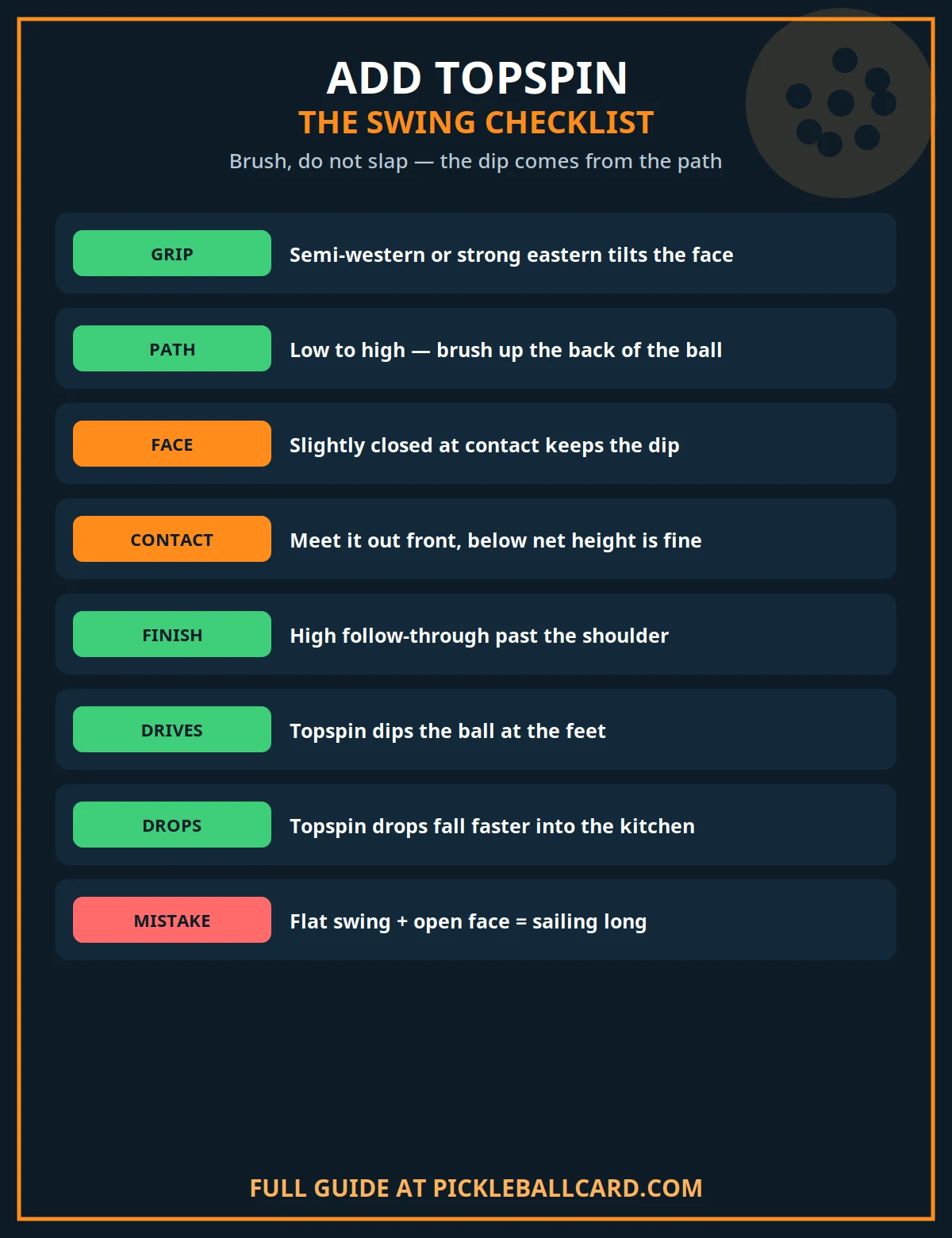
The 5-Step Topspin Swing Checklist
Every topspin shot, from a full baseline drive to a soft rolling dink, runs on the same five steps. Learn them in order, and check each one when something goes wrong. Most topspin problems trace back to skipping one of these.
Step 1: Set a Relaxed, Spin-Friendly Grip
You can create topspin with a continental grip, but an eastern or semi-western grip makes the low-to-high brush noticeably easier. The hand sits slightly more behind the handle, which naturally closes the face through the hitting zone.
Do not overhaul your grip on day one if you are comfortable with continental. A relaxed grip matters more than the exact bevel. Tension is the real enemy, because a tight hand locks the wrist and stops the paddle head from dropping below the ball.
Hold the paddle the way you would hold a hammer you are about to swing, not strangling it. Loose hands let the paddle head lag slightly behind and then whip up through contact, which is where real spin comes from.
Step 2: Get Athletic and Prepare Low
Set your feet at least shoulder-width apart with soft knees and your weight toward the balls of your feet. Turn your shoulders about a quarter turn so your chest faces the sideline, keeping your eyes locked on the incoming ball.
Take the paddle back with the paddle head clearly below the height of the incoming ball. This is non-negotiable. If your paddle starts level with the ball, there is no room left to swing upward, and you will hit flat by default.
Bend your knees to get down to low balls instead of reaching with a straight back. Dropping your body keeps the paddle path intact and lets your legs drive upward through the shot, adding easy power to the spin.
Step 3: Swing Low to High and Brush Up the Back of the Ball
This is the core mechanic. Swing the paddle along a diagonal line that starts below the ball and finishes above your shoulder. Think of brushing up the back of the ball, like brushing crumbs upward off a table, rather than punching straight through it.
Accelerate through contact instead of decelerating. Many players slow their swing because they fear missing, but upward acceleration is what creates the friction that spins the ball. Swing with commitment and let the spin control the flight.
The low-to-high path pairs with forward weight transfer. As Selkirk’s pro groundstroke tips explain, shifting your weight from the back leg to the front leg while swinging low to high is the foundation of a reliable, powerful groundstroke.
Step 4: Meet the Ball Out in Front With a Slightly Closed Face
Contact should happen in front of your body, roughly between knee and waist height for a standard topspin drive. Meeting the ball early gives the paddle room to travel upward through the hitting zone instead of running out of space.
Keep the paddle face slightly closed at contact, tilted a few degrees forward toward the court. This is the detail most players miss. They hear “swing up” and swing up with a square or open face, which launches the ball high with almost no spin.
Close the face first, then swing up through it. The closed face aims the ball downward while the upward brush adds the spin, and those two forces together produce the dipping, kicking flight you want.
Step 5: Finish High and Complete the Follow-Through
Let the paddle finish high, up over your shoulder or toward your opposite shoulder on a forehand. A full, high finish is not decoration. It is the second half of the low-to-high path, and cutting it short kills spin instantly.
Paddle maker CRBN’s coaching guide uses the cue “answer the phone”: finish with the paddle high by your ear, as if answering a call, to make sure the upward motion runs to completion (CRBN Pickleball). If your finish is low, your swing was flat.
Stay relaxed through the finish. Tension in the shoulders at the end of the swing usually means you muscled the shot with your arm instead of letting the legs, hips, and upward path do the work.
Topspin vs Flat vs Slice at a Glance
Topspin is one of three basic ball flights in pickleball. Knowing how each behaves helps you choose the right spin for the moment instead of defaulting to whatever feels familiar.
| Shot | Swing Path | Paddle Face | Ball Flight | Bounce | Best For |
|---|---|---|---|---|---|
| Topspin | Low to high, brushing up the back of the ball | Slightly closed | Arcs high, then dips sharply | Kicks up high and fast | Aggressive drives, passing shots, dipping drops |
| Flat | Level, driving straight through the ball | Square to the target | Straight line, low arc | True bounce, medium height | Putaways, quick hands battles at the net |
| Slice (backspin) | High to low, cutting under the ball | Slightly open | Floats and stays low | Skids low and slows down | Defensive resets, low dinks, change of pace |
Where to Use Topspin: Drives, Drops, Serves, and Dinks
Topspin Drives: Power With a Safety Net
The topspin drive is the signature application. From the baseline or midcourt, use the full low-to-high swing with a slightly closed face and accelerate through the ball. The spin lets you swing at near-full pace while the ball still drops inside the baseline.
Aim your drives deep, at your opponent’s feet or backhand hip, rather than going for outright winners. A heavy, dipping drive that lands deep forces a weak, upward reply, which sets up your next shot far better than a flat rocket that sails long.
Shot selection still matters. Attack balls that sit up around net height or higher, and reset the low, difficult ones. Topspin rewards good decisions; it does not rescue bad ones.
Topspin Third Shot Drops: The Dipping Drop
A topspin third shot drop uses a shorter, controlled version of the same brush. Start the paddle below the ball, brush up gently, and finish high but compact. The spin pulls the ball down into the kitchen instead of floating it up.
The goal is a ball that clears the net comfortably, then drops steeply near your opponent’s feet. That dipping flight is far harder to attack than a flat drop that sits up. Topspin turns your third shot from a liability into a weapon.
Our third shot drop guide covers the footwork, timing, and targets behind this shot in full detail if you want to drill it specifically.
Topspin Serves: Deep and Kicking
On the serve, brush up the back of the ball with the same low-to-high path, aiming deep into the service box. A topspin serve clears the net comfortably, lands deep, and kicks up off the bounce, pushing the returner behind the baseline.
Keep the swing smooth and repeatable rather than violent. The serve is the one shot you fully control, so it is the perfect laboratory for topspin. Groove the brush here and the motion transfers directly to your drives.
Topspin Dinks and Roll Volleys: Pressure at the Kitchen
Topspin works in the soft game too, in miniature. A rolling dink uses a short upward brush from below the ball with a compact finish. The ball clears the net low and then grabs the court, speeding up slightly off the bounce.
The same rolling motion applies to aggressive volleys at the net. Pair the technique with the patterns in our dinking strategies guide to know exactly when to roll and when to stay soft.
6 Common Topspin Mistakes (and the Fix for Each)
1. Hitting Long: Brushing Without Biting
The ball sails past the baseline even though your swing felt upward. The cause is almost always a swing that goes through the ball more than up it: forward-dominant with only a token lift at the end.
Fix it by exaggerating the vertical component. Practice at three-quarter pace with the single goal of making the ball dip, not driving it hard. Once the dip is automatic, the pace can come back.
2. Popping the Ball Up: The Open Face
Your swing goes low to high, but the ball balloons high with little spin and no dip. This is the classic open-face error: the upward path is correct, but the paddle face points skyward at contact.
Fix it by closing the face a few degrees before you start the upward swing, and keep it stable through contact. Think “face to the court, path to the sky” as your checkpoint.
3. Over-Rotating: The Wrap-Around Finish
Your follow-through whips across your body and wraps around your side instead of finishing high. This usually comes from rotating the shoulders too early and pulling across the ball rather than brushing up it.
Fix it by finishing with the paddle high and out in front of your hitting shoulder. If your elbow ends up behind your body, the path went sideways instead of upward.
4. Late Contact: Meeting the Ball Beside You
Contact happens beside your hip or behind your front foot, leaving no room for the upward brush. Late contact forces a cramped, wristy flick that produces weak spin and wild direction.
Fix it with earlier preparation and footwork. Move your feet so the ball arrives in front of your body, and start the paddle drop as the ball crosses the net, not as it reaches you.
5. The Death Grip: Tension Kills Spin
A white-knuckle grip locks the wrist, prevents the paddle head from dropping below the ball, and turns the swing into an arm push. The harder you squeeze, the flatter and more forced the shot feels.
Fix it by consciously relaxing your fingers between points and checking your grip pressure on a scale of one to ten. If you are above a six, loosen up. Supple wrists create spin; rigid ones prevent it.
6. Adding Pace Before the Spin Is Reliable
You can brush beautifully in drills, but in games you swing for the fences and the spin disappears. Pace without a grooved brush just produces faster flat shots that fly long.
Fix it with a simple rule: add speed only when you can hit ten topspin shots in a row that dip and land in at moderate pace. Earn the right to swing hard.
4 Practice Progressions That Build Topspin Fast
Topspin is a feel skill, and feel comes from repetition in the right order. Work through these four stages, moving on only when each one feels natural.
Progression 1: Shadow Swings
Without a ball, rehearse the full motion in front of a mirror or your phone camera. Start low with the paddle head below knee height, brush upward along a diagonal, and finish high over your shoulder.
Check three things: the paddle drops below the starting point, the face stays slightly closed through the imaginary hitting zone, and the finish ends high. Fifty clean shadow swings build the pathway before a ball complicates it.
Progression 2: Self-Drop Feeds
Stand near the baseline, drop a ball from your non-paddle hand, and brush it over the net with topspin. The self-feed removes timing pressure so you can focus entirely on the low-to-high brush and the dip.
Aim for a target zone deep in the court and count how many of twenty feeds dip and land in. When you can land fifteen or more with a visible dip, your brush is becoming reliable.
Progression 3: Wall Rallies
Stand about ten feet from a wall and rally with topspin only, brushing every ball. The wall returns it quickly, training compact preparation and a consistent upward path under mild time pressure. Aim for twenty-ball rallies with a visible dip on each shot.
Progression 4: Partner Feeds and Live Rallies
Have a partner feed balls to your forehand and backhand while you hit topspin drives to deep targets. Start at moderate pace, then vary the feed height and depth. Finish with live cross-court rallies, learning which balls deserve the big brush.
Frequently Asked Questions
Can I hit topspin with a continental grip?
Yes. The continental grip can produce topspin because the spin comes from the upward swing path, not the grip itself. Many players learn their first topspin this way without changing anything about how they hold the paddle.
That said, an eastern or semi-western grip makes the brush easier because the hand position naturally closes the face through the hitting zone. If topspin feels like a struggle with continental, a small grip shift is worth testing.
Why does my topspin keep hitting the net?
Net errors usually mean the swing started too flat or the contact point dropped too low. If the paddle begins level with the ball instead of below it, there is no upward path available and the ball drives straight into the tape.
Check your preparation first. Drop the paddle head clearly below the ball, bend your knees to get to the ball’s height, and commit to the high finish. Net clearance comes from the arc, and the arc comes from starting low.
Why does my topspin ball pop up high instead of dipping?
A high, floating ball with no dip means your paddle face was open at contact. The upward swing path was probably fine, but an open face turns the brush into a lift, sending the ball up with backspin-like float instead of forward roll.
Close the face a few degrees so it tilts toward the court at contact, and keep it steady through the hitting zone. The combination of a slightly closed face and an upward path is what creates the dip.
Should beginners learn topspin right away?
Beginners should first learn to make clean, consistent contact with a simple swing. Once you can rally reliably, topspin is the ideal next skill because it makes every other shot safer and more aggressive at the same time.
There is no need to wait until you are advanced. Start with the self-drop feed progression above as soon as your basic strokes are steady, and build the brush alongside the rest of your game.
Does topspin work on dinks, or only on power shots?
Topspin works on dinks in a compact form called the roll. A short upward brush from below the ball makes the dink clear the net and then accelerate slightly off the bounce, pressuring your opponent at the kitchen line.
Use the roll as a changeup mixed in with soft dinks. Rolling every dink makes you predictable and can pop the ball up if your touch is off, so pick your moments.
Put the Spin to Work
Topspin is the skill that turns power from a liability into a weapon. Start with the five-step checklist, groove the brush through the progressions above, and add pace only when the dip is automatic.
Once the mechanic feels natural, explore how it fits every shot in your game with our complete index of pickleball shots. The players who improve fastest drill one mechanic until it is boring, and topspin rewards that patience more than almost anything else.

Shoaib is the publisher of Pickleball Card. He oversees the site’s guides to pickleball rules, ratings, strategy and gear, all researched from primary sources — the USA Pickleball Rulebook, DUPR and manufacturer documentation — and updated as the game changes.