The two-handed backhand has gone from tennis import to pickleball essential. Once a rarity, it is now the default backhand for drives, returns, and kitchen speed-up battles at every competitive level — and it is easier to learn than most players expect.
This guide breaks down exactly when two hands beat one, the step-by-step technique, the mistakes that sabotage the switch, and the drills that make it stick.
Key Takeaways
- A two-handed backhand uses both hands on the paddle through contact, with the non-dominant hand supplying most of the power.
- It beats the one-hander for power, stability, topspin, and speed-up counters at the kitchen — but gives up reach and disguise.
- Keep both styles in your game: use two hands when you have time and space, one hand for stretched, jammed, or emergency balls.
- Grip: dominant hand in continental, non-dominant hand above it near the top of the handle, hands touching but not stacked.
- Meet the ball slightly in front of your lead hip with a low-to-high swing path, then finish toward your target shoulder.
- Transition drills — especially the non-dominant-hand isolation drill — build the muscle memory fastest.
What Is a Two-Handed Backhand in Pickleball?
A two-handed backhand is exactly what it sounds like: you keep both hands on the paddle through the entire stroke.
The dominant hand sits at the bottom of the grip and steadies the paddle, while the non-dominant hand sits above it and does most of the real work — pulling the paddle through contact.
The shot comes from tennis, but it has become a defining weapon of modern pickleball. Watch any high-level doubles match and you will see players using it for drives, returns, dinks, resets, and especially speed-up battles at the kitchen.
The basic idea is simple. Two hands give you more leverage and a more stable paddle face than one hand alone. That stability matters most when the ball arrives fast — a second hand braces the paddle against pace that would twist a one-handed grip.
This article covers when the two-hander wins, the exact technique, the mistakes that hold players back, and how to switch over if you learned the one-handed way first.
Two-Handed vs One-Handed Backhand: The Honest Comparison
No single backhand style wins every situation. Strong players carry both and choose by feel. Still, each version has clear strengths, and understanding them tells you exactly when to use which.
| Factor | Two-Handed Backhand | One-Handed Backhand |
|---|---|---|
| Power | Higher — both hands and full core rotation generate pace with a compact swing | Moderate — depends on arm strength and timing; harder to drive heavy balls |
| Reach | Shorter — both hands stay on the handle, limiting extension on wide balls | Longer — one arm extends several inches farther for stretched shots |
| Paddle stability | Higher — the second hand braces the face against fast incoming pace | Lower — the face twists more easily on off-center or rushed contact |
| Disguise | Harder to disguise — the two-hand setup telegraphs intent earlier | Easier to disguise — one hand keeps dink and attack looks similar longer |
| Topspin access | Easier — the low-to-high path and second-hand pull create natural brush | Harder — requires advanced wrist technique and precise timing |
| Reset ability | Excellent — absorbs pace and redirects heavy drives with control | Good — compact blocks work well but the face is less stable |
| Body balls | Awkward — needs setup space the body ball denies you | Better — a tucked-elbow punch handles jammed balls cleanly |
| Learning curve | Steeper at first — footwork and timing must be earlier | Gentler — feels natural from the start for most players |
Where the Two-Hander Wins
The two-hander wins whenever you have time, space, and intent. Drives from the baseline, returns of serve, speed-ups at the kitchen, and counters against attacks all favor two hands because the second hand adds force and keeps the paddle face honest through contact.
It also wins on high balls. A shoulder-high ball to the backhand side is one of the most awkward shots in pickleball with one hand. With two hands, the paddle stays stable and the stroke stays repeatable even when your footwork is imperfect.
Where the One-Hander Still Wins
The one-hander wins when you are stretched, jammed, or late. A ball two steps out of reach is a one-handed ball — reaching for it with two hands forces your body into an awkward lunge that kills control.
A ball fired straight at your chest or hip is also a one-handed ball. The compact punch block with a tucked elbow redirects pace in a fraction of the space the two-hander needs. Keep your one-hander sharp for these survival moments.
The Hybrid Approach: Use Both
The best answer for most intermediate and advanced players is not either-or. It is both. Use the two-hander as your default when the ball arrives in your hitting zone, and keep the one-hander as your emergency tool for wide, jammed, and stretched balls.
If you are still building the foundations of your forehand and backhand overall, read our full forehand vs backhand comparison first, then come back here to decide how to split the backhand side itself.
When the Two-Hander Wins: Three Court Zones
The two-handed backhand is not a specialty shot you pull out occasionally. In the modern game it works in every zone of the court. Here is where it earns its place.
At the Kitchen: Speed-Ups and Counters
The kitchen line is where the two-hander is most visible. From a backhand dink position, adding the second hand turns a neutral dink into a genuine speed-up threat. Many intermediate players simply cannot generate enough force with one hand to make a backhand speed-up dangerous.
It also works the other way. When an opponent speeds up at your backhand side, two hands absorb the pace and let you counter back with interest instead of just blocking and hoping.
Compact counters — short push, borrowed pace — are the highest-percentage version of this shot.
The extra deception cuts both ways here. With two hands on the paddle, opponents can read your speed-up intent a little earlier than with one. Mix in soft two-handed dinks from the same setup to keep them honest.
In the Transition Zone: Punishing Bad Attacks
The transition zone — the ground between the baseline and the kitchen — is where rallies get decided. When an opponent attacks from here and the ball sits up, the two-hander lets you redirect it before they can recover their position.
The key is the compact backswing. You do not have time for a big wind-up in transition. Turn your shoulders, keep the paddle in front, and let your hips do the work. Players who arm the ball from this zone spray it long.
From the Baseline: Drives and Returns
Baseline drives are the two-hander’s original home. Returning a deep serve or driving a short ball with two hands gives you the power and topspin to keep the ball dipping inside the baseline — the heavy ball that pushes opponents back.
That said, the two-hander is a complement to the drop, not a replacement. Most rallies still demand a soft third shot drop to advance safely. Use the drive when the ball sits up; use the drop when it does not.
Two-Handed Backhand Technique, Step by Step
Good two-handers are built from the grip up. Skip a layer and the shot looks right but performs like a one-hander with a confused second hand hanging on. Build it in this order.
1. The Grip
Start with your dominant hand in a continental grip at the bottom of the handle — the same neutral grip you use for volleys and dinks, with the V of your hand on top of the handle.
This means you can add the second hand mid-rally without changing your base grip.
Place your non-dominant hand directly above it, near the top of the handle.
Many players let one finger of the top hand extend onto the back of the paddle face for extra feel — this is normal, especially on shorter grips, and it does not hurt the mechanics.
The rule coaches repeat most: hands touching, not stacked. The hands should sit flush against each other so both contribute independently. The non-dominant hand grips slightly tighter because it leads the swing; the dominant hand stays firm but relaxed, guiding direction.
2. Stance and Unit Turn
Set up in an athletic stance: feet shoulder-width apart, knees bent, weight centered. The moment you read a ball coming to your backhand side, turn your shoulders as one unit so your non-dominant shoulder points toward the incoming ball.
This shoulder turn is the whole shot. It coils your torso and loads your core, which is where two-handed power actually comes from — not from the arms. Take a short, compact backswing with the paddle staying roughly in front of your lead shoulder.
Get your feet organized before you swing, not during. A small adjustment step toward the ball — the outside foot stepping diagonally — creates the spacing your shoulders need to rotate. Crowded feet produce a jammed, arming swing.
3. Contact Point
Meet the ball slightly in front of your lead hip, close to your body — closer than a one-handed backhand’s contact point. This closer contact is one of the two-hander’s biggest advantages in fast exchanges: you commit later and still arrive on time.
Keep your wrists firm through the hitting zone. Firm does not mean rigid — it means stable enough that the paddle face neither collapses nor rotates on impact.
A collapsing wrist produces weak, spinning misses; a stable wrist delivers the same face at the same angle every rep.
4. Swing Path and Follow-Through
Swing low to high. Drop the paddle head below the ball on the backswing, then brush upward through contact. This low-to-high path is what creates topspin, and topspin is what lets you swing hard while keeping the ball inside the court.
Finish with the paddle up near your opposite shoulder, your torso rotated toward the net, and your weight on your front foot. A complete follow-through is the proof that your body — not your arms — generated the power.
Recover immediately. As the swing finishes, let the non-dominant hand release naturally and get the paddle back in front of you in ready position. At the kitchen there is often no time between shots, so the follow-through and recovery blend into one motion.
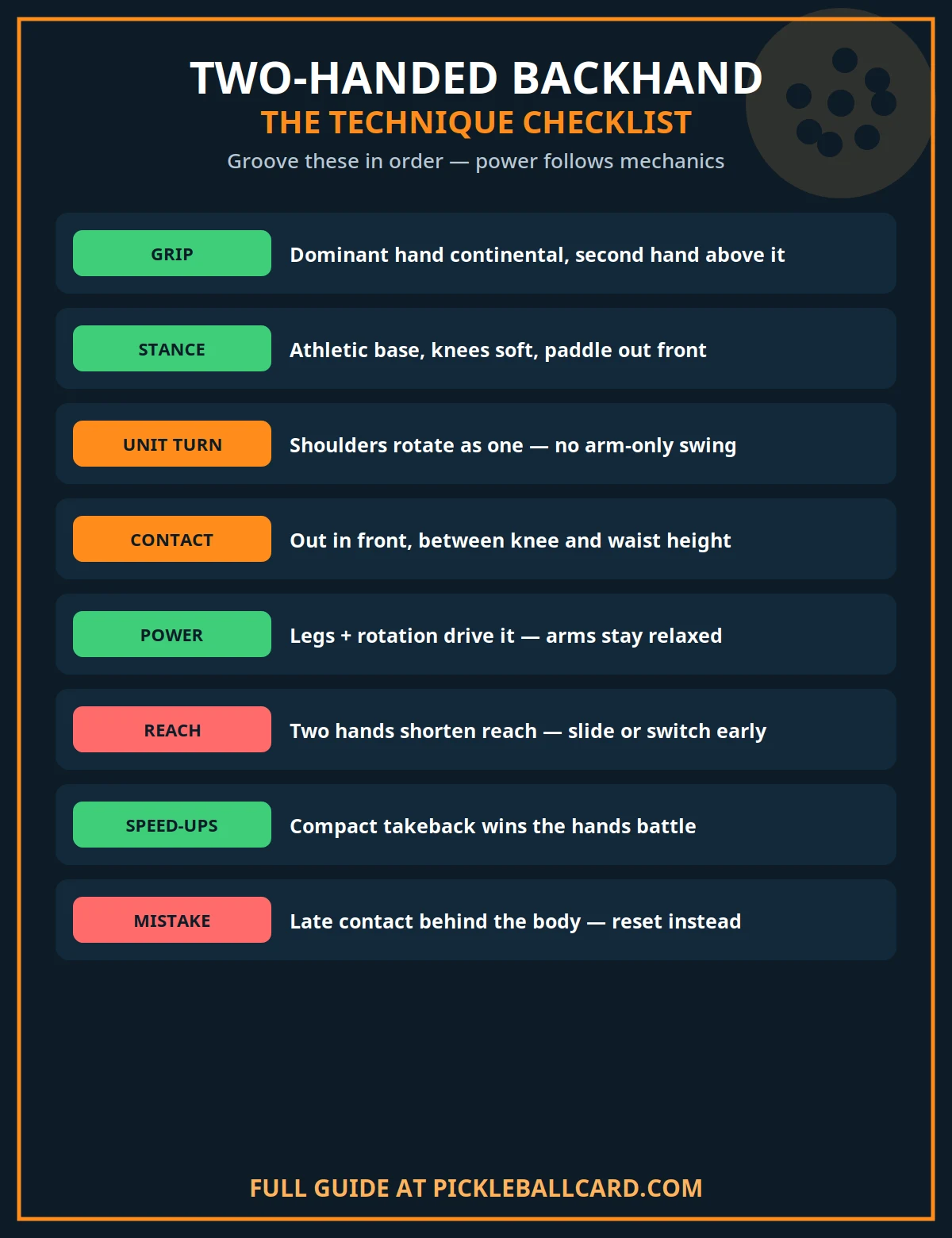
Two-handed backhand technique checklist — grip, stance and swing cues.
Common Two-Handed Backhand Mistakes (and Fixes)
- Too big a backswing. The most common error, especially at the kitchen. A long backswing makes you late by definition. Fix: keep the paddle within your line of vision and think compact push, not big swing.
- Arming the ball. Swinging with the arms while the feet and hips stay flat produces a weak, high contact. Fix: step into the shot first and let hip rotation start the forward swing.
- Contact too far in front. Reaching stretches the arms and disconnects the core. Fix: let the ball travel to the lead hip and meet it closer to your body.
- Loose top hand. If the non-dominant hand just rides along, you lose the shot’s entire advantage. Fix: the top hand grips tighter and actively pulls the paddle through contact.
- Collapsing wrist at contact. The paddle face rotates and the ball sprays. Fix: firm up the wrists in the hitting zone without tensing your whole arm.
- Forcing it on jammed balls. Trying a full two-hander on a ball at your chest produces a panicked, off-balance swing. Fix: switch to a compact one-handed punch block when the ball is on your body.
- Standing too upright on dinks. A high stance with two hands pops dinks up. Fix: stay low with bent knees and keep the paddle below net height on soft shots.
Transition Drills: Switching From One Hand to Two
Switching backhands is a muscle-memory project, not a technique lecture. Your old swing will surface under pressure for weeks — that is normal. These four drills shorten the process.
Drill 1: Non-Dominant-Hand Isolation
Hit forehands with only your non-dominant hand for ten minutes — against a wall or with a feeding partner.
This teaches the top hand to lead the swing, which is the single most unnatural part of the switch. Once the top hand moves confidently alone, add the dominant hand back underneath.
Drill 2: Dink-Only Two-Handed Games
Play dink-only games where every backhand dink must use two hands. The slow pace removes pressure while forcing hundreds of correct grip reps. Keep score to add just enough tension to reveal where your old habits resurface.
Drill 3: Speed-Up and Counter Feeds
Have a partner feed medium-paced balls to your backhand at the kitchen. Alternate: they speed up, you counter with a compact two-handed push. Start at half pace and increase only when your contact point stays at the lead hip.
Drill 4: Baseline Drive Targets
From the baseline, hit two-handed drives at a deep target zone — a towel or cone placed a few feet inside the baseline.
The target forces you to brush up for topspin instead of flattening the ball, which is exactly the swing path the shot needs.
For structured guidance beyond solo practice, USA Pickleball runs official coach education and certification programs through its partner organizations — a certified local coach can spot grip and footwork flaws in one session that take months to self-diagnose.
A Note for Senior Players: Less Wrist Strain
The two-hander has a quiet advantage for older players: it takes load off the wrist. A one-handed backhand asks the wrist and forearm to stabilize the paddle alone, which is exactly where many senior players feel strain and soreness after long sessions.
Two hands spread that force across both arms and the torso. Many players report that switching reduces the ache that used to appear after backhand-heavy games.
It is not medical advice — if you have a diagnosed wrist or elbow condition, check with your doctor or physiotherapist — but mechanically, the shared load is gentler.
The trade-off to watch is rotation. The two-hander needs more shoulder and torso turn than the one-hander, so warm up your upper back and shoulders before drilling it. Start with soft dink-pace reps and add power only when the motion feels smooth.
Checklist: Should You Switch to the Two-Hander?
- You want more power on backhand drives and speed-ups without swinging harder
- Fast balls twist your paddle face on one-handed contact
- You struggle to generate topspin from the backhand side
- High balls to your backhand consistently give you trouble
- You are willing to invest 3–4 weeks of drills before judging the results
- You can add a small shoulder turn to your preparation — the shot needs it
If you checked most of these, the switch is worth your time. If you mostly play a soft, placement-based game and your one-hander rarely breaks down, you can keep it — and still borrow the two-hander for the occasional drive.
Frequently Asked Questions
What grip should I use for a two-handed backhand in pickleball?
Dominant hand in a continental grip at the bottom of the handle, non-dominant hand above it near the top of the grip, hands touching.
The top hand grips slightly tighter since it leads the swing. If your grip is short, extending one top-hand finger onto the paddle back is fine.
Is a two-handed backhand better than a one-handed backhand?
Neither is universally better. The two-hander wins on power, stability, topspin, and counters; the one-hander wins on reach, disguise, and jammed balls. Most competitive players use both, choosing the two-hander when they have time and space and the one-hander when stretched or jammed.
Why does my two-handed backhand keep going into the net?
The usual cause is a flat or high-to-low swing path with the paddle starting at ball height.
Drop the paddle head below the ball before you swing and brush low to high through contact. Check that your wrists are firm, not collapsing, at the hitting point.
Can I use a two-handed backhand for dinks?
Yes, and many advanced players do. Two-handed dinks unlock topspin dinks that jump after the bounce, and they keep your speed-up threat live from the same setup. Stay low, keep the swing compact, and keep the paddle below net height on the soft version.
How long does it take to switch from a one-handed to a two-handed backhand?
Expect the grip and basic motion to feel comfortable within two to three weeks of regular drilling.
Trusting it in real games takes longer — typically four to six weeks — because your old swing resurfaces under pressure. Drill the non-dominant-hand isolation exercise to shorten the process.
Do professional pickleball players use two-handed backhands?
Yes — the two-hander is standard at the professional level for drives, returns, dinks, and speed-up exchanges. That said, pros also keep a one-handed option for stretched and defensive balls, which is the hybrid approach worth copying.
Start With the Situations That Pay Fastest
You do not need to rebuild your whole backhand in one session. Start by adding the two-hander to baseline drives, where the extra time makes the mechanics easiest to learn. Then bring it to the kitchen for speed-ups, where it pays the biggest dividends.
USA Pickleball’s official tips for developing players make the same underlying point this article does: a reliable backhand is what separates a one-dimensional player from a complete one. Building yours with two hands is one of the fastest ways to get there.
To round out the rest of your arsenal, browse our complete pickleball shots index — every shot in the game, with technique guides for each.

Shoaib is the publisher of Pickleball Card. He oversees the site’s guides to pickleball rules, ratings, strategy and gear, all researched from primary sources — the USA Pickleball Rulebook, DUPR and manufacturer documentation — and updated as the game changes.