Every pickleball player knows the feeling. You are halfway to the kitchen line, the ball arrives hard and low at your feet, you swing hopefully — and watch it sail into the net or float up to be smashed.
That halfway place is the transition zone, and the shot that survives it is the reset: a soft, controlled reply that drops into the kitchen, neutralises an attack, and lets you advance safely.
This guide teaches the reset properly — what it is, when to use it instead of driving or dropping, the exact mechanics, how to move through the transition zone, and the drills that make it reliable under pressure.
Key Takeaways
- A reset is a soft shot from a hard situation. It takes pace off an attacking ball and drops it unattackably into the kitchen.
- Ball height decides. Below net height in the transition zone, reset. Above net height with your feet set, you may attack instead.
- Push, do not swing. A short, stable push with a slightly open paddle face replaces any backswing. Big swings cause most reset errors.
- Get low and stay still at contact. Bent knees, weight balanced, contact in front of your body. Lunging resets rarely land softly.
- Split-step before the opponent hits. Arriving balanced in the transition zone matters more than arriving fast.
- The reset buys your advance. A good reset is not the end of the move — it is what earns you the kitchen line, one step at a time.
What Is a Reset Shot?
A reset is a defensive soft shot, usually hit from mid-court or the transition zone, that absorbs the pace of an opponent’s attacking ball and drops softly into the non-volley zone.
Its purpose is to restart the rally on neutral terms. Before the reset, your opponents are attacking and you are scrambling. After a good reset, the ball is bouncing low in their kitchen and they must hit up.
A player who can hit up on the ball cannot attack you. That single exchange — their hard ball for your soft, low one — is how rallies that looked lost turn back into ordinary dink rallies at the line.
What Is the Transition Zone?
The transition zone is the area between the baseline and the non-volley zone line — roughly the middle third of your half of the court. Coaches often call it no-man’s land, which tells only half the story.
It is dangerous ground, because balls arrive there at your feet while opponents at the kitchen hit down at you. But it is also unavoidable ground: every trip from the baseline to the kitchen passes through it.
The goal is therefore not to avoid the transition zone or sprint through it blindly. The goal is to pass through it under control, ready to reset any ball that arrives before you reach the line.
That control connects the reset to its closest relative, the drop. If you already know the third shot drop, you know the target and touch — the reset applies the same softness while you are moving and under attack.
When to Reset — and When Not To
| Situation | Best choice | Why |
|---|---|---|
| Hard ball at your feet, below net height, mid-court | Reset | Attacking a low ball from here produces nets and pop-ups |
| You are off balance, stretched, or moving backwards | Reset (or a high defensive lob if very deep) | Softness restores the rally; hero shots end it |
| Ball sits up above net height and your feet are set | Attack or drive | A high ball in transition is an opportunity, not a threat |
| You are already at the kitchen and the ball is driven at you | Block or counter, not a transition reset | Same soft hands, different position and target — see the bangers section below |
| Ball is slow, high-bouncing and you are balanced at the baseline | Drop or drive as a normal third/fifth shot | You have time to choose a full shot; a reset undersells the position |
The Height Rule
Make height your first filter, before tactics or ambition. A ball below the top of the net, arriving with pace while you are mid-court, is a reset ball in almost every case.
A ball above net height is different only if your feet are set underneath it. A high ball taken while lunging is still a defensive ball — treat it as one and you will stop donating points.
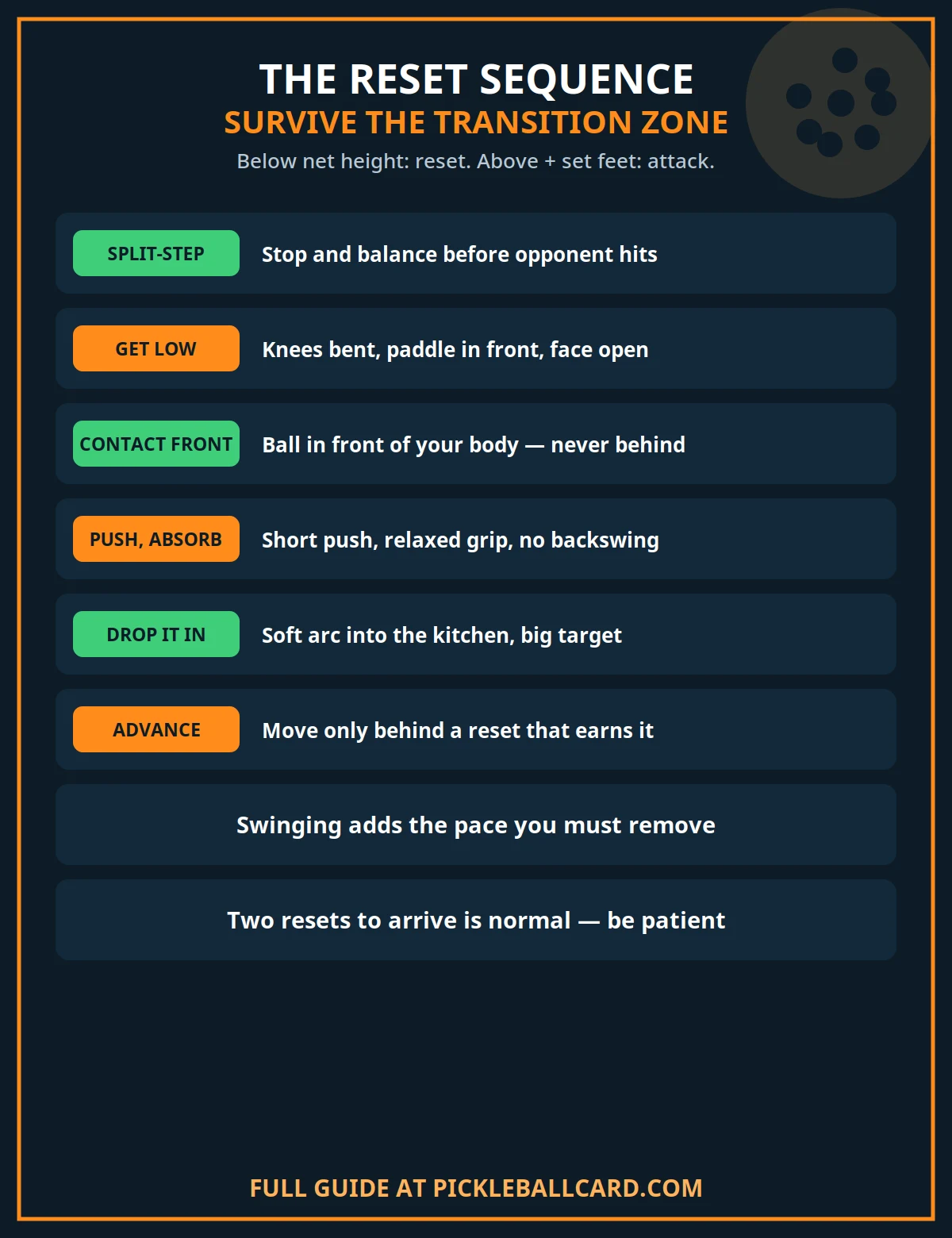
How to Hit a Reset: Step by Step
Step 1: Split-Step as Your Opponent Swings
Stop moving forward just before your opponent contacts the ball, with a small balanced hop onto both feet. This split-step is what turns a running player into a ready one.
From the split-step you can move in any direction, stay low, and present a stable paddle. Without it, most resets are attempted while falling forward — and fall into the net with their owner.
Step 2: Get Low, Paddle in Front
Bend your knees, keep your chest up, and hold the paddle in front of your body at roughly waist-to-chest height, face slightly open. Your non-paddle side should stay balanced, not reaching.
The reset is played from your legs and posture far more than from your arm. If your legs are straight and your paddle is down by your knee, the technique has failed before the ball arrives.
Step 3: Let the Ball Come to Your Contact Point
Contact the ball in front of your body, around the front of your lead foot’s line — never beside your hip or behind you. Move your feet in small steps so the ball arrives at that point.
Reaching and lunging stretch your contact point sideways and destroy the soft angle you need. Two small steps beat one big stretch on almost every reset you will ever hit.
Step 4: Push, Absorb, and Lift Just Enough
Use a short push rather than a swing. Let the paddle absorb the incoming pace — a relaxed but stable grip, minimal backswing, and a gentle lift through contact to clear the net.
The paddle face, slightly open, does the softening for you. Think of catching the ball on the strings and placing it over, rather than striking it back at your opponents.
Your target is the kitchen in front of the opponent who is least ready to bend — usually the player who just attacked, now recovering, or the middle between two partners.
Step 5: Recover and Advance Behind Your Own Shot
Watch your reset land. If it drops low into the kitchen, advance — in balance, split-stepping again if another ball comes before you arrive at the line.
If your reset sits up, hold your ground and prepare to reset again. Advancing behind a bad reset simply moves you closer to the smash it invites. The shot earns the steps; take only the steps it earns.
Forehand and Backhand Resets
Most players reset more reliably on one side, and opponents will find the weaker one quickly. Both sides use the same principles, with small differences.
- Forehand reset: the more natural side for most players. Keep the elbow relaxed and slightly away from the body, and resist the urge to roll the wrist for extra lift.
- Backhand reset: often steadier with two hands at club level, which stabilises the face against pace. One hand works if the grip stays relaxed and the push stays short.
- Balls at your body: step aside to create a forehand or backhand rather than jamming the paddle into your chest. A small sideways step is the hidden skill in body-ball defence.
The same soft-hand principles defend you at the kitchen line against hard hitters. For the full game plan built around them, see how to beat bangers in pickleball.
Moving Through the Transition Zone: The Fifth-Shot Mindset
Think of your advance as a sequence, not a sprint. A typical pattern for the serving team is: third shot, move in, split-step, reset if needed, move in again, and arrive at the kitchen.
The fifth shot — the ball after your third — is very often a reset, because good opponents drive or roll it at the advancing team. Expecting that ball, instead of resenting it, changes your whole transition.
- Advance in stages. Move when your team’s shot is good; stop and split-step when the opponent is about to hit.
- Stay connected with your partner. Advance together, a step apart in timing at most. A lone advancer opens diagonal gaps that no reset can cover.
- Expect the ball at your feet. Good opponents aim there deliberately. A paddle already low and in front is the answer prepared in advance.
- Be patient with one more reset. Needing two resets to arrive is normal against strong opponents. Needing zero is a bonus, not a plan.
Once you arrive, the rally becomes the soft game at the line. Our guide to pickleball dinking strategies picks up exactly where the reset leaves off.
Reset vs Drop vs Block vs Counter
| Shot | Where | Incoming ball | Goal |
|---|---|---|---|
| Reset | Transition zone, moving | Hard or low, attacking | Absorb pace, drop into kitchen, advance |
| Drop | Baseline or deep, set | Manageable, time to choose | Soft arc into kitchen to move forward |
| Block | Kitchen line, set | Drive at you | Short push back low, keep opponents back |
| Counter | Kitchen line, set | Speed-up that sits up | Short punch back with pace at feet or body |
The family resemblance is real: all four reward a stable face, a short motion, and contact in front. The differences are position, incoming pace, and how much pace you return.
Confusing them causes classic errors — countering from mid-court, which pops balls up, and resetting balls at the kitchen that should be countered, which gives attackers another free swing.
Drills That Build a Reliable Reset
- Feet-reset cooperative drill. One player at the kitchen drives controlled balls at a partner in the transition zone, who resets into the kitchen. Ten balls, then swap. Build pace only as resets keep landing softly.
- Advance-and-reset ladder. Start at the baseline. Hit a drop, advance two steps, reset a fed ball, advance again, and finish at the line. Repeat the ladder for five minutes to groove staged movement.
- Two-reset survival. Attackers may drive twice at the advancing player, who must reset both before any counter is allowed. This builds the patience that real transition rallies demand.
- Backhand-only resets. Feed only to the backhand for sets of ten. The weaker side improves fastest when it cannot be avoided — and opponents will not avoid it in matches.
- Live fifth-shot games. Play points where the serving team must hit a third shot and then play out the rally, scoring double if they reach the kitchen without error. The reset becomes a habit inside real decisions.
Common Reset Mistakes
- Swinging. A backswing adds pace you are trying to remove. Push instead.
- Running through the shot. Contact while sprinting forward sends the ball down into the net. Split-step, reset, then move.
- Standing tall. Straight legs raise your contact and flatten the arc. Get low before the ball arrives, not as it passes.
- Gripping too tightly. A locked grip rebounds pace straight back up. Relax the hand and let the face absorb the ball.
- Aiming too fine. Resets aimed at the sideline or the net tape miss in both directions. Aim for the big middle of the kitchen.
- Attacking low balls out of frustration. After three good resets, players often donate the fourth by driving a ball at their shoelaces. The height rule has no frustration exception.
- Watching instead of recovering. A reset you admire is a smash you receive. Recover first, appreciate later.
Frequently Asked Questions
What is a reset shot in pickleball?
A reset is a soft, controlled shot, usually hit from the transition zone, that absorbs the pace of an attacking ball and drops into the kitchen. It neutralises an attack and lets the hitter advance toward the non-volley zone line.
What is the transition zone in pickleball?
It is the mid-court area between the baseline and the non-volley zone line. Players pass through it on their way to the kitchen, and it is where hard balls at the feet most often force reset shots.
Should I reset or attack a ball in the transition zone?
Use height and balance. Below net height, or any time you are off balance, reset. Above net height with your feet set underneath you, attacking is reasonable — and often correct.
Why do my resets keep going into the net?
Usually because contact is too low, too close to the body, or made while still running forward. Split-step earlier, get lower with your legs, keep the paddle face slightly open, and add a gentle lift through contact.
Why do my resets pop up to be smashed?
Pop-ups come from a tight grip, a flat or closing paddle face under pace, or swinging at the ball. Relax the grip, keep the face slightly open and stable, and replace the swing with a short push that absorbs pace.
Is a reset the same as a third shot drop?
They share a target and a soft touch, but they are not the same shot. A drop is usually hit from deep court with time to choose it; a reset is hit under attack, often while moving, specifically to neutralise an opponent’s pace.
The Bottom Line
The reset shot is how good players survive the transition zone: split-step, get low, push softly with a stable, slightly open face, drop the ball into the kitchen, and advance only behind shots that earn it.
It will not make highlight reels, and it will quietly win you rallies every single session — the drives at your feet that used to end points become the balls that get you to the kitchen.
Learn to love the boring shot. In the transition zone, boring is what winning looks like, one soft landing at a time.
Sources: USA Pickleball, Official Rules (non-volley zone definitions). Coaching content in this article is original; no competitor content is linked or reproduced.