Pickleball Court Surfaces Explained: Acrylic, Asphalt, Concrete, And More
The ground beneath your feet shapes every pickleball rally. It affects ball bounce, foot grip, joint comfort, and how safely you can stop and change direction.
Many players choose a court for its location or its price. The surface itself often gets far less attention, even though it influences play every single point.
This guide explains the main pickleball court surfaces in plain language. You will learn how each one plays, how it lasts, how it handles weather, and where it fits best.
Key Takeaways
- Acrylic over asphalt or concrete gives the most consistent bounce for dedicated outdoor pickleball courts.
- Bare asphalt and bare concrete are firm, durable bases, but they play faster and feel harder underfoot.
- Cushioned acrylic adds comfort without changing the basic hard-court character of the game.
- Modular tiles drain quickly, install fast, and allow single-tile repair, but bounce depends on tile quality.
- Indoor wood suits gyms and multi-sport halls, while grass suits casual play only, not consistent competitive rallies.
- Drainage, slope, base condition, and maintenance matter as much as the top layer you choose.
- Match the surface to the setting first, then to playing style, climate, and long-term upkeep.
Why The Surface Matters So Much
A pickleball is light and perforated, so it responds quickly to surface texture. A rough surface can slow the ball and wear it faster, while a smooth surface can speed play up.
Your shoes interact with the surface on every split step, lunge, and lateral move. Too much grip can feel sticky, while too little grip can feel slippery and unsafe.
Joint comfort also changes with surface hardness. A firm court returns more impact to ankles, knees, and hips than a cushioned or slightly forgiving system.
Weather adds another layer of difference. Some surfaces shed water quickly, while others hold puddles, stay damp, or become slick after rain.
The Official Court Size, Whatever The Surface
A regulation pickleball court measures 20 feet wide and 44 feet long. The same dimensions apply to singles and doubles play, which keeps court planning simple.
The net stands 36 inches high at the sidelines and 34 inches high at the center. That gentle dip is part of the game and should not be changed to suit a surface.
The non-volley zone extends 7 feet from the net on each side. Lines are 2 inches wide and count as part of the area they border.
For comfortable play, the minimum playing surface area is 30 feet wide and 60 feet long. New courts and tournament settings often allow a larger area, commonly 34 feet by 64 feet.
Surface choice never changes these measurements. It only changes how the ball and your body behave inside the same court outline.
Acrylic Court Surfaces
An acrylic surface is a coating system applied over asphalt or concrete. It is the familiar colored hard court seen at many dedicated pickleball facilities and clubs.
The system usually starts with filler and resurfacer coats. Those coats seal pores, smooth the base, and create an even layer for the color coats above.
Finish coats often include fine silica sand. That sand creates texture, controls grip, and helps produce a predictable bounce across the court.
How Acrylic Plays
Acrylic offers a true, consistent bounce when the base is level and the coating is even. Players can trust the ball to behave the same way from one end to the other.
Speed can be tuned to a degree through texture and sand content. A finer texture tends to play faster, while a coarser texture tends to slow the ball slightly.
Grip is generally reliable in dry conditions with proper court shoes. The textured finish helps players plant, push off, and change direction with confidence.
Durability And Maintenance For Acrylic
Acrylic coatings resist ultraviolet light well and hold color better than many bare pavements. Fading still occurs over time, especially in strong sun and high-use areas.
Routine care is simple: sweep debris, wash dirt away, and keep drains clear. Leaves, grit, and standing water should not be left sitting on the coating.
Recoating is part of long-term ownership. Many outdoor acrylic courts need fresh color and texture coats after several years of regular play.
Asphalt Courts
Asphalt is a common base for outdoor courts. It is made from aggregate bound with bitumen, and it can be coated with acrylic or left bare for informal play.
As a base, asphalt is slightly more forgiving than concrete. Many players describe it as a touch softer underfoot, although it is still a hard court.
How Asphalt Plays
Bare asphalt is rough and fast in a different way from acrylic. The ball may bounce less evenly if the surface is worn, patched, or uneven.
Grip is usually strong on dry asphalt, but texture varies across older areas. Worn patches can feel smoother, while fresh patches can feel sharper and more abrasive.
Ball wear is a real drawback of bare asphalt. Its rough texture can scuff outdoor pickleballs faster than a smooth acrylic finish.
For serious play, asphalt works best as the base beneath acrylic. The coating evens out texture and gives players a more reliable bounce.
Durability And Maintenance For Asphalt
Asphalt can crack with ground movement, tree roots, and freeze-thaw cycles. Cracks should be filled promptly before water enters and widens them.
Sealing helps protect bare asphalt from moisture and sun. Sealed asphalt still needs cleaning, crack care, and periodic renewal to stay playable.
An asphalt base must cure before acrylic coating. Manufacturer guidance commonly allows 14 to 30 days of curing for new asphalt, depending on conditions.
Concrete Courts
Concrete is a rigid, long-lasting base for outdoor courts. It is often chosen for permanence, strength, and a flat, stable playing platform.
Like asphalt, concrete is usually coated with acrylic for dedicated pickleball play. Bare concrete can serve for casual games, but it is not ideal for regular play.
How Concrete Plays
Bare concrete feels very firm and fast. The ball bounces high and true on a smooth slab, but the surface offers little forgiveness for joints.
Texture depends heavily on finish. A medium broom finish gives more grip than a steel-troweled finish, which can become slippery when wet.
Once coated with acrylic, concrete plays much like an acrylic-over-asphalt court. The coating, not the bare slab, sets bounce, grip, and speed.
Concrete can feel the hardest of the common outdoor bases. Players with sensitive knees or ankles often prefer a cushioned coating over concrete.
Durability And Maintenance For Concrete
Concrete resists rutting and holds its shape well under heavy use. It is less likely to soften in heat than asphalt, which helps in hot climates.
Cracking remains possible, especially without control joints, proper curing, and drainage. A vapor barrier beneath the slab helps reduce moisture problems.
New concrete needs longer curing before coating than asphalt. Manufacturer guidance commonly requires about 28 days before acrylic application.
Cushioned Acrylic Systems
Cushioned acrylic adds rubberized layers beneath the color coats. The goal is comfort: less impact on joints without losing the predictable hard-court bounce.
These systems suit clubs, schools, and players who play often. They also suit older players and anyone returning from a lower-body injury, with medical advice as needed.
Play remains close to standard acrylic, but the feel is slightly softer. Some players notice a touch less speed, while others notice only the added comfort.
Maintenance is similar to standard acrylic, with recoating still needed over time. Cushion layers add upfront cost, but they may reduce fatigue during long sessions.
Modular Sport-Court Tiles
Modular tiles are interlocking panels, usually made from polypropylene. They snap together over a prepared base and form a complete playing surface.
Tile systems are popular for backyards, schools, churches, and multi-sport areas. They install quickly and can be removed or reconfigured more easily than a coated court.
How Modular Tiles Play
Well-designed pickleball tiles aim for a consistent, predictable bounce. Quality matters greatly: cheap tiles can feel hollow, uneven, or too lively.
Speed varies by tile design and texture. Many pickleball-specific tiles play at a brisk pace, which suits fast hands but rewards controlled dinks.
Grip is textured and tested for dry and damp play on quality systems. Still, wet leaves, dust, and worn tiles can reduce traction and should be cleaned promptly.
Joint feel is often slightly kinder than bare hard court. Tiles add a small amount of give and lateral forgiveness, although they are not soft like a gym mat.
Durability And Maintenance For Tiles
Outdoor tiles are made to resist ultraviolet light and weather. Color fading is slower on quality tiles than on some painted surfaces, but not impossible.
Drainage is a major strength. Open-grid tiles let water pass through, so courts often dry faster and resume play sooner after rain.
Repair is simple: a damaged tile can usually be lifted and replaced alone. That avoids recoating a whole court for one worn or cracked area.
Indoor Wood Courts
Indoor wood is the classic gymnasium floor. It is common in schools, recreation centers, and multi-sport halls that host pickleball alongside basketball and volleyball.
Wood plays fast and smooth, with a lively bounce. Players often find the ball skids a little more than on textured acrylic, so control matters.
Grip depends on finish and cleanliness. A clean, well-maintained wood floor grips well, while dust can make it slippery very quickly.
Joint feel is kinder than bare concrete, because wood flexes slightly over its subfloor. It is not cushioned, but it is less jarring than a rigid outdoor slab.
Grass Courts
Grass offers a soft, informal setting for casual pickleball. It suits garden games, social play, and introducing new players in a relaxed space.
Bounce is the main limit. Grass slows the ball, makes bounce less predictable, and changes with mowing, moisture, and wear patterns.
Grip varies with dampness and grass length. Wet grass can be slippery, while long grass can grab the ball and slow rallies to a crawl.
Pickleball Court Surfaces Compared
The table below sums up the main choices at a glance. Use it to narrow options, then weigh setting, climate, and upkeep before deciding.
| Surface | Speed And Bounce | Grip | Joint Feel | Weather | Upkeep | Relative Cost |
|---|---|---|---|---|---|---|
| Acrylic Over Asphalt Or Concrete | Consistent, tunable | Reliable when dry | Firm | Good with drainage | Clean, recoat over time | Mid to higher |
| Cushioned Acrylic | Consistent, slightly softer | Reliable when dry | Kinder than standard acrylic | Good with drainage | Clean, recoat over time | Higher |
| Bare Asphalt | Less even, wears balls | Strong, variable texture | Firm | Cracks in freeze-thaw | Seal, fill cracks | Lower as a base |
| Bare Concrete | Fast, true on smooth slab | Depends on finish | Very firm | Durable, needs drainage | Clean, repair cracks | Mid as a base |
| Modular Tiles | Brisk, quality dependent | Textured, good wet or dry | Slightly forgiving | Fast drainage | Clean, replace single tiles | Mid to higher |
| Indoor Wood | Fast, lively | Good when clean | Some flex | Indoor only | Clean, refinish over time | Higher, usually existing |
| Grass | Slow, uneven | Variable, slippery when wet | Soft | Poor when wet | Clean, refinish over time | Lower, high effort |
Costs vary widely by region, court size, base condition, and labor. This guide therefore uses relative bands only, not figures that quickly go stale.
Bare asphalt or an existing usable slab is usually the lower-cost starting point. That saving shrinks if the base needs repair, leveling, or drainage work.
Standard acrylic coating sits in the middle range for a dedicated court. It adds material and skilled labor over a bare base, but it buys consistency.
Cushioned acrylic and quality modular tiles usually cost more upfront. They may save effort later through comfort, drainage, or single-tile repair.
Indoor wood is usually an existing-venue cost, not a new-build choice. Building a new wood court from scratch is a larger project than coating an outdoor slab.
Choosing A Surface: The Checklist
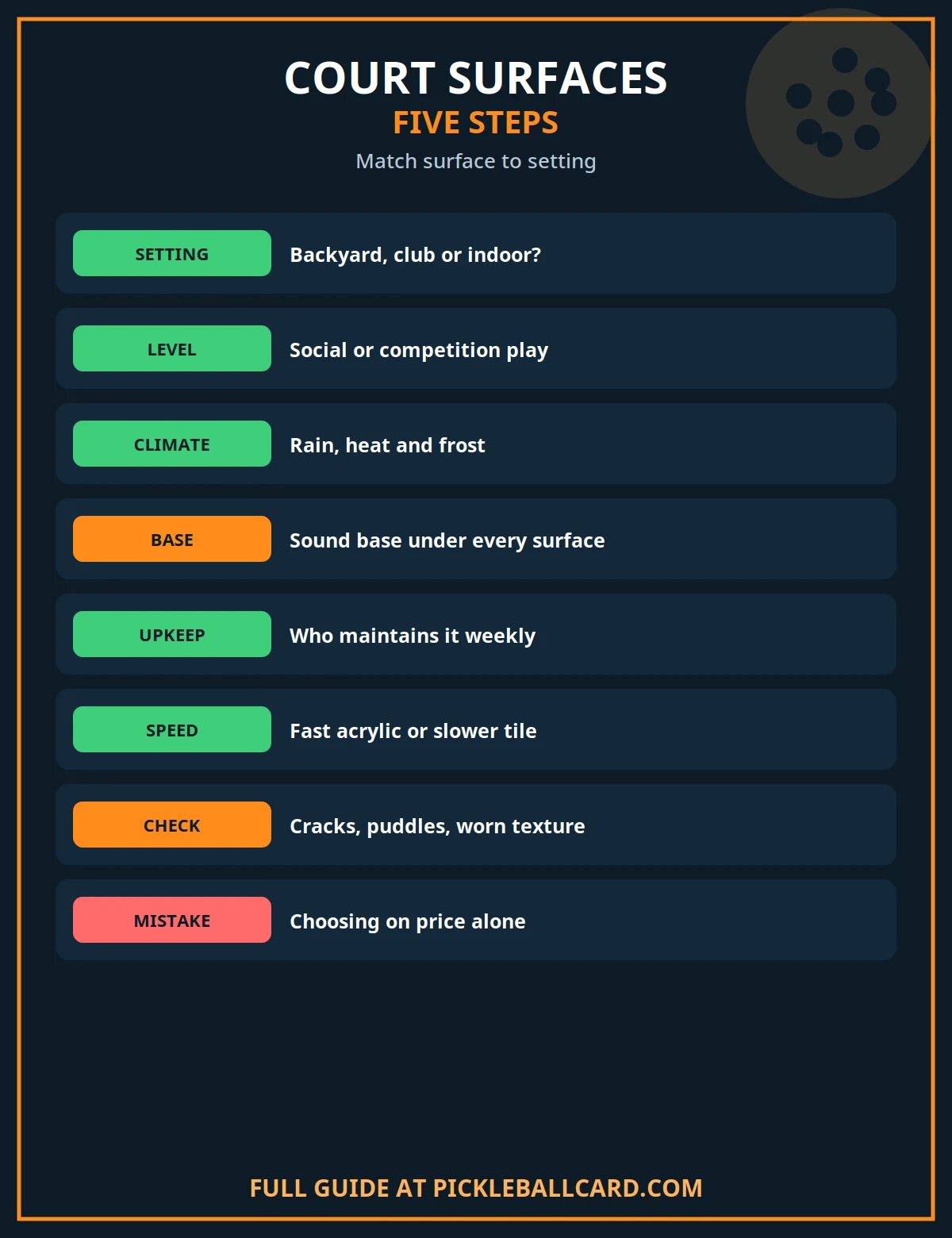
- Setting: Is this a backyard, club, school, gym, or temporary event space?
- Play level: Will play be casual, social, league, or competitive?
- Frequency: Will the court host daily play, weekly games, or occasional matches?
- Climate: Does the site face strong sun, heavy rain, frost, or long winters?
- Drainage: Does water slope away cleanly, or does it pool after rain?
- Base: Is the existing slab level, sound, and free of major cracks?
- Comfort: Do players need cushioning for knees, ankles, or long sessions?
- Upkeep: Who will clean, repair, and recoat or replace the surface?
- Flexibility: Must the space host other sports, events, or seasonal use?
- Budget over time: Have you counted recoating, sealing, and repairs?
Which Surface Suits Which Setting
Backyard Courts
Backyards suit acrylic over a sound slab for regular play. The surface gives consistent rallies, clear lines, and a proper pickleball feel at home.
Modular tiles suit backyards where speed, flexibility, or multi-sport use matters. They install fast and let one space serve several games.
Grass suits only occasional backyard fun. It is charming for a social hit, but it will not give fair, repeatable rallies for serious practice.
Before building, check space, slope, drainage, and local rules. A guide to planning a home court helps with layout and base choices, as does our backyard court guide: building a backyard pickleball court.
Clubs And Community Courts
Clubs usually need durability, consistent bounce, and manageable upkeep. Standard or cushioned acrylic over asphalt or concrete meets those needs well.
High-use clubs should favor cushioned acrylic where comfort matters. Long sessions and older players both benefit from a slightly softer hard court.
Indoor Venues
Indoor venues suit wood floors, sport tiles, or indoor acrylic systems. The choice depends on whether the hall is multi-sport or pickleball-only.
Wood suits schools and gyms that already own the floor. Temporary pickleball lines can turn a gym into a playable court without permanent changes.
Indoor acrylic or tile systems suit pickleball-only halls. They give a more pickleball-specific bounce than a general gym floor.
Temporary And Pop-Up Courts
Temporary courts suit modular tiles or taped lines on a suitable floor. Tiles give a real court feel, while tape gives a fast, low-cost trial.
Check the base first: it must be flat, clean, and safe. A bumpy car park or dusty hall will spoil play, whatever lines or tiles you add.
Resurfacing Signs To Watch For
Fading color is an early sign of wear. When lines and playing areas look pale, grip and visibility may already be declining.
Smooth, shiny patches signal worn texture. Those areas can feel slick, especially when damp, and they change ball behavior.
Cracks, even hairline ones, deserve attention. Water enters cracks, widens them, and can lift coatings or shift tiles over time.
Peeling, bubbling, or flaking coatings show bond failure. Those areas need proper preparation and repair, not just another coat on top.
Choosing Guidance: A Simple Decision Path
Start with the setting, not the product. A backyard, club, gym, and pop-up event each pull toward a different surface family.
Next, check the base honestly. A cracked, uneven, or poorly drained base must be fixed before any coating or tile system is judged.
Then match play level to bounce needs. Casual play tolerates more variation, while league and competitive play demand consistency.
Finally, compare whole-life upkeep. A surface you can clean, repair, and recoat on schedule will play better than a neglected premium surface.
Court size and layout still frame every choice. Confirm dimensions and run-off space in our guide to pickleball court size and layout before marking lines or ordering materials.
Weather planning also belongs in the decision. Learn how rain affects play and safety in our guide to playing pickleball in the rain before committing to an outdoor surface.
Frequently Asked Questions
What is the best pickleball court surface for most players?
For most dedicated outdoor courts, acrylic over asphalt or concrete is a strong default. It gives consistent bounce, reliable grip, and clear lines.
Is acrylic better than concrete for pickleball?
Acrylic is a coating, not a rival to concrete. Concrete is the base, and acrylic is the playing layer applied over it.
Coated concrete plays more consistently than bare concrete. The coating controls texture, grip, and bounce in a way bare concrete cannot.
Can you play pickleball on bare asphalt?
Yes, for casual play, bare asphalt works. It is firm, grippy when dry, and widely available in parks and driveways.
Do modular tiles bounce like acrylic courts?
Quality pickleball-specific tiles aim for a consistent, predictable bounce. On a level base, many players find the bounce close to acrylic.
How often should an acrylic pickleball court be resurfaced?
Timing depends on use, climate, and coating quality. Many outdoor courts need recoating after several years of regular play.
Watch for fading, smooth patches, cracks, and peeling. Those signs matter more than any fixed calendar date.
Which surface is kindest to knees and joints?
Cushioned acrylic and quality modular tiles tend to feel kinder than bare hard courts. Wood also offers some flex indoors.
No surface replaces good shoes, warm-ups, and sensible play volume. Comfort helps, but it does not remove injury risk entirely.
Sources And Further Reading
Court dimensions and net heights in this guide follow the USA Pickleball rulebook framework, with the court at 20 feet by 44 feet and the net at 36 inches at the sidelines and 34 inches at the center.
Coating preparation, curing times, and drainage guidance follow manufacturer surfacing guidance from SportMaster, including its pickleball surfacing system and its guidance on preparing asphalt and concrete bases.
For modular tile performance, Sport Court describes its pickleball tile system as the official modular tile surface of USA Pickleball, with textured traction and open-grid drainage for outdoor play.

Shoaib is the publisher of Pickleball Card. He oversees the site’s guides to pickleball rules, ratings, strategy and gear, all researched from primary sources — the USA Pickleball Rulebook, DUPR and manufacturer documentation — and updated as the game changes.