Every dink rally ends the same way: someone decides the soft game is over. That decision — the speed-up — is the most exciting and most misplayed moment in modern pickleball.
To speed up in pickleball is to suddenly attack from a dink rally: take a ball your opponent expects you to dink back softly, and drive it hard instead, usually at their body or into open court.
The rally shifts in an instant from a slow exchange to a fast hands battle.
Done right, a speed-up wins points outright or forces a weak reply you can finish. Done wrong, it hands your opponent a ball they can counterattack — and you become the target of the next speed-up.
This guide covers when to speed up, how to execute it, where to aim, and — just as important — how to counter a speed-up when one comes at you.
It builds on our guides to pickleball dinking strategies and how to beat bangers in pickleball.
Key Takeaways
- A speed-up is a deliberate tempo change from a dink rally: a sudden, controlled attack, usually at the kitchen line.
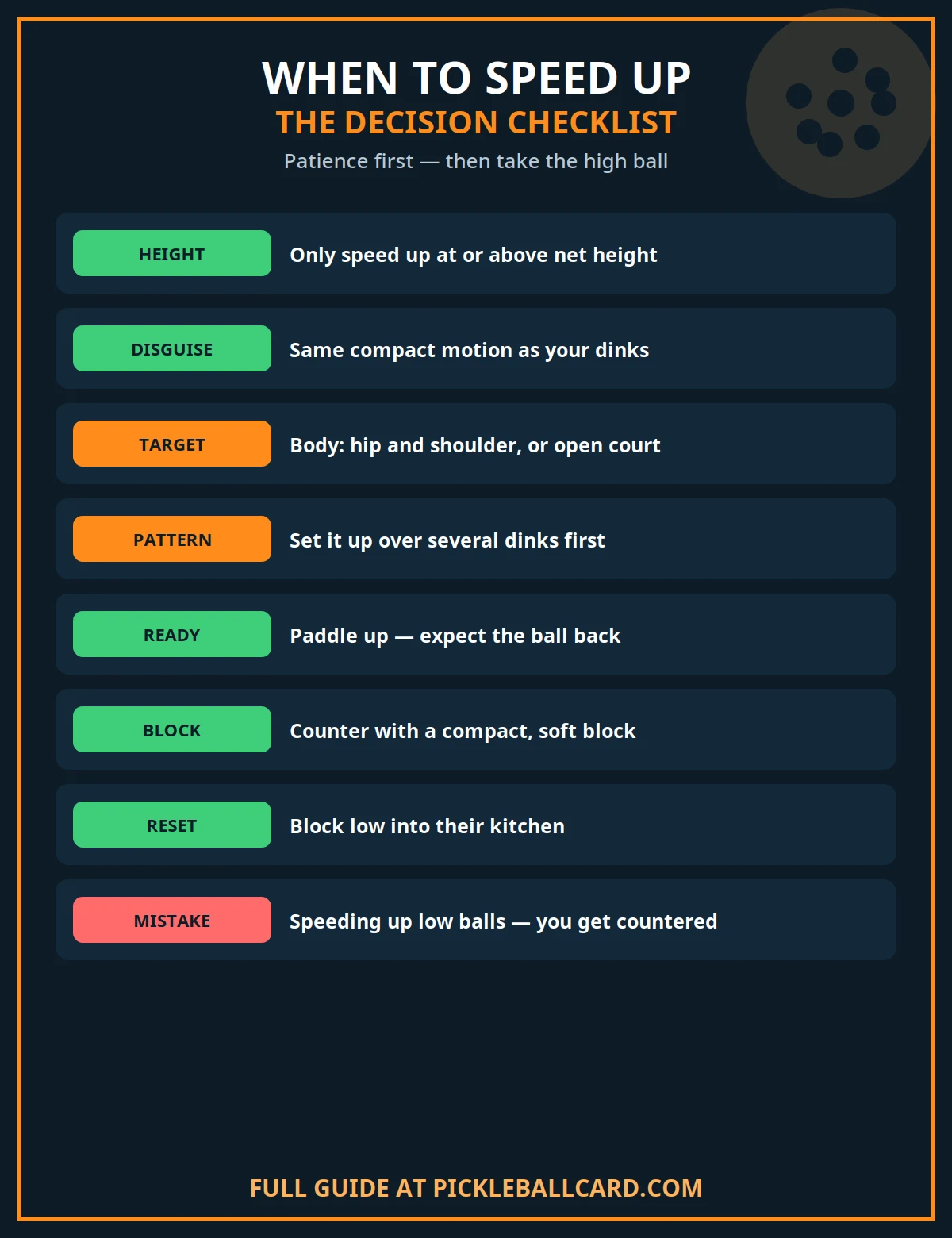
- The golden rule: only speed up balls at or above net height. Speeding up a low ball pops it up and invites a counterattack.
- The best triggers are a high dink, a short ball, an off-balance opponent, or a predictable pattern you have set up over several dinks.
- Aim at the body — paddle-side hip and shoulder — or into open court. Avoid the opponent’s paddle in ready position.
- Disguise matters: keep the same compact motion as your dinks, with no big backswing to warn your opponent.
- To counter a speed-up, block softly with a compact paddle, reset into the kitchen, and never swing big at a fast ball.
What Is a Speed-Up in Pickleball?
A speed-up is an attacking shot played from within a soft rally. You and your opponent are dinking — soft, controlled shots that arc just over the net and land in the kitchen — when you suddenly drive a ball with pace instead.
The speed-up is not simply hitting hard. It is a calculated acceleration at a moment your opponent does not expect, aimed at a target they cannot defend in time.
USA Pickleball’s own coaching material defines the speed-up the same way: a sudden change of pace from the kitchen designed to catch an opponent off guard.
Speed-ups happen mostly at the kitchen line, where the distance is short and reaction time is minimal. They can also happen from mid-court, but the kitchen speed-up is the one that defines the modern game.
Speed-Up vs Drive vs Slam
A drive is a hard groundstroke, usually from the baseline or mid-court. A slam is an overhead putaway of a high ball. A speed-up is different from both: it comes out of a soft rally, from a compact motion, and its weapon is surprise as much as pace.
That distinction matters for the counter. You defend a drive by blocking; you defend a speed-up the same way, but you have far less time, because you were expecting a dink.
Why Speed-Ups Define the Modern Game
Watch professional pickleball and you will see the pattern: long dink rallies punctuated by sudden speed-ups and the hands battles that follow. The team that speeds up first usually wins the exchange, because the first attacker forces the defender to react.
Recreational players copy the pros’ aggression but skip the patience. The result is speed-ups on low balls, from bad positions, with big swings — all of which lose points. Patience first, then speed.
When to Speed Up: The Triggers
Speed up only when the ball and the situation justify it. These are the triggers that make a speed-up a good decision rather than a gamble.
1. The Ball Is at or Above Net Height
This is the golden rule. A ball at or above net height can be driven downward into the court. A ball below net height must be lifted, and a lifted ball is a ball your opponent can attack.
Judge height at contact, not at its peak. A dink that peaks above the net but drops below it by the time you hit it is a low ball. Wait for the next one.
2. Your Opponent Is Off Balance or Out of Position
An opponent who is still moving, reaching, or recovering from the previous shot cannot defend a speed-up well. If you see them leaning, stretched wide, or late to the line, that is your window.
Creating this situation is a skill: dink wide to pull them out of position, then speed up through the space they vacated.
3. You Have Set Up a Pattern
The best speed-ups are earned over several dinks. Dink cross-court three or four times, establish a rhythm, then change direction and speed on the fourth or fifth ball. Your opponent, grooved into the pattern, reacts late.
Random speed-ups on the first dink rarely work. Patterned speed-ups work constantly.
4. The Ball Sits Up Short
A dink that lands short and bounces up is an invitation. Step in, keep your motion compact, and drive it at the body or into open court. Short balls give you time; use it to place, not to wind up.
The Speed-Up Decision Table
| What you see | Decision | Why |
|---|---|---|
| Ball above net height, opponent set | Speed up at the body | You can drive down; the body is the hardest target to defend |
| Ball above net height, opponent moving | Speed up into open court | Movement plus pace leaves no defense |
| Ball below net height | Keep dinking | A lifted ball becomes their attack |
| Ball at your feet or behind you | Reset or block | You have no attacking position; survive the ball |
| Opponent expecting it (you just sped up) | Dink instead — change the pattern | A predicted speed-up gets countered |
| High ball, partner in position to finish | Speed up to set up, not to win | Your speed-up creates the pop-up your partner finishes |
How to Execute a Speed-Up
Execution is about disguise and compactness. The best speed-ups look like dinks until the last instant.
Keep the Same Motion as Your Dinks
Do not take a big backswing. A big wind-up tells your opponent exactly what is coming and gives them time to prepare. Keep your paddle in the same ready position you use for dinks, then accelerate forward with a short, punchy motion.
Think of it as a dink with pace, not a drive. The swing is short, the contact is out in front, and the follow-through is compact.
Use Your Body, Not Just Your Arm
Step into the ball and rotate your shoulders slightly. Body weight behind a compact swing produces more pace with less effort than an arm-only swing, and it keeps the ball under control.
Aim at the Body or the Open Court
The two best targets are the opponent’s paddle-side hip and shoulder — the spots that produce the jammed “chicken wing” defense — and the open court away from their paddle.
Our guide to defending body shots explains exactly why those targets are so hard to handle.
Avoid hitting directly at a set opponent’s paddle. A ball at the paddle in ready position is a ball they can block back at you with interest.
Speed Up, Then Get Ready
A speed-up is the start of a hands battle, not the end of the point. After you speed up, keep your paddle up and expect the ball back. Players who admire their speed-up get hit by the counter.
Speed-Ups in Doubles vs Singles
In doubles, a speed-up is a team weapon. Your speed-up creates a pop-up or a weak block that your partner finishes. Communicate before speeding up in doubles: your partner needs to know a hands battle is coming so their paddle is up too.
Doubles speed-ups also have a second target: the seam between opponents. A ball driven at the middle forces a decision about who takes it, and hesitation at the kitchen is fatal.
In singles, the speed-up is riskier. There is no partner to finish a pop-up or cover a counterattack, and a failed speed-up leaves the whole court open. Singles players should speed up only on clearly high, short balls, and should aim for outright winners or forced errors rather than sustained hands battles.
The rule of thumb: in doubles, speed up to create. In singles, speed up to finish.
When NOT to Speed Up
Knowing when to hold back is what separates good attackers from reckless ones:
- Low balls: anything below net height at contact. Lift it and you lose.
- When you are off balance: reaching, moving backward, or stretched wide. Get set first.
- Every ball: speeding up constantly makes you predictable. Opponents start waiting for it.
- When your partner is out of position: a counterattack will go at them, not you.
- Out of frustration: speeding up because you are bored of dinking is how rallies are donated.
How to Counter a Speed-Up
Sooner or later, a speed-up comes at you. The counter decides whether you lose the point or win it back.
1. Keep Your Paddle Up and Out Front
Countering starts before the speed-up arrives. A paddle held at chest height, out in front of your body, is already in blocking position. A paddle hanging at your waist is not.
2. Block, Don’t Swing
When a fast ball arrives, do not take a swing at it. Hold a firm but relaxed paddle in its path and let the ball’s pace do the work. A short block, angled down into the kitchen, turns their attack into your reset.
Big swings at fast balls produce pop-ups. Pop-ups produce putaways. The block is the whole defense.
3. Soften Your Hands
Loosen your grip slightly at contact so the paddle absorbs pace instead of reflecting it. A soft block drops into the kitchen; a rigid block rebounds high and long.
4. Reset Into the Kitchen
Aim your block to land softly in the opponent’s kitchen, near their feet. A low reset forces them to hit up on the next ball, which ends their attack and restarts the dink rally on your terms.
5. Counterattack Only the High Ball
Sometimes the speed-up comes at you high and soft enough to re-attack. If the ball arrives above net height and you are set, drive it back at the attacker’s body or feet.
If it arrives low or fast, block it. The same golden rule applies in reverse.
For the full blocking system, read our guide to pickleball dinking mistakes — several of them are exactly the errors that make speed-ups against you work.
Speed-Up Drills
Drill 1: The Height Gate
Dink with a partner, but you may only speed up balls that arrive above net height. Mark the net height on a post with tape if it helps. This drill builds the height discipline that most players lack.
Drill 2: Three Dinks, Then Decide
Play kitchen rallies where neither player may speed up before the third dink. This forces pattern-building and patience, and it teaches you to recognize the set-up ball.
Drill 3: Block and Reset Relay
One player speeds up every ball; the other may only block and reset. Switch roles every five minutes. The blocker learns the compact defense; the attacker learns which speed-ups actually work against a set defender.
Frequently Asked Questions
When should you speed up in pickleball?
When the ball arrives at or above net height, your opponent is off balance or out of position, or you have set up a pattern over several dinks. Never speed up a ball below net height.
What is the difference between a speed-up and a drive?
A speed-up comes out of a soft dink rally with a compact motion and relies on surprise. A drive is a hard groundstroke, usually from farther back, with a fuller swing.
Where should you aim a speed-up?
At the opponent’s paddle-side hip or shoulder, or into open court away from their paddle. Avoid hitting directly at a set opponent’s paddle.
How do you defend against a speed-up?
Keep your paddle up, block with a compact motion and soft hands, and reset the ball low into the kitchen. Do not swing big at a fast ball.
Should beginners learn speed-ups?
Learn the dink rally first, then the block and reset. Once you can hold a rally and defend pace, add the speed-up — starting with high, short balls only.
Is speeding up rude in recreational play?
No, it is a normal part of the game. In casual games with beginners, use it sparingly and avoid targeting the body repeatedly. In competitive play, it is expected.
Final Word
The speed-up is a decision, not a reflex. The players who win with it are the ones who wait for the right ball, disguise the shot, aim at a real target, and stay ready for what comes back.
Practice the patience first. Dink until the high ball comes, then take it — compact, placed, and ready for the hands battle that follows. And when the speed-up comes at you, block it soft, reset it low, and make the attacker play one more ball.
USA Pickleball’s coaching explainer on what a speed-up is and the Official Rulebook are the authorities behind the definitions used here.

Shoaib is the publisher of Pickleball Card. He oversees the site’s guides to pickleball rules, ratings, strategy and gear, all researched from primary sources — the USA Pickleball Rulebook, DUPR and manufacturer documentation — and updated as the game changes.