The Mental Game of Pickleball: Focus, Confidence and Composure
Pickleball rarely tests only your shots. It also tests what happens between them, after a missed serve, or when a close game turns tense.
Two players can own the same forehand and still play very different matches. The difference is often attention, patience and composure under pressure.
The good news is that mental skills are trainable. You do not need a new paddle or a perfect serve to play calmer, steadier pickleball.
This guide covers practical routines, resets, self-talk, partner communication and process goals. It offers general advice for recreational play, not medical or mental health advice.
Key Takeaways
- Use the same short pre-point routine every time, so your mind has a familiar starting point.
- After an error, reset your body first, then your attention, then your plan for the next point.
- Replace outcome goals with process goals you can control on every point.
- Use short focus cues and calm self-talk instead of long internal arguments.
- Agree simple partner phrases before the match, not during a tense rally.
- Handle disputed calls with courtesy, and let the next point matter more than the last call.
- Practise mental skills in drills, not only when a match is on the line.
What the Mental Game Actually Means
The mental game is not about never feeling nervous or frustrated. Every player feels those things, including experienced players in important matches.
It is about what you do next. Do you rush the next serve, argue the last call, or tighten up and swing harder?
Or do you slow down, breathe, pick a clear target, and play the next point on purpose? That choice, repeated many times, shapes the match.
Think of composure as a skill, not a personality trait. Skills improve with repetition, feedback and a simple plan you can remember under pressure.
Build a Pre-Point Routine
A pre-point routine is a short sequence you repeat before every serve or return. It tells your brain that a new point has started.
Keep it simple enough to use when you are tired, nervous or behind. A routine with eight steps will collapse under pressure.
Three or four steps are enough. The exact steps matter less than repeating them in the same order, every time.
A Simple Routine You Can Copy
- Walk to your spot and set your feet.
- Take one slow breath and relax your grip.
- Look at your target and say your cue word.
- Serve or prepare to return, then move forward.
For the return of serve, the routine looks similar. Set your feet, breathe, watch the server, and pick a return target before the ball arrives.
Do not change your routine because the score is close. That is exactly when a familiar routine earns its value.
The Next-Point Reset
The next-point reset is the most useful mental skill in pickleball. It is a deliberate break between the point that just ended and the point ahead.
Without a reset, errors travel. A missed dink becomes a rushed serve, which becomes a poor third shot, which becomes another error.
A reset breaks that chain. It does not erase the error. It simply stops the error from choosing your next shot.
Reset in Three Short Steps
- Body: turn away briefly, loosen your shoulders, and take one slow breath.
- Attention: look at the court, not at the last shot, and notice your position.
- Plan: choose one clear job for the next point, such as return deep or dink low.
The whole reset can take five to ten seconds. That is usually enough, and it keeps the game moving at a fair pace.
If you need a little more time, walk calmly to your position instead of rushing. Rushing rarely fixes a mistake, but it often creates another one.
Manage Frustration Before It Manages You
Frustration usually arrives with a story. The story might be that you should never miss that shot, or that your partner should have covered it.
Those stories feel true in the moment, but they rarely help the next point. They pull attention away from the ball and toward blame.
A calmer response starts with noticing the feeling early. Tight shoulders, a hard grip, or a sigh are useful warning signs.
When you notice one, slow down on purpose. Breathe, loosen your grip, and return to a simple target for the next point.
Handle Momentum Swings With Patience
Momentum swings are normal in pickleball. A team can win six points in a row, then lose the next five, without anyone playing badly.
When opponents gain momentum, slow the game within the rules. Take your full time between points, use your routine, and simplify your targets.
When you gain momentum, stay with the plan that created it. Do not start trying spectacular shots just because you feel confident.
One steady point can stop a run. You do not need a perfect point, only a point played with a clear plan.
Match Situations and Mental Responses
The table below gives a starting response for common trouble spots. Use it as a guide, then adapt it to your own game.
| Situation | What to notice | Mental response | Next action |
|---|---|---|---|
| You miss an easy shot | Tension or rushing | Reset and breathe | Pick one simple target |
| Opponents win several points in a row | Speeding up | Slow down and simplify | Return deep and get set |
| You disagree with a line call | Anger or arguing | Accept the call calmly | Focus fully on the next point |
| Your partner misses twice | Blame or silence | Offer one kind cue | Cover the middle together |
| The score is tied late | Tight grip or nerves | Use your normal routine | Play your highest-percentage shot |
| You face a stronger opponent | Defeatist thinking | Set a process goal | Make every rally longer |
Notice that every response ends with an action. A mental skill is only useful if it changes what you do on the next point.
Focus Cues and Self-Talk That Help
Focus cues are short words or phrases that direct attention. They work best when they point toward something you can do, not something to avoid.
For example, watch the ball is more useful than do not miss. Feet set is more useful than do not be slow. Low and soft is clearer than be careful.
Choose one cue for serving, one for returning, and one for dinking if that helps. Too many cues become noise.
Build Self-Talk That Stays Useful
Self-talk is the running commentary in your head during a match. It can either steady you or talk you into trouble.
Helpful self-talk is short, specific and kind. It sounds like next point, deep return, or reset and go, rather than a long lecture.
Unhelpful self-talk usually involves labels, such as calling yourself terrible after one error. Labels close down thinking, while instructions open it up.
When negative talk appears, do not argue with it for a full minute. Replace it with your cue, then act on the cue.
Handling Pressure in Close Games
Close games feel different because every point seems larger. Players often tighten up, swing shorter, or avoid the shot they need most.
Pressure does not require a new strategy. It requires the same strategy, played with the same routine, at the same pace.
Remind yourself that the score does not change the court, the ball, or your best shot. Only your attention changes.
Play the Point, Not the Score
Thinking about winning or losing pulls attention away from the present point. It invites worry about a future that has not happened yet.
A better focus is the next shot. Where should it go, how high should it be, and where should you move after hitting it?
If score thoughts return, use your cue word to bring attention back. You may need to do this several times in one game.
That repetition is not failure. Refocusing again and again is exactly what focus practice looks like in a real match.
Choose High-Percentage Shots Late
Late in a close game, choose shots you can make most of the time. A safe deep return beats a risky winner attempt that hands opponents the point.
This does not mean playing passively. It means attacking when the ball and your position invite an attack, not when frustration demands one.
Patience is a weapon in close games. Many late points are won by the team that makes one fewer unforced error, not one more highlight shot.
Tournament Pressure Is Different
Tournaments add waiting, unfamiliar courts, new opponents and a visible score. Even calm social players can feel nervous before a first match.
Some nerves are normal and can even sharpen attention. The goal is not to eliminate nerves, but to keep them from taking over your decisions.
Arrive early when you can, warm up properly, and learn the court surface and lighting before your first match begins.
Partner Communication Under Pressure
Doubles adds a second mind to manage. Under pressure, partners often go quiet, or they start giving long advice between points.
Neither extreme helps. Quiet partners leave each other guessing, while long advice fills the short break with too much information.
Agree on communication before the match. Short phrases, clear calls and kind encouragement work far better than mid-match lectures.
For calm, practical partner habits, see our guide to how to stay calm on the pickleball court.
Agree Phrases Before You Play
Useful phrases include mine, yours, switch, stay, deep, and middle. They tell your partner what to do, without blame or confusion.
Between points, one short sentence is enough. Try next point, deep return, or we have the middle covered, then move on.
If a plan needs changing, say it once, clearly, and agree it together. Repeating the same advice three times rarely improves the next point.
Support After Errors, Not Just After Winners
Encouragement matters most after errors. A simple good try, next point, or we are fine can stop a partner from spiralling.
Avoid eye rolls, sighs, paddle taps in anger, or silence that feels like blame. Your partner already knows the shot missed.
If you feel frustrated with your partner, focus on your own next job. You control your position, your target and your tone.
After the match, discuss tactics calmly if needed. Mid-match is a poor time for a full review of your partnership.
Your Between-Points Checklist
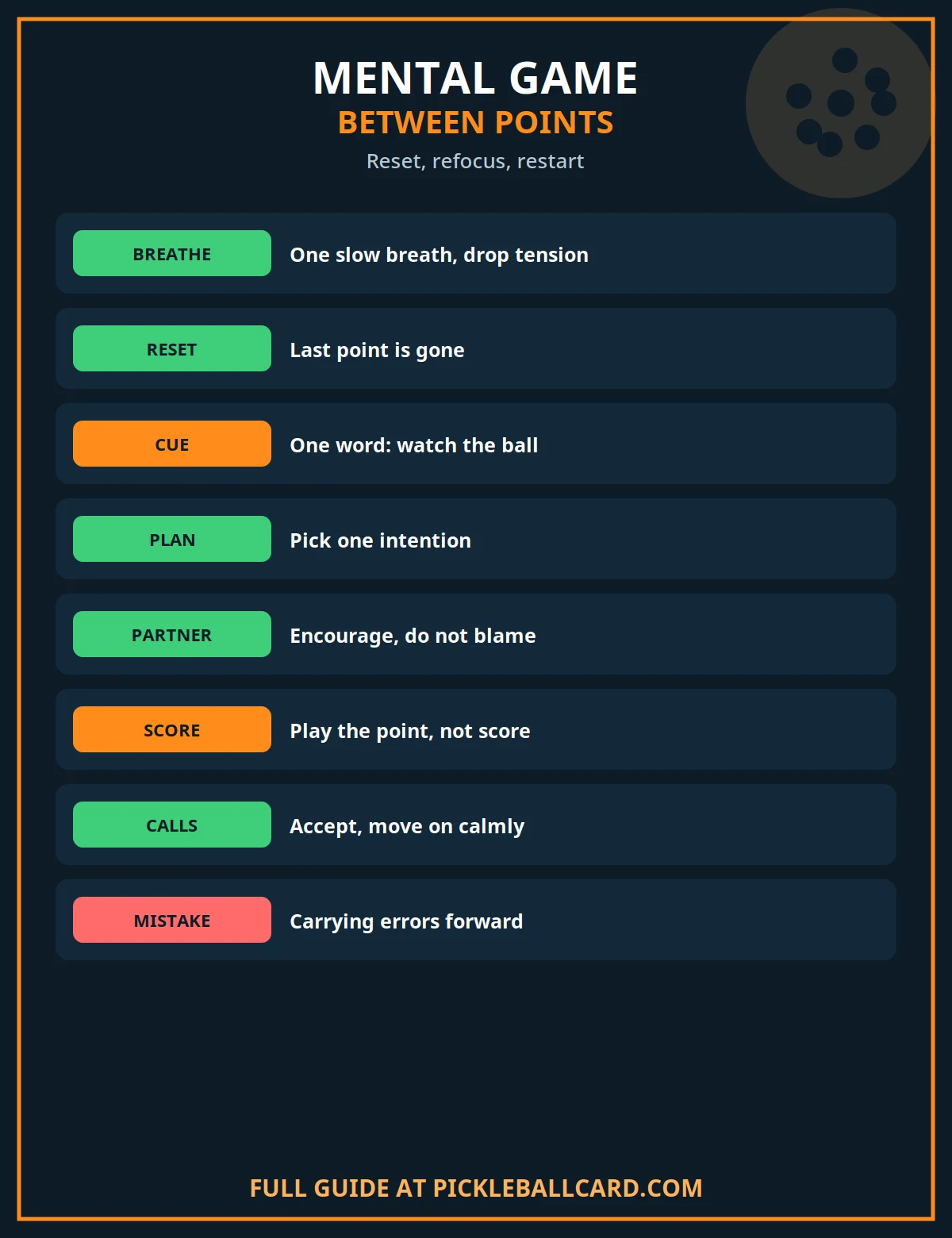
Use this checklist between points until it becomes habit. It combines the body reset, attention reset and plan from earlier sections.
- Turn away briefly and loosen your shoulders.
- Take one slow breath and relax your grip.
- Look at the court and check your position.
- Choose one clear target for the next point.
- Say your cue word and return to your routine.
- Encourage your partner with one short phrase.
Dealing With Bad Calls and Difficult Opponents
Bad calls are one of the hardest mental tests in pickleball. You may be sure a ball was in, yet your opponents call it out.
In most recreational play, players call lines on their own side. That system depends on honesty, good viewing angles and calm acceptance.
USA Pickleball publishes a sportsmanship guide that asks players to respect opponents calls, question a call respectfully if needed, and accept a deferred call graciously. You can read it in the USA Pickleball Sportsmanship Guide.
The guide also says to call a ball out only when you see it clearly, and to resolve uncertainty in favour of your opponents.
A Calm Process for a Disputed Call
- Ask once, politely, if they are sure, without raising your voice.
- Accept their answer, even if you disagree, and move to the next point.
- Use your reset routine before the next serve or return.
- Do not replay the call in your head for the next three points.
If a call seems deliberately unfair, stay courteous and keep playing. In organised events, use the proper channel, such as asking a referee, rather than arguing on court.
For wider court manners, including calls, behaviour and partner etiquette, see our guide to pickleball etiquette and the unwritten rules.
Handling Difficult Opponents With Sportsmanship
Difficult opponents come in many forms. Some argue calls, some celebrate opponents errors loudly, and some aim hard shots at weaker players in social games.
You cannot control their behaviour, but you can control your response. Stay polite, keep your routine, and do not mirror behaviour you dislike.
Do not retaliate with hard shots aimed at a person, angry words, or deliberate delays. Retaliation usually escalates the match and hurts your own focus.
In social play, adjust intensity to the group when needed. In competitive play, play your full game within the rules, and let your steadiness be the answer.
If behaviour feels unsafe or abusive, stop the game and speak to the facility organiser or event official. You do not need to endure that to prove toughness.
Confidence Through Process Goals
Confidence often drops when it depends only on winning. Wins depend on opponents, conditions, partners and luck, none of which you fully control.
Process goals give confidence a steadier base. They focus on actions you can repeat, whatever the score or opponent.
For example, return deep on most serves is a process goal. Win the match is an outcome goal. Only the first one guides your next shot.
| Outcome goal | Process goal instead | How you will know |
|---|---|---|
| Win every match | Use your pre-point routine every point | You reset before each serve |
| Never miss a dink | Keep dinks low and cross-court | Most dinks stay below net height |
| Beat a stronger player | Make rallies longer with deep returns | Returns land deep most times |
| Play perfectly | Reset within ten seconds after errors | You return to your routine quickly |
Choose two or three process goals before a match. Review them between games, not after every point, so they guide you without becoming a distraction.
After the match, judge yourself on those goals first. A loss with strong process goals still teaches you something useful for next time.
Over weeks, process goals build real confidence. You learn that you can reset, focus and execute a plan, even when results vary.
Practice Drills for Mental Skills
Mental skills need practice just like dinking and serving. The drills below add pressure, recovery and focus practice to normal sessions.
Keep drills short and specific. Ten focused minutes usually teach more than an hour of unfocused rallying.
Drill 1: Reset After Every Error
Play a normal game, but pause briefly after every error. Use your full reset routine before the next point starts.
The drill feels slow at first, but it trains the habit you need in matches. Speed up only when the reset feels natural.
Drill 2: One Cue Word Games
Play games where each player chooses one cue word, such as low, deep or steady, and uses it before every point.
This drill teaches short, useful self-talk. If the cue stops helping, change it, but keep it to one word.
Drill 3: Comeback Scoring
Start practice games from a losing score, such as down by four points. Practise steady targets, routines and calm communication while behind.
The goal is not only to win the practice game. It is to play the same way when behind as you play when ahead.
Drill 4: Pressure Serves and Returns
Take turns serving or returning with a small consequence for a miss, such as losing the practice point or restarting the rally.
Use your routine every time, even when the drill feels tense. That link between routine and pressure is the whole point.
For handling fast, aggressive opponents without losing composure, see our guide to how to beat bangers in pickleball.
Frequently Asked Questions
What is the mental game in pickleball?
The mental game is how you manage attention, emotions and decisions during a match. It includes routines, resets, focus cues, partner communication and calm responses to pressure.
How do I stop thinking about my last mistake?
Use a short reset after the error. Loosen your body, breathe once, look at the court, and choose one clear target for the next point.
What should I say to myself during a match?
Use short, specific cues such as steady, deep or next point. Avoid long criticism or labels, and return to your cue whenever your mind wanders.
How do I handle pressure in a close game?
Keep your normal routine and choose high-percentage shots. Focus on the next shot, not the score, and simplify your targets until composure returns.
What should I do after a bad line call?
Ask politely once if needed, accept the call, and reset for the next point. Arguing rarely changes the call, but it often harms your next three points.
Can mental skills really improve without a coach?
Yes, with regular practice. Use routines, process goals and pressure drills in casual games, and review what helped after each match.
The Bottom Line
Strong mental play is not mysterious. It is a routine before the point, a reset after the point, and a clear plan for the next one.
Start with one routine, one cue word and one reset habit. Add process goals and partner phrases as those habits feel natural.
Play the point in front of you, treat opponents and partners with courtesy, and let steady points do the work. Over time, composure becomes your most reliable shot.

Shoaib is the publisher of Pickleball Card. He oversees the site’s guides to pickleball rules, ratings, strategy and gear, all researched from primary sources — the USA Pickleball Rulebook, DUPR and manufacturer documentation — and updated as the game changes.