You serve, the ball clips the net, and the whole court freezes. One player calls for a replay. Another player is already moving to return it.
That moment causes more arguments than almost any other serve in recreational pickleball. The confusion usually comes from tennis, where a net-cord serve is replayed.
Modern pickleball works differently. There is no let replay for a serve that touches the net. The ruling depends on where the ball lands, not on whether it touched the net.
Key Takeaways
Keep this short version in mind, and most net-cord disputes will end before they start.
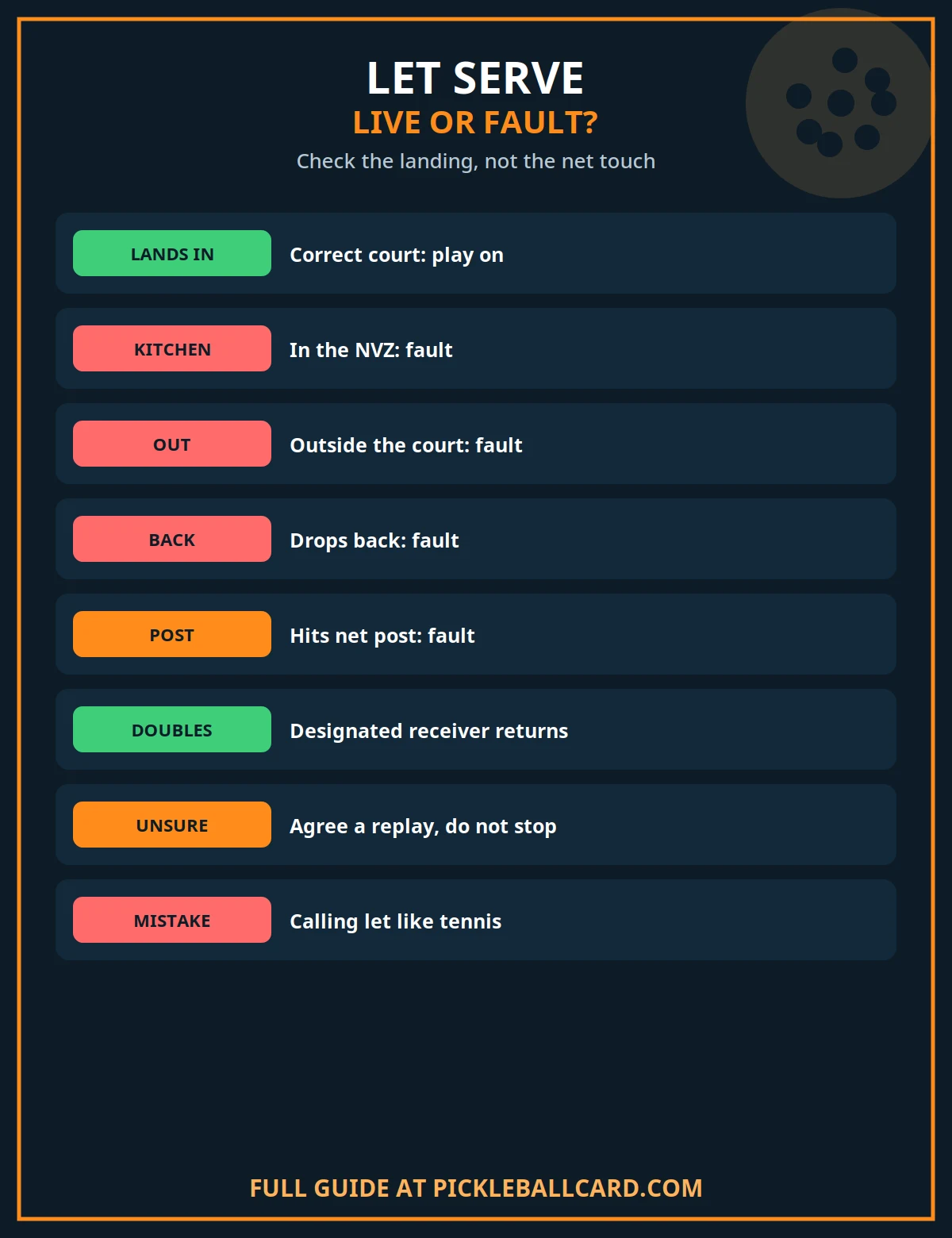
- A serve that touches the net and lands in the correct service court is live. Play continues.
- A serve that touches the net and lands in the kitchen is a fault. The kitchen line counts as kitchen.
- A serve that touches the net and lands outside the correct service court is a fault.
- A serve that touches the net post or net support system is a fault, even if it might otherwise land in.
- Calling “let” does not stop play or earn a replay under current pickleball rules.
- A replay happens only when both sides agree to one before play, or when a referee orders one for another reason.
- Watch the landing, not the net. The landing decides live or fault every time.
The Short Answer: There Is No Let Replay in Modern Pickleball
In current pickleball, the word “let” does not create a serve replay. A serve may clear the net or touch the net on its way across.
If that serve then lands in the correct diagonal service court, and clears the non-volley zone, it is a legal serve. The receiver must play it.
The server does not get a second attempt. The receiving side does not get to stop the rally and ask for a redo.
This rule applies in singles and doubles. It applies whether the net touch was a light graze or a heavy clip that changed the ball.
What Counts as a Net-Cord Serve
Players use several terms for the same event. Sorting out the words first makes the ruling much easier to apply on court.
Net Cord, Net Tape, and the Top Band
The net cord, net tape, and top band all describe the top edge of the net. A ball that brushes, clips, or rolls over that edge is a net-cord serve.
The size of the touch does not matter. A faint tick and a hard deflection are treated exactly the same way by the ruling.
What matters is what happens next. The ball must still cross the net and land where a legal serve must land.
What Is Not a Net-Cord Serve
A ball that hits the body of the net below the top band and drops back is not a live net-cord serve. It never reached the receiving court.
A ball that hits a net post, a centre support, or another part of the net support system is a different case. That contact is treated separately below.
A ball that clears the net cleanly is simply a normal serve. The net-cord ruling adds nothing to it, and it also takes nothing away.
Live or Fault: The Ruling Table
Use this table as a quick court-side check. Find the landing first, then read across to the ruling.
| Serve Outcome | Ruling | What Happens Next |
|---|---|---|
| Hits net, lands in correct service court | Live | Play continues; receiver must return it |
| Hits net, lands on a service court line | Live | Lines are in, except the kitchen line |
| Hits net, lands in the kitchen | Fault | Server loses the serve or the rally |
| Hits net, lands on the kitchen line | Fault | The kitchen line counts as kitchen |
| Hits net, lands outside the service court | Fault | Server loses the serve or the rally |
| Hits net, drops back on the server side | Fault | The serve never reached the receiving court |
| Hits net post or support system | Fault | Fault on the server, whatever the landing |
| Hits net, then touches the receiver | Point to serving side | The ball was live when it touched the receiver |
Serve by Serve: Every Outcome Explained
The table gives the answer at a glance. This section explains why each outcome is ruled that way, so the call feels clear rather than arbitrary.
Hits the Net and Lands in the Correct Service Court
This is the classic case that used to be called a let. Today, it is simply a legal serve, and the rally is live.
The receiver must be ready to play it, even if the ball drops short or bounces awkwardly. An awkward bounce is part of the game, not a reason for a replay.
The serving side keeps any advantage the net gave it. That may feel unfair in the moment, but it is the rule for both sides equally.
Hits the Net and Lands in the Kitchen
A net-cord serve often loses speed and drops short. If it lands in the non-volley zone, it is a fault.
The kitchen line is part of the kitchen for a serve. Landing on that line is therefore a fault, even by a fraction of an inch.
This fault is no different from a clean serve that lands in the kitchen. The net touch does not rescue a short serve.
Hits the Net and Lands Outside the Service Court
A serve that clips the net and then flies long or wide is a fault. The net touch does not change an out ball into a good ball.
Line calls still belong to the receiving side for balls landing on its side. If the ball is clearly out, call it out and move on.
If the ball lands on the sideline or baseline of the correct service court, it is in. Only the kitchen line is treated differently on a serve.
Hits the Net and Drops Back on the Server Side
Sometimes a serve hits the tape, loses all forward motion, and falls back on the server side. That serve has failed.
It never crossed the net, so it never reached the receiving court. There is nothing for the receiver to play, and no rally to continue.
Call it a fault and continue with the next server or the next rally, just as you would for any other failed serve.
Hits the Net Post or the Net Support System
The net posts and supports are not part of the playing net for this purpose. A serve that contacts them is a fault.
This applies even if the ball might have landed in the correct court afterwards. The support contact itself ends the serve as a fault.
Do not confuse a post with the top band. The top band is the net itself, while the post is the structure holding the net up.
Hits the Net and Then Touches the Receiver
A net-cord serve that crosses the net is a live ball. If it then touches the receiver or the receiver partner, the serving side wins the point.
This is why receivers must stay alert after a net touch. Standing still and letting the ball hit you does not earn a replay.
The same principle applies to a clean serve that touches a receiver before bouncing. A live serve that strikes a player is not a do-over.
Doubles: Receiver Positioning on Net-Cord Serves
Net-cord serves cause the most trouble in doubles, because two receivers must react as one team. Clear roles prevent most of the confusion.
The Designated Receiver Stays Ready
Only the designated receiver should return the serve. That player should stand behind the baseline, ready to move forward for a short ball.
A net-cord serve often drops shorter than a normal serve. A receiver who stands too deep will struggle to reach it before the second bounce.
Stay light on your feet during the serve. A small split step as the server strikes helps you move either forward or sideways.
The Partner Stays Clear and Calls It
The non-receiving partner should stand where the serve cannot easily strike them. Do not crowd the receiver or block their view of the ball.
A good partner position is near the kitchen line on the opposite side, ready for the third shot. That spot keeps you out of the serve path.
Call the landing early and clearly. A simple “in,” “out,” or “short” helps the receiver commit, rather than hesitating at the worst moment.
If the serve touches the partner before bouncing, the serving side wins the point. Moving clear is therefore a real tactical duty, not just good manners.
Covering the Short Net-Cord Drop
When a net-cord serve drops just past the kitchen line, the receiver must move forward fast. The partner should not rush across and cause a collision.
The receiver takes the short ball, while the partner holds position and prepares for the next shot. That division keeps the court covered.
After a short return, expect a fast reply. Net-cord rallies often speed up quickly, because both teams are already close to the net.
Let Serve Checklist: Decide It in Three Seconds
Run through this checklist in order. Stop at the first answer that fits, and you will have the ruling.
- Did the serve touch a post or support? If yes, it is a fault.
- Did the serve cross the net? If no, it is a fault.
- Did it land in the kitchen or on the kitchen line? If yes, it is a fault.
- Did it land outside the correct diagonal service court? If yes, it is a fault.
- Did it land in the correct service court? If yes, it is live. Play on.
- Did it touch a receiver while live? If yes, the point goes to the serving side.
- Did anyone call “let”? Ignore the word and apply the checklist instead.
- Are you still unsure about the landing? Apply the normal line-call rule for your game.
Why Players Still Call Let: Tennis Habits and the Pre-2021 Rule
Most let calls come from habit, not from the current rulebook. Tennis players learn early that a net-cord serve is replayed, and that instinct travels with them.
Pickleball borrowed that idea in its early years. A serve that touched the net and landed in the correct court was replayed without penalty.
That old let rule ended with the rule changes effective 1 January 2021. From that date, a net-cord serve that lands in is live, with no replay.
The change removed a constant source of disputes. Players no longer had to agree on whether a serve had grazed the net before deciding what to do.
It also removed an unfair edge. Under the old rule, a server could keep a lucky net-cord serve out of play by claiming a let, then try again.
Tennis Let Rules Are Not Pickleball Rules
Tennis still replays a serve that touches the net and lands in the correct service box. That is a tennis rule, and it stays in tennis.
Pickleball has no second serve to fall back on. A fault ends the serve, so a replay rule would change the balance of every service game.
When you switch sports, switch the rule too. Carrying the tennis let into pickleball will cost your team points and patience.
When You Are Unsure: What to Do
Uncertainty is normal, especially when a serve clips the net at speed. The answer is not to invent a replay, but to follow a clear order.
Do Not Stop Play on Your Own
If you are the receiver and the ball may be live, play it. Stopping to argue gives away a ball you might have returned.
If you are the server and the ball may be live, stay ready. A serve you assume is dead can still be returned for a winner.
Stopping play unilaterally can itself create a fault or a dispute. Play first, discuss second, and only after the rally ends.
Replay Only by Agreement, Not by Rule
There is no official replay for a net-cord serve that lands in. A group may still agree, before a match starts, to replay such serves as a house rule.
That agreement must be made in advance and apply to everyone equally. It is a social choice, not an official ruling.
Do not spring a house rule on opponents mid-match. If it was not agreed before play, the official ruling stands.
In a Refereed Match, the Referee Decides
In a refereed match, play to the referee call. The referee judges the landing and any fault, just as for any other serve.
Players should not call a let to the referee and expect a replay. State what you saw, briefly, and accept the ruling.
After the match, you can check the rulebook together. During the match, the referee ruling keeps play moving fairly.
Common Mistakes With Net-Cord Serves
These errors appear in almost every open-play session. Avoiding them will make your games smoother and your calls more respected.
- Calling “let” and stopping, when the ball landed in and was live.
- Assuming a hard net clip must be a fault, whatever the landing.
- Treating the kitchen line as in on a serve, when it counts as kitchen.
- Standing where a live serve can strike you, then asking for a replay.
- Replaying a serve because one player felt it was unlucky, without prior agreement.
- Arguing about whether the net was touched, instead of judging the landing.
Frequently Asked Questions
Is there a let serve in pickleball?
No. Modern pickleball has no let serve replay. A serve that touches the net and lands in the correct service court is live.
The old let replay ended with the rule changes effective 1 January 2021. Since then, the landing alone decides the outcome.
What happens if the serve hits the net and lands in?
Play continues. The receiver must return the ball, and the rally proceeds exactly like any other legal serve.
The server keeps the point if the receiver fails to return it. The net touch gives neither side a second chance.
What happens if the serve hits the net and lands in the kitchen?
It is a fault. The serve failed to clear the non-volley zone, so the server loses the serve or the rally.
Landing on the kitchen line is also a fault. For serves, that line belongs to the kitchen, not to the service court.
Does a serve that hits the net post count as live?
No. A serve that contacts a net post or another part of the net support system is a fault on the server.
This is different from touching the top band of the net. The top band is the net itself, while the post is its support.
Can we agree to replay net-cord serves in a friendly game?
Yes, if everyone agrees before the match starts. That is a house rule for your group, and it must apply equally to both sides.
Without that prior agreement, the official ruling applies. Do not introduce a replay rule halfway through a match.
What should I do if I am not sure whether the serve landed in?
Play the ball if you can, then resolve the call after the rally. Use the normal line-call practice for your game.
For balls on your side, the receiving side makes the call. Genuine doubt should favour the opponent, not your own team.
The Bottom Line
Forget the word “let” when a pickleball serve touches the net. Ask one question instead: where did the ball land?
If it landed in the correct service court, play on. If it landed in the kitchen, on the kitchen line, or out, it is a fault.
That single test settles almost every net-cord serve. It also keeps games fast, fair, and free of the old let argument.
For the full serving rules, see our guide to serving rules in pickleball, and for the wider game, see pickleball rules. For a close cousin of this ruling, see ball comes back over the net.
Sources: USA Pickleball Official Rulebook, via the USA Pickleball official rules page. Rulings are summarised in plain language; check the current rulebook edition for the exact wording.

Shoaib is the publisher of Pickleball Card. He oversees the site’s guides to pickleball rules, ratings, strategy and gear, all researched from primary sources — the USA Pickleball Rulebook, DUPR and manufacturer documentation — and updated as the game changes.