Most third-shot advice forces a false choice. One camp says always drop. The other says drive everything and trust your hands.
Neither camp is reading the return. The return has already made most of the decision for you, if you know what to look for.
This guide gives you that read. It covers the four things to check at contact, a decision table you can memorise, the hybrid shot between drop and drive, and the fifth-shot plan that follows a drive.
Key Takeaways
- The return decides, not a preset plan. Depth, height, pace and opponent position tell you whether to drop, drive or play the hybrid.
- Deep or low return, opponents set: drop. A drive from deep gives set volleyers time and height to punish.
- Short, sitting-up return, opponent moving: drive. Attack the player in motion before the pair is set at the line.
- Balance overrides bounce location. A ball you reach off balance is a drop ball, wherever it bounced.
- Drive the third, drop the fifth is a real plan. A firm third often earns a weaker fourth that is far easier to drop.
- Never pre-decide during the serve. Choosing before the return is hit is the most common third-shot mistake at club level.
The Short Answer
Read four things as the return comes back: how deep it is, how high it sits at contact, how much pace it carries, and whether both opponents are already set at the kitchen line.
Deep, low or fast returns against a set pair point to the drop. Short, high returns, or an opponent still moving forward, point to the drive.
USA Pickleball states a compact version of the same rule in its skill guidance: drop low balls, drive high balls, and follow your shot in. That rule is the starting point here, not the whole system.
The sections below turn that one line into a complete decision you can make in the half-second you actually have.
What Each Shot Is Actually For
Players choose better when they stop thinking about technique and start thinking about jobs. The drop and the drive do different jobs.
What the Drop Buys You
The drop buys you the advance. A soft ball arcing into the kitchen cannot be volleyed down at your feet.
While it travels and bounces, you and your partner move forward together. A good drop is how the serving team earns the kitchen line without sprinting through danger.
The drop is therefore the neutralising shot. It answers a strong return by taking the rally back to even terms.
What the Drive Buys You
The drive buys you a weaker fourth shot. It rarely wins the point outright against players already set at the line.
Its real value is pressure. A firm drive at a moving opponent, at feet, or through the middle forces a rushed block that often sits up or floats short.
That weaker fourth is then your chance. You step in and drop the fifth shot against a pair that is no longer comfortably set.
Why Mechanics Are Not Covered Here
This article is the decision article. Stroke mechanics for the drop itself are covered in full in our guide to the third shot drop.
Read that guide for grip, arc and contact point. Come back here for the harder skill: choosing correctly, return after return, under pressure.
The Decision Table: Read the Return
| Read on the return | Best choice | Why |
|---|---|---|
| Deep, near the baseline, and you are moving backward | Drop | A drive from deep gives set opponents time, height and an easy volley |
| Low or skidding, below net height at contact | Drop | You cannot get on top of it; driving produces a rising, attackable ball |
| Short, in the transition zone, sitting up at or above net height | Drive | You are forward and balanced, with a target to attack |
| One opponent late to the line, or a pair still unwinding a stack | Drive | Pressure the player in motion before the pair is set |
| Heavy pace straight at you, feet not yet set | Drop or hybrid | Absorb and soften; do not swing back at a ball you cannot control |
| Mid-depth and ambiguous, no clear signal either way | Your stronger shot, or the hybrid | Balance and contact height override bounce location alone |
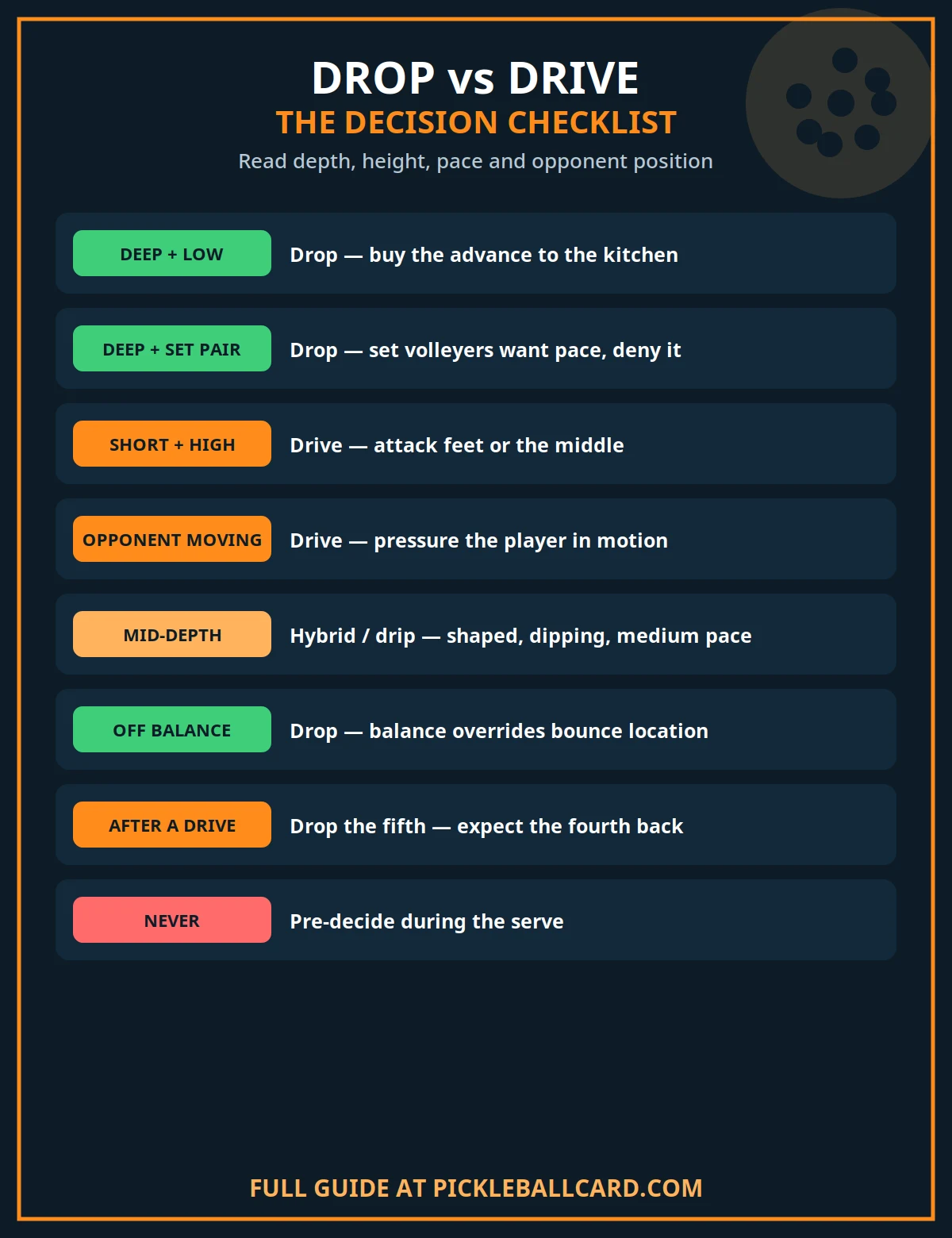
Notice what the table does not do. It never asks what you planned during the serve, and it never asks which shot you prefer.
Preference still matters on the truly ambiguous ball. On every other ball, the return has outvoted your preference before you swing.
Read One: Depth
Depth is the first and loudest signal. A return landing within a step or two of your baseline pushes you deep and steals your forward momentum.
From there, a drive must travel the full court. Set opponents at the kitchen have time to track it, set their feet and volley it back at yours.
A drop from deep travels the same distance softly. It asks the opponents to wait, bend and hit up, which is exactly what you want.
Short returns reverse the logic. A return bouncing in the transition zone brings you forward, shortens the court, and puts an opponent in your sights while they are still moving.
That is the drive ball. Passing it up to attempt a delicate drop usually wastes the one clear attacking chance the rally offered.
Read Two: Height at Contact
Height decides what your paddle can physically do. A ball below net height at contact cannot be driven downward.
Every drive from below the net must start by going up. Opponents at the line live for that rising ball.
Below net height, the honest options are the drop and the hybrid. Both accept the ball’s height instead of fighting it.
Above net height, with time to set, the drive becomes real. You can hit through the ball, keep it low over the net and aim at feet or the middle.
This is the sense behind the coaching phrase about driving high balls. It describes contact height, not bounce height and not ambition.
Read Three: Pace
A hard, flat return shortens your preparation whether it is deep or mid-court. Swinging a full drive back at it compounds the problem.
Against pace, soften first. A drop or hybrid with a shorter motion absorbs speed and restores your balance for the next ball.
A slow, floating return gives you the opposite gift: time. Time lets you step in, choose a target and drive with your feet underneath you.
Pace also tells you about the returner. A player who drives returns hard usually expects a hard reply and is ready for it.
Denying that expected pace, with a calm drop into the kitchen, often draws the error the drive would never have forced.
Read Four: Opponent Position
Look up before you look down. Where the opponents are matters as much as where the ball is.
Both opponents set at the kitchen line, paddles up and balanced, is the strongest possible case for the drop. There is no gap to drive into.
One opponent still travelling forward is the strongest case for the drive. Hit at the moving player, or into the space their movement has opened.
A pair unwinding a stack is a special version of the same read. For a few seconds their middle and sidelines are unsettled and their communication is busy.
Driving the middle in that moment creates hesitation. Our guide to who should take the middle in pickleball explains why unsettled pairs concede that space.
When to Drop: The Full Case
- The return is deep and you are near or behind the baseline. Your priority is neutralising, not attacking.
- The ball is low at contact. You cannot drive a ball upward and expect it to survive the kitchen line.
- Both opponents are set. Set volleyers want pace; the drop denies them the ball they are waiting for.
- You are off balance or moving backward. The drop is the only shot your body position can honestly support.
- Your drive has been read all match. Changing to the drop breaks a pattern set opponents have started timing.
- Wind is pushing drives long. A soft shot with margin is the safer tool when pace keeps sailing.
A good drop still needs a follow-through of a different kind: your feet. Dropping and then standing at the baseline to admire it wastes the shot completely.
Move in behind every drop you trust. Split-step if the opponents play it early, and keep advancing if it lands low and forces them to hit up.
When to Drive: The Full Case
- The return is short and sits up. You are forward, balanced and hitting down toward feet.
- An opponent is still moving up. Attack the mover before their feet and paddle are set.
- The pair is unwinding a stack. The middle is briefly nobody’s clear responsibility.
- Your forehand is loaded and balanced. A set forehand drive is a different weapon from a stretched backhand swipe.
- Opponents are camping on your drop. If every drop is being taken out of the air early, pace changes their timing.
- You have a clear fifth-shot plan. The drive is chosen because you want the fourth shot it will produce.
Drive targets matter more than drive speed. Feet are first, the middle is second, and a body at the transition line is third.
Drives aimed at a set player’s paddle, at shoulder height, are gifts. That player simply blocks, and the rally you tried to speed up speeds up against you.
For what that block looks like from the other side, see how to beat bangers in pickleball — and drive in a way that does not feed it.
The Third Option: The Hybrid or Drip Shot
Many returns are neither clean drop balls nor clean drive balls. They land mid-depth, sit at about net height, and punish a binary decision.
The hybrid answers them. It is a shaped, medium-pace ball, usually with topspin, that dips down toward the opponents’ feet or the kitchen edge.
Hit harder than a drop, it still arrives low. Hit softer than a drive, it still pushes opponents back off the line they wanted to hold.
Use the hybrid when the return is mid-depth, when you are moving forward but not fully set, or when a full drive has started sailing long.
Think of it as buying drive pressure at drop risk. For developing players, it is often the highest-percentage third shot they own.
Drive the Third, Drop the Fifth: The Two-Shot Plan
The most misunderstood idea in third-shot strategy is that a drive is a failed drop. Played deliberately, it is the first half of a two-shot plan.
Drive the third firmly at a mover or the middle. Most returns of that drive — the fourth shots — come back shorter, higher or slower than the original return.
Now drop the fifth. You are closer to the net, the ball is easier, and the opponents have just been pushed out of their set positions.
The plan fails only when the third-shot driver expects to win the point immediately and stops moving. Expect the fourth, step in behind your drive, and be ready.
Playing the Fourth Shot You Get Back
If the fourth comes back soft and short, drop it and advance. The plan has worked exactly as drawn.
If the fourth is blocked hard and low at your feet in transition, do not force another drive. That ball is a reset.
Our guide to the pickleball reset shot covers that exact situation: absorb it, drop it into the kitchen, and keep your advance alive.
If the fourth sits up high, you may drive again or counter. Two drives in a row are justified by the ball, not by momentum or frustration.
After the Shot: Do Not Get Marooned
The decision does not end at contact. Where you go next decides whether a correct choice actually wins anything.
Behind a good drop, advance together. Move while the ball travels, split-step before the opponent contacts it, and take the line the drop earns.
Behind a drive, advance with caution. Step in ready to play a fifth, but do not sprint into the block that is coming back.
Behind a poor shot of either kind, hold and defend. Advancing behind a floaty drop or a weak drive simply shortens the distance on the smash it invites.
The transition zone punishes indecision more than it punishes either shot. Pick your line, move with your partner, and be balanced before the next contact.
Common Third-Shot Mistakes
| Mistake | What happens | Fix |
|---|---|---|
| Pre-deciding during the serve | You drive deep returns and drop short ones — exactly backwards | Decide only after the return bounces |
| Driving from deep, off the back foot | Rising ball, easy volley, point ends at your feet | Deep plus off balance always means drop |
| Dropping every ball by habit | Set opponents step in and take drops out of the air | Drive short, high returns to keep volleyers honest |
| Aiming drives at a set paddle | Simple block comes back faster than your drive | Target feet and the middle instead |
| No plan for the fifth shot | You admire the drive while the block passes you | Step in expecting the fourth shot |
| Dropping, then standing still | The advance the drop bought is never taken | Move in behind every drop you trust |
A Simple Drill: Feed and Call
Practise the read, not just the shots. Stand at the baseline as the serving player while a partner feeds returns of mixed depth and height.
Before you swing, call your choice out loud: drop, drive or hybrid. The call forces the read to happen before the stroke, which is the whole skill.
Play each ball out as a fifth shot where possible. A correct call followed by a normal error still counts as a win in this drill.
Ten minutes of feed and call teaches more third-shot judgement than an hour of dropping fed balls you already knew were drops.
Frequently Asked Questions
Should beginners just always drop the third shot?
No, although the drop deserves the most practice time. Beginners should learn the drop first, then add the drive for short, high returns that are clearly attackable.
What if my drop is unreliable under pressure?
Use the hybrid more often while you build the drop in practice. A shaped, medium-pace ball at the feet is far safer than a full drive from deep.
Is driving at the body acceptable in pickleball?
A firm drive at feet, hips or the middle is normal competitive play. Deliberately head-hunting a set opponent is poor practice and, in recreational play, poor etiquette.
What does driving high balls actually mean?
It means contact height. A ball you meet above net height, with your feet set, can be driven flat and low. A low ball must be lifted, so drop it instead.
How often should I drive the third shot?
There is no correct quota. Let the returns you actually receive set the mix, match by match. A set percentage chosen before the match is pre-deciding by another name.
What is the drip or hybrid shot?
It is a medium-pace, shaped ball between a drop and a drive, usually with topspin that makes it dip. It suits mid-depth returns that are neither clean drops nor clean drives.
The Bottom Line
Third shot drop vs drive is not a loyalty test. It is a reading test you take on every single rally.
Check depth, height, pace and opponent position. Drop the deep and low balls against set opponents, drive the short and high balls at movers, and use the hybrid between them.
Then play the shot after the shot: advance behind a good drop, and drop the fifth behind a good drive. That complete system, not either shot alone, is what reaches the kitchen.
Sources: USA Pickleball, Skill Level Three guidance (third-shot rule: drop low balls, drive high balls, follow your shot in) and Official Rules. Coaching content in this article is original; no competitor content is linked or reproduced.