Most players can name the third shot. Few can name the fourth. That is strange, because the fourth shot decides whether the returning team keeps the advantage they earned with a good return — or hands the kitchen straight back.
The fourth shot in pickleball is the returning team’s reply to the serving team’s third shot. The serve, the return, and the third shot have already happened.
Now the returning team must answer, usually from near the kitchen line, against a ball designed to push them back.
Get the fourth shot right and your pair holds the line, neutralizes the serve team’s attack, and turns defense into offense. Get it wrong and you pop the ball up, get driven at, or retreat to the baseline you just fought to leave.
This guide explains what the fourth shot is, the two choices it presents — attack or concede — and how to decide between them. It is the direct sequel to our guides on the third shot drop and third shot drop vs drive.
Key Takeaways
- The fourth shot is the returning team’s first shot after the third shot — usually a volley, block, or reset at or near the kitchen line.
- Its job is to neutralize the third shot and hold the kitchen, not to win the point outright.
- Attack the fourth shot when the third shot sits up high, short, or soft — drive it at the server’s feet or into open court.
- Concede the fourth shot when the third shot is low, hard, or well placed — block or reset it softly into the kitchen and stay in the point.
- The most common fourth-shot error is attacking a low ball, which produces pop-ups and counterattacks.
- Position beats power: a pair already at the line handles fourth shots far better than a pair still moving forward.
What Is the Fourth Shot in Pickleball?
Count the shots in a rally. Shot one is the serve. Shot two is the return of serve. Shot three is the serving team’s next shot — usually a drop, a drive, or a lob.
Shot four is the returning team’s answer to that third shot.
The fourth shot usually arrives while the returning team is at or approaching the kitchen line. The returning team has the advantage of position: they were never required to stay back, so they can reach the line first.
The fourth shot is how they defend that advantage.
It is rarely a spectacular shot. Most fourth shots are blocks, volleys, dinks, or resets. Their quality is measured by what they prevent — a lost kitchen, a pop-up, a retreat — rather than what they win.
Why the Fourth Shot Is Overlooked
Coaching spends far more time on the third shot than the fourth, because the third shot is the serving team’s problem to solve. The fourth shot feels like a reaction, not a decision.
That framing is wrong. The fourth shot is a decision, and it is often the harder one: the returning team must read the third shot’s height, pace, and placement in a fraction of a second and choose between attacking and resetting.
Fourth Shot vs Fifth Shot
The fifth shot is the serving team’s reply to the fourth shot, and it completes the opening sequence. A common plan at higher levels is “drive the third, drop the fifth” — attack first, then soften the next ball into the kitchen.
Understanding the fourth shot helps you understand the fifth. When your fourth shot is a good reset, the serving team’s fifth shot arrives as a dink, not a drive. When your fourth shot pops up, the fifth shot arrives as a putaway.
The Two Choices: Attack or Concede
Every fourth shot presents the same choice. Attack it, or concede it. Attacking means driving, volleying aggressively, or speeding the ball up. Conceding means blocking, resetting, or dinking it softly back into the kitchen.
Neither choice is always right. The correct choice depends on the ball in front of you, and players who default to one choice lose points to players who read the ball.
When to Attack the Fourth Shot
Attack when the third shot gives you something to attack. The triggers are clear: the ball sits above net height, it lands short in the court, it arrives slowly, or the server is still moving forward and off balance.
Attack with placement, not power. Drive at the server’s feet as they approach, or into the open court away from their partner. A placed attack forces a weak fifth shot; a wild attack forces a counterattack against you.
When to Concede the Fourth Shot
Concede when the third shot is good. A low, hard drive at your feet, a well-placed drop that dies in the kitchen, or a ball that arrives while you are still moving forward are all balls to reset, not attack.
Conceding is not losing. A soft reset into the kitchen neutralizes the server’s attack, keeps your pair at the line, and turns the rally into a dink exchange — which is exactly where the returning team wants to be.
The reset is a core skill in its own right. Our guide to the pickleball reset shot covers the technique in full.
The Decision in One Sentence
High, slow, or short: attack. Low, fast, or well placed: reset. When in doubt, reset — a reset keeps you in the point, while a failed attack usually ends it.
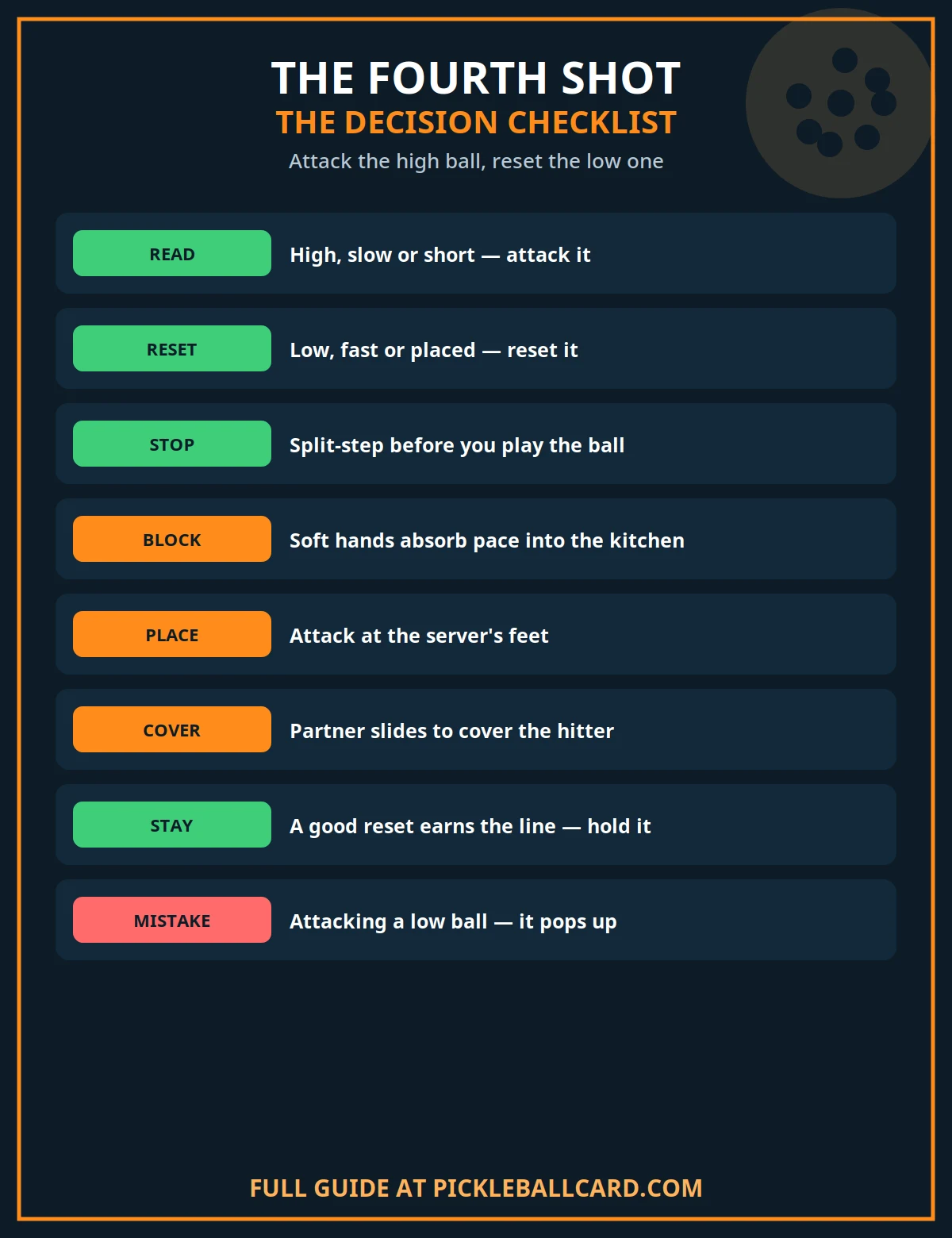
The Fourth Shot Decision Table
Read the third shot, then choose:
| Third shot you receive | Fourth shot answer | Why |
|---|---|---|
| High drop that sits up | Attack — drive at the server’s feet | The ball is in your strike zone and the server is moving |
| Short, slow drive | Attack — volley into open court | You have time and an open target |
| Low, hard drive at your feet | Concede — soft block into the kitchen | Attacking a low ball pops it up |
| Deep, well-placed drop | Concede — dink it back low | The ball is doing its job; reset and start the dink rally |
| Third-shot lob over your head | Concede — drop back, let it bounce, reset | Attacking a lob overhead from the line is low percentage |
| Third shot while you are still moving | Concede — block and stop | Moving feet cannot attack; stop first, then play |
Fourth Shot Technique
Technique follows the decision. Attacking fourth shots need a compact swing and a clear target. Conceding fourth shots need soft hands and a low trajectory.
The Attacking Fourth: Compact and Placed
Keep the backswing short. At the kitchen line there is no time for a full swing, and a short swing keeps the ball down. Contact the ball out in front, with the paddle face slightly closed, and drive through the ball toward your target.
Aim low. The best attacking fourth shots land at the server’s feet or skid into the kitchen. A high attack gives the server a ball they can counter.
The Reset Fourth: Absorb and Drop
Loosen your grip at contact and let the paddle absorb the third shot’s pace. Angle the paddle face slightly open and guide the ball down into the opponent’s kitchen, near their feet.
The reset’s goal is a ball the server must hit upward. A reset that lands high is just a delayed attack against you. Practice soft hands until your resets die in the kitchen.
Footwork: Stop Before You Hit
The most underrated fourth-shot skill is stopping. Players who hit while still moving forward mishit constantly. Split-step as the server hits the third shot, plant, then play the fourth.
If you are caught moving, concede the ball. A block hit from a planted stance beats an attack hit on the run every time.
Fourth Shots in Doubles vs Singles
In doubles, the fourth shot is usually played by the partner who is not facing the third shot directly — the player with the better angle or the shorter distance to the ball. Partners must call it early.
In singles, the fourth shot is simpler and harder: you play every ball yourself, and the third shot often comes as a drive you must block or pass.
The same decision applies — attack the high ball, reset the low one — but there is no partner to cover a mistake.
Singles players should study the fourth shot through the lens of court coverage: a reset that buys time to recover to the middle is worth more than an attack that leaves the court open.
The Opening Sequence, Shot by Shot
The fourth shot only makes sense inside the full opening sequence. Here is how the first five shots typically flow in doubles:
Shot one, the serve, goes deep to push the returner back. Shot two, the return, goes deep down the middle to buy time. Shot three is the server’s answer — a drop to approach the net, a drive to pressure, or occasionally a lob.
Shot four is yours: neutralize that third shot and hold the line. Shot five is the server’s reply to your fourth — and its difficulty depends entirely on your fourth shot’s quality.
Notice the pattern: every shot in the sequence exists to win position, not to win the point. Points at the kitchen come later, after both teams are established. Players who try to win the point on shot three or four usually lose the position battle instead.
When you watch better players, watch their fourth shots specifically. You will see almost no highlight-reel winners — and almost no errors. That consistency is the skill.
Common Fourth Shot Mistakes
- Attacking every third shot: the fastest way to lose the kitchen advantage. Low drives are not invitations.
- Popping up the reset: a stiff grip turns a block into a pop-up, and pop-ups get put away.
- Hitting on the move: advancing through the fourth shot instead of stopping to play it.
- No partner communication: both players going for the same fourth shot, or neither going for it.
- Retreating after a good reset: a reset earns you the line — stay there instead of drifting back.
- Forgetting the fifth shot: a fourth shot that sets up an easy fifth shot for the server is a bad fourth shot, even if it stays in.
Drills for a Better Fourth Shot
Drill 1: Attack or Reset Call
Have a partner feed third shots of mixed height and pace. Before each ball, call “attack” or “reset” as soon as you read it, then play the shot you called. This trains the read, which is the real skill.
Drill 2: The Reset Rally
Play rallies where the returning team may only reset the fourth shot — no attacks allowed. Learn how much pressure a good reset alone can absorb.
Drill 3: The Punishment Game
Play normal points, but any fourth shot attacked from below net height loses the point immediately, even if it lands in. This breaks the habit of attacking low balls fast.
Frequently Asked Questions
What is the fourth shot in pickleball?
It is the returning team’s reply to the serving team’s third shot — the fourth shot of the rally, usually played at or near the kitchen line as a volley, block, dink, or reset.
Should you attack or reset the fourth shot?
Attack high, slow, or short third shots. Reset low, fast, or well-placed ones. When unsure, reset — a reset keeps you in the point, while a failed attack usually ends it.
Who hits the fourth shot in doubles?
Whichever partner has the better angle on the third shot, decided by an early call. The partner who does not hit it slides to cover the court the hitter vacates.
Is the fourth shot always a volley?
No. It can be a volley, a block, a dink, or a groundstroke after a bounce. The shot type follows the third shot: high balls get volleyed, low balls get blocked or dinked.
How is the fourth shot different from the third shot?
The third shot is the serving team’s problem — getting to the kitchen against a deep return. The fourth shot is the returning team’s problem — holding the kitchen against the third shot. Both are transition shots, played by opposite teams.
What if the third shot is a lob?
Drop back, let it bounce, and reset it softly into the kitchen or deep to the server’s backhand. Do not try to attack a good lob overhead from the kitchen line.
Final Word
The fourth shot is where returning teams win or lose the opening sequence. It is not glamorous, but it is decisive: a good fourth shot holds the kitchen, and holding the kitchen wins rallies.
Learn the read first. High, slow, or short means attack. Low, fast, or well placed means reset. Then practice the reset until it is automatic, because most fourth shots are resets — and most points are lost by players who refuse to play them.
The shot rules behind every decision here come from the USA Pickleball Official Rulebook. Next, study the other half of the opening sequence in our third shot drop vs drive guide.

Shoaib is the publisher of Pickleball Card. He oversees the site’s guides to pickleball rules, ratings, strategy and gear, all researched from primary sources — the USA Pickleball Rulebook, DUPR and manufacturer documentation — and updated as the game changes.