A good round robin feels effortless for players and calm for the organizer. Everyone knows where to go, who they play next, and how results are recorded. That calm does not happen by accident.
It comes from decisions made before the first ball is hit. You choose the format, balance the groups, build the rotation, and set the scoring and tiebreakers in advance. Players then simply play.
This guide walks through that whole process for a social or club event. It covers formats, player numbers, courts, seeding, partner rotation, scoring, tiebreakers, score sheets, and time planning.
Key Takeaways
- A round robin gives every team a match against every other team in the same group.
- Choose the format, group size, scoring method, and tiebreakers before entries open.
- Four players per court, plus a fair bye rotation, keeps most social events moving smoothly.
- Balanced groups matter more than perfect seeding, especially for a friendly club day.
- Fixed partners suit teams that enter together, while rotating partners suit mixed social play.
- Timed matches protect your schedule, while games to 11 give a more traditional finish.
- Publish the tiebreaker order in advance so no result is argued after the final match.
- A simple score sheet, collected after every round, prevents most results disputes.
What A Round Robin Really Is
In a round robin, every player or team plays every other player or team in the group. Nobody is eliminated after one loss, so a slow start does not end the day.
Standings are built from match wins across the whole group. The team with the most wins finishes first, followed by the rest in order.
Some round robins stand alone, with the group winner taking the event outright. Others feed into playoffs, where the top two or four teams advance to semifinals or a final.
That flexibility is the main appeal for clubs. You can promise every entrant several matches, keep the mood social, and still finish with a meaningful final.
Round robins also suit mixed ability better than sudden elimination. Weaker teams still get full value from their entry, and stronger teams face a range of opponents.
Round Robin Vs Ladder Vs Bracket
Organizers often confuse three different structures. A round robin is a fixed group schedule. A ladder is a ranking that changes after each match. A bracket is a knockout draw.
In a ladder, winners move up and losers move down, usually by swapping court positions. Ladders are lively, but they can leave some players waiting or facing the same opponents repeatedly.
In a bracket, losing usually ends your run or sends you into a consolation draw. Brackets are exciting and fast, but they guarantee far fewer matches than a round robin.
| Format | Matches Guaranteed | Best For | Main Drawback |
|---|---|---|---|
| Round robin | One against each group rival | Social days and fair standings | Needs careful scheduling |
| Ladder | Several, but varies | Drop-in and ranking nights | Matchups can repeat |
| Single elimination bracket | One | Fast, high-stakes finals | Early losers go home |
| Double elimination bracket | At least two | Competitive tournaments | Complex and time hungry |
| Pool play plus bracket | Group matches plus playoffs | Larger competitive fields | Longer day overall |
For a club social, round robin is usually the safest choice. It balances play time, fairness, and atmosphere without demanding a tournament director at every court.
Choose Your Format First
Decide the event shape before you invite anyone. Your choice affects entry numbers, court bookings, match length, and how long the day will last.
A pure round robin works best with small to medium groups. Groups of four to eight teams keep the match count manageable and the day within a few hours.
Pool play plus playoffs works better for larger fields. Split entrants into pools, run a round robin inside each pool, then advance the top teams to a bracket.
If you are still weighing options, our guide to pickleball tournament formats explains how round robin, elimination, and pool play compare in a competitive setting.
How Many Players And Courts Do You Need
Start with courts, not entries. Courts set the pace of the whole event, because only one doubles match can use a court at a time.
Four players make one doubles match. Eight players fill two courts, twelve players fill three courts, and sixteen players fill four courts.
Odd numbers need a plan, not improvisation. With twelve players and three courts, everyone plays every round. With fourteen players, two players sit out each round.
Rotate byes fairly and publish them in advance. Nobody should sit out twice while another player has played every round, unless an injury or late arrival forces a change.
| Players | Courts For Doubles | Players Resting Each Round | Group Feel |
|---|---|---|---|
| 8 | 2 | 0 | Fast and simple |
| 12 | 3 | 0 | Ideal social size |
| 16 | 4 | 0 | Lively club day |
| 20 | 5 | 0 | Needs strong coordination |
| 14 | 3 | 2 | Needs a bye rotation |
Cap entries at a multiple of four when you can. That single decision removes most scheduling headaches and keeps every round full.
Seeding And Balancing Skill Levels
Seeding sounds formal, but for a club event it simply means avoiding wildly uneven groups. The goal is close matches, not a perfect ranking.
Use ratings when you have them, recent results when you do not, and organizer knowledge as a last resort. Ask entrants to self-rate honestly, with a short description of each level.
For a social event, split ability across groups rather than stacking all strong players together. Each group then has a similar spread, and finals feel earned rather than predetermined.
For a competitive event, do the opposite. Group similar levels together so matches are tight and the winner clearly earns the top place.
Never publish a seeding list that embarrasses a beginner. Keep individual ratings private, and present groups as balanced draws rather than ranked ladders.
Fixed Partners Vs Rotating Partners
Fixed partners means each team stays together for the whole event. Rotating partners means players change partners each round and collect individual points.
Fixed partners suit pairs who enter together, practise together, or plan to play tournaments together. Their results reflect real teamwork, communication, and shared strategy.
Rotating partners suit social nights, new members, and mixed groups. Players meet more people, no pair dominates through familiarity alone, and nobody is left without a partner.
With rotating partners, score the individual, not the pair. Each player earns wins and point differential from every match, regardless of who their partner was that round.
Design the rotation so partners do not repeat too soon. A good rotation also avoids pairing the same two players against each other in consecutive rounds when possible.
State the partner system in the invitation, in bold if needed. Players who expect a fixed partner will be unhappy if they are split up on arrival.
Build The Rotation Schedule
A rotation is simply a list of who plays whom, on which court, in which round. Build it the night before, print several copies, and post one at the desk.
Work round by round, not match by match. In each round, every available court should have a match, and every resting player should be clearly marked as on a bye.
Check that no team plays twice in one round and no team meets the same opponent twice. Those two checks catch most scheduling errors before players notice them.
Allow a short gap between rounds for score reporting and water. Back-to-back matches with no break exhaust players and delay the next round when a match overruns.
Worked Example: Twelve Players On Three Courts
Imagine twelve players forming six fixed pairs, labelled A to F. Three courts run at once, so all six pairs play in every round.
With six pairs, each pair needs five matches to face every other pair. That means five rounds in total, plus a final if you choose to add one.
The schedule below shows a simple five-round rotation. Each pair appears once per round, and no pairing repeats across the event.
| Round | Court 1 | Court 2 | Court 3 |
|---|---|---|---|
| 1 | A vs B | C vs D | E vs F |
| 2 | A vs C | B vs E | D vs F |
| 3 | A vs D | B vs F | C vs E |
| 4 | A vs E | B vs D | C vs F |
| 5 | A vs F | B vs C | D vs E |
For fourteen players, the same idea applies with a bye pair each round. Rotate the bye pair so each pair rests once across seven rounds, if time allows.
Test your schedule by counting matches per team. If every team has the same number of matches, and no opponent repeats, your rotation is sound.
Scoring Choices: Games To 11 Vs Timed Matches
Scoring choice is really a time choice. Traditional games give a clear winner, while timed matches guarantee your schedule holds even when rallies run long.
Games to 11, win by 2, are the familiar standard for club play. They feel complete, reward comebacks, and are easy for players to understand without extra explanation.
Timed matches, often 15 or 20 minutes, keep a large event on track. When time expires, the team ahead wins, and the score at that moment is recorded.
For timed matches, decide the tie rule before play starts. Either the leading team wins outright, or teams play one deciding point, sometimes called a golden point.
Whichever method you choose, use it for every group match. Mixing scoring methods between groups makes standings hard to compare and invites complaints.
| Scoring Method | Typical Match Length | Best When | Watch Out For |
|---|---|---|---|
| One game to 11, win by 2 | 15 to 25 minutes | Groups of six pairs or fewer | Long games can delay rounds |
| One game to 15, win by 2 | 20 to 35 minutes | Small groups, generous bookings | Fatigue late in the day |
| Timed 15 minutes | 15 minutes plus changeover | Large fields, tight bookings | Ties need a clear rule |
| Timed 20 minutes | 20 minutes plus changeover | Balanced play and schedule control | Slow starters are penalised |
Announce the scoring method, the win-by rule, and the side-change point at the opening briefing. Players should never learn a rule midway through a match.
Tiebreakers That Prevent Arguments
Ties are common in round robins, especially in groups of five or six teams. Without a published tiebreaker order, a tie can turn a friendly day sour very quickly.
For sanctioned play, USA Pickleball sets a clear round robin tiebreaker sequence. The winner is first decided by matches won, then by head-to-head matches won among tied teams.
The next steps are point differential across all games played, then head-to-head point differential, then point differential against the next-highest team. Once a tie is broken, later ties restart from the first step.
For a social event, you may simplify this sequence. Matches won, then head-to-head result, then point differential is usually enough, provided you publish it in advance.
Record full scores, not just win or loss. Point differential cannot be calculated from a tick mark, and a missing score can change the final standings.
Post standings after every round so players can see the picture forming. Surprises at the end feel unfair, while a visible table feels transparent even when results are close.
Score Sheets And Results
A score sheet needs only a few fields: round, court, team names, game score, and winner. Keep it on one page per round so sheets do not get mixed up.
Ask the winning team to return the sheet to the desk immediately after the match. That simple habit keeps results flowing and stops sheets from vanishing into bags.
Use one results table for the whole event, visible to everyone. Update it after each round, with wins, losses, points for, points against, and point differential.
Keep all completed sheets until prizes are awarded and results are published. If a dispute arises, the original sheet settles it faster than any memory.
For players new to organised play, a guide to how pickleball open play works is a useful warm-up, since open play rotations share many of the same fairness ideas.
Time Planning: Build A Realistic Running Order
Estimate match length generously, then add changeover time. A 20-minute match plus five minutes for reporting and water means 25 minutes per round.
Five rounds at 25 minutes take just over two hours, before warm-up, briefing, breaks, and any final. A six-pair event therefore needs at least a three-hour booking.
Build in one longer break halfway through the event. Players need water, food, and rest, and the desk needs time to catch up on results.
Publish start times, not just round numbers. A player who knows Round 3 starts at 11:00 can plan food, rest, and warm-up far better.
Have a plan for overruns before they happen. Shorten later matches, drop a final, or extend the booking only if the venue allows it and players agree.
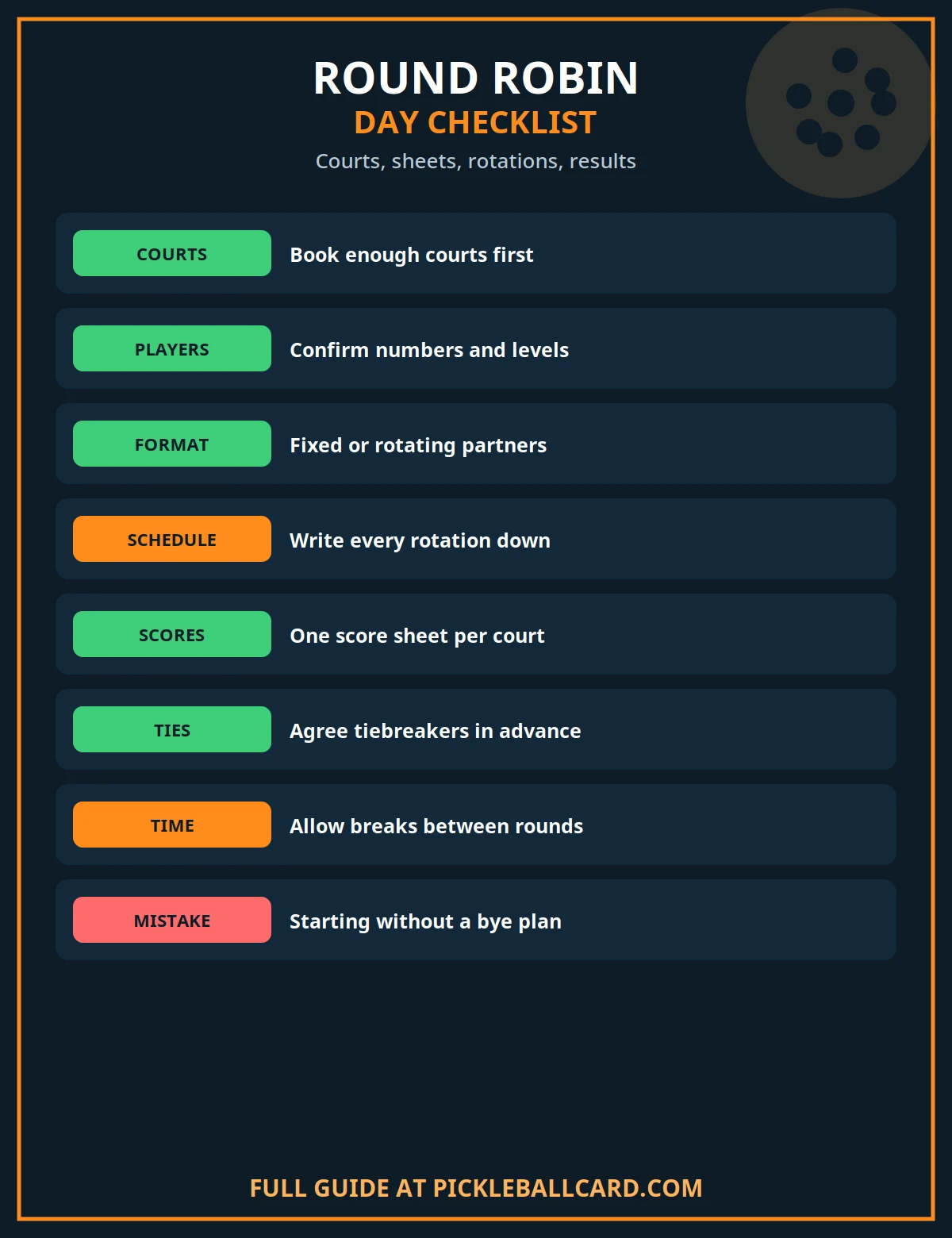
Pre-Event Checklist For Organizers
Use this checklist in the week before your event. Tick each item off only when it is genuinely ready, not merely planned.
- Confirm court booking, start time, finish time, and access arrangements with the venue.
- Set the format, group size, partner system, scoring method, and tiebreaker order in writing.
- Open entries with a clear closing date, entry limit, and refund or waitlist policy.
- Balance groups by ability, publish the schedule, and share court assignments before arrival.
- Print the rotation, score sheets, results table, and a copy of the rules summary.
- Pack balls, nets if needed, score sheets, pens, a timer, water, and first aid supplies.
- Brief volunteers on check-in, score collection, court calls, and dispute handling.
- Plan prizes, photographs, and a short closing announcement so the day ends cleanly.
- Confirm a wet-weather or overrun plan, including how players will be contacted.
- Set up a results board in a visible spot and assign one person to update it.
Common Mistakes Organizers Make
The most common mistake is inviting too many players for the courts available. A crowded schedule creates long waits, rushed matches, and frustrated players.
The second mistake is leaving scoring or tiebreakers undecided. Players assume different rules, argue different scores, and blame the organizer for a gap they never filled.
The third mistake is changing the schedule mid-event without telling everyone. A quiet court swap can strand a team on the wrong court at the wrong time.
Another frequent error is ignoring rest. Players who play five matches without a break play worse, tire faster, and enjoy the day far less.
On The Day: Running The Event
Arrive early, set up courts, and post the schedule where everyone can see it. Early preparation sets a calm tone for the whole day.
Open with a five-minute briefing covering format, scoring, tiebreakers, court calls, and score reporting. Answer questions now, not during a close match.
Call each round clearly, by court and team names, and give a two-minute warning before play starts. Players who miss a call delay every court.
Handle disputes quickly and privately, using the published rules and the completed score sheet. Keep the decision short, calm, and consistent for all groups.
Close with results, thanks, and photographs while players are still together. A tidy finish encourages the same players to return next time.
If your round robin is a first step toward competitive play, our guide to a first pickleball tournament explains check-in, warm-up, waits, and what a tournament day really feels like.
Frequently Asked Questions
How many players do I need for a pickleball round robin?
You can run a round robin with as few as four players in singles or eight in doubles. Twelve to sixteen doubles players on three or four courts gives a smooth, social event.
How long does a round robin take?
Allow about 25 minutes per round for a game to 11 plus changeover. Five rounds therefore take just over two hours, plus warm-up, breaks, and any final.
What happens if a player drops out during the event?
Keep the remaining schedule intact where possible and record the withdrawal clearly. For sanctioned tiebreaker purposes, a withdrawn team is treated under the official rule sequence, so note the timing of the withdrawal.
Should partners be fixed or rotating?
Use fixed partners for teams that enter together and rotating partners for social mixers. Publish the choice in advance, because it changes how players prepare and how points are counted.
What is the fairest tiebreaker for a club round robin?
Matches won first, then head-to-head result, then point differential is fair and easy to explain. Publish that order before play, record full scores, and update standings after every round.
Do I need a referee for every match?
No, most club round robins are self-officiated, with players calling lines and scores honestly. Keep an organizer nearby to settle disputes, check scores, and keep rounds moving.
The Bottom Line For Organizers
A successful round robin is decided before play starts. Clear format, balanced groups, a tested rotation, and published tiebreakers do most of the work.
On the day, your job is simpler: call rounds clearly, collect scores promptly, update standings visibly, and protect rest and good humour.
Start small, keep the first event manageable, and learn from what worked. Your second round robin will run faster, feel smoother, and fill up sooner.
Sources: USA Pickleball, Official Rules — round robin format and tiebreaker sequence in Rule 12.C.3, via USA Pickleball Rules.
This guide is original; no competitor content is linked or reproduced.

Shoaib is the publisher of Pickleball Card. He oversees the site’s guides to pickleball rules, ratings, strategy and gear, all researched from primary sources — the USA Pickleball Rulebook, DUPR and manufacturer documentation — and updated as the game changes.