• Skip to primary navigation
  • Skip to main content
  • Skip to primary sidebar

Pickleballcard

All About Pickleball Gears

  • About Pickleball
    • How To Play Pickleball
    • Pickleball Rules
    • Pickleball Kitchen Rules
    • Serving Rules
    • Pickleball Ratings
    • Pickleball Tips
    • Pickleball History
  • Pickleball Shoes
    • Best Pickleball Shoes
    • Best Pickleball Shoes For Men
    • Best Pickleball Shoes For Women
  • Pickleball Paddles
    • Best Pickleball Paddles
    • Elongated Pickleball Paddles
    • Graphite Pickleball Paddles
    • Onix Pickleball Paddles
    • Pickleball Paddles for Women
    • Pickleball Paddles For Spin
  • Vs
    • Pickleball Vs Tennis
    • Paddle Tennis Vs Pickleball
    • Indoor Vs Outdoor Pickleball

How To Find The Perfect Pickleball Ball | All You Need To Know

September 11, 2026 by Jeena Noven

Here is a complete guide on how to find the perfect Pickleball ball based on court, weather conditions, skill set, and material construction.

How To Find The Perfect Pickleball Ball?

Pickleball has been there for ages, and people are still interested in this game, all credit to its game structure. And the first thing one would ask while planning to get started with this game is which ball is right for me. There is no one-size-fits-all-all, and it all depends upon factors like the court, weather conditions, skill rating, material construction, and much more.

Difference Between Indoor And Outdoor Pickleball Balls

Here are the key differences between indoor and outdoor pickleball balls,

Aspect Indoor Pickleballs Outdoor Pickleballs
Material Smooth, softer Textured, harder
Bounce Lower and controlled Higher and lively
Durability Less durable More durable
Weight Slightly lighter Slightly heavier
Wind Resistance Not designed for wind Designed for wind
Surface Suited for smooth courts Suited for rough courts
Noise Level Quieter Louder
Playing Style Controlled and precise Faster-paced and dynamic
Indoor/Outdoor Use Primarily indoor Primarily outdoor

These differences in material, bounce, durability, and other factors make indoor and outdoor pickleballs suitable for different playing conditions and styles.

Want to know how to find the perfect Pickleball ball for your skill set? Don’t waste more time, and give this guide a quick read to make a wise decision.

1. Material Construction

It is pretty evident that Pickleball balls are made up of plastic, be it indoor and outdoor balls. However, the plastic used in each ball is different and determines its weight, durability, and hardness. This is why it is of foremost importance that you check what material is used to make the Pickleball ball you are interested in.

Material Of The Pickleball Ball
Hard Plastic Is The Most Durable Pickleball Material Compared To Others

So, if you are most likely to play outdoor Pickleball matches, it is important to go for polyethylene plastic with a high-density rating, polypropylene, or TPE Plastic. This is because it helps to add weight and thickness to the ball, so there is no chance that wind interferes with its trajectory. It further allows players to generate power and speed.

In contrast, for indoor Pickleball matches, low-density polyethylene plastic, and part of the reason is that they are lighter in weight, feel thinner, and are hollow from the inside. They also have more negative space that allows players to get a hold of the ball and feel at ease throughout. If you are someone struggling with control, these balls may be the most appropriate.

2. Weight And Bounce Level

Pickleball ball weight can make a huge difference in the playability of a Pickleball ball, even if it is by just a fraction. For instance, a lighter ball means no power but better control. A heavier ball means incredible power and a fast swing but limited control and extra effort from the players’ end.

Balls created for indoor courts are lighter in weight and vice versa. This is why beginners are fond of using indoor balls, as they are easy to play with and feel light, whereas Pickleball experts prefer outdoor balls, considering that they provide them with power and speed. And if you are a mid-level player, do consider your skill set and then invest in the ball.

3. Color Of The Ball

Similarly, it is equally important to consider the color of the Pickleball ball, as it plays an important role in improving your game. For instance, if you are most likely to play outdoors, you will need a visible ball, even in dark and dim-lit conditions. Here, I usually prefer colors like red and orange.

Likewise, if you are most likely to use it for indoor matches, any color will work well. That said, I would advise beginners to go for bright neon colors so the ball doesn’t get lost in the audience’s vibrant clothes. And if it goes with your style, it will be a cherry on top.

4. Noise

If you are a player who gets easily annoyed by unusual and unnecessary noises while playing Pickleball games, this is especially important for you. This is because some balls are more noisy than others, and part of the reason is the plastic used in the construction. And do consider that noise also increases the chances of cracks in the ball.

That said, do consider that outdoor balls tend to be a bit noisier than indoor balls. So, comparing the sounds of these two types with each other would be useless. You need to compare balls of the same category with each other to get the appropriate analysis of their noise level.

5. Number Of Holes

It is equally important to look into the number of holes your preferred ball has. The usual difference between indoor and outdoor balls is that the former has fewer holes (approximately 26) than the latter (approximately 40). Hence, this influences their utility and your decision to buy one.

Number Of Holes On Pickleball Balls

If you are someone who is bothered by weather interference while playing Pickleball, an outdoor ball is the right choice. This is because it disturbs the aerodynamics of the ball and cancels out the external factors. However, for indoor matches, where you are mostly looking for a slow pace and spins, indoor balls with fewer holes will work well.

6. Skill Set

While buying the right Pickleball ball, you also need to consider your skill set, as it evidently plays an important role. Beginners usually prefer slow-paced games because they are still in the learning stages. Whereas professionals are preferably fond of momentum and speed.

So, if you are a beginner who is in search of a ball that gives a slower pace and is easy to get a hold of, indoor balls may work for you. On the contrary, outdoor balls are best suited for experienced players looking for opportunities to play with speed and momentum.

7. Conditions On The Field

In the end, conditions on the field also guide your choice of the Pickleball ball, as it directly impacts your gameplay. It is a common understanding that each type of court has its own designated ball design and structure. For instance, you must use outdoor balls for outdoor matches and vice versa.

This is because balls designed for outdoor conditions have a specific structure, including more holes, a higher hardness rating, robust plastic construction, and minimal negative space. All this combined helps players resist wind interference and maintain the straight trajectory of the ball.

Similarly, it goes the same for indoor balls. Considering that indoor courts require you to throw the ball at a slower pace in a spin motion, they feel light, have a lesser number of holes, and have soft plastic construction. Hence, with these balls, you will be able to maintain stability, bounce, and control at a slower pace.

USAPA Guidelines For A Quality Pickleball Ball

USAPA, or USA Pickleball Association came up with some guidelines that help players get a perfect match of gear for their game. This also goes for official Pickleball balls. So, for a ball to be USAPA approved, the following are some conditions it must fulfill.

  • The ball must have a non-textured surface.
  • It must be made up of molded plastic.
  • The diameter of a pickleball ball must be between 2.87 and 2.97 inches.
  • The ball variance must not exceed 0.02 inches.
  • The weight of the ball must be between 0.78 and 0.9 ounces.
  • The ball hardness is measured on a D scale, with not more than 50-60 ratings.
  • The ball should bounce at least 30 to 34 times when it is dropped from 78 inches in height.
  • The holes on the shoulder must be between 26 and 40. They must not exceed 40 and must have a uniform distribution over the ball surface.
  • Players can choose the color of their ball according to their preference.

Frequently Asked Questions

Are All Pickleball Balls The Same?

No, all Pickleball balls are not the same, as they are designed for different conditions. There are commonly two types of Pickleball balls, indoors and outdoors. Each has its own specialized structure, designed to survive specific conditions.

How Long Do Pickleball Balls Last?

The life of a Pickleball ball depends on its use, playing surface, and temperature on which it has been used; for instance, cold and outdoor conditions can easily crack these balls. Also, each ball is made up of different qualities, so the lifespan varies from model to model. I would say Onix balls typically tend to last for a longer time.

Can Beginners Use Outdoor Pickleball Balls?

No, beginners are not advised to use outdoor pickleball balls, considering they are really difficult to handle. It takes extra effort to take control of a fast-moving outdoor Pickleball with immense power, even from a professional player. Hence, starting your Pickleball journey with an indoor ball is always better.

Can You Use Indoor Pickleball Outdoors?

Though you can use indoor Pickleball for outdoors and vice versa, I would not recommend it. This is because there is a reason why they are designed for different conditions. And if you are using an indoor ball for outdoor matches, it won’t last you for a few matches.

What Kind Of Ball Is Used In Pickleball?

A round, perforated, smooth surface ball is used in pickleball. A Pickleball ball is the same size as a baseball. For indoor pickleball, a lightweight pickleball is used, having 26 holes in it. For outdoor pickleball, a heavyweight ball is used, having 40 holes in it.

What Is The Diameter Of A Pickleball?

Pickleballs have a diameter of 2.874”-2.972” and a circumference of 9.03”-9.34”. The mass of a Pickleball is between (22-26.5 g).

The Test Nobody Mentions: Spotting a Dead Ball

Choosing well also means knowing when a ball is finished, because a dead ball ruins good games. First, run three checks. Roll the ball across a table: an out-of-round ball wobbles instead of tracking straight. Squeeze it: a soft spot or a hairline crack near a seam means it is done. Then bounce it beside a new ball from the same height — the tired one lands noticeably lower and deader. Retire it: on indoor courts especially, where the game is built on touch, one dead ball changes every rally, and the same goes for any temporary court.

Final Thoughts

Choosing the right Pickleball can be challenging, especially if you are a beginner and don’t know where to start. Though no one pickleball ball size fits all, you can still do some research on the basics. I hope this guide has helped determine which type of Pickleball is best suited for your skill set and gaming conditions.


Other Related Posts:
  • Best Pickleball Paddles
  • Best Pickleball Shoes
  • Pickleball Court Dimensions
  • Difference Between Indoor And Outdoor Pickleball
  • Best Pickleball Nets


Jeena Noven, Pickleballcard Author
Jeena Noven

Jeena Noven is one of Pickleball Card’s main writers for rules, ratings and everyday play. She focuses on the questions players actually argue about on court — scoring, faults, ratings and match situations — and checks each answer against the current USA Pickleball rulebook before it goes live. Her guides are written for real club players: clear first, technical when it matters, and updated when the rules change.

Filed Under: About Pickleball

7 Mistakes Made By Recreational Pickleball Players

September 9, 2026 by Jeena Noven

Here is a complete guide on the common mistakes made by recreational players and how to fix them through practice.

Mistakes Made By Recreational Pickleball Players And How To Fix Them

Pickleball is a great time pass for recreational players who enjoy leisure while being productive. However, for anyone not taking it seriously, it is important to note that the game is not the same for recreational and professional players.

Not many people understand this entirely and try to do professional pickleball tricks with their limited skill set. This ruins their entire experience, and they commonly get fed up with it. This is also why they make the biggest pickleball mistakes.

If you are in a similar situation and want to know the common mistakes recreational players make, here is a complete guide. It also tells you how to fix them. So, dive right in for more.

Beginner Pickleball Mistake

1. Hitting Off A Fancy Spin

The biggest pickleball mistake most recreational players tend to make is playing their spins fancy. Although it sounds great and works incredibly well for professionals, it is not the best for beginners.

If you are new to the game, they can work once in a blue moon. However, attempting them repeatedly can lead to irreversible mistakes in pickleball. Also, if the person on the other side of the pickle net is better than you, forget about winning the battle.

Before you even plan to play fancy spins, consider that they demand a lot of skill and accuracy. This sounds a bit difficult for recreational players. Hence, it is always wise to avoid them at all costs. I am not saying you should never hit a spin but always approach it intelligently.

2. Improper Serving Technique

Another common mistake in pickleball that can break your game is not having the right serving technique. This pickleball serving mistake is primarily because most recreational players try to be all fancy, making them not prioritize the serving technique.

You first need to identify a comfortable technique to eliminate this habit. Once it is done, practice it repeatedly to improve the flip. To master any serving technique, keep your back straight and pickleball paddle perpendicular to the ground. This will help you in balancing each shot, including the serves.

3. Hitting The Ball Too Hard

Smashing the pickleball ball as hard as you can is tempting. But, the issue is that it can land you in a difficult situation. These shots are generally known as power shots and drive shots. These pickleball trick shots are for advanced players, partly because of their unruly and unpredictable nature.

But don’t worry, as I am here with a simple trick to resist the urge to hit the ball too hard. Instead of playing a power hit, you should focus on returning the ball to the opponent’s side. This will divert your attention from using all your force to enjoy the sudden moment.

4. Standing In A No-Man Land

Another beginner pickleball mistake is staying in the no man’s land. Generally, you have two places to stand in the field: the baseline or the pickleball kitchen area. Suppose you are not standing on any of these sides; it is considered a no-man land, and doing so will ruin your game.

This is the most consistent fault most recreational players tend to make. So, you will have to put in extra effort to avoid this. All you need to do is make sure you don’t give the opponent a chance to hit the shot in the direction of your feet. This is because handling such shots is impossible for newbies.

5. Poaching Unnecessarily

Another biggest mistake pickleball players make is poaching at times when it is not required. In simple terms, poaching means stealing a shot from your partner. Most recreational players like to do it, but they forget that scooting to their side can be annoying for the other person playing from your side.

Poaching is generally best for professional players accustomed to playing pickleball doubles. Part of the reason is that they know when and how to attempt this strategy.

The right way of doing it is having the male member on the left side who is responsible for scooting over to the woman’s side and hitting the shot. Even if you are attempting it, note that it is risky as you leave the left side unattended for a long time. Hence, the opposite side can easily take advantage of it.

6. Having Asymmetric Dinking Battles

Although cross-court dinking matches can be a thrilling experience, they are not always ideal for recreational players. They are seriously risky if you are a beginner and learning the basics. Also, playing them against someone better than you on the field is a recipe for disaster.

Firstly, an intelligent player wouldn’t get into such a situation. But, if, for some reason, you are caught up by a better opponent, try counting his/ her dinks. Once you have counted up to three dinks, hit back a bailout dink. This will give you an edge. This strategy also helps newbies gain momentum.

7. Playing Low Smashes

Last but not least, another reason you are not getting better at defending your stance is playing too low smashes. Most beginner players tend to hit back the shots while in the kitchen area.

This happens when a player on the other side of the net hits the shot with the third drop at an awkward height. In this scenario, most recreational players think they can volley the ball or play the smash. But it is really difficult to hit back with such smashes.

To avoid pickleball beginner mistakes, you must resist jumping into the kitchen area. Instead, push yours to a distance where it is comfortable to hit the ball in the direction you want to play the shot. Or, if you are not confident, don’t attempt it.

People Also Ask

What Is The Ten-Second Rule In Pickleball?

Well, it is the simplest rule, yet most beginners forget it. According to this rule, the server has only ten seconds to serve when the scores have already been called. If he/ she crosses this limit, it is a fault, and the server loses the points. This rule exists in the game, as it keeps the game simple and moving for the entire time.

What Are Some Common Mistakes Recreational Pickleball Players Make?

There are multiple mistakes recreational players make during pickleball matches. This includes not having the right paddle, improper posture, hitting the ball too hard, and copying fancy spins inspired by professionals. Similarly, they like to play unnecessary spins and poach.

Why Do Recreational Players Often Hit The Ball Too Hard?

Most recreational players enjoy playing multiple games like tennis, racquetball, and pickleball. Because they always play tennis and racquetball, hitting the ball hard is considered the best strategy. This is quite the opposite in pickleball. This is why players take more time to learn this skill.

How Can Players Improve Their Ability To Watch The Ball?

The only way to improve your ability to watch the ball is through practice. For this, while playing warm-up matches, always keep your eyes on the ball from when it leaves your side to when it is on your opponent’s side. Make sure to pick up things like tracking the ball’s movement and how the ball behaves with different techniques.

Why Is Footwork Important For Pickleball Games?

Footwork is significant when it comes to pickleball games. This is because having the right posture can keep your body relaxed and firm. So, it is easy to move quickly and keep your movements in control. This is especially important if you are fond of doubles, as you will always be on your toes while communicating with your partner. And the only trick to making it better is repeated practice.

How Can Pickleball Players Improve Their Communication With Their Partners?

Hand signals and cues can allow players to communicate better on the pickleball field, especially while playing the doubles. For this, you can even make hand signals that are explicit to you and your partner. For instance, you can signal who will hit the ball or who will poach from which direction, and so on.

How To Get Better At Pickleball?

To improve at pickleball, you must know all the rules, strategies, and tricks that pro players use. First, learn all pickleball rules, including kitchen, scoring, serves, and dinking. After that, practice the pickleball game by performing drills. To get an edge, keep your opponent back and learn different pickleball shots, including dink, Erne, and chop.

Mistake 8: Backpedaling for Lobs

When a lob goes up, most recreational players shuffle backwards, eyes in the sky — and either mishit the overhead off-balance or, worse, fall. Backpedaling is the most dangerous movement in the sport. The correct pattern is a turn: pivot sideways like a tennis player, move back in a crossover run with the paddle already up, then hit the overhead moving forward again, or let the ball bounce and play it from behind the baseline if you cannot get set. It feels slower; it is actually faster and far safer. Our lob shot guide covers when lobs work against you, and the recovery positions tie back to the basics in how to play pickleball.

Conclusion

In conclusion, if you are a recreational player, my advice is to keep things simple and not try to do fancy stuff just because it looks cool on the field. The biggest pickleball mistake most beginners make is to try to copy professionals, which is why they usually get fed up with the entire game.

Finally, I hope this guide has been helpful for you in figuring out what you have been doing wrong all this time and how to fix it.


Other Related Posts:
  • Pickleball Dinking Mistakes
  • Top Pickleball Shoes
  • Official Pickleball Rules
  • Difference Between Pickleball And Paddle Tennis
  • Best Pickleball Bags


Jeena Noven, Pickleballcard Author
Jeena Noven

Jeena Noven is one of Pickleball Card’s main writers for rules, ratings and everyday play. She focuses on the questions players actually argue about on court — scoring, faults, ratings and match situations — and checks each answer against the current USA Pickleball rulebook before it goes live. Her guides are written for real club players: clear first, technical when it matters, and updated when the rules change.

Filed Under: About Pickleball

The Official Rules For Line Calls In Pickleball

September 8, 2026 by Jeena Noven

Read a brief article on the official rules for line calls in Pickleball to get some help and assistance as a newbie.

Pickleball is all fun and games unless you start playing it professionally. However, it is liked by many because it is not physically excruciating like other sports. If you are a new player who seems to develop an interest in the game like me, you can dig into the article below to look for some rules. These will help you increase your knowledge and improve the game.

I played the game for at least three months before breaking down the rules for line calls in Pickleball for you all. These are simple yet important to help you maintain the winning streak. Please read all the calling rules carefully before stepping onto the court. The information will help you have a competitive advantage over others in the game.

The Official Rules For Line Calls In Pickleball

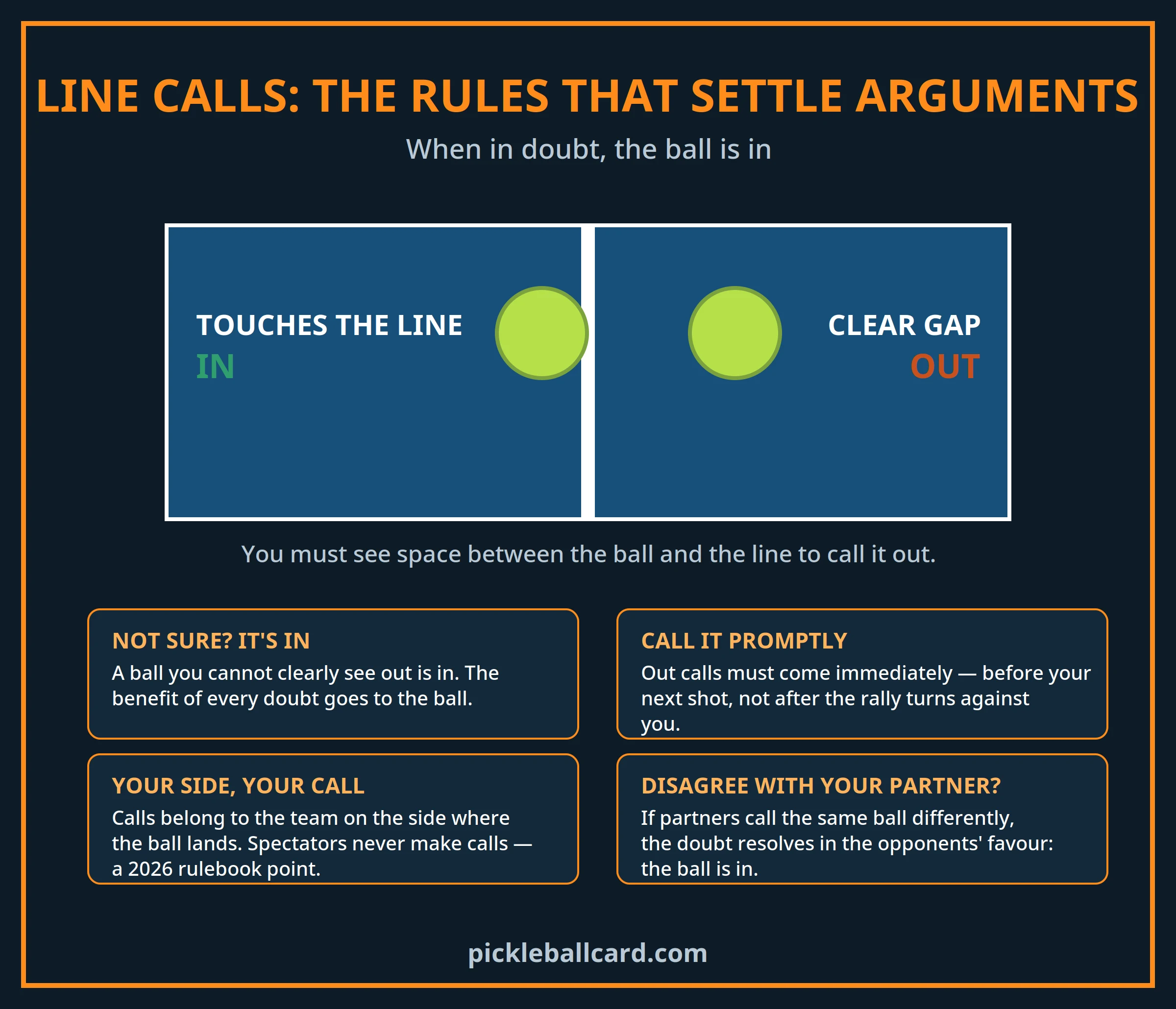
Pickleball line call rules showing a ball touching the line is in and a ball with a clear gap is out
Line calls: touch the line and it’s in; you must see a clear gap to call it out.

If you are new to Pickleball, you should know some basic rules that will help improve the game and win against the opponents. Knowledge of the official rules is crucial for staying in the game and having a competitive advantage. I have been playing the game for two months and can break down the line call rules for all the newbies. Hence, the rules can be beneficial in the long run.

Pickleball Line Call Rule, Pickleball Line Rules
Pickleball Line Call Rules

1. Serve Should Always Land In The Serving Court

The first and the most fundamental rule the entry-level player might know is that the serve should always land in the serving court. A ball entering the non-volley zone or the Kitchen is called “serve out.” You can hit anywhere on the centerline, sideline, or baseline as it will be considered as “serve in.” Hence, this is a basic rule that should be kept in mind if you serve.

2. Players Are Held Responsible For Calling Lines

The players on the court are held responsible for calling pickleball lines when standing on their side. All the players in the game have the right to review the decision or get a second opinion. The referee gives a second opinion to know if the ball is out or would get accepted.

3. Opponents Who Are Not Serving Will Get An Advantage

When going through the rules for line calls in Pickleball, the opponents who are not serving are always at an advantage. They benefit from the doubt because every team has to be treated equally in the game. Appeals are made before the serving team makes their next shot.

However, the pickleball ball can be observed when lined out. In pickleball doubles, one team can call out and wait for the referee to respond. If the ball were out, the opponent team would have an advantage.

Pickleball Rules

The following rules will help you when stepping on the pickleball court. You all might know that the court is 44 feet long and 20 feet wide. In this 20 feet, the 7 feet is dedicated as the “Kitchen” or the non-volley zone. The ball or the player cannot enter the Kitchen or the non-volley area. Now that you know when playing on the court, let’s dig into some pickleball line rules.

1. Begin With A Serve

This game can be played as a single player or in a team of two players. Whatever the case, the game will start from the team standing on either of the sides. The player on the right side will start serving, and the ball is hit diagonally. It has to be ensured that the ball does not fall into the Kitchen on your side of the court.

2. Position Of The Hand

The second and most important thing that can help you win points is to monitor the position of your hands. Keeping the hand below the waist area is mandatory when hitting the stroke. The arm must move upwards so that you move the ball out of the air. Some players drop the ball onto the court and hit it when it rises to their waist.

3. Serve Continues Until A Fault

If either team is serving, it continues until a fault is committed. The service is changed from one team to another after a fault. Most of the time, a serving player commits three types of faults. He might hit the ball into the pickleball net, or it might go beyond the baseline. Lastly, there are chances that the ball lands in the non-volley zone or the Kitchen area. All these will commit a fault, and the service will be transferred to another team.

4. Not Allowed To Stand In Kitchen

Any player cannot hit the ball or serve while standing in the non-volley zone. The players are not to step onto the line of the Kitchen. It is impermissible to enter that 7 feet when hitting the ball. This rule is great for gaining points against opponents. I used to hit the ball near the opponent’s Kitchen, so they had to cross the line, committing a fault.

5. Ball Must Bounce On Court

The ball must bounce on the court before the opposite team hits it back at you. This can be extremely difficult if you play pickleball singles, as one player cannot cover 20 feet of the court. However, the other members can cover near the baseline if you play as a team. I faced many issues when I started to play the game as a newbie because of this rule.

Frequently Asked Question

Can You Cross The Kitchen Line In Pickleball?

Yes, you can cross the Kitchen line in Pickleball if you are not serving. It is allowed to stand in the non-volley zone except for the time you serve.

What Is Not Allowed In Pickleball?

You cannot hit the ball when your hand is above the waistline. Moreover, you cannot stand in the Kitchen while making a shot.

Can Momentum Carry You Into The Kitchen?

Yes, momentum can unconsciously carry you into the Kitchen, which should be avoided at all costs. Even if you are not serving, stay out of the non-volley zone.

Is The Line In Or Out In Pickleball?

In pickleball, when a ball lands on a boundary line, is it considered “in” or “out” according to official rules? When there is a clear difference between the ball and the boundary line, it is considered “out.” On the other hand, when a ball touches any line except the kitchen or non-volley zone, it is considered “in.”

What Happens If You Hit An Out Ball In Pickleball?

The ball is still in the game, as you have to let it bounce first. Saying “out” after the ball touches the court line will be considered as “out.” You can’t hit the ball without letting it bounce once.

Is The Kitchen Line In Or Out In Pickleball?

The kitchen line is considered as “Out” in pickleball. You can’t hit the kitchen or non-volley zone line while serving. You can’t hit the volley without letting it bounce first. All other pickleball court lines of the service area are considered as “In.”

When You Are Not Sure: Give the Benefit of the Doubt

The official tiebreaker is simple: a ball is only ‘out’ when you clearly see space between the ball and the line. If you are unsure, the ball is in — and that applies to your team, so if one partner calls it out and the other sees it in, the ball is in. You may ask your opponents to help with a call on your side, and their view settles it; spectators, however, must never be consulted. Make the call promptly, before playing your return — the same standard runs through the fault rules and the pickleball rules themselves.

Conclusion

A brief article explaining Pickleball’s official rules for line calls is written for your guidance as a newbie. These rules can help you improve and have an advantage over competitors. You need to practice while keeping these basic rules in mind before stepping onto the court for the game. I hope the article explains some essential rules that will be handy during your next match.


Other Related Posts:
  • Best Paddles For Pickleball
  • Best Shoes For Pickleball
  • Indoor Pickleball Courts
  • Stacking In Pickleball
  • Why Pickleball Is Popular?


Jeena Noven, Pickleballcard Author
Jeena Noven

Jeena Noven is one of Pickleball Card’s main writers for rules, ratings and everyday play. She focuses on the questions players actually argue about on court — scoring, faults, ratings and match situations — and checks each answer against the current USA Pickleball rulebook before it goes live. Her guides are written for real club players: clear first, technical when it matters, and updated when the rules change.

Filed Under: About Pickleball

How To Perfect The Dink Shot In Pickleball?

September 5, 2026 by Jeena Noven

If you wonder how you hit a perfect dink in pickleball, here is a guide discussing when, why, and how to dink in pickleball.

Dink in pickleball is vital as it is a crucial part of the offensive and defensive strategies. A dink shot in pickleball is the shot you hit from the non-volley zone line and make the ball land in the opponent’s non-volley zone. A dink shot can be used as an active weapon against your opponents to make a mistake. Also, it is the best way to neutralize the valley and release some pressure. This guide will discuss when, why, and how to dink in pickleball.

How To Perfect The Dink Shot In Pickleball?

What Is Dink In Pickleball

What Is Dink In Pickleball?

Dink is a well-controlled soft shot hit from the non-volley zone that arcs over the net and lands within the kitchen zone of the opponent’s court. It could be straight across or diagonally cross-court.

Key Steps For Hitting A Perfect Dink In Pickleball | Pickleball Dinking Drills

1. Prepare Your Body

An excellent athletic stance is crucial to hitting a perfect dink shot. You need to prepare your body to react. Stretch your body with your knees slightly bent. The feet should be shoulder-width apart. Since it is a soft hit, you cannot afford miss-hits. Only a well-controlled hit will land on the desired spot in the opponent’s court. Therefore, you need to watch the pickleball to your pickleball paddle.

2. Positioning

Holding the line is very important in pickleball. You need to position yourself on a point from where you can hit a perfect dink shot. You can’t play a perfect dink if you stay farther from the pickleball net. Stay as close to the net as possible, only when you stay on the kitchen line.

When you step back from the kitchen line, give your opponent a wide space to return your dinks. The opponent will return your dinks through different angles, ultimately making it difficult for you to return all of them. While staying on the line, you can put much pressure on the opponent.

Though you cannot always stay on this line, the opponent may start hitting your feet. In that case, you can step back a bit, but don’t forget to return to your position (the non-volley zone line) as soon as possible. Also, you can take a small drop step back off to return quick hits.

3. Get Your Paddle Ready

It’s time to prepare your paddle once you stand in the right spot in a perfect stance. You hit the ball in front of your body in a cross court dink shot. This short is less about power and more about control. Hold your paddle slightly loose to keep your hit from being overpowered. So, you must keep the paddle face open in front of your body with a soft grip. It will help you hit the ball with a gentle lift motion.

4. Footwork

Footwork is a key factor in all racket games, and it goes true for dinking in pickleball. Moving your feet too much is not a good idea since you must hold the line. However, you must be ready to move left, right, up, or down. Being flat-footed on the kitchen line makes it easy for your opponent to hit your feet.

Keep your body parallel to the kitchen line, but do not hesitate to step back when needed. Avoid crossover steps and try to step back laterally to create room for yourself while returning a pickleball dink shot approaching your feet. Getting back to your ready position is essential, and if you take a crossover step, you won’t be able to grab your ready position quickly.

5. Protect Your Hit

Dinks that land close to your feet are hard to return as you have minimum time to react, you need to step back, and you need to create a steep angle. Therefore, you must practice protecting your feet while dinking in pickleball. The best way to protect your feet is to hit the pickleball on a short hop.

Hitting it on a short hop means hitting the ball right after it rises from the ground after the bounce. You need to get low to take the ball on the paddle before it rises, spins away, or moves away from your body. You need to be careful as the ball has a lot of speed when it rises. You can easily power it to shoot it back over the net with a gentle push.

This way, you can return a pickleball dink shot without putting your feet in the poor position or leaving your ready position. Another way to protect your feet is to take the ball out of the air. Don’t overextend your body, and take the ball out in the air to give a quick response.

6. Making A Contact

When striking the pickleball, you need to get under the pickleball. The best way to do this is by getting as low as possible. Pro players almost touch the ground when they bend their knees to hit the pickleball. Remember, this is a soft and controlled shot; your goal is not to overpower it. It is played with movement from the shoulder and doesn’t involve a wrist break or backswing.

Now, it’s time to make contact. When you strike a dink, you gently lift and throw the pickleball. You should not swing your hip, and it should look like you are standing from a sitting position. Provide a controlled motion with the form wrist and avoid the wrist snap or jerk.  Stay low through the contact. If you stand, the paddle will also come up with you and hit the ball with too much height.

7. Revert To Ready Position

As soon as you finish hitting, get back to your ready position.

Pickleball Dinking Strategy

Dink is a simple yet important shot in pickleball and can be part of defensive and offensive strategies. So before you start dinking, you must know what you want to accomplish. The most common Dinking strategy is to extend the life and wait for your opponent to make a mistake.

If you want to win a point, you must wait a lot. Dinking will not win you a point on the first hit. Plan your dinking shots first, and then start a dinking rally. Please stick to your plan, manipulate your opponents by extending the game, and wait patiently until they make a mistake. This is the best dinking strategy.

People Also Ask

What Is The First Rule Of Dinking In Pickleball?

The first rule of dinking in pickleball is control. You must hit a controlled, unattackable shot into the opponent’s kitchen zone. If your opponent hits hard, he will hit it in the net or out.

How Can I Be A Better Dinker?

You must hold the line (stay parallel to the net on the non-volley zone line), use your legs and shoulders, and never overpower your shots. Also, you must practice a lot to learn from your mistakes and be a better Dinker.

How To Hit A Dink Shot In Pickleball?

To hit a dink shot in pickleball, you must learn how to complete it, as patience and control are a significant part of dinking. It would be best to hit in the opponent’s kitchen zone for a perfect dink shot, so it should be difficult for him to return.

What Is A Dead Dink In Pickleball?

If your dink shot fails to create any spin that can stress, press, or pressure your opponent, it is called a dead dink in pickleball. Try to create maximum spin using different strategies and practices to create aggressive dink shots.

How To Practice Dinking In Pickleball?

There are certain pickleball drills that you should practice to improve yourself at dinking. These drills include footwork, target practice, dummy dinking matches, and toss-the-ball drills. You can’t perfect dink shots if you don’t practice.

What “Perfect” Actually Looks Like: The Landing Test

Judge a dink by one question: did your opponent have to hit up? A perfect dink peaks on your side of the net, crosses low, and lands in the kitchen close to the net — ideally at the feet or toward the backhand side — so the only reply available is another soft shot. If the ball bounces high enough for them to swing down at it, the dink failed no matter how smooth it felt. Aim small to miss small: pick a target patch a paddle-length inside the kitchen line rather than “somewhere in the kitchen,” and your errors shrink with your target. This is the same apex principle behind keeping the ball low, and it is the foundation every pattern in our dinking strategies is built on.

Conclusion

So, we can safely conclude that dinking in pickleball is all about control. In dinking, doing less equals more. You must do limited footwork and add limited speed and restricted power to your hits. Also, you need to stay in your ready position to hit perfect dinks.


Other Related Posts:
  • Top Rated Pickleball Shoes
  • Pickleball Rules & Scoring
  • Pickleball Vs Paddle Tennis
  • How To Play Pickleball On A Tennis Court?
  • Best Pickleball Bags
  • Pickleball Dinking Drills


Jeena Noven, Pickleballcard Author
Jeena Noven

Jeena Noven is one of Pickleball Card’s main writers for rules, ratings and everyday play. She focuses on the questions players actually argue about on court — scoring, faults, ratings and match situations — and checks each answer against the current USA Pickleball rulebook before it goes live. Her guides are written for real club players: clear first, technical when it matters, and updated when the rules change.

Filed Under: About Pickleball

Why Is Pickleball So Popular? | Pickleball Growth Statistics

September 4, 2026 by Jeena Noven

Why is pickleball so popular amongst people these days, irrespective of their age, height, intelligence, and body shape? Read to know!

Why is pickleball so popular? Could it be because it resembles tennis, or is it because it looks cool playing and running around the court with wicked paddles in your hands? The answer is that pickleball is a game of great benefits. You have no idea what a great impact this game has on you and your life. It is literally a life-changing game that not only helps you create a social life for yourself but also trains your body and mind to be stronger and more flexible.

Pickleball Popularity Trend Over The Last 5 Years

I am personally a huge fan of pickleball. In fact, I have been playing this game since I was four years old. But it was only after I learned its astonishing benefits that I started taking it more seriously. In the following article, I will tell you all about why this game is so popular amongst people of all ages these days. So, if you want to know more, keep on reading the following article.

Why Is Pickleball So Popular?

1. A Great Workout

If physical fitness is your motive, but you hate doing boring exercise consistently, then you should definitely try playing pickleball. Trust me, it is the best form of pickleball exercise I know. It keeps you in shape and provides your brain with all the oxygen it needs for proper functioning. It also helps improve your muscle coordination and agility. This will make you more alert to the surroundings and prepare you for any situation.

Playing pickleball burns around 250-350 calories per hour at a rate of 120 to 150 beats per minute (bpm), which varies depending on several factors, such as your weight, intensity of play, and individual metabolism.

It is such a fun game that you won’t even realize that you are even getting a workout. You will be so busy chasing the ball and throwing it back at your opponents that you won’t even feel the burn in your limbs. Besides, the mental relaxation that this game provides you is simply out of the world. You will instantly feel an improvement in your mental ability to tackle difficult situations and be more alert to your environment. It will relax your nerves and release tension.

2. Helps Improve Your Social Circle

If you are a hermit and looking to expand or build up your social circle, then you should definitely start playing pickleball. It doesn’t matter where your pickleball skills stand. You will be able to make new friends and learn so much from every person you meet. It is the best way of finding like-minded people and seeing the world through their perspective.

There is no way that you go out to play pickleball and return home without interacting with people. You will naturally fall into conversation with your teammates who are there to learn and connect as well. It is a highly social game and an excellent start for people looking for an easy way to connect with people and get out of their comfort zone.

3. Super Easy To Learn

Pickleball is not like any other sport. It is the easiest to learn. In fact, if you ask me, I had the most fun learning to play this game. It is a kind of game in which you fall easily into a pattern and get a handle on its simple pickleball rules. If you already play table tennis or lawn tennis, you will instantly understand how to play pickleball game and even find it much simpler than the other two games I mentioned.

However, you may take some time to learn and get the hang of this game if you are an absolute beginner and haven’t played any sport in your life. Your muscles will take some time to coordinate with your hand and eye receptivity. You won’t be too flexible to move around the court too quickly. However, it will only be a matter of a week or two before you start seeing improvement in yourself. This period is way less than other games.

4. Does Not Require Much Equipment

The best thing about pickleball is that it does not require much equipment. You will just need a pickleball paddle and a wiffle ball to get started. No need for precautionary stuff or any special equipment. You don’t even need a special costume, either. A simple pickleball outfit would suffice, given that you feel comfortable playing pickleball in it.

Hence, it means that you won’t even need too much investment in this fastest growing sport. In fact, you may even get started within a total budget of a hundred dollars. Besides, there is no need to get a high-end pickleball paddle in the beginning, either. First, learn how to play pickleball using a cheap paddle and then upgrade later on when you have the funds.

5. Goes Easy On Your Body

Have you ever wondered why most tennis players shift to pickleball after their retirement? This is because pickleball is a lighter version of tennis. It does not demand your body to be too agile or in good shape. It does not even wear out your joints.

This is because the wiffle ball used for playing pickleball is much larger and softer than the tennis ball. So, it is much slower and does not require you to hit it with as much force. Neither does it require you to be extra quick in catching the ball. Shifting from tennis to pickleball will prove to be a very smooth transition for you.

6. Low Impact Game

Pickleball is a low-impact game. It does not put too much pressure on your knees, feet, and elbows. So, suppose you have previously suffered from a muscle or a joint injury, and your physicians are not advising you to start playing high-impact games such as tennis. In that case, you should definitely consider playing pickleball and ease your way into high-impact games smoothly.

This game will also train and prepare your muscles and joints for high-impact games as well. So, if you ask me, pickleball is exactly the kind of low-impact game that will help you train your muscles to get back into shape.

7. Does Not Require Too Much Space

Pickleball requires only half the space needed for tennis. In fact, you can play pickleball on the tennis court as well, with only minor modifications. It means that you don’t need any separate space for playing pickleball, either. Even if you don’t have a tennis court, you will still be able to play pickleball on a makeshift pickleball court.

And the best part is that pickleball can be played indoors as well as outdoors. It is the kind of game that you can play in your free time with your friends and family in your backyard.

8. Play Anywhere You Want

As I mentioned earlier, you don’t need any specified space for playing pickleball. It means that you can play this game almost anywhere you want. Simply tag your pickleball paddles and the wiffle balls along to your place of choice and set up your court anywhere you want. You may play pickleball in parks, beaches, schools, colleges, or any recreational centers accessible to you.

Frequently Asked Questions

Where Is Pickleball Most Popular In The World?

Pickleball is played worldwide but when it comes to the hub of pickleball players, that would be California. It has more than seven hundred pickleball places in all of California where you can play this game with your friends.

Why Is Pickleball So Addictive?

The reason why pickleball is so addictive is because it is suitable for all ages and people with all skill sets. You may be a beginner or an amateur, but you will be treated with the same respect.

Why Is Pickleball Better Than Tennis?

Pickleball is far better than tennis because it is a low-impact game. You may be injured or old and still be able to play pickleball without any trouble.

Why Is Pickleball Good For Seniors?

Seniors love playing pickleball as it is a great workout, a low-impact game, provides social interaction, and requires less amount of running. Most seniors feel loneliness and physical issues in older age, which can negatively affect their mental and physical health. Pickleball is a great way for social engagement and physical activity.

Why Is Pickleball So Noisy?

Pickleball is notably noisy due to the design of its equipment and playing surface. The solid paddles, typically made of wood or composite materials, strike the hard plastic ball and produce a distinctive ‘pop’ sound. Additionally, the game often involves rapid volleys and is played on hard court surfaces, which amplify the sound of ball contact, contributing to its characteristic noise level.

The Hidden Engine: Short Games, Open Play, No Team Needed

One reason rarely makes the lists, yet it may be the biggest: pickleball is built for drop-in play. A game to 11 is short, so courts turn over quickly and nobody waits long. At most venues you stack your paddle in a rack and play with whoever is next — three strangers who become partners within a month. There is no team to recruit and no league commitment, and ratings let hosts group levels so games stay close. It is the structure behind the friendliness: a beginner who learns how to play on Monday can join the rotation by Friday.

Final Thoughts

So, this was all from my side. I hope you all enjoyed reading through this article. I tried my best to provide you with all the information that you needed in order to understand why pickleball is so popular amongst people of all ages. It is a game that does not have a minimum or a maximum age limit.

You may be slim, fat, tall, short, black, or white; it doesn’t matter at all except for how willing you are to take a step in this direction. The USA Pickleball Association has 124,000 members, which is increasing daily. According to the Sports & Fitness Industry Association’s report, there is an increase of 21.3% in pickleball growth from 2019 to 2021.

Pickleball Popularity Graph By Player's Contribution
Pickleball Popularity Graph By Player’s Contribution

It is a simple, low-impact game that helps you build up invaluable skills within yourself. It provides a superb full-body workout to your body as well as your mind. It relaxes your nerves and provides you with a source of outlet to let all the negative energy out. After playing this game, you will feel considerably lighter and fresher. Besides that, it does not require expensive equipment, nor does it need too much space. You can set up your portable pickleball court in any space available to you.


Other Related Posts:
  • Best Shoes For Pickleball
  • Best Pickleball Drills
  • Pickleball Grips
  • Pickleball Courts Near You
  • Pickleball Terminologies


Jeena Noven, Pickleballcard Author
Jeena Noven

Jeena Noven is one of Pickleball Card’s main writers for rules, ratings and everyday play. She focuses on the questions players actually argue about on court — scoring, faults, ratings and match situations — and checks each answer against the current USA Pickleball rulebook before it goes live. Her guides are written for real club players: clear first, technical when it matters, and updated when the rules change.

Filed Under: About Pickleball

  • « Go to Previous Page
  • Page 1
  • Interim pages omitted …
  • Page 15
  • Page 16
  • Page 17
  • Page 18
  • Page 19
  • Go to Next Page »

Latest Posts

  • Raw Carbon Fiber Pickleball Paddles Explained
  • Pickleball Court Surfaces Explained: Acrylic, Asphalt, Concrete, And More
  • How To Organize A Round Robin In Pickleball
  • What Is The PPA Tour? The Professional Pickleball Tour Explained
  • The Mental Game of Pickleball: Focus, Confidence and Composure
  • Let Serve in Pickleball: What Happens When the Serve Hits the Net
  • Overhead Smash in Pickleball: How to Hit It
  • Forehand Drive in Pickleball: Power and Consistency
  • Common Pickleball Injuries and How to Prevent Them
  • Pickleball Tournament Formats Explained
  • About
  • Privacy Policy
  • Terms And Conditions
  • Affiliate Disclosure

COPYRIGHT © 2026 · Pickleballcard.COM, ALL RIGHTS RESERVED.

PICKLEBALLCARD.COM IS A PARTICIPANT IN THE AMAZON SERVICES LLC ASSOCIATES PROGRAM, AN AFFILIATE ADVERTISING PROGRAM DESIGNED TO PROVIDE A MEANS FOR SITES TO EARN ADVERTISING FEES BY ADVERTISING AND LINKING TO AMAZON.COM. AMAZON, THE AMAZON LOGO, AMAZONSUPPLY, AND THE AMAZONSUPPLY LOGO ARE TRADEMARKS OF AMAZON.COM, INC. OR ITS AFFILIATES. AS AN AMAZON ASSOCIATE WE EARN AFFILIATE COMMISSIONS FROM QUALIFYING PURCHASES.