Few shots stop a game on the next court like an around-the-post. A dink is angled so wide that it pulls a player completely off the side of the court — and instead of trying to lift the ball back over the net from an impossible position, that player swings it around the outside of the net post, a few inches off the ground, and watches it skid into the opponent’s court. Half the spectators cheer. The other half ask whether that can possibly be legal.
It can, it is, and it is one of the most useful defensive weapons an intermediate player can add. This guide covers the ATP properly: the exact legality in plain language, the situations that create one, a step-by-step technique that works at club level (not just on highlight reels), how to defend against it, and the drills that build the recognition the shot actually depends on.
Key Takeaways
- The ATP is fully legal. Under the USA Pickleball Official Rules a ball may travel around the outside of the net post; it does not have to cross over the net at all.
- There is no height restriction. An ATP may pass around the post below net height — that low, skidding trajectory is the whole point of the shot.
- It must still land in. The ball must land in the opponent’s correct court, and it must not touch the post or the net system on the way.
- Your body has rules too. After contact you may cross the imaginary extension line of the net around the post, but you must not touch the opponent’s court, the net system or the opponent while the ball is live — and crossing that line without making contact is a fault.
- The ATP is created by your opponent’s angle, not by your ambition. The setup is a wide, low, angled ball that bounces and travels outside the sideline. No wide ball, no ATP.
- Recognition beats mechanics. Most failed ATPs are decided before the swing — the player spotted the opening a step too late.
What Is an Around-the-Post Shot?
An around-the-post shot — ATP for short — is a return hit from outside the sideline in which the ball passes around the outside of the net post rather than over the net, and then lands in the opponent’s court. Because the ball goes around instead of over, it can travel far below the height of the net tape: many ATPs are hit from near ankle height and never rise above knee height before they land.
That trajectory is what makes the shot so hard to defend. A normal reply from a wide position has to go up and over the net, which gives defenders time and height to attack. An ATP stays low, arrives fast along the ground, and often lands at an angle the defending team cannot reach because they are still covering the cross-court reply they expected. It is less a power shot than a geometry shot: you are using the space outside the post that most players forget exists.
Is the ATP Legal? The Rules in Plain Language
Yes. The USA Pickleball Official Rules deal with returns around the net post in the rules on the plane of the net and legal returns. Summarised in plain language:
- The ball may go around the outside of the post. A return does not have to travel back over the net to be legal.
- There is no restriction on the height of that return. It may pass the post below the height of the net.
- The ball must land in the opponent’s correct court and must not strike the post or another part of the net system on the way. A ball that clips the post is a fault, just like a ball into the net.
- The hitter may follow through around the post and cross the net’s imaginary extension line after making contact, provided neither the player nor anything they wear or carry touches the opponent’s court, the net system or the opponent while the ball is live.
- Crossing that extension line without hitting the ball is a fault. You cannot pre-run to the other side in case the ball comes; contact comes first, crossing second.
Two common confusions are worth clearing up. First, an ATP is a rally shot, not a serve: a serve has its own legal delivery and must be played under the serving rules into the service court, so there is no such thing as a legal around-the-post serve. Second, an ATP does not excuse a non-volley-zone fault. If you volley the ball, the usual kitchen rules still govern where your feet may be and where your momentum may carry you. Most ATPs are hit off a bounce from outside the sideline, which is why the kitchen rarely enters into it — but a volleyed ATP taken while stepping into the zone is still a fault. For the full fault list, see what is a fault in pickleball.
When an ATP Opportunity Actually Appears
You do not decide to hit an ATP the way you decide to hit a drive. The opportunity is handed to you by a specific kind of ball, and learning to recognise that ball is 80 per cent of the shot.
The Classic Setup: The Wide Angled Dink
The most common ATP is born at the kitchen line. Your opponent hits a sharp cross-court dink that lands near your sideline inside the non-volley zone and then bounces outward, travelling away from the court at a low angle. By the time you reach it, you are outside the sideline, the ball is low and still moving away from the net, and the direct line back into the opponent’s court passes outside the post. That is the moment. Trying to lift that same ball back over the net means hitting up into two waiting paddles; going around the post turns a desperate defensive position into an attacking one.
Other Setups
- A wide angled drive or passing shot that pulls you beyond the sideline on the run. If it bounces and carries wide and low, the ATP lane may be open — though pace makes this version much harder.
- A sharply angled return or third shot in singles, where one player covers the whole width and angles naturally run wider.
- A defensive scramble wide of the court where your partner has the middle covered and you have time to choose the around-the-post line rather than a lob. The lob is the safer default; the ATP is the choice when the ball is low, wide and still travelling outward.
The Three Checks Before You Swing
- Is the ball outside the post line? If a straight reply would still have to cross the net, it is not an ATP ball — play the normal shot.
- Is it low enough that going over is the worse option? If the ball sits up, a conventional cross-court reply is higher percentage.
- Can you get there balanced? An ATP hit while falling sideways usually finds the post, the net or the fence. If you cannot set, defend with a lob or a reset instead.
How to Hit an ATP: Step by Step
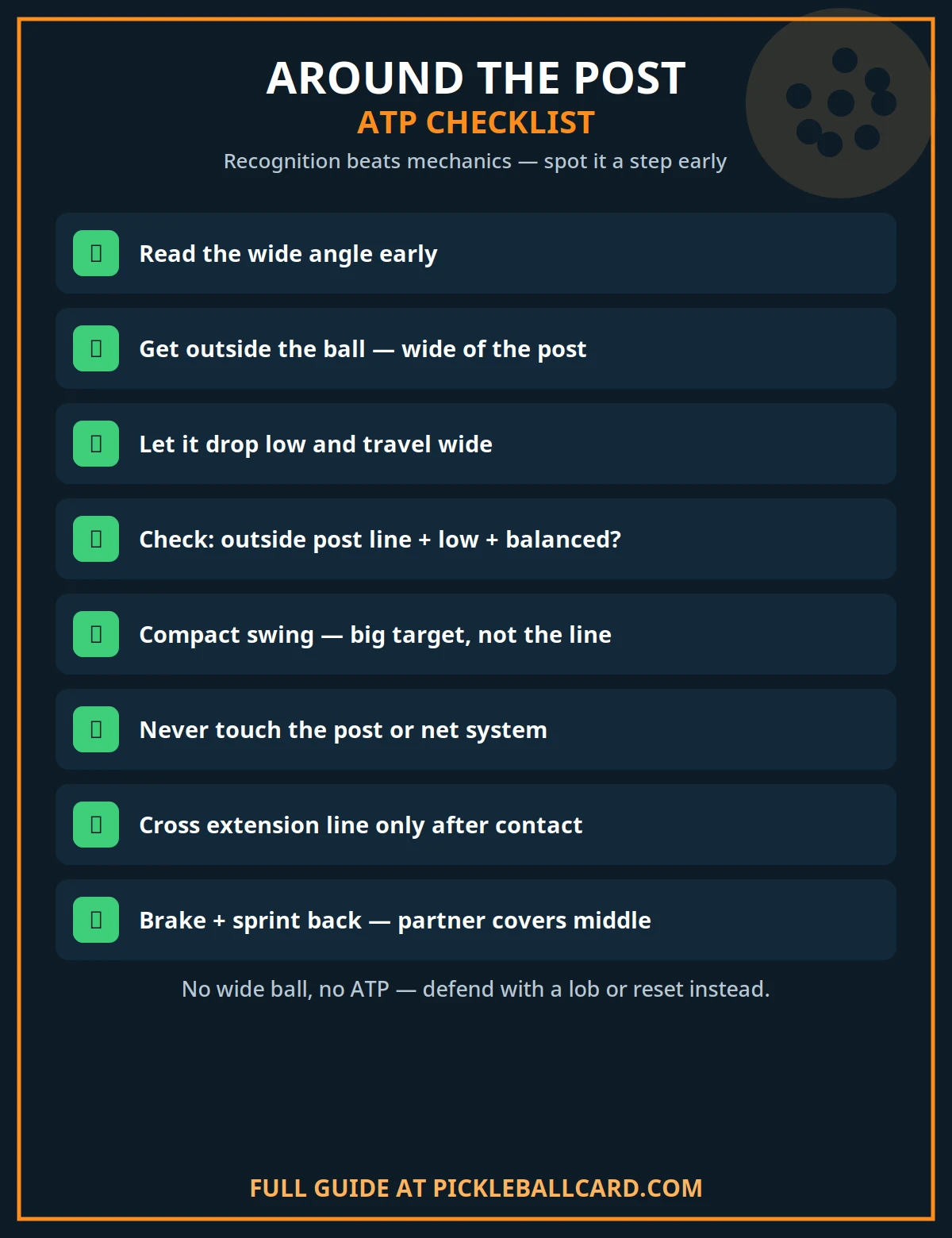
Step 1: Go Early and Go Wide
Start moving the instant you read the angle, and aim to get outside the ball — further wide than feels natural — so the ball is in front of you and slightly to your side as you contact it, rather than behind you. Players who chase straight at the ball arrive with it at their ankles and no lane around the post. Give the post a wide berth: your swing path and the ball’s flight both need clear space outside it.
Step 2: Let It Drop and Travel
Patience is the technical core of the ATP. Because there is no net to clear, you can — and usually should — let the ball drop low and travel well outside the sideline before you hit it. The lower and wider it gets, the flatter and safer the lane around the post becomes. Beginners ruin ATPs by hitting early, while the ball is still inside the post line and high enough that their “ATP” is really a wild cross-court swipe. Wait. The ball bouncing and running wide is your friend.
Step 3: Compact Swing, Open Lane, Target the Court — Not the Line
Use a short, firm, mostly forward swing — a guided punch with a stable wrist rather than a full groundstroke — and aim for a generous target inside the opponent’s court, not for the sideline. The most common club-level misses are hitting the post (aiming too tight to it) and hitting wide beyond the far sideline (aiming for a highlight). The middle of the available court, hit low and firm, wins far more points. A touch of topspin helps the ball dip after passing the post, but at club level a flat, controlled contact is the reliable version.
Step 4: Recover Like You Missed
Your momentum will carry you further from your court, and you are allowed to cross the net’s extension line after contact — but you must not touch the opponent’s court while the ball is live, and you must get back. Good ATP hitters treat recovery as part of the shot: hit, brake outside the opponent’s court, and sprint back to your position, because a saved ATP comes back quickly and your side of the court is wide open. In doubles, your partner should shift to cover the middle the moment you commit wide — the same covering principle that makes our guide to pickleball dinking strategies work: wide balls move the whole team, not just the player chasing them.
ATP vs Erne: The Two Wide Shots Compared
| Around the Post (ATP) | Erne | |
|---|---|---|
| Ball path | Around the outside of the net post, below or at net height | Over the net, hit early near the sideline |
| Usual contact | Off a bounce, wide outside the sideline, often very low | A volley, taken in the air beside the non-volley zone |
| Player position | Outside the sideline, beyond the post line as the ball travels wide | Outside (or jumping from outside) the non-volley zone at the side of the kitchen |
| Key legality point | Ball need not cross over the net; no height restriction; do not touch the post or opponent’s court | Feet and momentum must stay out of the non-volley zone on a volley; do not touch the net system |
| What creates it | An opponent’s wide, angled, low ball that bounces away from the court | An opponent’s predictable, floaty ball close to your sideline at the kitchen |
| Main risk | Hitting the post, hitting wide, or being caught out of position | Kitchen foot faults and being countered while airborne / off balance |
The two shots are siblings, which is why they are so often taught together: both punish predictable width, and both are decided by feet and timing more than by swing. If you are learning one, read the other next in our guide to what is an Erne in pickleball — and notice that an Erne threat and an ATP threat defend each other: a player who shows they can Erne forces wider dinks, and wider dinks are exactly what feeds the ATP.
How to Defend Against an ATP
- Respect the angle you just hit. The moment your dink or drive pulls an opponent wide and low, expect the ATP lane to open. Shade toward the post on your side and get low, paddle in front, ready for a ball arriving around — not over — the net.
- Cover the post, then the middle. The defending player on the ATP side has first responsibility for the around-the-post ball itself; their partner squeezes the middle. Both players watching the wide chase is how the middle is left empty for a fake.
- Do not crowd the net post area illegally or dangerously. You are defending your own court; there is no need — and no permission — to interfere with the hitter on the other side of the post.
- Make your wide balls safer when it matters. Against a player with a proven ATP, hit your angled dinks with a little more margin inside the sideline, or mix in balls at their feet. The ATP needs extreme width; deny the extreme and you deny the shot.
- Stay in the rally after it lands. Many ATPs are hit well but not for clean winners — a low, ready defender who simply blocks the ball back into the open court wins a surprising share of these exchanges, because the ATP hitter is metres out of position.
Drills That Build an ATP
- Feed-and-recognise (cooperative). A partner at the kitchen feeds angled dinks wide to one side. Your only job is to call “ATP” or “normal” before the second bounce and then play the shot you called. Ten balls per side. This trains the recognition that decides the shot, without pressure.
- Wide-bucket targets. Place a large target — a towel — well inside the opponent’s court on the ATP side. From fed wide balls, hit around the post into the bucket area, ignoring the lines. Shrink the target only after you can clear the post ten times in a row; post contact in practice is your margin warning.
- Hit-and-recover rallies. Play out every practice ATP: after you hit it, a third player (or your feeding partner) plays the next ball into your empty court if your ATP is returned. This builds the brake-and-sprint recovery into the habit instead of letting practice end at the pretty part.
- Live wide-dink games. Play cross-court dink games where a rally ball that goes wide enough to attempt an ATP scores double. Constraints like this manufacture repetitions in real rally conditions, which is where recognition has to survive.
Common ATP Mistakes
- Trying to create an ATP from a ball that is not wide. If the ball has not travelled outside the post line, there is no lane. Forcing it produces post contact and wide misses.
- Hitting too early. Contact before the ball has dropped and travelled wide turns an open lane into a tight one. Let the ball do the travelling.
- Aiming at the line or at the post’s edge. The spectacular target is the low-percentage one. Big court, low ball, firm contact wins club matches.
- Watching it. The shot is not over at contact. Brake without touching the opponent’s court and recover — the counter is coming to where you used to be.
- Forgetting the fault lines. Grazing the post, touching the net system, stepping on the opponent’s court while the ball is live, or crossing the extension line without making contact all turn a legal idea into a fault.
- Attempting it on every wide ball. A lob or a patient reset is often the better defensive play, especially when you are off balance. The ATP is a bonus weapon on the right ball, not a default reply to width.
Frequently Asked Questions
Is an around-the-post shot legal in pickleball?
Yes, completely. The official rules allow a return to travel around the outside of the net post, with no requirement that it cross back over the net and no restriction on its height, provided it lands in the opponent’s correct court and does not touch the post or net system.
Does an ATP have to go below the top of the net?
No. There is no height restriction in either direction. Most ATPs are hit low because the ball that creates them is low and wide, and a low trajectory is tactically hardest to defend — but a ball that passes around the post above net height and lands in is equally legal.
Can I hit an ATP as a volley, or does the ball have to bounce?
It can be volleyed in principle, provided every other rule is satisfied — in particular the non-volley-zone rules if you are volleying near the kitchen, and the rule against crossing the net’s extension line before contact. In practice the classic ATP is hit off a bounce, because the wide, angled balls that create it are usually dinks that land in or near the kitchen and travel out wide.
What happens if my ATP hits the net post?
It is a fault. The post is part of the net system for this purpose, and a ball that strikes it has not made a legal return — the rally goes to your opponents, however close the shot looked. This is why margin around the post matters more than a tight, spectacular line.
Can I run around the post before I hit the ball?
You may move wide and around on your own side in anticipation, but you may not cross the imaginary extension line of the net around the post without making contact with the ball — doing so is a fault. The legal sequence is: get wide, make contact, then your momentum may carry you across that line, without touching the opponent’s court while the ball is live.
What is the difference between an ATP and an Erne?
An ATP sends the ball around the post, usually off a bounce from well wide of the sideline. An Erne sends the ball over the net: the player steps or jumps outside the non-volley zone at the side of the kitchen and volleys a ball early, before it travels wide. They are created by related balls — predictable width at the kitchen — but the ball path, footwork and main fault risks are different, as the comparison table above shows.
The Bottom Line
The around-the-post shot is legal, learnable, and far more about recognition than flair. The rules give you the space outside the post and put no height limit on using it; your job is to spot the one ball that opens that lane — wide, low, angled and travelling away from the court — let it drop and run, hit a compact, controlled shot into a big target without touching the post, and then recover like the rally is still on, because it is. Add that single pattern to your game and opponents will have to stop hitting the wide dink that used to trouble you. Few shots change how a whole rally is played quite like that.
Sources: USA Pickleball, Official Rules (returns around the net post, plane of the net). Technique in this article is original coaching guidance; no competitor content is linked or reproduced.