Wind is the opponent nobody entered the draw. It bends dinks sideways, carries safe drives long, and turns a routine overhead into a guess.
A pickleball weighs less than an ounce and is full of holes. No mainstream racket-sport ball gives the weather more to work with.
The good news: wind rewards adjustment, not talent. Read it early, keep the ball low, and aim with margin, and conditions become your advantage.
Key Takeaways
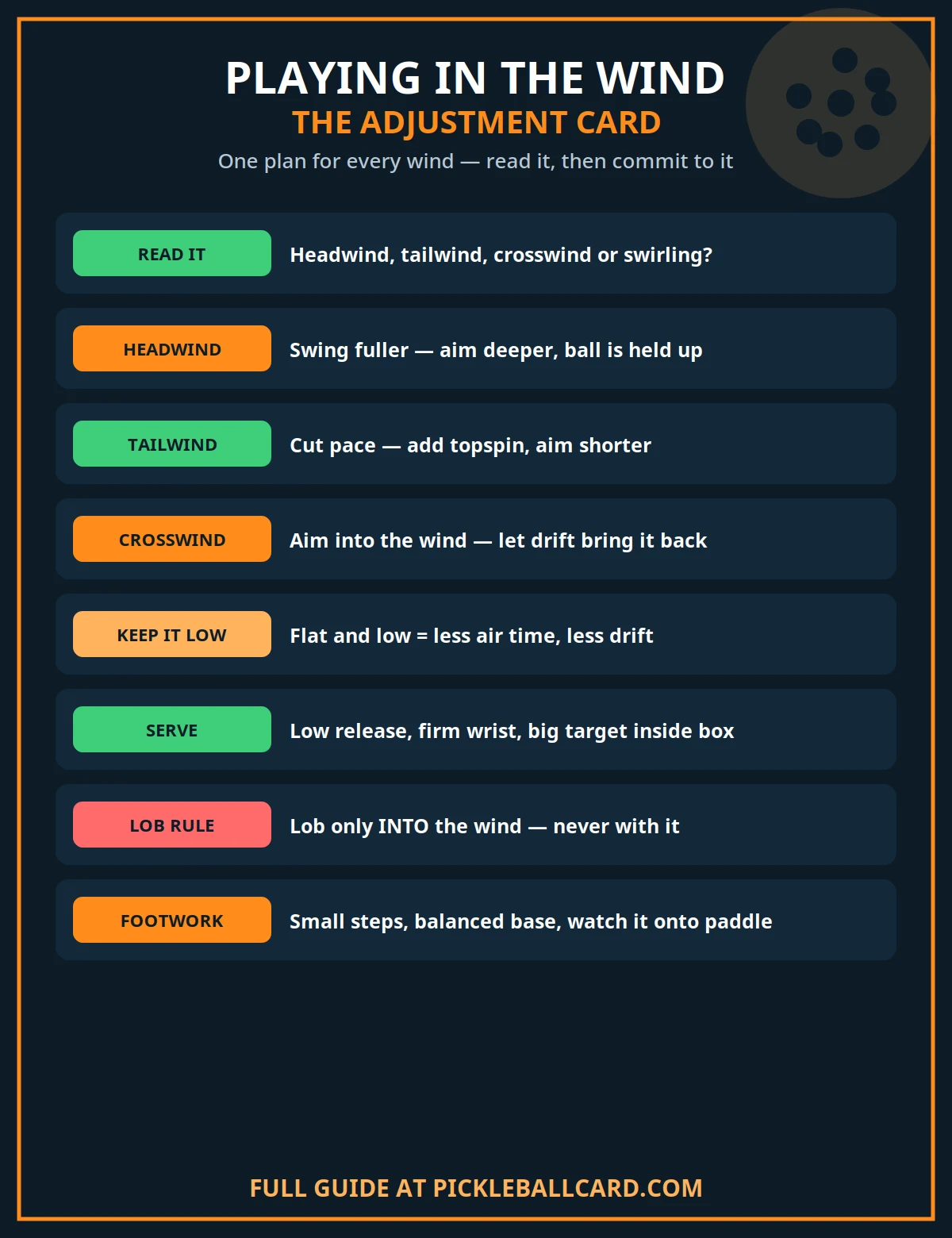
- Read the wind before the first serve. Headwind, tailwind, crosswind and swirling wind each demand a different plan. Name it, then play it.
- Keep the ball low. Air time is exposure. Flat, low shots spend less time in the wind and drift far less than high, floaty ones.
- Into the wind, swing fuller. The wind holds the ball up, so you can drive with pace and aim deeper without sailing long.
- With the wind, soften everything. Ease off pace, add topspin to dip the ball, and aim shorter than your normal target.
- In a crosswind, aim into the wind. Give the ball room to drift back on target instead of starting it on the line.
- Never lob with the wind behind you. Lob into the wind instead, where the breeze holds the ball up and drops it inside.
Why Wind Hurts Pickleball More Than Other Sports
A regulation pickleball weighs between 0.78 and 0.935 ounces. It is light, hollow and perforated, so moving air pushes it easily and late.
The holes matter too. Air passes through and around the ball, which is why a gust can move a shot after you have already judged it.
Outdoor balls limit the damage by design. They typically use about forty smaller holes and harder plastic, and sit at the heavier end of the range.
Indoor balls go the other way: about twenty-six larger holes and softer plastic. Played outdoors, they drift badly, which is why ball choice is step one.
Our comparison of indoor vs outdoor pickleball explains the ball and surface split in full. Outdoors, always start with an outdoor ball.
Step One: Read the Wind in Sixty Seconds
Before warm-up ends, work out which of four winds you have. Toss grass or dust, watch flags and nets, and feel it on your face.
Then confirm it with balls. Hit a few drives each way in warm-up and watch where identical swings actually finish. Trust the balls, not the flags.
- Headwind: it blows into your face as you face the net. Shots into it slow down, drop shorter and hang longer in the air.
- Tailwind: it blows at your back toward the net. Shots carry further, bounce livelier and punish any extra pace you add.
- Crosswind: it blows side to side across the court. Shots curve and drift sideways, and one sideline becomes far riskier than the other.
- Swirling wind: it changes direction between and during rallies. No fixed plan survives; margin and footwork matter more than tactics.
Re-read it at every change of ends. Afternoon thermals strengthen, die and swing, and the plan from game one may be wrong by game three.
The Master Adjustment Table
| Wind | Your power | Your target | Shots to favour | Shots to avoid |
|---|---|---|---|---|
| Headwind (into you) | Add pace, swing fully | Aim deeper and slightly higher | Drives, firm volleys, lobs | Soft drops that die short |
| Tailwind (behind you) | Cut pace, shorten swing | Aim shorter, add topspin | Drops, dinks, topspin drives | Lobs, flat hard drives |
| Crosswind | Normal pace, firm contact | Aim into the wind, use the middle | Middle balls, low cross-courts with margin | Tight shots down the windy sideline |
| Swirling / gusty | Slightly firmer, decisive | Big targets, middle third | Low, simple, repeatable shots | Finesse shots and late changes of mind |
Print this logic into one sentence per end. Into the wind: hit through it. With the wind: let it be the power. Across: aim upwind.
Serving in the Wind
The serve is the one shot the wind cannot rush. Use that control: routine first, adjustment second, and never serve on autopilot in gusts.
Fix Your Toss and Contact First
Lower your ball release and shorten the motion. A high, drifting release gives a crosswind time to move the ball before contact ever happens.
For a drop serve, drop the ball from lower and strike it sooner. The less time the ball spends falling, the less it wanders.
Keep a firm wrist through contact. A gust can twist a loose paddle face open or shut, and the serve is where that error costs most.
Serving Into the Wind
Swing with confidence and keep the ball flat. The headwind acts as a brake, so a firm serve that might sail on a calm day lands in.
Aim deep, close to the baseline. Headwind serves die shorter than they look off the paddle, so depth must be chosen, not hoped for.
Serving With the Wind
Cut your pace noticeably and aim a clear margin inside the box. The same swing that is perfect indoors carries long with a tailwind pushing it.
Add topspin if you have it. Topspin pulls the ball down at the end of its flight, which is exactly the help a tailwind serve needs.
Serving in a Crosswind
Start the ball on the upwind side of your target. Let the drift bring it back toward the middle of the service box.
Avoid chasing the windy sideline. A serve that starts near that line only needs one gust to become a fault you gave away.
Returns, Third Shots and the Soft Game
Returns of Serve
Expect late movement and set your feet later than usual. Small adjustment steps beat one big lunge when the ball bends in the final metres.
Returning into the wind, swing through the ball and still aim deep. Returning with the wind, shorten the swing and let the breeze supply the depth.
Aim returns toward the middle in crosswinds. It buys margin on both sides and forces the serving team to create angles in difficult air.
Third Shots: Drop or Drive?
Into the wind, the drive becomes safer. You can swing properly, and the wind holds the ball inside the baseline at the far end.
With the wind, the drop becomes safer. A drive needs almost no help to sail, while a drop the breeze carries still lands softly near the kitchen.
If you drop into a headwind, give it more height and pace than feels right. A normal drop will stall and fall into the net.
Dinking in the Wind
The soft game survives wind best because the ball stays low and slow. Our pickleball dinking strategies still apply; the targets simply get bigger.
Keep dinks lower than usual and aim for the middle of the kitchen. Wide dinks in a crosswind drift out or sit up to be attacked.
Shorten your swing and punch slightly through the ball. A delicate, floating dink is a kite; a compact, firm dink stays on its line.
Be patient for one extra shot. Wind creates errors for free, and the partnership that chases winners in gusts donates the match instead.
Volleys, Overheads and the Lob Rule
Volleys and Hands Battles
Take volleys out in front with a short, firm block. Reaching and swinging gives gusts two chances: moving the ball and moving your paddle.
Choke up slightly on the grip if the wind keeps twisting your paddle. A shorter lever makes the paddle noticeably steadier in your hand.
Expect the ball to hold up into the wind. Balls you would leave on a calm day can drop in, so call every close ball honestly and late.
Overheads
Move with small steps and keep tracking the ball until contact. An overhead in wind moves twice: once on the way up, once falling.
Let it bounce if you are unsure. A bounced overhead is a smaller shot, but a whiffed overhead in a gust is a lost point and rhythm.
Aim overheads at big targets, ideally at feet in the middle. Placement into a corner is a calm-day luxury the wind has not granted you.
The Lob Rule: Only Into the Wind
Lob into the wind and the breeze becomes your brake. The ball climbs, stalls and drops inside, buying you time to regain the kitchen line.
Never lob with the wind behind you. The same shot sails beyond the baseline before your opponents even need to move for it.
Defending a lob into the wind, expect it to drop shorter than it looks. Move early, and do not drift backwards waiting for carry that never comes.
Doubles Teamwork in Wind
Call the wind out loud at every change of ends. One sentence — “strong left to right, aim right” — keeps both partners playing the same plan.
Favour the middle together. Middle balls remove sideline drift from the equation and let your partner cover the one direction the wind cannot create.
Over-communicate on floaters. A ball bending late belongs to whoever calls loudest and earliest, not to whoever it was originally heading toward.
Choose ends deliberately when you win the choice. Many teams take the wind at their backs first, banking early help before conditions or light change.
There is no universal right answer on ends. The wrong answer is not discussing it, then playing two different wind plans on one side.
Footwork, Gear and Safety
Stay on the balls of your feet with a wider base. Wind moves the ball late, and late movement is only playable from balance, never from heels.
Watch the ball all the way onto the paddle. In gusts your eyes want to plan the next shot early; the moving ball punishes exactly that.
A slightly heavier paddle feels steadier, and a firm grip helps, but neither replaces low targets. Do not buy your way out of an adjustment problem.
Clear leaves and debris between games, and stop if gusts start moving furniture or fencing. Our guide to playing pickleball in the rain covers the wider bad-weather judgement calls.
Sunglasses or a cap help against both glare and dust. Eye protection matters more, not less, when a light ball can bend toward your face late.
How Much Wind Is Too Much?
There is no official wind-speed limit in the rules. Play continues until conditions become unsafe or the tournament director or group decides otherwise.
As a practical guide, light wind needs small target changes. Moderate wind needs the full plan in this article on every shot.
Strong, gusty wind that moves the ball visibly while it sits on the ground has stopped being a tactics problem. Shorten the session or move indoors.
One rules point confuses players here: wind does not replay points. If a gust moves your shot out, it is out. Adjust the next shot, not the score.
The exception players remember is the ball that bounces in, then blows back over the net untouched. That scenario has its own ruling in the official rules.
A Simple Windy-Day Practice Session
- Ten serves each way. Serve one set into the wind and one with it. Note how much pace each direction actually needs.
- Cross-court dinks with margin. Aim a metre inside the sideline on the windy side and watch the drift do the rest.
- Drive-and-catch tracking. Have a partner feed high balls in gusts. Practise small steps and late, balanced contact, not power.
- One game, big targets only. Play a full game scoring normally, but mentally ban lines. Consistency in wind is a trainable skill.
Frequently Asked Questions
What is the best shot to hit in windy pickleball?
The low, firm shot at a big target. Low balls spend the least time in moving air, and middle targets give drift on both sides room to stay in.
Should I lob in the wind?
Only into the wind. A headwind holds a lob up and drops it inside the court. With the wind behind you, the same lob almost always sails long.
Does a heavier paddle help in the wind?
A little, for stability. The wind twists lighter paddles more easily. But target size, ball height and pace changes help far more than any equipment change.
Which pickleball ball is best in wind?
An outdoor ball. Its smaller, more numerous holes and harder, heavier build cut through wind and fly straighter than a soft indoor ball with large holes.
Is there a wind limit for pickleball?
No official speed limit exists in the rulebook. Recreational groups and tournament directors stop play when conditions become unsafe or the ball cannot be controlled at all.
How do I stop the wind blowing my serve out?
Lower your release, shorten your swing, and aim well inside the box. With the wind behind you, cut pace and add topspin so the ball dips instead of sailing.
The Bottom Line
Wind does not ruin pickleball. Refusing to adjust ruins pickleball. The conditions are identical for the players across the net from you.
Read the direction, keep the ball low, swing fuller into it and softer with it, and aim every crosswind shot back into the breeze.
Do that for one full game and the wind stops feeling like luck. It becomes the part of the match you prepared for and they did not.
Sources: USA Pickleball, Official Rules and USA Pickleball equipment standards for ball size, weight, hole range and bounce specifications.
This guide is original; no competitor content is linked or reproduced.