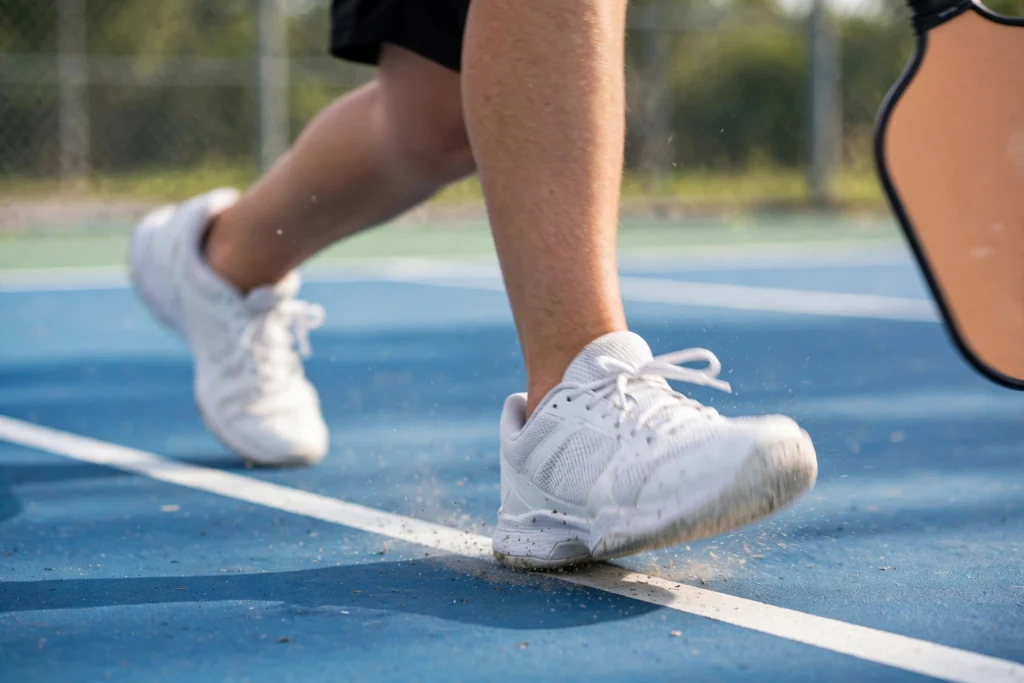
Walk onto a pickleball court and you will see tennis shoes everywhere.
That is not a mistake. The two sports share a surface, a net and most of their footwork, so a good hard-court tennis shoe is a reasonable pickleball shoe.
But “reasonable” is not “identical”. The shoes differ in weight, build and intent, and the differences matter more the more you play.
This guide separates the genuine differences from the marketing ones, so you can judge any shoe — whichever sport is printed on the box.
The Short Answer
Hard-court tennis shoes work for pickleball. Pickleball-specific shoes are not a different species; they are court shoes tuned for a shorter, more lateral game.
The shoe that genuinely does not belong on a pickleball court is the running shoe, and it fails for reasons that have nothing to do with labels.
Everything below explains those two sentences.
How The Two Games Move Differently
A pickleball court is 44 feet long; a tennis court is 78. That single fact shapes everything your feet do.
Pickleball points are built on short bursts: split-steps, lateral shuffles along the kitchen line, quick stops and two-step drives to the net.
Tennis asks for more of everything at higher speed — longer sprints, deeper lunges at the baseline, and repeated forward charges over a much bigger area.
Neither game is gentle on shoes, but they wear them differently. Pickleball loads the sides of the shoe; tennis loads the toe and the outsole over longer distances.
Where The Shoes Actually Differ
Weight And Build
Tennis shoes are built for three-set matches and heavy toe drag, so many run heavier, with reinforced uppers and thick, durability-first outsoles.
Pickleball shoes tend to be cut lighter and lower, because the points are shorter and the distances smaller. Many players feel the difference as freshness in the third game, not the first.
Lateral Support
Both sports need it, but pickleball lives sideways. Long dink rallies are a sequence of side-to-side pushes at the non-volley zone line.
Pickleball models often put their stability work into the midfoot and the outer edge, where a shoe can roll during a hard lateral plant.
A tennis shoe with a firm midfoot shank and a wide, stable base passes this test too. A soft, narrow one does not — whatever its label says.
Outsole And Surface
Outdoor pickleball is played on the same acrylic hard courts as tennis, and the herringbone tread that grips them suits both sports equally.
Indoor pickleball is different. On wood gym floors, a gum-rubber outsole grips where a hard-court herringbone can skate, and plenty of pickleball is played indoors through the winter.
Match the outsole to the floor first; the sport on the box comes second.
Fit And Toe Box
Several pickleball lines are cut with a roomier forefoot, suiting the wider stance and constant weight-shifting of kitchen-line play.
Tennis shoes skew narrower in some ranges, built to lock the foot down for long slides and sprints. Neither is better — but feet notice the difference within a session.
When Tennis Shoes Are The Right Choice
If you already own hard-court tennis shoes with a non-marking outsole and solid lateral support, you do not need new shoes to start pickleball.
They also suit players who split time between the two sports, and heavier players who want the extra durability a tennis build provides.
Our brand guides take the same view — the ASICS, Nike and Adidas lineups on this site include tennis models chosen honestly for pickleball, because the construction earns it.
What you are checking is the shoe, not the sport: herringbone or similar court tread, a stable base, support you can feel when you push sideways.
When Pickleball Shoes Earn Their Place
Play three or more times a week and the tuning starts to pay: the lighter build, the lateral emphasis, the indoor options.
If your games are mostly on gym floors, a pickleball shoe with a gum-rubber outsole is the straightforward answer — most tennis ranges simply do not offer one.
And if your feet run wide, pickleball lines are where the roomier cuts increasingly live. Our full roundups — best pickleball shoes and best pickleball court shoes — compare the current models in detail.
Players managing aches should also read the support question separately: our guide to shoes for knee pain covers what cushioning and stability can and cannot do.
The Shoe That Does Not Work: Running Shoes
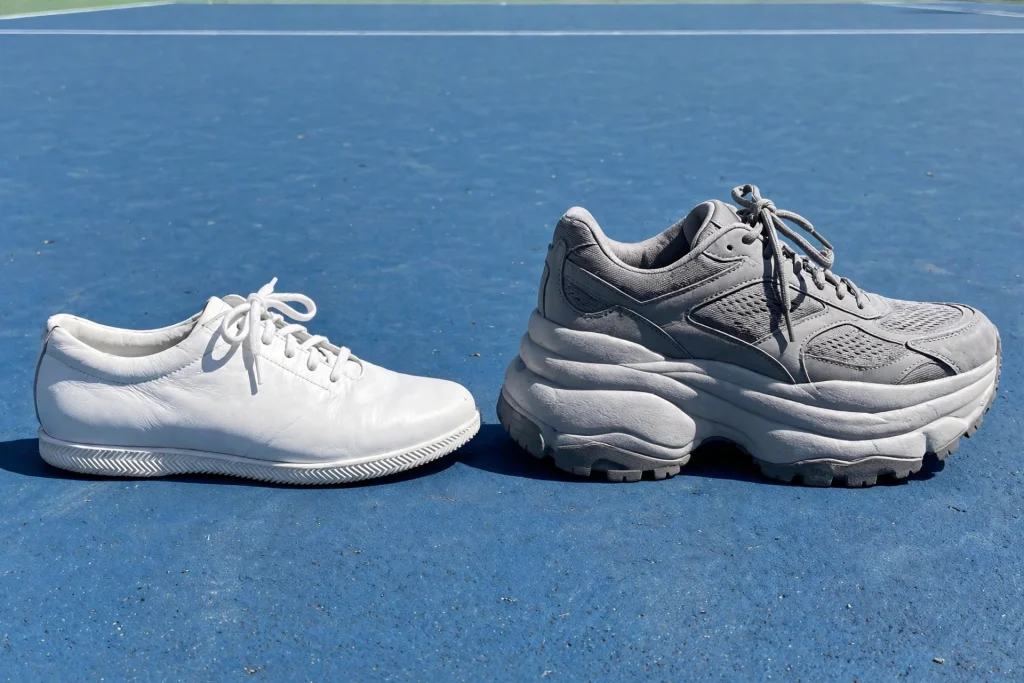
Running shoes are built to move in one direction, on a raised, cushioned heel, with a narrow base and a smooth, road-tuned sole.
Pickleball moves sideways, on a hard stop. The raised heel raises your centre of gravity exactly when you plant and push laterally — the classic ankle-roll setup.
The soft foam that makes them kind on a run compresses unevenly under lateral load, and the tread has nothing to bite with on acrylic.
This is the one footwear rule in pickleball with no grey area: borrow court shoes, buy budget court shoes, but do not play in runners.
A 60-Second Check For Any Shoe
Whatever the label, a shoe suits pickleball when it passes five checks.
Non-marking outsole with court tread. A base that feels wide and planted, not tippy. A heel that sits low rather than stacked.
Support you can feel when you push off sideways. And an upper and toe that can survive being dragged.
Pass all five and the shoe is a pickleball shoe in everything but name.
Frequently Asked Questions
Can I play pickleball in tennis shoes?
Yes, if they are hard-court tennis shoes with a non-marking outsole and real lateral support. That combination covers most pickleball movement well, especially for newer and occasional players.
Are pickleball shoes just marketing?
No, but the difference is tuning, not technology. Pickleball shoes are court shoes biased toward lighter weight, lateral stability and indoor outsoles. The label alone guarantees none of that — check the construction.
Can I play pickleball in running shoes?
It is the one pairing to avoid. The raised, narrow, cushioned build of a runner works against lateral movement and raises the risk of rolling an ankle on a hard stop.
Do tennis shoes last longer than pickleball shoes?
Often, yes. Tennis models are built for longer matches and heavier toe drag, so their uppers and outsoles tend to outlast lighter pickleball builds — one fair reason to choose them.
Do I need different shoes for indoor and outdoor pickleball?
Ideally. Outdoor acrylic wants a durable herringbone court tread; indoor wood wants gum rubber for grip. One shoe can cross over, but it will be a compromise on one of the two floors.
How do I tell if a tennis shoe suits pickleball?
Run the five checks above: non-marking court tread, a wide planted base, a low heel, sideways support you can feel, and a toe built to be dragged. Pass them and it suits the game.
Conclusion
Pickleball shoes and tennis shoes are cousins, not strangers — the same court-shoe family tuned for courts of different sizes.
Tennis shoes earn their place on a pickleball court whenever their construction passes the checks; pickleball shoes repay frequent players with lighter, more lateral builds.
Judge the shoe in your hand, not the sport on its box, and leave the running shoes for running.

Shoaib is the publisher of Pickleball Card. He oversees the site’s guides to pickleball rules, ratings, strategy and gear, all researched from primary sources — the USA Pickleball Rulebook, DUPR and manufacturer documentation — and updated as the game changes.