Parents usually ask the same first question about kids and pickleball: what age should my child start?
The honest answer is that birthdays matter less than readiness. A child who can hold a paddle, track a slow ball and copy a simple game is ready to begin.
This guide gives parents the full picture: readiness signs, what to expect at each age, the right equipment, a first-session teaching plan, and how to keep it safe and fun.
Key Takeaways
- There is no official minimum age. USA Pickleball runs junior competition for under-18s, but starting is about readiness, not rules.
- Simple play can start around 5–6. Short paddle games and easy rallies suit most children at that stage.
- Full rules land around 8–10. Scoring, the kitchen rule and real games make sense once attention and coordination catch up.
- Light paddle, small grip, court shoes. Junior-sized equipment prevents the bad habits an adult paddle teaches small arms.
- Fun first, technique second. Games, not drills, are how children under ten actually learn a sport.
- Keep sessions short. Twenty to forty minutes of quality play beats an hour that ends in frustration.
The Short Answer
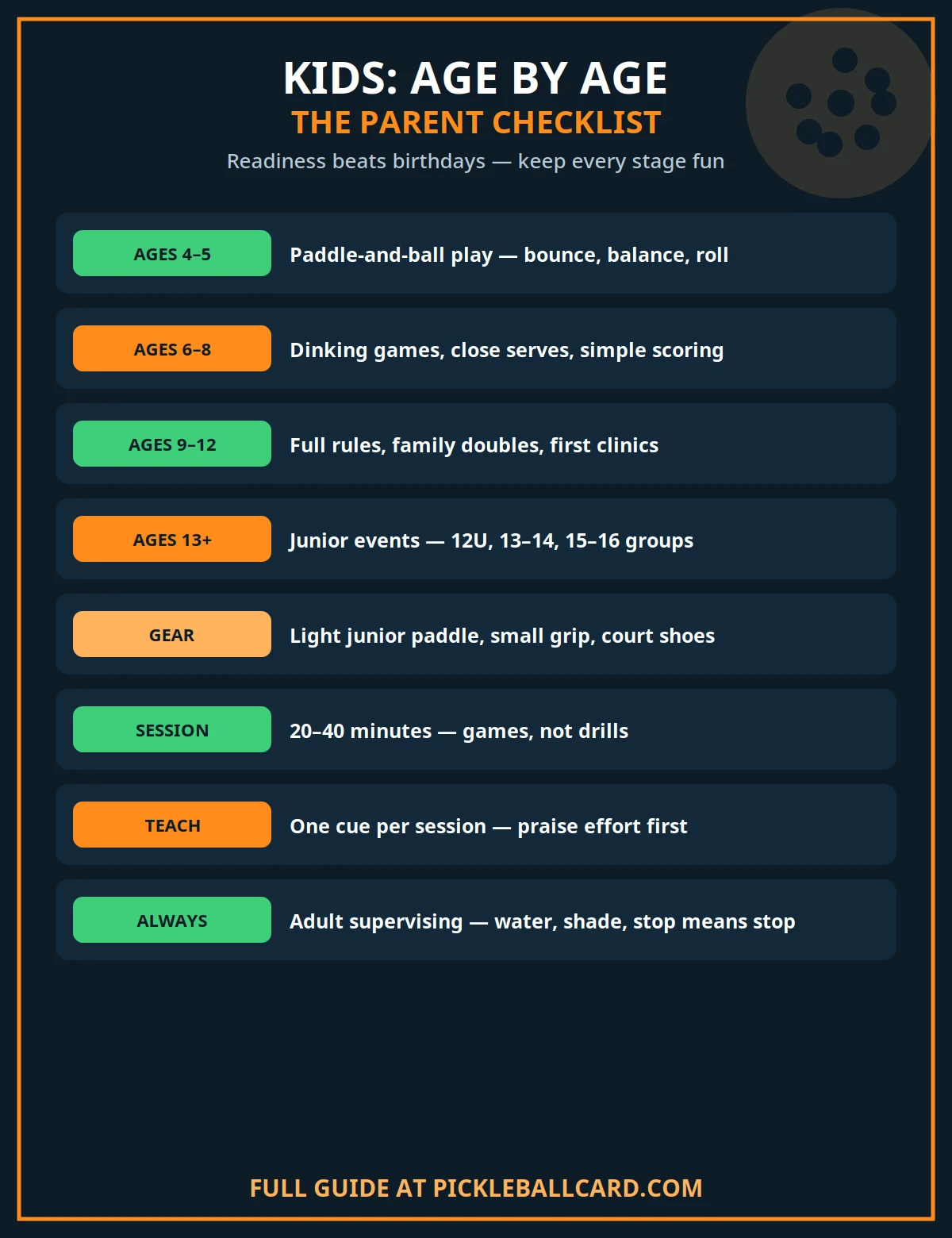
Most children can try simple pickleball play around age five or six: bouncing a ball on a paddle, dinking games, and short rallies with an adult feeding easy balls.
Between six and eight, children can learn simplified games with a real serve and simple scoring. Between eight and ten, most are ready for the full rules.
USA Pickleball’s junior pathway then takes over for keen players, with tournament age groups of 12 and under, 13–14 and 15–16 in its junior events.
Readiness Beats Age: The Signs to Look For
Age ranges are averages. Your child is ready for a first session when most of these are true:
- They can hold a paddle comfortably with one hand and swing it without it dragging on the ground.
- They can track a rolling or gently tossed ball and make contact more often than they miss completely.
- They can copy a simple rule — wait for the bounce, hit it back over — and remember it for a few minutes.
- They can share a court safely, stopping when someone says stop and keeping distance from other swinging paddles.
- They are asking to play. Interest is the readiness sign that predicts everything else.
If only some signs are there, start anyway — just start smaller. Balloon-style paddle games in the garden build exactly the tracking skills the list describes.
What to Expect at Each Age
| Age | What works | What to skip for now |
|---|---|---|
| 4–5 | Paddle-and-ball play: bouncing, balancing, rolling target games, very short sessions | Rules, scoring, real games, any correction-heavy coaching |
| 6–8 | Dinking games, underhand serve practice, simplified rallies, first simple scoring | Kitchen faults, long matches, competitive pressure |
| 9–12 | Full rules and scoring, doubles with family, beginner clinics, first junior events | Adult open-play intensity, heavy adult paddles |
| 13+ | Regular games, lessons, USA Pickleball junior tournaments in their age group | Nothing structural — progression is now about interest and coaching |
Children develop at wildly different speeds. A coordinated seven-year-old may out-rally a cautious ten-year-old, and both are completely normal.
Use the table as a menu, not a test. Move your child to the next stage when the current one feels easy and still fun.
Why Pickleball Works So Well for Kids
Pickleball succeeds with children for the same reason it succeeds with grandparents: success arrives quickly. The court is small, the ball is slow, and rallies start on day one.
That early success matters. Children stick with activities where they feel competent, and pickleball delivers competence faster than almost any other racket sport.
Skills It Builds Without Feeling Like Training
Hand-eye coordination is the obvious one: tracking, timing and striking a moving ball, hundreds of times an hour, inside games children chose to play.
Footwork and balance develop the same way. Short shuffles, stops, turns and reaches are built into every rally, no cones or drills required.
Scoring quietly teaches arithmetic and memory. Keeping score aloud — server number, side, points — is genuine mental exercise dressed as part of the game.
Doubles adds teamwork and communication. Children learn to call balls, share space, encourage a partner and lose a point without melting down.
A Rare Sport the Whole Family Can Share
Pickleball’s handicap is built in: adults can dial their pace down and children can still play real rallies against them, on the same court, in the same game.
That makes it one of very few sports where grandparents, parents and children genuinely play together rather than taking turns watching each other.
Equipment: Light, Small and Simple
- Paddle: a junior paddle — lighter than an adult model, with a shorter, smaller grip that fits a child’s hand. An adult paddle teaches wristy, strained technique.
- Balls: standard pickleballs are fine on court. For the youngest beginners at home, a softer foam ball slows everything down and saves the furniture.
- Shoes: court shoes or trainers with good grip and sideways support. Avoid chunky running shoes that catch and tip on lateral moves.
- Eye protection: worth wearing from the start, especially in doubles. A deflected ball at close range is the sport’s main eye risk.
- Water and sun kit: a filled bottle, hat and sunscreen for outdoor courts. Children overheat faster than they realise.
Borrow before you buy where you can. Many clubs and recreation centres lend junior paddles, and USA Pickleball’s youth provider network exists partly to lower this equipment barrier.
Make the Court Smaller and the Rules Simpler
Shrink the Playing Area
Young children do not need a full court. Play dinking games inside the kitchen and service box, where rallies are short, contact is constant and success comes quickly.
Move the serve closer too. Let a young child serve from inside the baseline, or even mid-court, until the motion works; move them back as it strengthens.
Every modification has one job: more successful hits per minute. Success is what brings a child back tomorrow.
Teach Rules in Layers
Teach only three things first: hit the ball over the net, let it bounce once on each side at the start of a rally, and serve underhand diagonally.
Add the kitchen rule as a simple picture — “you can step in the kitchen, but you cannot hit the ball out of the air while standing there” — once volleys begin.
Scoring comes last, and adults can call it aloud for weeks. Our full guide to how to play pickleball is the parent reference when your child is ready for the complete rule set.
Your Child’s First Session: A 30-Minute Plan
- Ball familiarity (5 minutes). Bounce the ball on the paddle, walk while balancing it, roll it to targets. No net, no pressure, lots of contact.
- Dinking game (5 minutes). Stand either side of the net inside the kitchen area. Count cooperative rallies together and chase your record, not a winner.
- First serves (5 minutes). Serve underhand from close range at a big target. Celebrate any serve that lands in the box; ignore the rest.
- Rally game (10 minutes). Play gentle rallies where the adult feeds playable balls. Score cooperatively: one point for every rally of five shots or more.
- Fun finisher (5 minutes). End with the game they liked most, on a success. Always stop while they are still asking for more.
Notice what is missing: technique lectures. One tiny cue per session — “watch the ball onto the paddle” is plenty — is all a young beginner can use.
Safety for Young Players
- Supervision: an adult on court or courtside for every session involving young children, with a clear rule that play stops when the adult calls stop.
- Spacing: teach the paddle-distance rule early — never swing within reach of another player, and call “ball on court” and stop when a stray ball rolls in.
- Hydration and heat: scheduled water breaks, shade between games, and shorter sessions on hot days. Children do not self-pace reliably.
- Lessons and coaches: for organised instruction, choose programs through schools, parks departments or recognised youth providers, and ask about coach certification and background checks.
- Effort and pain: children should finish tired and happy, not sore. Recurring wrist, elbow or knee pain means stop and get it checked.
The CDC recommends that children and adolescents aged 6 to 17 get at least 60 minutes of moderate-to-vigorous physical activity daily, in activities that are varied, age-appropriate and enjoyable.
Pickleball fits that guidance well precisely because children experience it as play. The broader benefits are covered in our guide to the health benefits of pickleball.
Keeping It Fun (Which Is the Whole Point)
Children quit sports that feel like tests. Keep score cooperatively, play parents-versus-kids games with the adults handicapped, and let the child invent one silly rule per session.
Praise effort and specific things — “you watched that ball all the way in” — rather than results. Confidence in young players grows from noticed competence.
Sportsmanship is a pickleball gift worth teaching early: call lines fairly, tap paddles, and thank your partner. Our guide to pickleball etiquette and its unwritten rules is written for adults, but every habit in it starts here.
If a child wants competition, follow that interest rather than manufacturing it. Junior clinics and USA Pickleball junior events are built to be encouraging first and competitive second.
A Simple Progression From First Hit to First Event
Stage one is the garden or driveway: paddle games, bounce challenges and a parent feeding balls. Most children live happily here for months.
Stage two is the court with family: simplified games, real serves from a closer line, and scoring called aloud by an adult.
Stage three is a beginner clinic or youth session, where your child plays with other children at the same level and learns from a coach.
Stage four, only for children who ask for it, is a junior event. USA Pickleball’s junior divisions are co-ed, age-banded and designed as an encouraging first taste of competition.
There is no deadline on any stage. A child who stays at stage two for two years and loves it has not fallen behind anyone.
Finding Lessons and Junior Programs
Start local: school PE programs, parks and recreation departments, YMCAs and Boys & Girls Clubs increasingly run youth pickleball, often with loaner equipment.
USA Pickleball supports this through its Youth Pickleball Provider resources for schools and community organisations, including a youth playbook, activity cards and activity plans written separately for ages 8–12 and 13–18.
For a ready competitor, USA Pickleball’s junior divisions at select Golden Ticket Tournaments offer co-ed singles and doubles in the 12-and-under, 13–14 and 15–16 age groups.
Ask any program three questions: What is the coach-to-child ratio? Are coaches certified and background-checked? And how much of the session is games versus drills? Good programs answer all three happily.
Common Mistakes Parents Make
| Mistake | Why it backfires | Better approach |
|---|---|---|
| Starting with an adult paddle | Weight and grip size strain small wrists and teach wristy technique | Borrow or buy a light junior paddle with a small grip |
| Teaching every rule on day one | Overload kills the fun before the first rally | Layer the rules: bounce, underhand serve, kitchen, scoring last |
| Long, drill-heavy sessions | Children learn through games; boredom ends the experiment | Twenty to forty minutes, mostly cooperative games |
| Correcting every shot | Constant correction makes children afraid to swing | One simple cue per session, praise effort specifically |
| Adults playing at full pace | Overwhelmed children stop moving toward the ball | Feed playable balls, dial pace down, handicap yourself |
| Skipping water and shade breaks | Children overheat and fade without noticing | Schedule breaks; do not wait for complaints |
Frequently Asked Questions
What is the best age for a child to start pickleball?
There is no official minimum. Most children can enjoy simple paddle-and-ball play at five or six, simplified games at six to eight, and full rules and scoring somewhere around eight to ten.
Can kids use an adult pickleball paddle?
Briefly, for a first try, yes. For regular play, no: adult paddles are heavier with larger grips, which strains small wrists and teaches poor technique. A light junior paddle is the right tool.
Is pickleball safe for children?
It is a non-contact sport with a light plastic ball and a small court, which makes it one of the gentler racket sports. The main precautions are supervision, court shoes, eye protection in doubles, hydration and sensible session lengths.
How long should a child’s pickleball session be?
Twenty to forty minutes for young beginners, including games and breaks. Older children who are enjoying themselves can play longer, with regular water breaks and an adult watching for fatigue.
Do kids need lessons to start pickleball?
No. A parent, the plan in this article and a borrowed paddle are enough to start. Lessons and clinics become valuable once a child is keen, wants proper technique, or is heading toward junior events.
Can parents and kids play pickleball together?
Yes — it is one of the sport’s real strengths. Adults simply dial back pace, feed playable balls, and play doubles together. Few sports let three generations share one competitive court.
The Bottom Line
Start when your child shows the readiness signs, not when a birthday arrives: paddle in hand at five or six, simplified games soon after, full rules by around eight to ten.
Give them a light junior paddle, a smaller court, layered rules and short, game-filled sessions, and pickleball becomes what it should be for a child — play that happens to build skills.
Then let their interest set the pace. For some children it stays a family game; for others, USA Pickleball’s junior pathway is waiting when they are ready.
Sources: USA Pickleball, Junior and Youth Pickleball and Pickleball Educator Resources; CDC, Physical Activity Guidelines for School-Aged Children and Adolescents.
Coaching content in this article is original; no competitor content is linked or reproduced.