A paddle can be fully legal the day you buy it and illegal for sanctioned play two seasons later.
Approval is a status, not a permanent property of the paddle. USA Pickleball tests paddles, lists the ones that pass, and removes models when the standards change or a paddle stops meeting them.
This guide explains why paddles lose approval, the recent changes that caught players out, and the specific models that have been delisted.
It ends with the two-minute check that tells you whether your own paddle is still on the list.
Why Paddles Lose Approval
USA Pickleball maintains the approved paddle list, and sanctioned tournaments require a paddle that appears on it.
A model earns its place by passing the certification tests in the form it was submitted. It can lose that place in several ways.
The standards themselves can move. When a new performance ceiling arrives, paddles certified under the old rules may no longer qualify.
Production can also drift. If the paddles reaching shops differ from the sample that passed, the listing is at risk.
And paperwork matters: a certification that lapses or is withdrawn takes the model off the list just as surely as a failed test.
The PBCoR Sunset: The Change That Caught Players Out
PBCoR — paddle/ball coefficient of restitution — measures how lively the combination of paddle and ball is.
In plain terms, it captures how much energy the pairing returns to the ball. USA Pickleball set 0.44 as the ceiling for certification.
Paddles already certified above that line were not removed overnight. They were grandfathered — allowed to stay, temporarily.
That grandfathering expired on May 1, 2026. From that date, models over the ceiling came off the list for sanctioned play, even though the physical paddles had not changed at all.
The headline case is the ProKennex Black Ace Pro. In a statement on December 27, 2024, USA Pickleball set its approval to end on July 1, 2025 under the PBCoR rule.
If you own a power paddle from before these changes, its absence from the current list is the first thing to check — our guide to power paddles sticks to models whose approval is current.
The Spin Limit Arrives Next
Power is not the only measured quality. Spin is now tested directly as well.
For certifications from October 1, 2026, a paddle’s measured spin rate must be 2,100 RPM or less.
That puts a ceiling on the grittiest raw-carbon faces. A surface that generates more spin than the limit allows simply cannot be certified.
Existing listings are governed by the rules under which they were certified, but any player buying a maximum-grit paddle today should know the direction of travel.
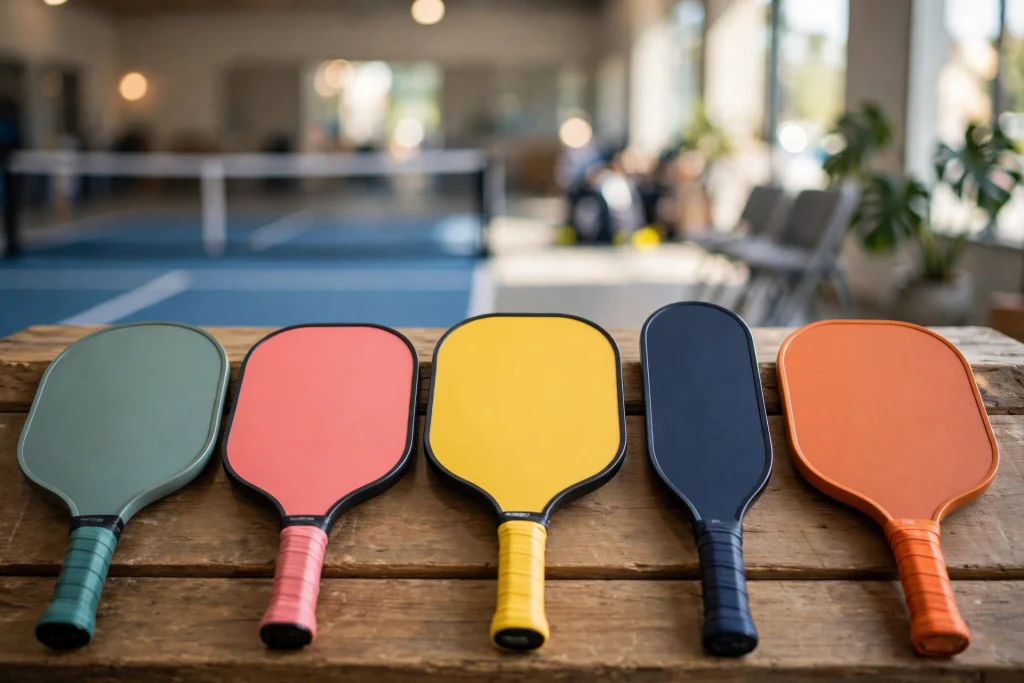
The Models That Have Lost Approval
Delistings are uncommon enough that the confirmed cases are worth naming plainly.
On July 1, 2025, three ProKennex models — the Ovation, the Ovation Pro and the Ovation XF — were removed from the approved list.
The same date brought the Black Ace Pro’s PBCoR sunset into effect, ending that model’s approval as scheduled.
The Black Ace LG shows the other direction. It was removed, then reinstated on June 3, 2025 — proof that a delisting can be reversed when the issue behind it is resolved.
That reinstatement is exactly why old forum posts are a poor source here. The list is the authority, and it changes in both directions.
Banned, Delisted, Or Never Approved?
The three labels sound alike but describe different situations.
Never approved means the paddle was never certified at all. Many inexpensive no-name paddles sit in this group: playable, but never listed.
Delisted means the paddle was on the list and was removed, whether by a failed standard, a rules change or a lapsed certification.
A sunset is a delisting with a date announced in advance, as the Black Ace Pro’s was — players get warning, but the end still comes.
For sanctioned play, the practical effect of all three is identical: if it is not on the current list, it is not allowed.
Recreational Play Vs Sanctioned Play
None of this reaches into a casual game at the park.
Nobody inspects paddles in recreational play, and a delisted paddle remains perfectly usable there unless your club or league has adopted the approved list as its own rule.
The list bites where it was designed to bite: sanctioned tournaments, and the growing number of leagues and ladder nights that copy the tournament standard.
So the honest answer to “is my paddle banned?” is “from what?” The same paddle can be welcome on Tuesday and refused on Saturday.
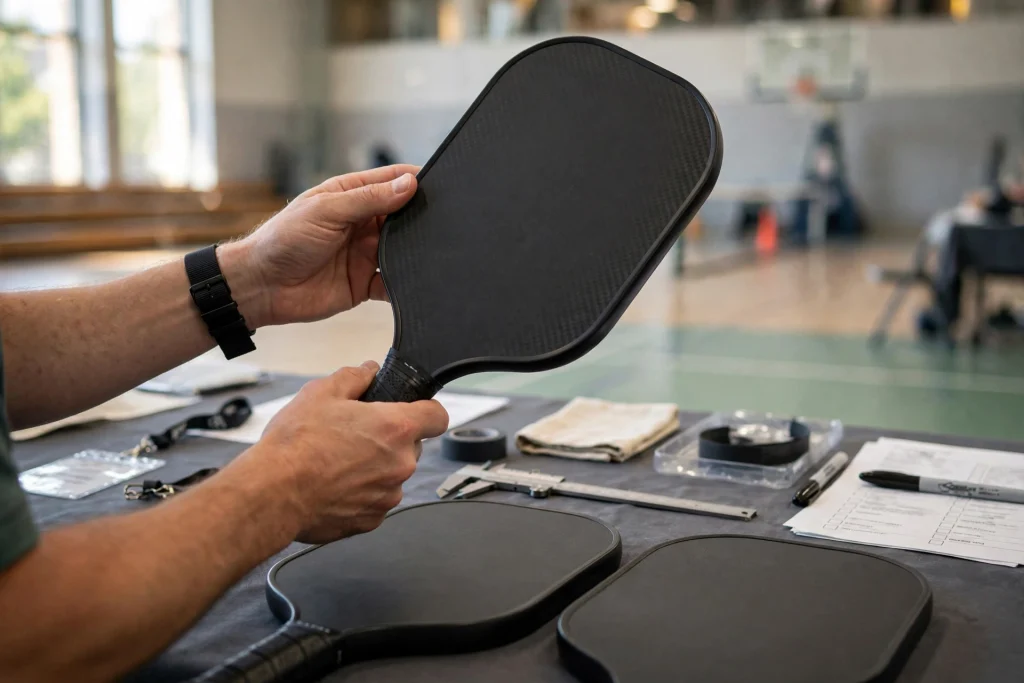
How To Check Your Paddle In Two Minutes
The check is short, and it is worth redoing before any event that follows the list.
First, read the exact model name off the paddle itself — generation and suffix matter, because near-identical names can have different statuses.
Second, search for that exact name on USA Pickleball’s approved paddle list.
Third, match carefully. If your exact model appears, you are legal for sanctioned play. If it does not, you are not — whatever the seller claimed.
Finally, re-check close to the event. The Black Ace LG’s reinstatement shows the list moving both ways, and a check from last season can mislead.
The same legality mindset applies to modifications: tape and grips are allowed within limits, which our lead tape guide sets out. And if you are choosing a new paddle, the tournament section of our buying guide covers what to verify before you buy.
Buying Secondhand Without Getting Burned
Every delisting pushes the affected models onto the secondhand market, often at tempting prices.
There is nothing wrong with buying one — for recreational play. The risk is paying a tournament player’s price for a paddle you cannot use in a tournament.
Run the two-minute check before you pay, not after. Ask the seller for the exact model name and a photo of the markings if the listing is vague.
Treat “USA Pickleball approved” in an old listing as a claim about the past. What matters is the list as it stands on the day you buy.
Frequently Asked Questions
Is my paddle banned if it was legal when I bought it?
For sanctioned play, the current list decides, not the purchase date. A paddle removed since you bought it cannot be used in a sanctioned event, though it stays fine for recreational games.
What is PBCoR in simple terms?
It measures how lively the paddle-and-ball combination is — how much energy comes back off the face. USA Pickleball caps certification at 0.44, and grandfathering for paddles above that line expired on May 1, 2026.
Can I use a delisted paddle in recreational games?
Almost always, yes. Recreational play has no equipment inspection. The exception is a club or league that has adopted the approved list as its own rule.
Why was the Black Ace LG brought back?
USA Pickleball reinstated it on June 3, 2025 after its removal. The reinstatement is a reminder to check the current list rather than rely on older news, which only records the removal.
Does delisted mean the paddle is unsafe or faulty?
No. Delisting is about measured performance ceilings and certification status, not safety or build quality. A delisted paddle plays exactly as it did the day before its removal.
How often does the approved list change?
Whenever certifications are granted, lapse or are withdrawn — there is no fixed schedule. Checking before a sanctioned event, rather than once and for all, is the safe habit.
Conclusion
Banned and delisted paddles are not defective paddles; they are paddles whose paperwork no longer matches the current standards.
The PBCoR sunset and the incoming spin limit show those standards tightening around power and grit.
Check the list before you compete and before you buy secondhand, and the whole subject becomes a two-minute errand instead of a tournament-day surprise.

Shoaib is the publisher of Pickleball Card. He oversees the site’s guides to pickleball rules, ratings, strategy and gear, all researched from primary sources — the USA Pickleball Rulebook, DUPR and manufacturer documentation — and updated as the game changes.