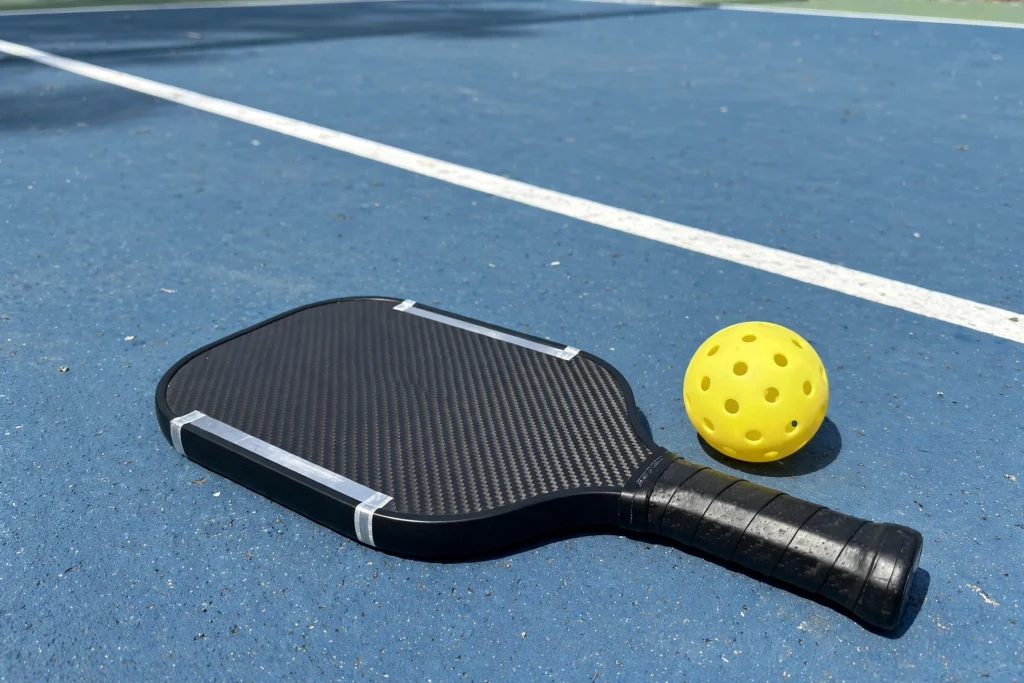
Almost every professional plays a paddle that did not come out of the packet the way they use it. Under the edge tape of a tour paddle you will usually find grams of added weight, placed with intent.
You can do the same to yours. Lead tape is cheap, reversible, and — placed well — the single most effective change you can make to a paddle you already own.
Placed badly, it is just a slower paddle with a strained arm attached. This guide covers the placements, the amounts, the application, and the rules, so the tape works for you instead of against you.
What Lead Tape Does, And What It Cannot Do
Lead tape adds mass at a chosen point on the frame. Because of how rotation works, where the mass goes matters more than how much you add — a gram at the head changes the swing far more than a gram at the handle.
That is the physics our swingweight and twistweight explainer covers in full. Tape at the head raises swingweight; tape at the sides raises twistweight; tape at the throat mostly raises static weight.
Tape cannot change your core, your face material, or your paddle’s shape. It tunes the distribution of the weight you have. A soft control paddle with tape is still a soft control paddle — one that swings heavier.
It also cannot fix damage. A delaminated face, a crushed core, or a cracked edge guard are replacement problems, not tuning problems.
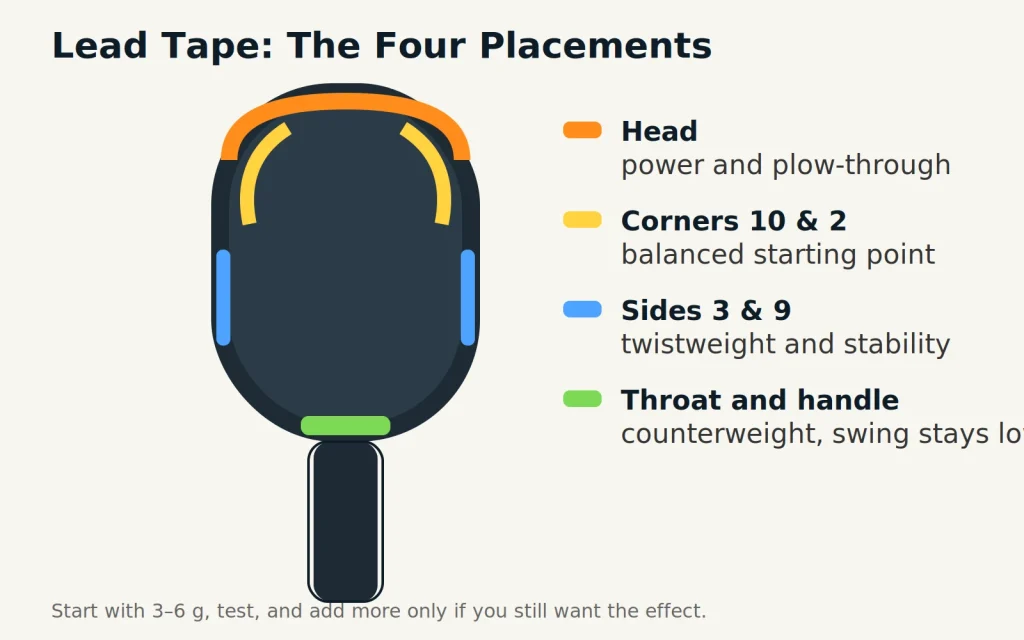
The Four Placements, And What Each One Buys
Top Of The Head — Power And Plow-Through
A strip across the top edge, around the 12 o’clock position, is the power placement. The mass sits as far from your hand as the frame allows, so every gram works hard on swingweight.
Expect drives to carry more pace and blocks to feel heavier. Expect, too, the slowest hands of any placement — this is the one to test carefully if you live at the kitchen line.
The Top Corners — Power With Stability
Strips at roughly 10 and 2 o’clock split the difference. You gain most of the head placement’s plow-through, and the off-centre mass adds some twist resistance as a bonus.
For most players adding tape for the first time, the corners are the right starting point: the gains are broad and the costs arrive more gently.
The Sides — Stability Against Twisting
Strips at 3 and 9 o’clock target twistweight directly. The mass sits far from the paddle’s long axis, so the face resists rotating on strikes near the edge.
Choose this placement if your paddle feels like it wobbles on off-centre contact, or if mishits spray. You gain forgiveness, not pace — swingweight rises only modestly.
The Throat And Handle — Counterweighting
Tape low on the throat, or wrapped under the grip, adds static weight while barely touching swingweight. Players use it to make a head-heavy setup feel balanced again, or simply to make the paddle feel substantial.
It buys no power by itself. Its job is feel: shifting the balance point down until the paddle stops feeling like it is pulling your wrist over.
How Much Tape To Add
Work in steps of 3 to 6 grams, and play a full session at each step before adding more. Small steps feel minor in the hand and large on the scorecard — overshooting is the most common tuning mistake there is.
Weigh the paddle before you start and write the number down. A kitchen scale is accurate enough, and the record lets you return to a setup that worked if an experiment does not.
Change one thing at a time. If you move the tape and add more of it in the same session, you will never know which change produced the feel you liked — or the ache you did not.
As a ceiling, be suspicious of any setup that needs more than about 10 to 12 grams to feel right. At that point the paddle is telling you it is the wrong paddle, and our weight guide will help you read what it is saying.
How To Apply Lead Tape, Step By Step
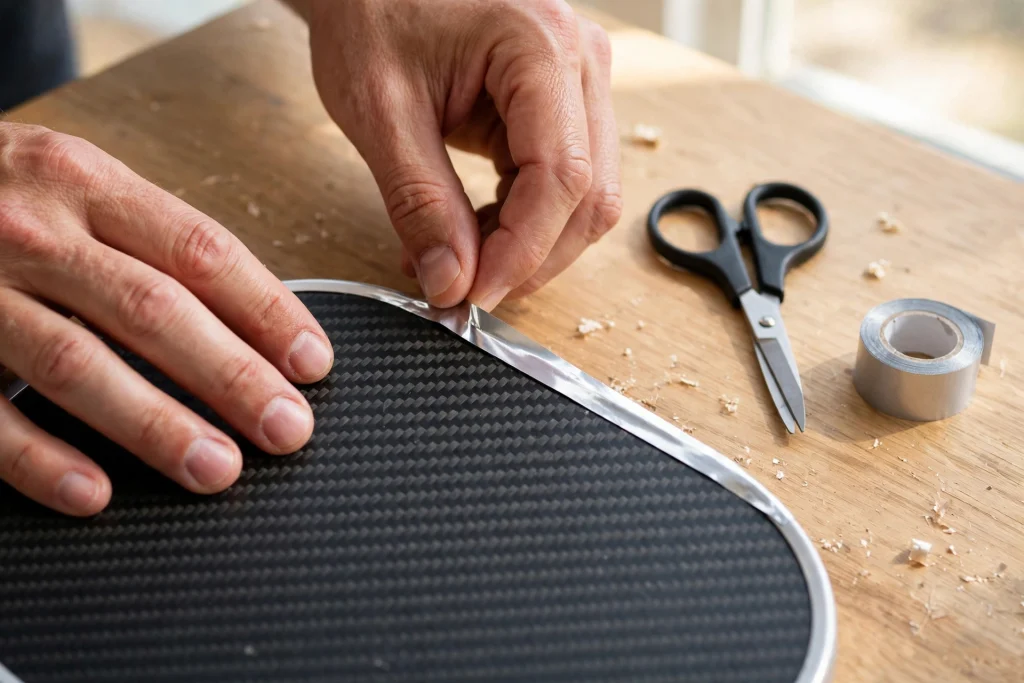
Clean the edge guard first. Skin oil, court dust and ball felt all defeat adhesive, so wipe the rim with a dry cloth, then a lightly damp one, and let it dry fully.
Measure and cut your strips before anything touches the paddle. Standard lead tape comes in pre-cut strips and on rolls; cut to length with ordinary scissors, and keep the pieces paired so both sides match.
Peel, position, and press along the edge guard, working from the centre of the strip outward to push air out. Run a fingertip firmly along the strip several times — adhesion is pressure-activated.
Cover the lead with a layer of electrical tape or edge-guard tape. This protects the strip from knocks, stops it lifting during play, and guards the edge beneath — the same rim-tape habit our weight guide recommends.
Handle lead with ordinary care: apply it with dry hands, do not chew or sand it, and wash your hands after a tuning session. If you would rather skip lead entirely, tungsten tape and tungsten weights offer similar density without it.
Staying Legal: What The Rules Allow
USA Pickleball’s equipment rules allow a paddle to be modified with additions such as tape on the edge guard and weight on the handle — tuning is a recognised part of the game, not a loophole.
The limits are about the result, not the tape itself. The finished paddle must still meet the size rules — combined length and width no more than 24 inches — and the hitting surface itself may not be altered.
A referee can also rule out a paddle that has been changed so far from its approved construction that it no longer matches the model that was certified. Grams of edge tape are nowhere near that line; structural changes are.
If you play sanctioned events, keep the setup modest and the tape under the edge guard line. Our guide on when to replace a paddle covers the related question of when wear, not tuning, becomes a legality issue.
Common Tuning Mistakes
The first is enthusiasm: adding the whole roll in one evening. Every placement section above exists because a large change hides its own costs until your arm reports them a week later.
The second is copying a professional’s setup wholesale. A tour player’s tape map is built for a tour player’s swing speed and a fresh paddle every few weeks. Your arm files its own report.
The third is taping over damage. Tape hides a cracked edge guard from view while the crack keeps growing, and it can turn a warranty claim into an argument. Inspect first, tune second.
The fourth is never re-testing. Your swing changes as you improve, and the setup that suited you in spring can be the weight that slows you in autumn. Peel it off and re-earn it each season.
Frequently Asked Questions
Is lead tape legal in pickleball tournaments?
Yes. The equipment rules allow added tape on the edge guard and weight on the handle, provided the finished paddle still meets the size limits and the hitting surface is unaltered. Keep additions modest and under the edge line for sanctioned play.
How much lead tape is too much?
When your hands slow down or your arm starts aching, you have passed your personal limit, whatever the scale says. As a working ceiling, most players land between 3 and 12 grams total. Needing more than that usually means the paddle itself is the wrong starting point.
Lead tape or tungsten tape — which is better?
Both tune the same way; the difference is the material. Lead is cheaper, thinner for its weight, and needs basic handling care. Tungsten products cost more and are bulkier per gram, but avoid lead entirely. The placement physics is identical.
Will lead tape damage my paddle or void the warranty?
Applied to the edge guard and removed gently, tape should not damage a paddle. Aggressive removal can lift finish or edge printing, and warranty wording varies by maker — check yours before tuning a paddle you might claim on, and photograph the paddle first.
Can lead tape make a light paddle feel stable?
Yes — that is one of its best uses. Side placement raises twistweight, which is the stability number, without needing a heavy head. A light paddle with taped sides can feel steadier on mishits than a heavier paddle with all its mass in the middle.
Where should a beginner place lead tape first?
At the top corners, in a small step of about 3 grams per side. It is the most forgiving experiment: a little plow-through, a little stability, and fully reversible if your hands feel slower. Play a full session before deciding whether to keep, move, or remove it.
Conclusion
Tuning is the cheapest experiment in pickleball: a few grams, honestly placed and honestly tested, can turn a paddle you merely own into a paddle that fits.
Start at the corners, move in small steps, write everything down — and let your arm, not a tour player’s setup sheet, have the final vote.

Shoaib is the publisher of Pickleball Card. He oversees the site’s guides to pickleball rules, ratings, strategy and gear, all researched from primary sources — the USA Pickleball Rulebook, DUPR and manufacturer documentation — and updated as the game changes.