Two paddles can weigh exactly the same on a kitchen scale and feel like completely different equipment in your hand. One swings light and fast. The other pulls through the ball like it has a mind of its own.
The scale is not lying — it is just answering a narrower question than the one your arm asks. Static weight tells you how heavy a paddle is. Swingweight and twistweight tell you how that weight behaves when you swing it and when the ball hits off-centre.
This guide explains both numbers in plain language: what they measure, why they matter, how they are produced, and how to change them on a paddle you already own.
What Is Swingweight?
Swingweight measures how hard a paddle resists being swung. Physicists call it moment of inertia: the paddle’s reluctance to rotate around an axis near your hand as you swing.
It is expressed in kg·cm², and the number climbs fast when weight sits far from your hand. A gram at the top of the paddle raises swingweight far more than a gram at the handle.
That distance effect is the whole story. Two 8.0 oz paddles can post very different swingweights if one carries its mass in the head and the other carries it in the handle.
On court, a higher swingweight drives through the ball: drives carry more pace and blocks feel solid. A lower swingweight changes direction faster, which is what fast hands at the kitchen line are made of.
What Is Twistweight?
Twistweight measures a different rotation: how much the paddle resists twisting around its long axis — the line running from the butt of the handle to the top of the face.
That twist is what you feel on an off-centre hit. The ball strikes near the edge, the face tries to rotate in your hand, and twistweight is the paddle’s built-in resistance to that rotation.
Width is the big lever here. Mass placed far from the centre line — out toward the edges of a wide face — raises twistweight much more than the same mass placed in the middle.
A higher twistweight means a steadier face on mishits: fewer balls sprayed wide by a strike near the edge. A lower twistweight leaves the face easier to manoeuvre, but less forgiving when your contact wanders.
Why The Scale Lies: Static Weight Vs Swingweight
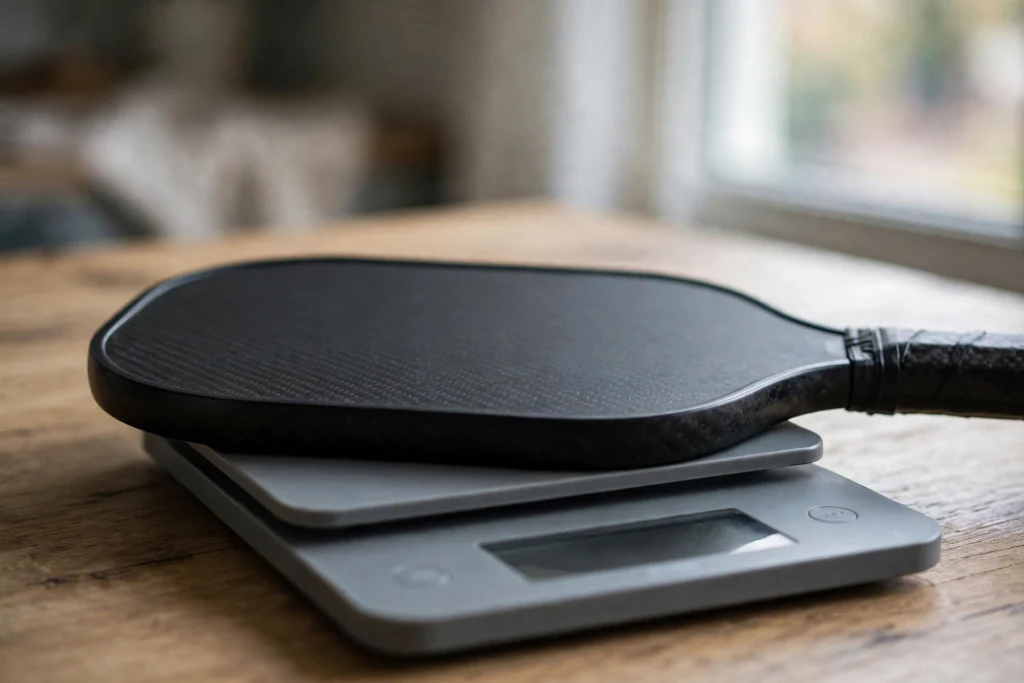
Static weight is one number: total mass. It treats a gram at the butt cap and a gram at the top edge as identical, because on a scale they are.
Your arm disagrees. Swinging multiplies the effect of distance, so head-heavy mass dominates how a paddle feels at speed, while handle mass mostly disappears once the paddle is moving.
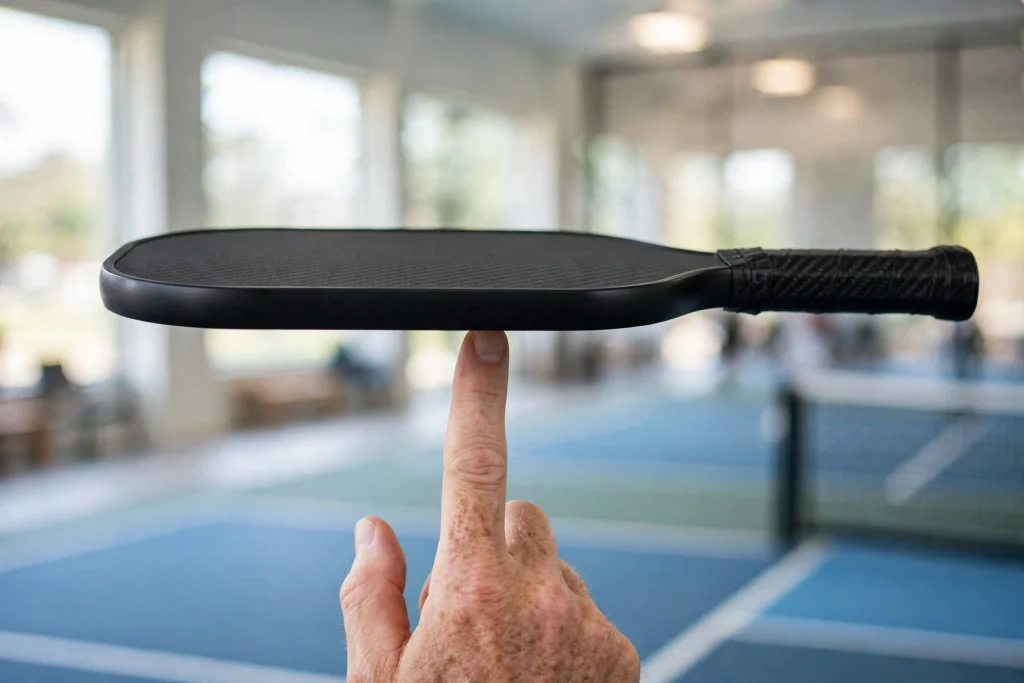
Balance point is the bridge between the two ideas. It is the spot where the paddle balances on a finger, and it hints at how the weight is distributed — but two paddles with the same balance point can still swing differently.
This is why our paddle weight guide treats weight classes as a starting point, not an answer. The class tells you the mass. Swingweight tells you the behaviour.
How The Numbers Are Measured
Swingweight is measured on a machine that swings the paddle like a pendulum and times the oscillation. Tennis has used these machines for decades; pickleball adopted the same method and the same units.
Twistweight is measured with a similar rotational setup, or calculated from the paddle’s dimensions and weight distribution. Either way, the figure describes the paddle, not the player.
Home methods exist — timing a paddle swung from a pivot and running the physics — but they are approximations. Small errors in the pivot point or timing swing the result by more than the differences players argue about.
Few manufacturers publish either number, which is why these figures rarely appear in our guides. One exception: Six Zero publishes swingweights for its Double Black Diamond — 114 for the 16 mm version and 110 for the 14 mm, in the maker’s own listing. Where a brand publishes, we can cite. Where it does not, we will not guess.
How Lead Tape Changes Both Numbers
Lead tape is applied physics. Where you put the grams decides which number moves, and by roughly how much.
Tape at the top of the head raises swingweight the most per gram — this is the placement for more plow-through on drives. It barely touches twistweight, because the mass sits close to the centre line.
Tape at the sides of the face, around the 3 and 9 o’clock positions, is the twistweight placement. The mass sits far from the long axis, so the face resists twisting on edge strikes.
Tape at the throat or under the grip raises static weight with the least swingweight change. It is how you make a paddle heavier without making it slower — useful for feel, useless for power.
Work in steps of a few grams and play between changes, exactly as the weight guide describes. And if you are chasing power specifically, our power paddles guide shows which builds start with these numbers already in your favour.
Which Numbers Suit Your Game?
There is no correct swingweight, only a correct match. The trade is always the same: mass in motion buys pace and stability, and charges you hand speed and arm comfort.
Kitchen-focused players who win with quick counters usually prefer the lower, faster end. Every gram of head weight is a gram their wrists must stop and restart fifty times a game.
Drivers and bangers lean the other way. A higher swingweight is free pace on full swings, and the same mass steadies blocks against opponents who hit hard.
Players whose misses spray off the edge should look at twistweight first. A steadier face forgives the contact they actually make, not the contact they plan to make.
If your arm complains after sessions, treat that as data. A setup that is too demanding shows up in the elbow and shoulder long before it shows up on the scorecard — our choosing guide covers the comfort side of the decision.
Frequently Asked Questions
Is a higher swingweight always better?
No. Higher swingweight adds pace and stability on full swings, and costs you hand speed, manoeuvrability and arm comfort. The best swingweight is the highest one you can still swing fast in the third game of a session, not the highest one on the shelf.
Does twistweight matter for beginners?
Yes — arguably more than for advanced players. Beginners make more off-centre contact, and twistweight is precisely the number that decides how much those mishits cost. A forgiving, higher-twistweight paddle keeps more of a beginner’s off-centre balls in play.
Can I measure my paddle’s swingweight at home?
Approximately. Pendulum methods using a pivot, a timer and the published formulas can get you close, but small setup errors move the result by several points. Treat a home figure as a way to compare your own paddles, not as a number to quote against a maker’s published value.
Why don’t most brands publish swingweight?
Partly tradition — pickleball grew up quoting static weight — and partly because the number exposes how differently two same-weight paddles play. A few brands, like Six Zero, publish swingweights in their listings. Until more do, treat any unsourced swingweight figure for a specific paddle as unverified.
Does an overgrip change swingweight?
Barely. An overgrip adds a few grams at the handle, the place where added mass has the least effect on swingweight. It raises static weight slightly and changes grip size, which you will feel far more than any change in how the paddle swings.
What is a good twistweight for pickleball?
There is no governing standard or official range, and makers rarely publish the figure, so beware any source quoting precise twistweights for paddles whose makers never released them. Judge it by shape instead: wider faces and perimeter-weighted builds twist less than narrow, head-light ones.
Conclusion
Static weight is what a paddle weighs. Swingweight is how it swings, and twistweight is how it behaves when you miss the middle. Together they explain the thing every player has felt and few could name: why the same eight ounces can feel like two different paddles.
Learn to read them, place your tape with intent, and the next paddle you buy will be chosen on behaviour — not just on a number from a scale.

Shoaib is the publisher of Pickleball Card. He oversees the site’s guides to pickleball rules, ratings, strategy and gear, all researched from primary sources — the USA Pickleball Rulebook, DUPR and manufacturer documentation — and updated as the game changes.