Pickleball is the rare sport where the over-55 crowd is the core of the game, not the exception. The shoe that suits a 25-year-old tournament player is not automatically the shoe that suits a 65-year-old playing four mornings a week.
What changes with age is what your feet need from a shoe: more cushioning, more stability, a wider toe box, and — for many players — a shoe that goes on without a fight.
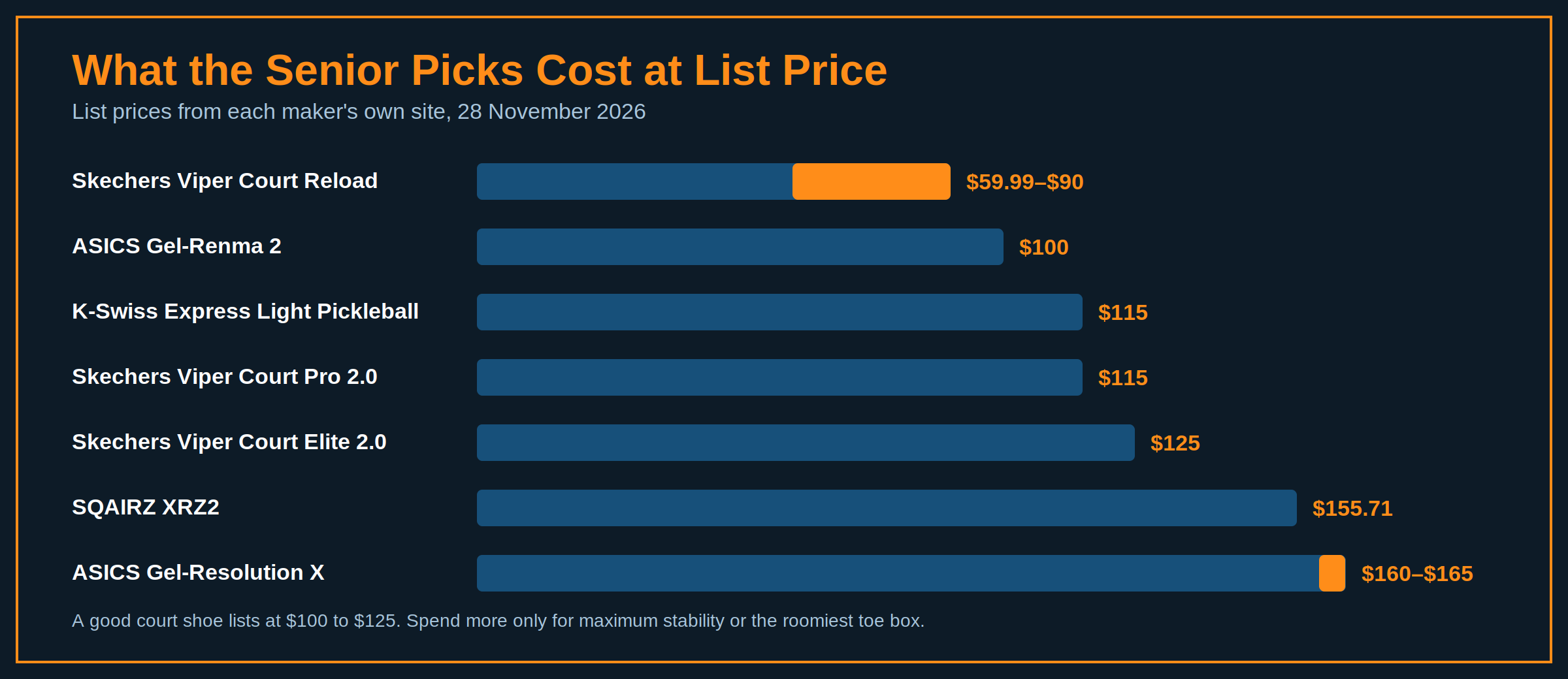
Every model here was checked against its maker’s own site on 28 November 2026; every price below is its list price unless stated otherwise. No shoe can prevent injury, and none here is claimed to.
Why Footwear Matters More After 55
An ankle sprain is an injury to one or more of the ligaments that stabilise the ankle, and the American Academy of Orthopaedic Surgeons (AAOS) says about 90% of them are inversion injuries — the ankle rolling inward. The AAOS names two footwear risk factors directly: wearing shoes that do not provide enough foot and ankle support, and wearing shoes with slippery soles.
Its prevention advice is practical: warm up thoroughly, strengthen the ankles, choose footwear with appropriate support, and add balance training. A court shoe is the footwear half of that list. Our common pickleball injuries hub covers the injuries themselves, and our warm-ups and cool-downs guide has a timed routine that includes ankle work.
Bunions are the other age-related foot change that shapes shoe choice. The AAOS says bunion pain is often relieved by wider shoes with enough toe room, and advises shoes with wide insteps, broad toe boxes, soft soles and plenty of stability.
Five Checks Before You Buy
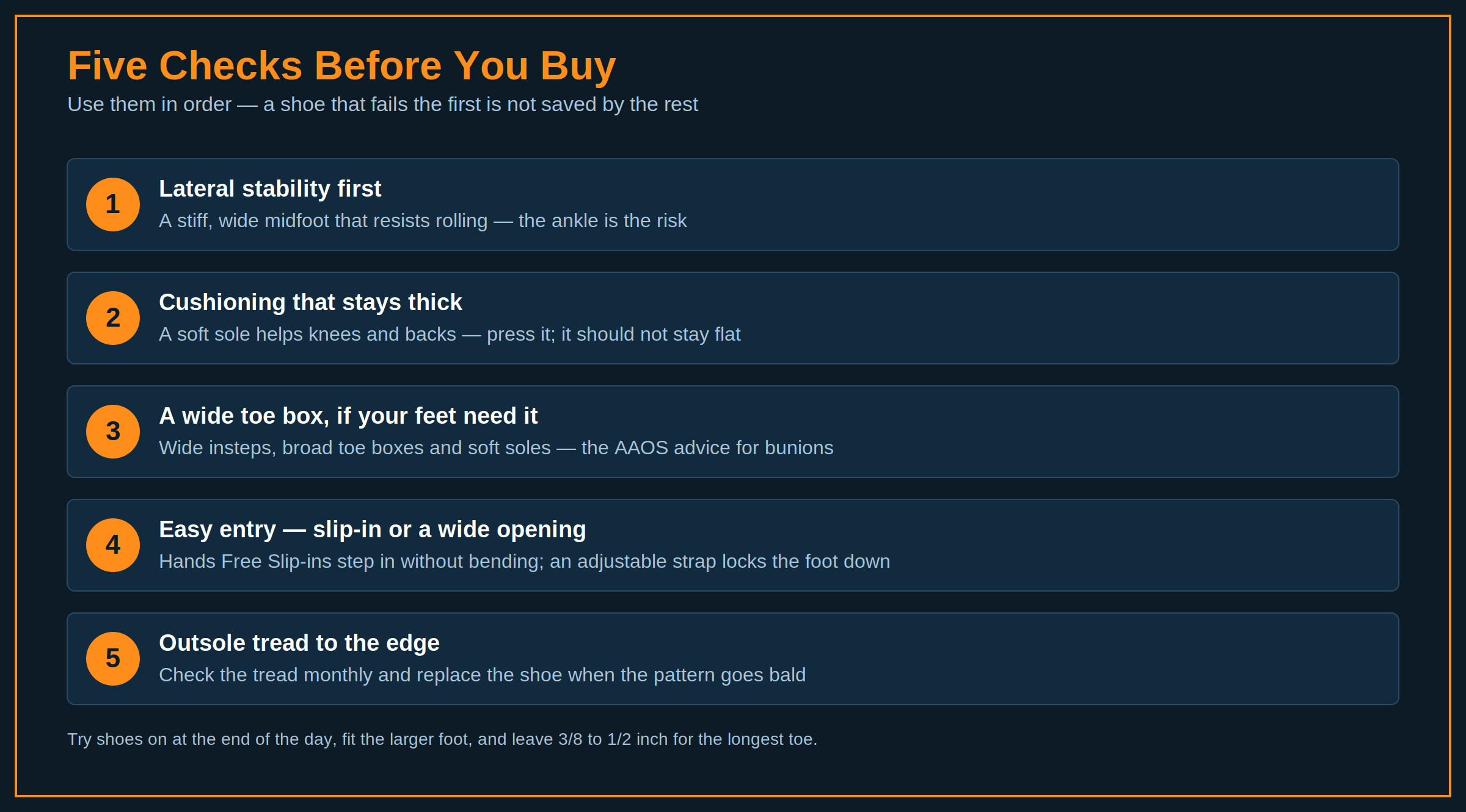
Use these five checks in order — a shoe that fails the first is not saved by passing the other four.
1. Lateral stability. Pickleball is a cutting sport, and the ankle rolls sideways. Look for a stiffened midfoot — TRUSSTIC in the Gel-Renma 2, DYNAWALL in the Gel-Resolution X, a TPU plate in the XRZ2, or a support chassis in the Express Light; twist it and a court shoe should barely give through the middle.
2. Cushioning that does not collapse sideways. Thick foam feels good on the first day, but soft foam that compresses sideways gives you nothing on a hard cut. Look for cushioning paired with stability: GEL and FF BLAST PLUS foam in the Gel-Resolution X, ULTRA GO foam in the Viper Court Pro 2.0, or K-EVA in the Express Light.
3. A toe box with room. Feet spread with age, and a narrow shoe squeezes the joint a bunion already hurts — Skechers builds its Viper Court line on a Relaxed Fit last, and SQAIRZ’s patented toe-box geometry lets toes spread naturally. If the standard width pinches, buy the wide version — several models below sell one at the same price.
4. Easy entry. Bending to lace up is a chore for many players. Skechers’ Hands Free Slip-ins line is built for this: a Heel Pillow that lets you step in without touching the shoe, with laces or a strap for lockdown once it is on.
5. Grip you can trust. A smooth sole is a slippery sole, and the AAOS lists slippery soles as a sprain risk factor. Check the tread: it should be patterned edge to edge, with no bald patch under the ball of the foot.
The Picks
| Model | List price | Why it suits 55+ |
|---|---|---|
| Skechers Viper Court Reload | $59.99–$90 | Cheapest hands-free Slip-ins; Relaxed Fit |
| ASICS Gel-Renma 2 | $100 | TRUSSTIC stability; indoor-friendly |
| K-Swiss Express Light Pickleball (original) | $115 | Light, stable; 2E wide at the same price |
| Skechers Viper Court Pro 2.0 | $115 | Arch Fit insole; APMA Seal; wide available |
| Skechers Viper Court Elite 2.0 | $125 | Hands-free Slip-ins; adjustable strap |
| SQAIRZ XRZ2 | $155.71 | Roomiest toe box; 6-month sole warranty |
| ASICS Gel-Resolution X | $160–$165 | Maximum stability; DYNAWALL; wide version |
The K-Swiss Express Light is the all-rounder: light but stable, with a K-EVA midsole, a Plantar Support Chassis and an Aosta rubber outsole with DragGuard. It comes in a 2E wide at the same $115 list price.
The Skechers Viper Court Pro 2.0 is the comfort pick. Its Arch Fit EVA insole carries the Seal of Acceptance from the American Podiatric Medical Association, developed with 20 years of data and 120,000 foot scans. It pairs that with ULTRA GO foam and a Goodyear Gold compound outsole, and it is listed in wide.
The Skechers Viper Court Elite 2.0 is the easy-entry pick: a Hands Free Slip-ins shoe with a Heel Pillow, a removable Arch Fit insole and an adjustable top strap — step in without bending, then tighten the strap. List price $125; on sale at $84.99 on Skechers’ own site on 28 November 2026.
The Skechers Viper Court Reload is the budget easy-entry pick: also a Hands Free Slip-ins shoe with a Relaxed Fit, listed at $59.99 to $90 on Skechers’ own site depending on colour.
The ASICS Gel-Renma 2 is the indoor pick: ASICS describes it as a good choice for indoor sports players, with a TRUSSTIC midsole and wrap-up outsole built for stability. List price $100; on sale at $79.95 on 28 November 2026.
The ASICS Gel-Resolution X is the maximum-stability pick, for players who have rolled an ankle before. Its DYNAWALL technology extends into the heel for added stability, and its higher medial collar adds support on abrupt cuts. It lists at $160 to $165, and it comes in a wide version.
The SQAIRZ XRZ2 is the roomy-toe pick. Its patented toe-box geometry lets toes spread naturally, with an external TPU stability plate, a Blumaka non-slip footbed and a 6-month sole warranty. It lists at $155.71; on sale at $109 on 28 November 2026.
Fitting Feet That Have Changed
The AAOS advises having your feet measured regularly, because their size changes as you grow older. Do not assume the size you wore at 40 still fits at 65 — measure both feet and fit the larger one.
Try shoes on at the end of the day, in the socks you play in, when your feet are at their largest. Leave 3/8 to 1/2 inch of space between your longest toe and the end of the shoe, and check that the ball of your foot sits in the widest part of the shoe.
If you wear an aftermarket insole or an orthotic, bring it to the fitting. The Viper Court Pro 2.0 and the Viper Court Elite 2.0 both have removable insoles, so swapping in your own is straightforward.
What to Avoid
Do not play in running shoes. They are built for straight-line motion, with a high, soft heel and a flexible forefoot, and on a lateral cut they tip. A court shoe is flat, wide and patterned edge to edge.
Walking shoes fail the same test: they are built for heel-to-toe rolling, not for sideways stops.
Do not play in worn-out shoes. A court shoe fails quietly — the tread wears smooth under the ball of the foot first, and the midsole stops springing back, both before the shoe looks worn out. A smooth sole is a slippery sole.
Check the tread monthly, and replace the shoe when the pattern goes bald or the midsole stays compressed. Do not buy on price alone: the right shoe passes the five checks on your feet. Our best pickleball shoes guide lists the site’s current main-list picks, and our pickleball near me guide explains how to find courts and clubs where you can try shoes on before buying.
The Short Version
After 55, buy for stability, cushioning, toe room, easy entry and grip — in that order. The Express Light at $115 is the all-rounder, the Viper Court Pro 2.0 at $115 is the comfort pick, and the Viper Court Elite 2.0 at $125 is the easy-entry pick.
Get measured, try shoes on at the end of the day, and buy the wide version if the standard width pinches. Never play in running shoes or walking shoes, and replace a pair when the tread goes smooth.
If you are new to the game, our how to play pickleball guide and our first day at open play guide explain what to expect. For grandchildren, our pickleball for kids guide covers junior sizes — and once the shoes are sorted, our footwork and agility drills guide is the right next step.
Frequently Asked Questions
What is the best pickleball shoe for seniors?
There is no single best shoe — it depends on your feet. The Express Light at $115 is the all-rounder: light, stable, and available in a 2E wide at the same price. The Viper Court Pro 2.0 at $115 is the comfort pick, with an Arch Fit insole carrying the APMA Seal of Acceptance.
Are slip-on pickleball shoes safe for older players?
Yes, if they are real court shoes with lockdown. The Viper Court Elite 2.0 and Viper Court Reload are Hands Free Slip-ins with a Heel Pillow for step-in entry, but they still have laces or a strap to lock the foot down, and a Goodyear outsole for grip.
Do I need a wide pickleball shoe as I get older?
Often, yes. Feet spread with age, and the AAOS advises having your feet measured regularly. If the standard width pinches your toes or presses a bunion, buy the wide version rather than sizing up.
How much should a senior spend on pickleball shoes?
A good court shoe lists at $100 to $125 — the Gel-Renma 2 at $100, the Express Light and Viper Court Pro 2.0 at $115, the Elite 2.0 at $125. The Reload lists at $59.99 to $90 if budget matters.
Can I play pickleball in walking shoes?
No. Walking shoes are built for heel-to-toe rolling in a straight line, not for sideways stops and cuts, and they tip on a lateral cut like running shoes do. A court shoe is flat, wide and patterned edge to edge.
How often should seniors replace pickleball shoes?
When the tread wears smooth under the ball of the foot or the midsole stops springing back — whichever comes first. Both happen before the shoe looks worn out, so check the tread monthly if you play several times a week.

Shoaib is the publisher of Pickleball Card. He oversees the site’s guides to pickleball rules, ratings, strategy and gear, all researched from primary sources — the USA Pickleball Rulebook, DUPR and manufacturer documentation — and updated as the game changes.