Most players do not need to choose one format forever. They need to choose the right format for where they are now.
If you are new to the game, a group clinic is usually the better first spend. If you are stuck on one specific problem — a serve that keeps failing, a third shot that keeps floating — a private lesson will fix it faster.
Clinics buy you reps, structure and company at a low price. Private lessons buy you a coach’s undivided attention, at roughly three to five times the price. Most improving players end up using both.
What a Clinic Is
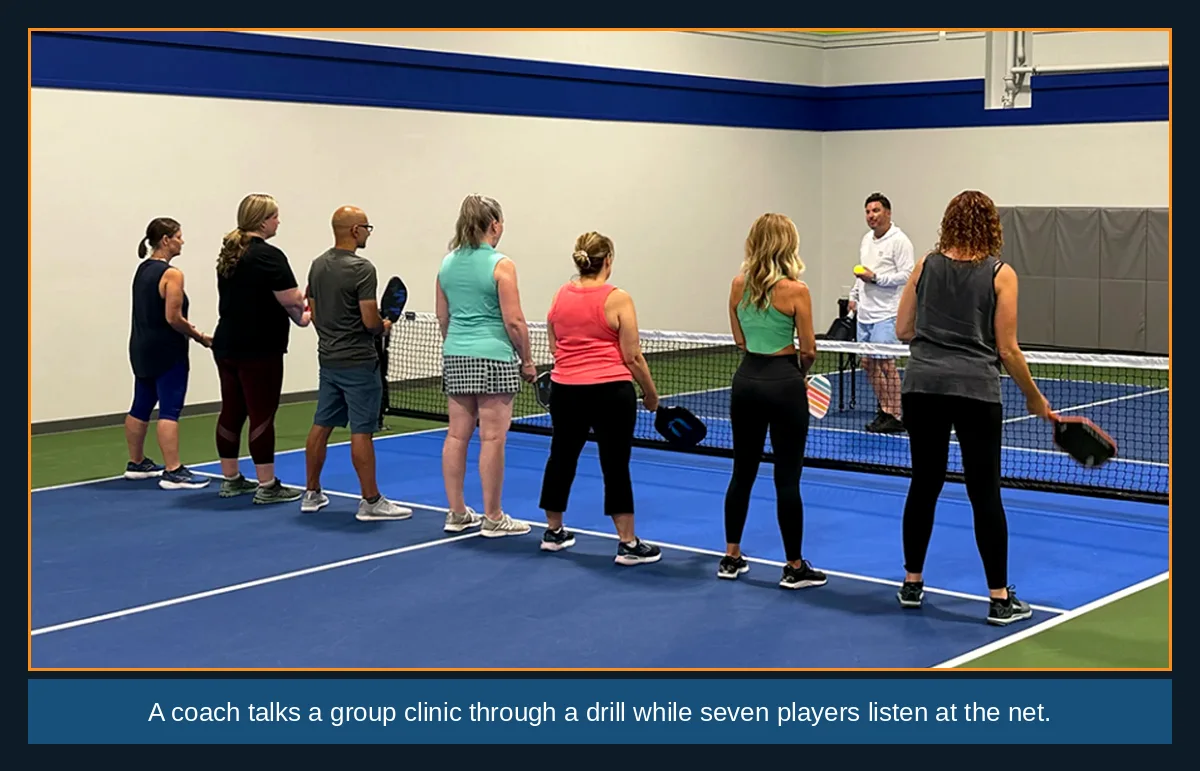
A clinic is a structured group session built around one theme. A beginner clinic might cover grip, serve, dink and basic court positioning in one session.
Sessions usually run 60 to 90 minutes. A club guide published in January 2026 puts beginner clinics at groups of 8 to 12 players, with roughly four players per instructor. Another 2026 guide puts the more common clinic at 4 to 8 students per coach.
That difference matters: a clinic of four gives you plenty of feedback, while a clinic of twelve is closer to a class. Always ask how many players will be on court before you book.
Clinics follow a set plan: demonstration, group drills, then short guided games. The coach teaches the group’s skill, not yours.
What a Private Lesson Is
A private lesson is one player, one coach, one hour. Most sessions last 60 minutes, although 30-, 45- and 90-minute formats exist.
The coach watches you play first, finds the one or two habits holding you back, then drills those specifically. That diagnosis is what you are paying for.
A coach watching only you can spot a dropped wrist on contact or a step into the kitchen a fraction too early. In a clinic, the group moves on when the schedule says so, whether you have got it or not.
Private lessons work best with a clear problem. “Fix my game” is a poor brief. “My third-shot drop keeps landing short against 3.5 players” is a good one.
How Much Each Format Costs
Prices vary widely by city, facility and coach, and published guides disagree. That disagreement is useful: it tells you there is no single national price.
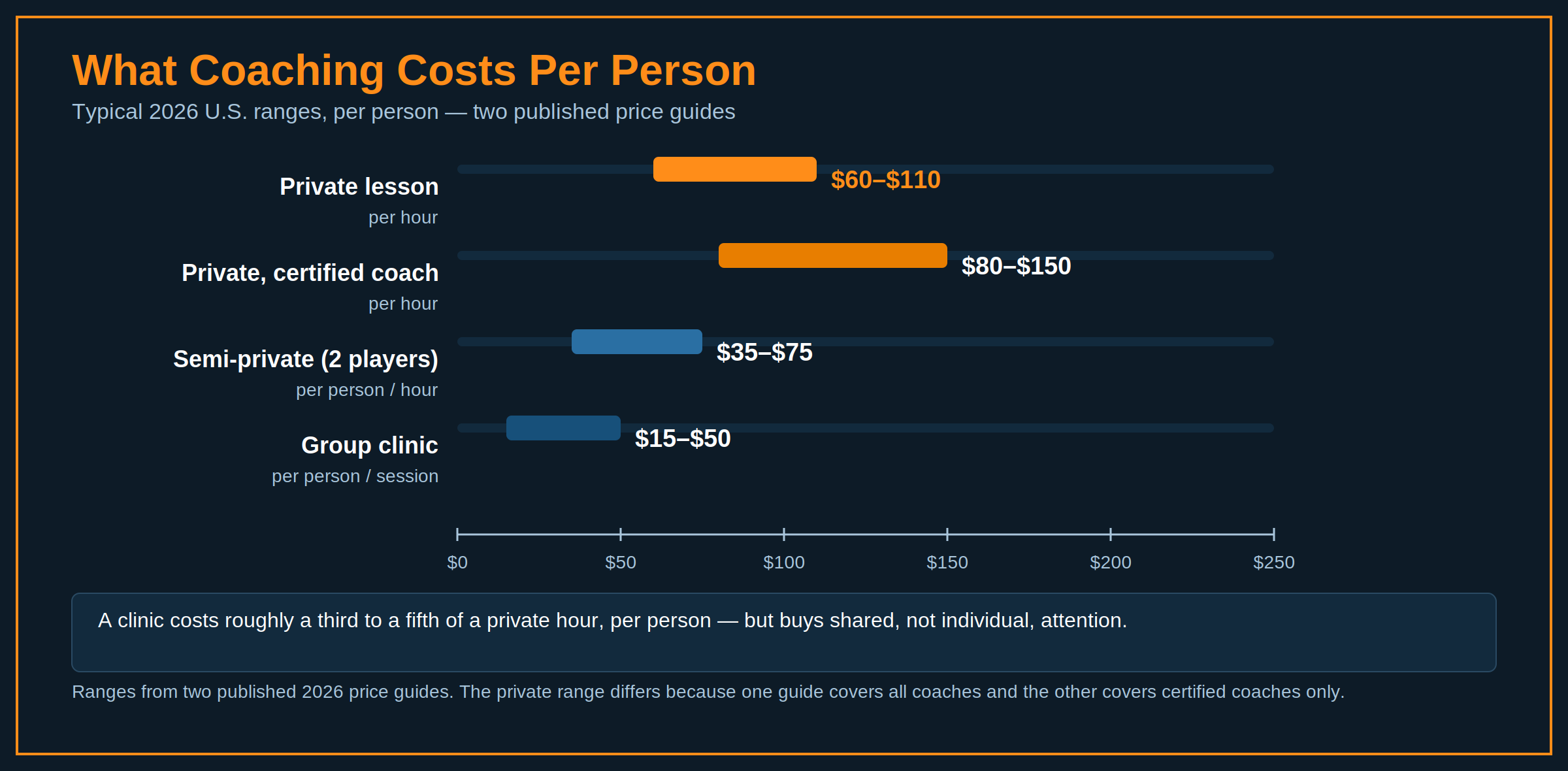
A price guide updated 4 October 2026 puts private coaching at $60 to $110 per hour, semi-private at $35 to $75 per person per hour, and group clinics at $15 to $50 per person per session. Elite coaches, it says, charge $120 to $250 or more per hour.
A second guide, published in May 2026, puts clinics at $20 to $50 per person and private lessons with a certified coach at $80 to $150 per hour. The gap is mostly about who is included: the lower range covers all private coaches, the higher one only certified coaches.
| Format | Typical cost (per person) | What you get for it |
|---|---|---|
| Group clinic | $15–$50 per session | Shared coaching, drills and guided play |
| Semi-private (2 players) | $35–$75 per hour | Half a coach’s attention, a live partner |
| Private (1 player) | $60–$110 per hour | The coach’s full attention for the hour |
| Private, certified coach | $80–$150 per hour | Full attention plus formal coach training |
| Elite or former professional | $120–$250+ per hour | Top-level coaching, tournament preparation |
The table uses the lower private range as its headline row because it covers the widest set of coaches. Certified coaches sit at the higher end of that range and above it, which is why both ranges appear here rather than one settled number.
Always compare the all-in price. One coach charges $80 for instruction plus a $30 court fee, making the real lesson $110. Ask whether court time, paddle rental or a rating session is included.
Parks programmes are the cheapest way in. One city programme charges $155 for ten weekly one-hour classes — $15.50 per class — with groups of four to eight. Check your parks department before spending hundreds on private coaching.
How Much Attention Do You Actually Get?
In a private lesson, 60 minutes of coaching is 60 minutes for you. In a clinic, the coach’s hour is shared across the whole group.
Do the arithmetic: in a 60-minute clinic with eight players, an even split would give each player under eight minutes of one-to-one time. In practice much of the hour is group drilling, where the coach watches everyone at once.
That is not a flaw. Group drilling is where you get your repetitions, and watching others attempt the same shot teaches you plenty. But a clinic cannot give you real-time correction of only your movement — the coach must keep the whole group moving.
A semi-private lesson splits the difference. Two players share one coach and roughly half the private rate each. For doubles partners, the coach can also work on movement and communication between you — the heart of doubles strategy.
Who Each Format Suits
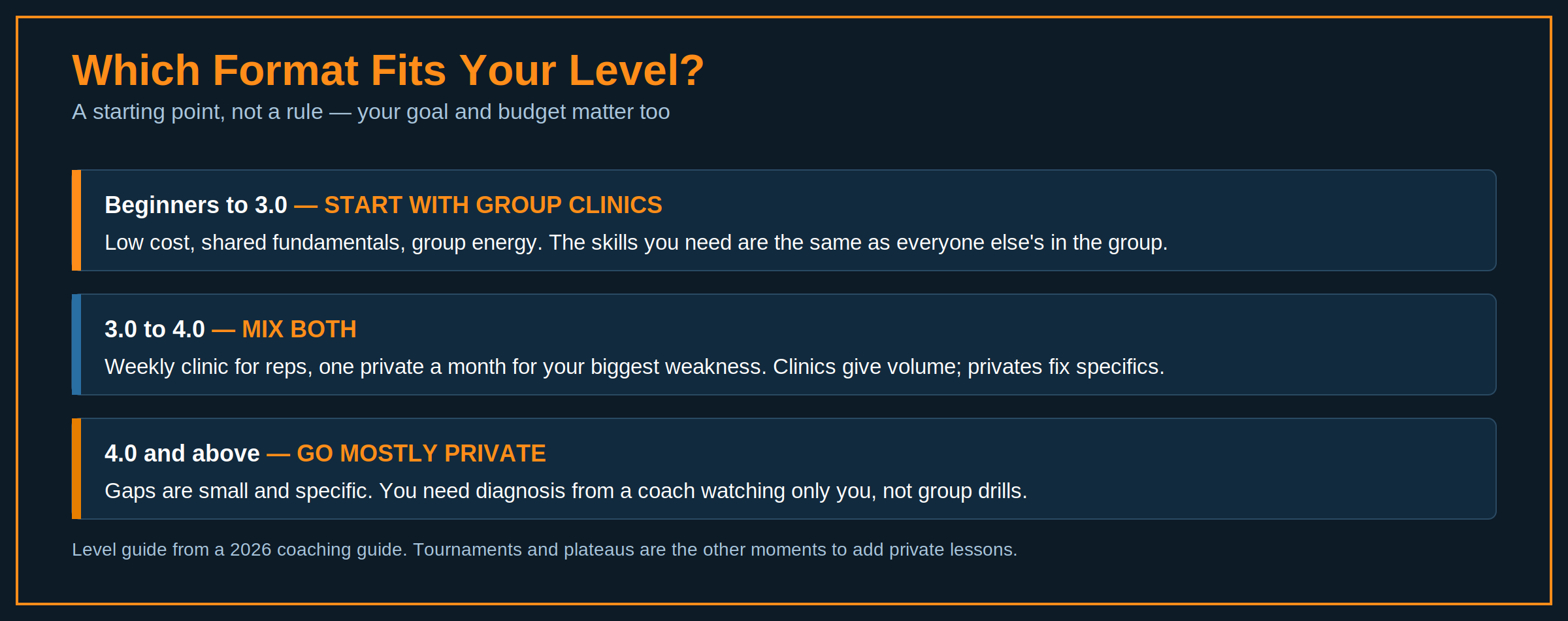
The rule of thumb from a 2026 coaching guide is by level: beginners to 3.0 start with clinics, 3.0 to 4.0 mix the two, and 4.0 and above get the most from private lessons.
Up to 3.0, everyone needs the same skills: a consistent serve and return, keeping rallies going, basic dinks and court positioning. Our how to play pickleball guide and our pickleball rules guide cover the same ground a beginner clinic teaches.
Between 3.0 and 4.0, the gaps start to differ from player to player. Clinics still give you the reps, but a monthly private lesson can fix the specific thing holding you back. Our footwork and agility drills are the kind of work a 3.5 player brings to a private session.
At 4.0 and above, the gaps are smaller and more specific — a dropped elbow on resets, a positioning habit that costs points. Closing them needs diagnosis, and diagnosis needs a coach watching only you. Our guide to what a good DUPR rating is explains the 2.0 to 8.0 scale, and how to get a DUPR rating explains how to get rated.
When to Combine Both
For most players the best answer is clinics for volume and private lessons for precision — and the combination is cheaper than private lessons alone.
One published example: four group sessions at $25 each plus one $90 private lesson costs $190. Five $90 private sessions cost $450. The mixed approach saves $260.
A workable pattern is a weekly clinic plus one private lesson a month aimed at your single biggest weakness. Bring the drills from the private lesson to the clinic and practise them there.
Warm up properly before either: our warm-ups and cool-downs guide has a ten-minute routine. And do not book both formats on the same skill in the same week with no practice between — the lesson diagnoses, the practice is the treatment, and the clinic is where you test it.
How to Pick a Good Clinic
Price is the easiest thing to compare and the least useful on its own. These five questions tell you far more.
How many players per coach? Four to eight students per coach is the common range. Above eight with a single coach, ask whether an assistant helps.
Are players grouped by level? A clinic mixing 2.5 beginners with 4.0 players serves neither group. Ask how they check level — a DUPR rating is one way.
Is the coach certified? The two main certifications are PPR (Professional Pickleball Registry) and IPTPA (International Pickleball Teaching Professional Association). PPR describes itself as the official education and certification partner of USA Pickleball.
What does a session look like? Look for demonstration, drills, then guided play. A session that is mostly open play with a coach watching is what your first day at open play already gives you for free.
Can you talk to current students? Ask what improved and in what timeframe. Also ask about the cancellation policy: some coaches charge missed sessions in full.
The Short Version
Start with clinics. Add a private lesson when you hit a specific problem or prepare for a tournament. Past 3.5, shift the balance: keep the clinic for reps and let private lessons fix the one or two habits capping your level.
To find coaching near you, our pickleball near me guide explains how to search for courts, clubs and coaches in your area.
Frequently Asked Questions
How much do pickleball clinics cost compared to private lessons?
Group clinics typically cost $15 to $50 per person per session, per a price guide updated 4 October 2026. Private lessons cost $60 to $110 per hour in the same guide, or $80 to $150 for a certified coach in a second 2026 guide. Compare the all-in price: court fees can add $30.
Are pickleball clinics good for beginners?
Yes. The skills a new player needs — serve, dinks, court positioning — are the same for everyone in the group. One city parks programme charges $155 for ten weekly classes, or $15.50 per class.
How many players are in a good pickleball clinic?
Published guides put the common range at 4 to 8 students per coach, with beginner groups of 8 to 12 in one club guide. Above eight players with a single coach, individual feedback gets thin.
When should I switch from clinics to private lessons?
Switch when group coaching cannot fix a specific problem — a failing serve, a floating third shot, or a plateau lasting a year. That usually happens around 3.5 to 4.0.
Can I combine clinics and private lessons?
Yes. A weekly clinic plus one private lesson a month is the best-value approach for most players. One published example: four $25 sessions plus one $90 private lesson costs $190, against $450 for five private sessions.
What should I ask before booking a pickleball clinic or lesson?
Ask the player-to-coach ratio, whether players are grouped by level, and whether the coach holds a recognised certification such as PPR or IPTPA. Ask what a session looks like, whether court time is included, and for references from current students.

Shoaib is the publisher of Pickleball Card. He oversees the site’s guides to pickleball rules, ratings, strategy and gear, all researched from primary sources — the USA Pickleball Rulebook, DUPR and manufacturer documentation — and updated as the game changes.