Thirty days can change how you play, if the month has a shape. Most 3.0 players practise by showing up and hitting, and that keeps them at 3.0.
This plan gives the month a shape: four weeks, one job per week, three drill sessions and one match session a week, and a self-test at each end.
What 3.5 Actually Looks Like
USA Pickleball describes skill levels by what a player can do, shot by shot. It labels 3.0 as Advanced Beginner and 3.5 as Intermediate.
At 3.0, a player hits medium-paced shots with limited direction and consistency. Dinks are basic, the third shot is generally a medium-paced ball, and unforced errors are frequent.
At 3.5, serves and returns go in consistently, dinks are more consistent with some control of height and depth, and the third shot is developing into a drop that gets the player to the net. A 3.5 player also moves quickly to the non-volley zone and varies between the hard game and the soft game.
That is the gap this plan targets: consistency on serve, return, drop, dink, and the choice to speed up or stay patient.
On the DUPR scale, the same move is a real step: a 3.0 sits at about the 31st percentile among rated doubles players, and a 3.5 at about the 60th, according to DUPR’s snapshot of 22 September 2026.
Our guides to what DUPR is, what counts as a good DUPR rating and how to get a DUPR rating explain the scale and the first steps.
The Day 1 Self-Test
Do this before your first drill session and repeat it on day 30. You need a partner, ten balls and a notebook, and it takes about 30 minutes.
Serve: Hit 10 serves. Count how many land in, and how many land deep.
Return: Your partner serves 10 balls. Count how many returns land in, and how many land deep.
Third-shot drop: Your partner feeds 10 balls from the kitchen line. Hit a drop from the baseline, and count how many land in the kitchen or bounce too low to attack.
Dink rally: Dink crosscourt at the kitchen line. Count your longest rally without a miss, best of three tries.
Unforced errors: Play one game to 11 and count only your own unforced errors — misses with no pressure on the shot.
| Test | What to count | Day 1 | Day 30 |
|---|---|---|---|
| Serve | In, out of 10 | ||
| Return | Deep, out of 10 | ||
| Third-shot drop | In kitchen, out of 10 | ||
| Dink rally | Longest rally, best of 3 | ||
| Unforced errors | In a game to 11 |
Write the numbers down.
The Weekly Time Budget
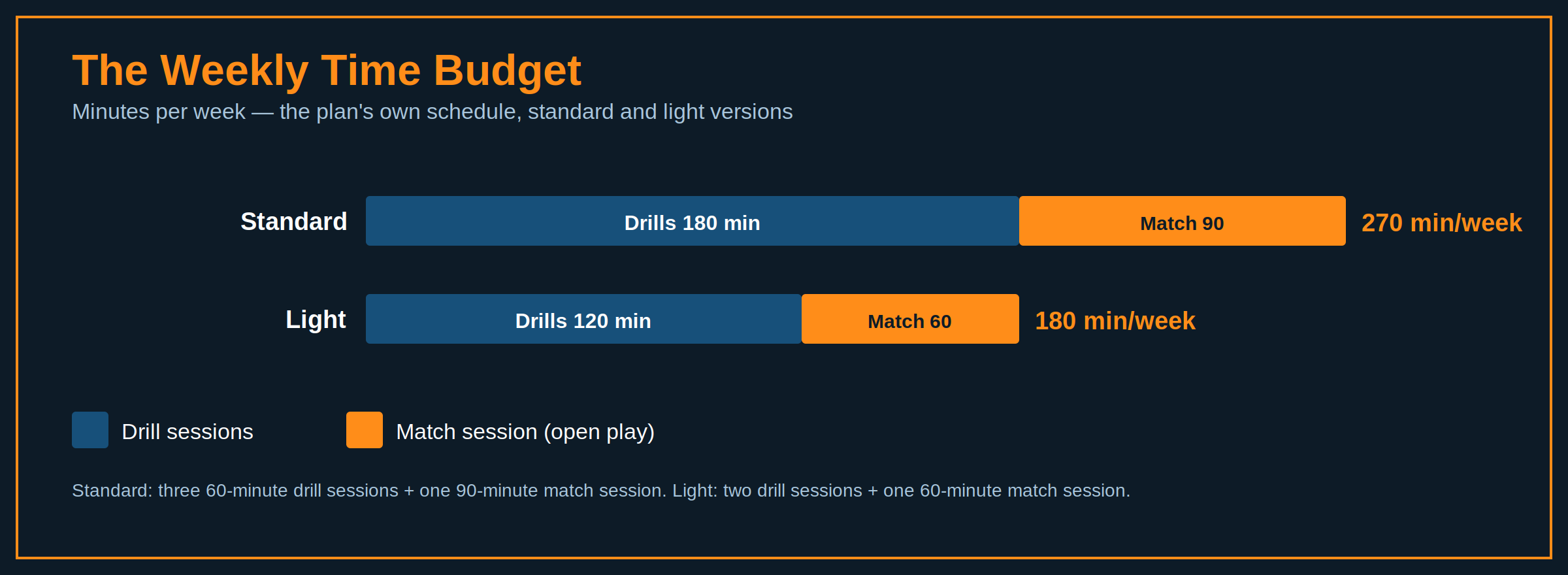
This plan asks for about four and a half hours a week: three 60-minute drill sessions and one 90-minute match session, usually open play or an arranged doubles game.
That is a real commitment, but an honest one for a working adult: three evenings, or two evenings and a weekend morning.
The light version is two drill sessions and one 60-minute match session, three hours a week, with each week stretched to ten days.
Warm up before every session: our warm-up and cool-down guide fits in under ten minutes.
The Plan at a Glance
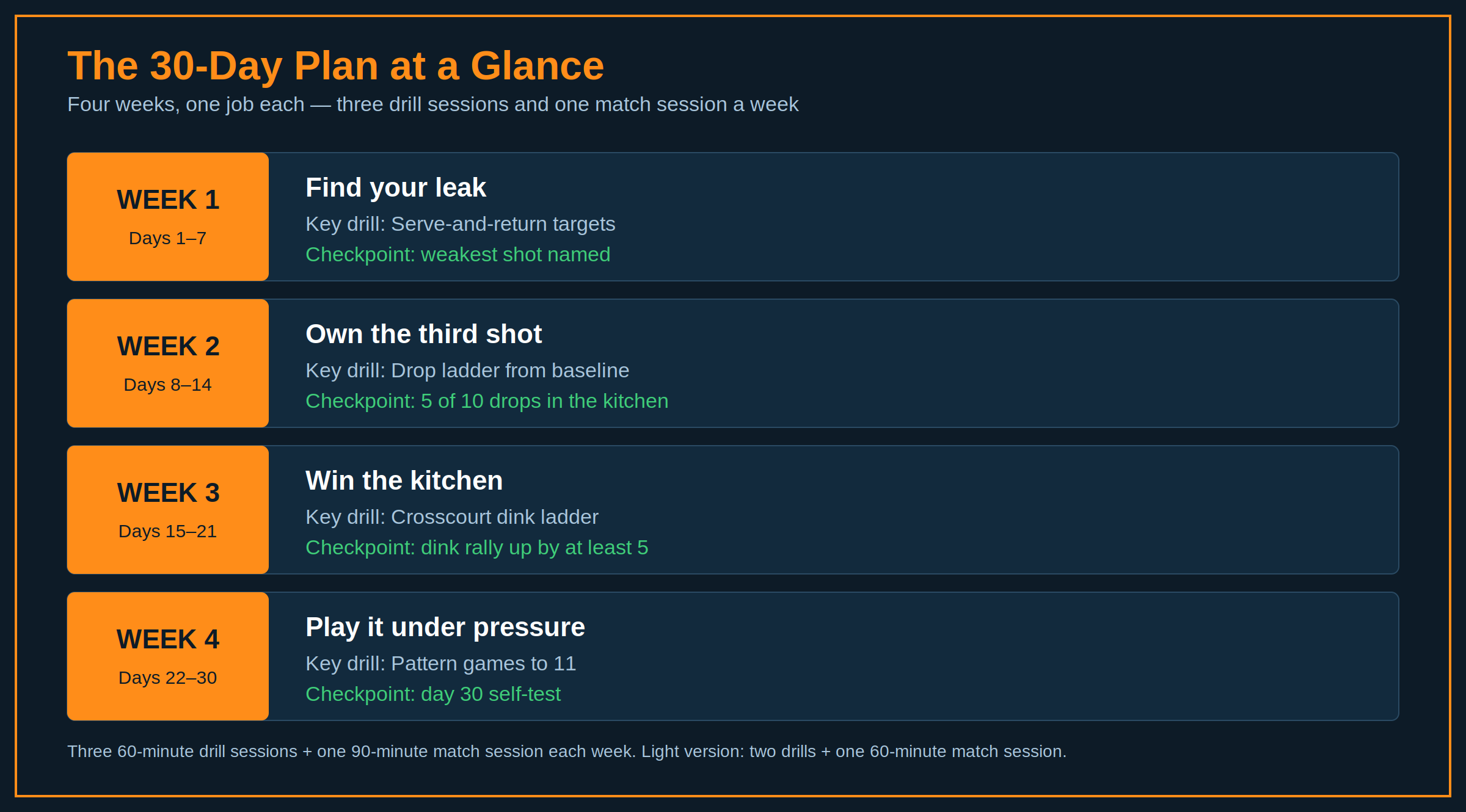
Each week has one job.
| Week | Job | Key drill | Checkpoint |
|---|---|---|---|
| 1 | Find your leak | Serve-and-return targets | Weakest shot named |
| 2 | Own the third shot | Drop ladder from baseline | 5 of 10 drops in the kitchen |
| 3 | Win the kitchen | Crosscourt dink ladder | Dink rally up by at least 5 |
| 4 | Play it under pressure | Pattern games to 11 | Day 30 self-test |
Week 1: Find Your Leak
Week 1 is diagnosis. Your self-test showed where the points leak: usually the serve and return, or the third shot.
Session 1 is serve and return targets: place a towel in each deep corner, serve 10 balls at it, then return 10 serves aiming deep. Session 2 is the third shot, with your partner feeding from the kitchen line.
Session 3 is straight dinks at the kitchen line, down the line rather than crosscourt. By the end of the week, name your weakest shot in one sentence.
Our how to play pickleball and pickleball rules guides cover the serve, return, scoring and kitchen rules.
Week 2: Own the Third Shot
The third shot separates 3.0 from 3.5 more than any other. USA Pickleball’s 3.5 description has the player “developing the drop shot in a way to get to the net”.
The key drill is the drop ladder. Start halfway between the baseline and the kitchen line, and hit drops until you land three in a row in the kitchen. Then step back two paces and repeat, until you are at the baseline.
Do the ladder in every drill session this week: about 15 minutes.
The second drill is the fifth-shot reset: your partner hits a firm ball at your feet in the transition zone, and you block it softly into the kitchen. Finish with skinny singles, half-court singles to 7.
Our footwork and agility drills help: the drop needs your feet to arrive in balance.
Week 3: Win the Kitchen
Week 3 moves to the kitchen line, where most 3.0 rallies are lost. The job is patience: keep the ball low and wait for a ball you can attack.
The key drill is the crosscourt dink ladder. Dink crosscourt and count the rally. At 10 without a miss, switch sides.
At 15, every fifth dink goes to your partner’s backhand side.
The second drill is speed-up recognition. Dink crosscourt, and after five or six soft shots one player speeds the ball up. The lesson is which balls are safe to attack.
The third drill is the block volley: your partner hits firm volleys at your chest, and you block them back low into the kitchen. By the end of the week, your dink rallies should feel boring. That is the goal.
Week 4: Play It Under Pressure
Week 4 puts the three weeks together in games that count. Drills build shots, but only scored games teach you to use them at 9–9.
Each drill session ends with pattern games to 11. The serving team must hit a third-shot drop on every serve, and a drive costs the point.
The second pattern is the dink-first game: the first five shots of every rally must be dinks.
Your match session is the real test. Play your normal open play, but track one number: unforced errors. On day 30, repeat the self-test exactly as on day 1.
The 60-Minute Session Template
Every drill session follows the same shape.
| Time | Block | What to do |
|---|---|---|
| 0–8 min | Warm up | Easy movement, then soft dinks. |
| 8–28 min | Key drill | Drop ladder in Week 2, dink ladder in Week 3. |
| 28–43 min | Second drill | Resets, speed-ups, or pattern games. |
| 43–55 min | Live pattern | Skinny singles, or a short game with the week’s rule. |
| 55–60 min | Cool down | Easy hitting, then two notebook lines: what worked, what to fix. |
Read our doubles strategy guide before Week 4.
How to Know It Is Working
Improvement shows in the self-test first: more drops in the kitchen, longer dink rallies, fewer errors.
PickleballMate’s plan sets these targets for a 3.0-to-3.5 month: drops in the kitchen rising from 50% to 60% and then 70%, dink rallies from 10 or more to 20 or more, and unforced errors per game below 8.
Those are that plan’s targets, not a published standard. Use them as a yardstick: drops moving from 4 in 10 to 6 in 10 is real progress.
Unforced errors matter most. A 3.5 player does not hit many more winners than a 3.0 player; they miss less.
Treat a moving DUPR rating with the same caution: DUPR recommends logging at least 10 to 15 matches before fully trusting your number.
Our pickleball ratings hub and rating estimator explain how skill levels and DUPR ratings relate.
What to Do When It Stalls
Most players stall in Week 2, when the drop ladder feels worse before it feels better. Stay with it: you are replacing a drive you can hit with a drop you cannot yet trust.
If your shoulder or elbow complains, drop one drill session that week. Our common pickleball injuries guide covers the warning signs. If you miss a whole week, do not double up: just restart it.
If day 30 arrives and you are not yet at 3.5, that is not failure. Run the self-test again and repeat Weeks 2 and 3 with your weakest shot as the focus.
Frequently Asked Questions
Can I really go from 3.0 to 3.5 in 30 days?
It depends on where you start. A strong 3.0 who rallies well and just needs a reliable drop can make the jump in a month. A player still working on basics will more likely end as a much stronger 3.0.
How many hours a week does this plan take?
About four and a half hours a week: three 60-minute drills and one 90-minute match session. The light version is three hours, each week stretched to ten days.
Do I need a partner to follow this plan?
Yes, for most of it. The drills, the self-test and the pattern games all need someone across the net.
What is the most important shot to fix first?
The third-shot drop: the shot USA Pickleball’s 3.5 description calls out, and the one that gets you to the kitchen line. If your serve or return leaks more, fix that in Week 1 first.
Should I stop playing open play during the 30 days?
No. Open play is the match session, and it is where the drills get tested. Keep one session a week for it, and treat the other three as practice.
How do I know if I am actually playing at 3.5 yet?
Compare yourself against USA Pickleball’s 3.5 description, not a feeling: consistent serves and returns, medium-length dink rallies, and a drop that gets you to the net.

Shoaib is the publisher of Pickleball Card. He oversees the site’s guides to pickleball rules, ratings, strategy and gear, all researched from primary sources — the USA Pickleball Rulebook, DUPR and manufacturer documentation — and updated as the game changes.