Yes, for most players — but only at the right moment, in the right format, and only if you practise between sessions. A lesson speeds up progress, but only if you practise between sessions: it can fix a bad habit in an hour, or it can be money wasted if you play once a fortnight and never drill.
What Lessons Cost in 2026
There is no single price for a pickleball lesson: published 2026 guides disagree on the exact ranges, so treat every figure below as a range to plan against, not a quote.
Two independent guides published in 2026 put a private hour with a certified coach at roughly $60 to $150. One puts the low end at $60, the other at $80; both agree the top end is around $150.
Current or former pros cost more: both guides put pro-level private coaching at $120 to $250 or more per hour, with the higher figure in major cities.
| Lesson format | Published 2026 range | What it usually covers |
|---|---|---|
| Group clinic | $15–$50 per person, per session | 60–90 minutes, 4–8 players, one coach |
| Semi-private (2–3 players) | $35–$90 per person, per hour | Shared hour |
| Private, certified coach | $60–$150 per hour | One-on-one |
| Private, current or former pro | $120–$250+ per hour | One-on-one, pro coach |
| Tournament-prep package | $400–$1,200 for 4–6 sessions | Bundled privates before an event |
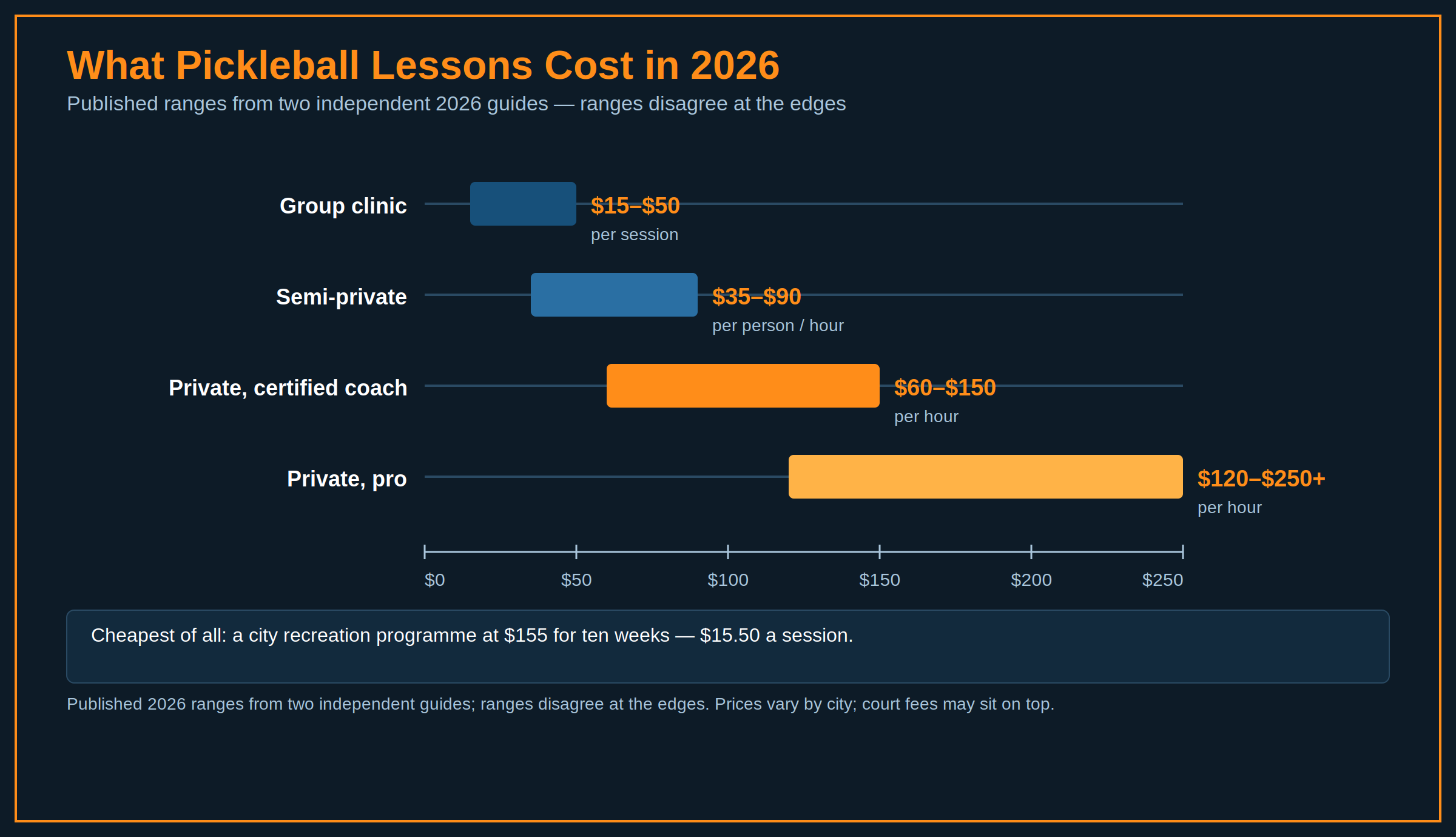
The cheapest structured option is often run by your town: one 2026 guide found a city recreation programme at $155 for ten weeks, or $15.50 a session.
Ask what the quoted price includes: court rental and club membership can sit on top of the coaching fee — one guide found a coach charging $80 for instruction plus $30 for the court.
What a Lesson Gives You That Free Resources Cannot
Free video shows what a shot should look like. It cannot tell you what you are doing wrong.
A competent coach can watch you play for ten minutes and name the two or three habits capping your level: a dropped wrist on contact, a paddle face that opens when you panic, stepping into the kitchen too early. That is why coached practice beats practising alone — you stop reinforcing bad mechanics.
A coach also picks the right drill: choosing the one that matches your specific problem is the hard part. And lessons buy reps you would not otherwise do. Most players tell themselves they will hit dinks against a wall for twenty minutes, and most never do — a booked lesson turns into actual reps, with feedback attached.
Who Benefits Most, by Level
The value of a lesson depends heavily on where you are: a beginner needs different help from a 4.0, and the wrong format wastes money at either end.
| Your level | Best first spend | Why |
|---|---|---|
| New to the sport | 1–2 group clinics | Clean foundation before bad habits form |
| Up to 3.0 | Group clinics | Low cost; no bespoke feedback needed yet |
| 3.0 to 4.0 | Mix: one private a month plus weekly clinics | Privates fix specific issues; clinics provide reps |
| 4.0 and above | Private lessons | Small, specific gaps suit one-on-one |
| Stuck on a plateau | One private lesson | Diagnose what you cannot see |
| About to play a tournament | 4-session prep package | Match pressure, division-specific shots |
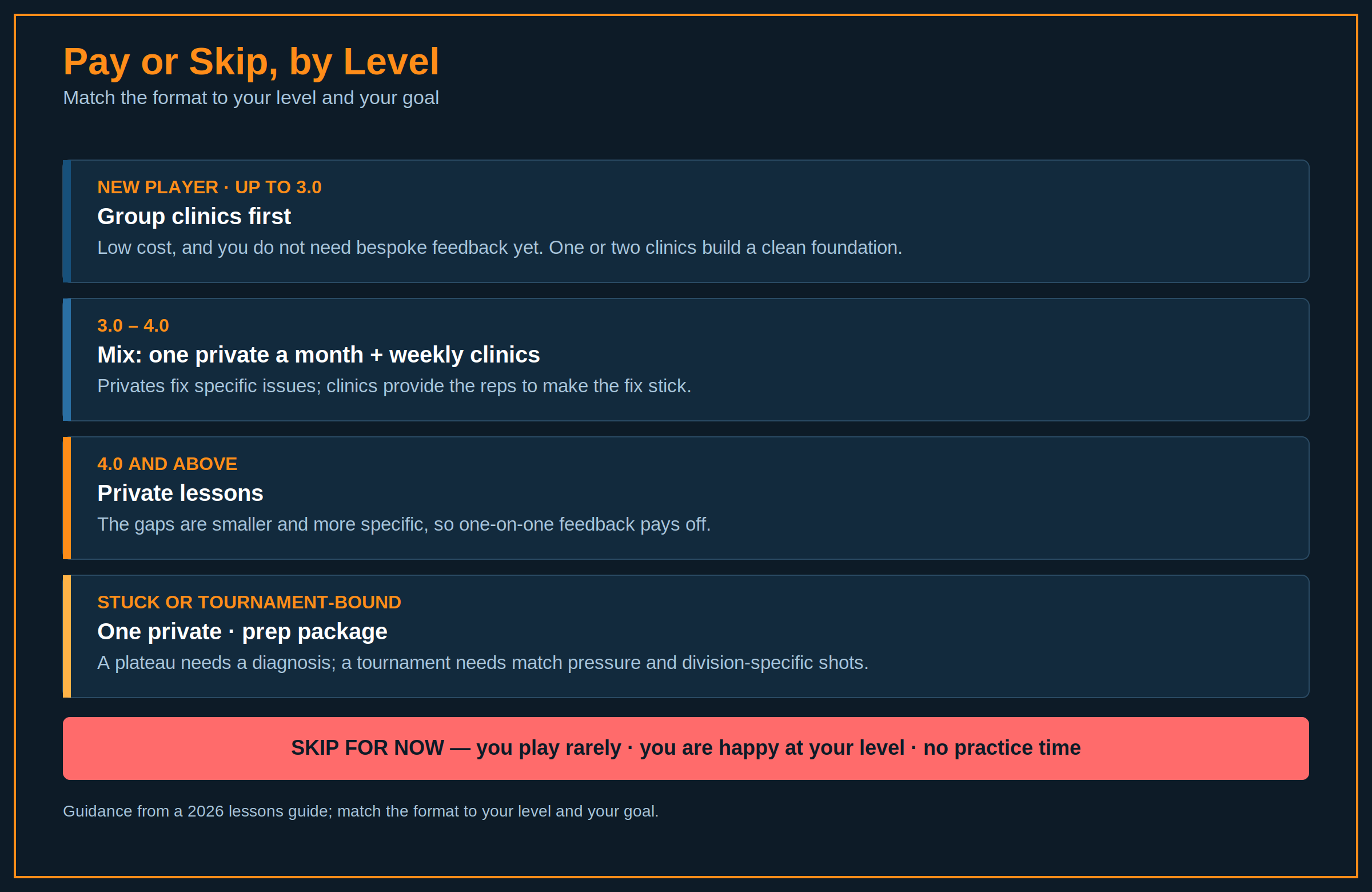
Beginners get the best return per dollar: one or two clinics in your first month can save a year of unlearning bad mechanics. Players between 3.0 and 4.0 get the best return from a mix — a private a month fixes the specific issue holding you back, while weekly clinics give you the reps to make it stick. Above 4.0, private lessons are usually the right call.
If you do not know your level, our guide to what a good DUPR rating is explains the 2.0–8.0 scale, and how to get a DUPR rating walks through the steps.
When Group Clinics Beat Private Lessons
Group clinics win on price, energy and volume of reps. They are the right choice when you are learning the basics, want regular supervised practice, or your problems are general rather than specific. If your serve, return and positioning all need work, a clinic covers more ground per dollar than a private.
Clinics also suit players who enjoy the social side of the sport. Our first day at open play guide explains what those sessions look like, and our doubles strategy guide covers the patterns a coach will keep coming back to.
Private lessons win when the problem is specific. A pop-up on your backhand, a third-shot drop that keeps floating long, a return you keep hitting late — one private hour, plus a video of yourself for the coach, often fixes a mystery that has lasted months.
When to Skip Lessons
Skip lessons if you play once every couple of weeks. A lesson teaches mechanics you will forget before your next game, so spend the money on more court time first — and ease back in with our warm-ups and cool-downs routine.
Skip them if you are happy at your current level. A 3.0 who plays for fun twice a week in a 3.0 group does not need coaching to enjoy the sport — lessons there are a luxury, and there is no shame in that.
Skip them if you will not do the homework. Coaches consistently say their fastest-improving students are the ones who drill between sessions — our footwork and agility drills give you drills to run, and our common pickleball injuries guide covers what to watch for — and if you will not practise, a lesson buys you an hour of good advice you will not use.
Use the free material first instead: our how to play pickleball and pickleball rules guides cover the foundations, and lessons near you can wait.
For children, use a coach trained to teach kids safely, not just any strong player — see our pickleball for kids guide.
What to Ask a Coach Before You Pay
What is your DUPR or USA Pickleball rating? Match the coach to your goal: one 2026 guide’s rule of thumb is that a 3.5-rated coach suits beginners, while a 4.5-plus coach can take a player much further.
Are you certified, and by whom? Certification is not required to be a great coach, but it signals formal training. USA Pickleball names three official partners: the Professional Pickleball Registry (PPR), Pickleball Coaching International (PCI), and the Racquet Sports Professionals Association (RSPA).
What does your certification actually cover? PPR’s Level 1 workshop tests skills, teaching ability and knowledge, and awards an Associate Coach, Coach or Pro rating; Level 2 needs a Level 1 pass at Coach level plus a 4.0 playing level. The International Pickleball Teaching Professional Association (IPTPA) runs its own ladder — Level I for beginners, Level II for intermediate players, plus rating-specialist and junior-instructor credentials — and its directory shows whether each credential is current.
How do you structure a first lesson? Listen for a diagnostic phase — watching you play for ten minutes first, then working on the highest-leverage thing — and be cautious of a coach who launches into drills without watching you play.
Can you provide a few references? Most established coaches can put you in touch with current students. Ask what improved, in what timeframe, and whether they kept going. Also ask the price, whether court fees are included, and the cancellation policy.
Red Flags
Walk away from a coach who promises a rating jump in a set number of sessions — no coach can guarantee that, because your rating depends on your matches, your practice and your opponents. Our what DUPR is guide explains how ratings move. Walk away, too, from a coach who never watches you play before prescribing drills: a lesson without a diagnosis is guesswork at $100 an hour.
Be wary of a coach who keeps drilling the same skill across sessions because you cannot transfer it to real games, and of pressure to buy a large package before a single lesson. One trial lesson is enough to judge the fit.
Finally, watch for a coach who teaches pickleball like a different sport — some former tennis pros treat it as junior tennis, and some coaches have never played at the level you want to reach.
The Short Version
Lessons are worth it when you have a specific goal, play regularly, and will practise between sessions. Start with group clinics, add private lessons only for problems you cannot diagnose yourself, and check any coach’s rating, certification, first-lesson structure and references before you pay.
Frequently Asked Questions
How much do pickleball lessons cost?
Published 2026 guides put group clinics at $15–$50 per person per session, semi-private at $35–$90 per person per hour, and private lessons with a certified coach at $60–$150 per hour. A current or former pro runs $120–$250+ per hour.
Are group clinics worth it, or do I need private lessons?
For players at 3.0 and below, group clinics are usually the right tier: cheaper, and similar value for foundational work. Above 3.0, one-on-one feedback matters more. One private a month plus weekly clinics suits 3.0–4.0.
Are pickleball lessons worth it for beginners?
Yes. One or two group clinics in your first month build a clean foundation before bad habits form — far cheaper than unlearning sloppy mechanics later. A private lesson is usually unnecessary at this stage.
How many lessons do I need to see improvement?
One 2026 guide suggests most students improve meaningfully within 4 to 6 sessions, paired with at least 3 hours of practice per week. A single lesson rarely moves the needle alone.
What should I ask a pickleball coach before booking?
Ask for their DUPR or USA Pickleball rating, their certification, how they structure a first lesson, and references. A good first-lesson answer includes watching you play first. Also confirm price, court fees, and cancellation policy.
Are pickleball lessons worth it for casual players?
Maybe not. If you play twice a week for fun and are happy at your level, lessons are a luxury. They make sense with a specific goal — a tournament, a plateau breakthrough, a foundational fix — and the willingness to practise between sessions.

Shoaib is the publisher of Pickleball Card. He oversees the site’s guides to pickleball rules, ratings, strategy and gear, all researched from primary sources — the USA Pickleball Rulebook, DUPR and manufacturer documentation — and updated as the game changes.