Pickleball’s growth has created a real opening for coaches. Every week, new players arrive at courts with no idea how to serve, dink or score — and they will pay someone patient to show them.
Becoming a coach is not about being the best player at your club. It is about teaching clearly, running a safe session, and building a small group of regular students.
How Good Do You Need to Be?
You need to be clearly better than the players you teach. That is the honest test, and it is lower than most people assume.
The Professional Pickleball Registry (PPR) requires a 3.5 level before you register, shown through USA Pickleball’s self-rating tool or a sanctioned tournament.
The International Pickleball Teaching Professional Association (IPTPA) publishes no playing-level minimum for entry Level I. Its Level II test says candidates need consistency, control and correct technique — not advanced play.
Check your level before you spend money. A DUPR rating from logged matches is the most objective check — see how to get a DUPR rating and what a good DUPR rating is. With no rating yet, our pickleball rating estimator gives a starting point.
If you can hold your own in 3.5 open play and explain why a shot worked, you can teach beginners.
Do You Actually Need a Certificate?
You do not need a certificate to teach a friend at a public court. No law or USA Pickleball rule requires certification before you teach pickleball.
Most clubs, parks departments and rec centres that hire coaches ask for one, because it is tied to their insurance. If you want paid work on someone else’s courts, certification is the entry ticket.
The Two Certification Paths
Two organisations certify pickleball coaches in the United States.
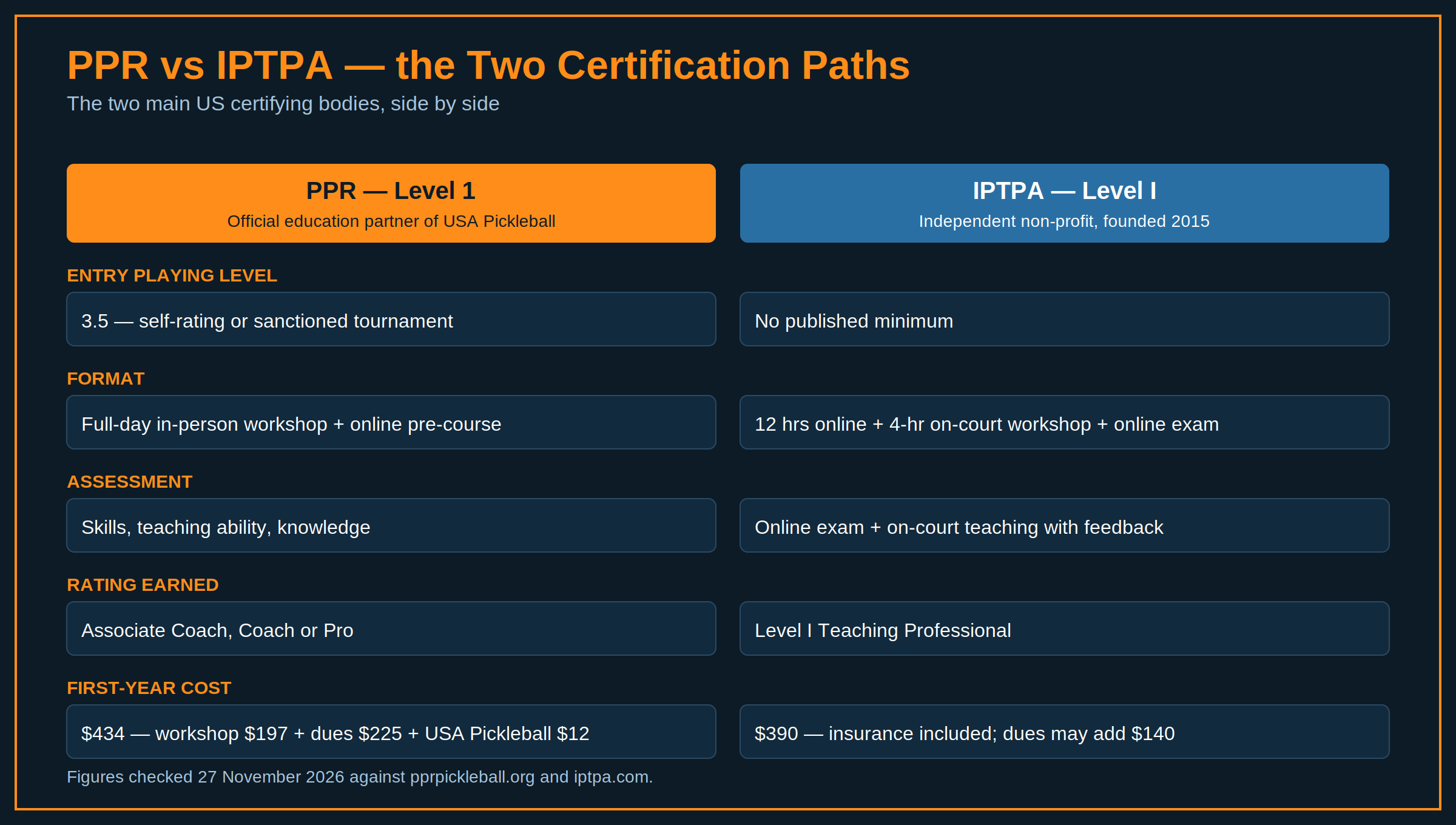
PPR is the official education and certification partner of USA Pickleball. Its entry point is a Level 1 workshop — a full day, in person, run by a trained clinician — assessing skills, teaching ability and knowledge, and earning you an Associate Coach, Coach or Pro rating.
IPTPA is the older, independent body: a non-profit founded in 2015, with 5,500+ instructors in 90 countries. Its entry Level I blends 12 hours online, a four-hour workshop, and a final online exam.
| PPR Level 1 | IPTPA Level I | |
|---|---|---|
| Entry playing level | 3.5 (self-rating or sanctioned tournament) | No published minimum |
| Format | Full-day in-person workshop + online pre-course | 12 hrs online + 4-hr workshop + exam |
| Assessment | Skills, teaching ability, knowledge | Online exam + on-court teaching with feedback |
| Rating earned | Associate Coach, Coach or Pro | Level I Teaching Professional |
| Minimum age | Not published | 14 (under-18s need a Level II mentor) |
| Next step | Level 2 workshop for advanced players | Level II: skills test + lesson, $200 |
What It Costs
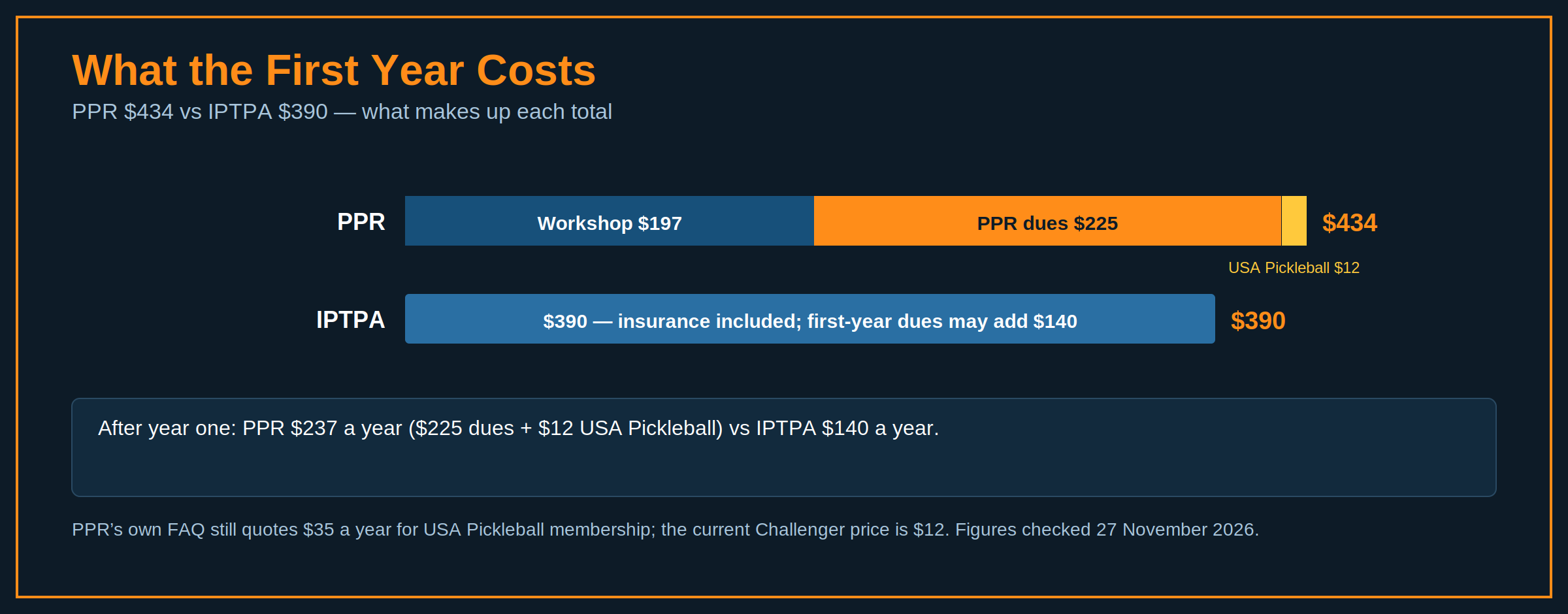
The first-year cost of the PPR route is $434: a $197 workshop, $225 a year in PPR dues, and a $12-a-year USA Pickleball Challenger membership, which PPR requires. PPR’s own FAQ still quotes $35 — an older price.
The IPTPA route is simpler: Level I costs $390 in the United States, Canada and England, including insurance access. Elsewhere it is $320, insurance not included. (First-year dues may add $140 — IPTPA’s pages disagree.)
| Cost | PPR route | IPTPA route (US) |
|---|---|---|
| Certification / workshop fee | $197 | $390 (includes insurance; first-year membership may be extra) |
| Annual membership dues | $225/yr | May add $140 in year 1, then $140/yr |
| Governing-body membership | $12/yr (USA Pickleball Challenger) | Not required |
| First-year total | $434 | $390 (or $530) |
| Ongoing, per year after year 1 | $237 ($225 + $12) | $140 |
Budget for more than the fees: travel, balls, and unpaid practice teaching. IPTPA needs at least 10 registered participants before a workshop runs. Moving up is optional: IPTPA Level II is $200.
The Step-by-Step Path
The route is the same whichever body you choose.
1. Check your level. Get a DUPR rating from logged matches or use USA Pickleball’s self-rating tool — below 3.5 and set on PPR, spend a season in open play first; see our first-day open play guide.
2. Pick a body and join. For PPR, join PPR and USA Pickleball, then register for a workshop. For IPTPA, register for a Level I workshop (first-year membership may be extra — its pages disagree).
3. Do the pre-course study — PPR sends a study guide and video pre-course on registration. Its advice: read the guide two or three times (about an hour per read) and watch the video course once (three to four hours). Then practise writing and delivering lesson plans.
4. Attend the workshop. A day on court, teaching real players while a clinician watches and gives feedback.
5. Pass the assessments. PPR tests your skills, teaching and written knowledge in the same workshop. IPTPA’s final online exam follows the on-court workshop; a failed section costs $40 to retake.
6. Sort insurance before you teach anyone. PPR membership includes basic liability insurance — $8 million personal liability once certified with Safe Play approval, plus $25,000 occupational accident coverage. IPTPA’s Level I fee includes insurance access in the US, Canada and England.
Insurance and Background Checks
Insurance is part of being hireable. A facility that books you will ask what cover you carry before it asks what you charge.
PPR’s cover is the more generous on paper: $8 million personal liability once certified with Safe Play approval. Safe Play is the shared safety programme of the racquet-sport registries: a criminal background check, a policy acknowledgement, and U.S. Center for SafeSport training.
IPTPA differs: liability insurance is bought separately through its approved provider once your membership is active, and workshop fees exclude your first year of dues.
USA Pickleball’s own background screening applies to its board, staff, contractors and ambassadors — not ordinary coaches. But any facility hiring you to coach children will almost certainly require a background check and SafeSport training. Plan for it early; our pickleball for kids guide explains junior sessions.
Finding Your First Students
Your first students are almost never strangers — they are the people already around you.
Start with your own club. Tell the club pro or open-play organiser that you are getting certified and looking for beginners. Clubs need beginner clinics, and a certified coach who already plays there is an easy yes.
Rec centres and parks departments are the second-best door. They run beginner programmes, hire sessional coaches, and usually require the certification you now hold. Offer a free four-week clinic to prove it.
Friends and family come third. Two or three regular students who tell their friends are worth more than any advert — teach them well and ask them to bring a friend.
Whatever route you take, teach beginners first — they are the largest group of new players.
Setting Your Rates
Published lesson-price surveys put private lessons at roughly $50 to $100 an hour, and group clinics at $20 to $50 a person. Treat those as a starting range, not a promise: rates vary by city, facility and reputation.
Price your first lessons at the low end. You are buying experience and testimonials, and a full court at $50 an hour beats an empty court at $90. Raise your rate with a waiting list.
Group clinics are where the maths improves. Four players at $25 each is $100 for the same hour as one private at $60. Build a clinic around one skill per session, with a warm-up and cool-down built in; our warm-ups and cool-downs and footwork and agility drills guides give you material to build from.
Your First Month, Realistically
Week one is admin: certification confirmed, insurance in place, a one-page lesson plan for a beginner session written out. Our how to play pickleball and pickleball rules guides cover what a first-timer needs to know, in the order they need it.
Week two is your first free or cheap sessions: a free 45-minute intro clinic at your club, or two friends for the cost of the court. The point is reps: explaining the serve, the return and the kitchen line to real beginners.
Weeks three and four are about turning one session into a habit. A weekly beginner clinic at the same time and place, even with only three or four players, is the seed of a coaching business. Teach doubles strategy once your students can hold a rally, and read our common pickleball injuries guide first.
Nobody can promise you students or an income by the end of month one. What a good first month gives you is a routine, a handful of regulars, and proof you can teach.
Frequently Asked Questions
Do I need a certification to teach pickleball?
No law or USA Pickleball rule requires it. But most clubs and rec centres that hire coaches do require a recognised certification, tied to their insurance.
What playing level do I need to become a pickleball coach?
PPR requires a 3.5 level before you register. IPTPA publishes no minimum for Level I. Be clearly better than your students — and able to explain shots, not just hit them.
How much does it cost to become a certified pickleball coach?
PPR: $434 in year one. IPTPA: $390 in the US, Canada and England, including insurance; first-year dues may add $140. Ongoing: $237 a year for PPR, $140 for IPTPA.
PPR or IPTPA — which certification should I choose?
PPR is USA Pickleball’s official education partner, so it carries the most weight at American clubs. IPTPA is the older independent body, with 5,500+ instructors in 90 countries. Teach in the US: PPR; teach abroad: IPTPA.
How much can a new pickleball coach charge for lessons?
Published surveys put private lessons at roughly $50 to $100 an hour and group clinics at $20 to $50 a person. Start at the low end and raise rates once you have a waiting list.
How do I find my first students as a pickleball coach?
Start at your own club: offer a beginner clinic. Then try rec centres and parks departments. Teach friends well and ask them to bring a friend — a weekly clinic at a fixed time builds regulars.

Shoaib is the publisher of Pickleball Card. He oversees the site’s guides to pickleball rules, ratings, strategy and gear, all researched from primary sources — the USA Pickleball Rulebook, DUPR and manufacturer documentation — and updated as the game changes.