Two organisations certify most pickleball coaches in the United States. PPR, the Professional Pickleball Registry, is the official education and certification partner of USA Pickleball. IPTPA, the International Pickleball Teaching Professional Association, is an independent teaching association with certified instructors in more than 90 countries.
They test similar things — how you play, how you teach, and how well you know the game — but differ in price, format, and what the credential opens up. Neither is a licence: no governing body requires either before you teach.
What PPR Is
PPR is the pickleball arm of the Professional Tennis Registry. USA Pickleball’s own coaching page names it as one of its three official education and certification partners.
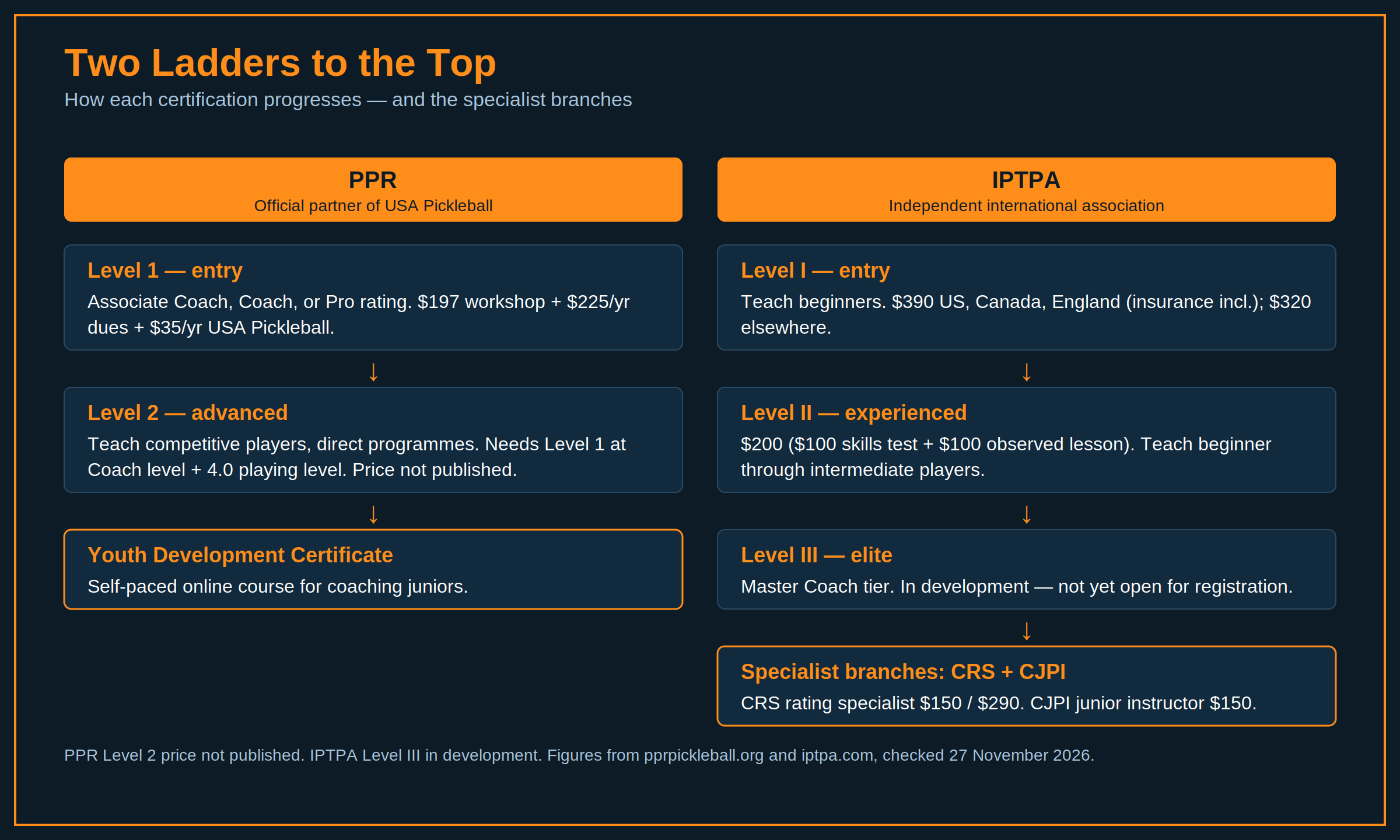
PPR runs two levels. Level 1 is the entry certification, for coaches working with adult beginners and improvers.
Level 2 is the advanced step, for competitive players and programme directors. Level 1 assesses skills, teaching, and knowledge, and awards one of three ratings: Associate Coach, Coach, or Pro.
What IPTPA Is
IPTPA was founded in 2015 to standardise how pickleball is taught, and it is a registered US nonprofit. It lists more than 5,500 instructors across more than 90 countries.
It is not a USA Pickleball official partner. Its strength is international reach and its own rating system.
IPTPA’s ladder has three levels. Level I is the entry credential, for teaching beginners. Level II is the experienced tier, for beginner through intermediate players.
Level III, the elite Master Coach tier, is still being developed and not yet open. IPTPA also runs two specialist credentials: the Certified Rating Specialist (CRS), for assessing player skill levels, and the Certified Junior Pickleball Instructor (CJPI), for coaching children.
PPR vs IPTPA at a Glance
| PPR | IPTPA | |
|---|---|---|
| Standing | Official partner of USA Pickleball | Independent international association; US nonprofit |
| Entry level | Level 1 (Associate Coach, Coach, or Pro) | Level I (beginner teaching) |
| Entry cost | $434 first year ($197+$225+$12) | $390 in US, Canada, England; $320 elsewhere |
| Annual dues | $225/yr (renews each 31 August) | $140/yr US/Canada/England; $70/yr elsewhere |
| Next level | Level 2 (needs Level 1 at Coach + 4.0 level; price not published) | Level II, $200 ($100 skills test + $100 observed lesson) |
| Format | Pre-course + 1-day in-person workshop | 12 hrs online + 4-hr workshop |
| Playing level to start | 3.5 | None stated for Level I |
What PPR Costs and Requires
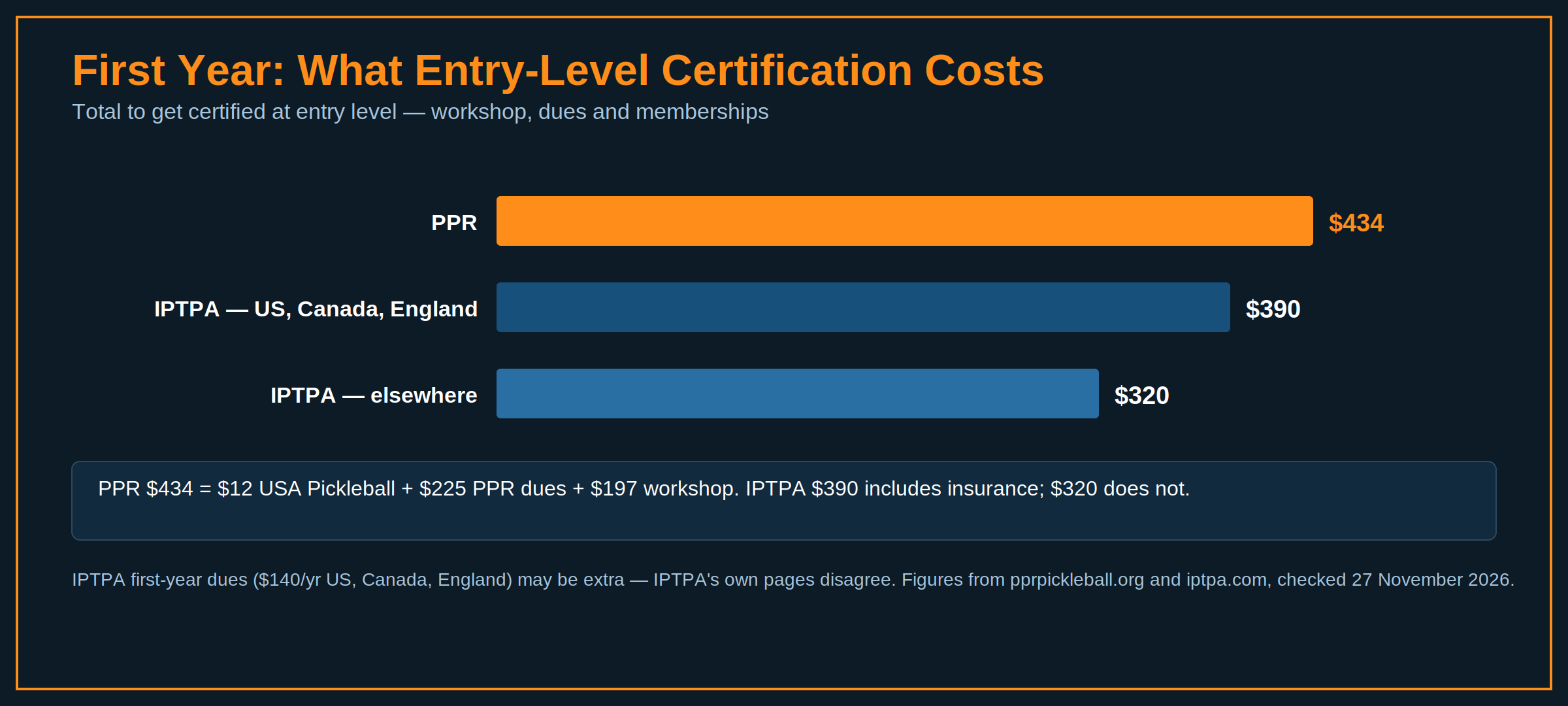
The first year has three charges. USA Pickleball membership is $12 a year (Challenger rate — PPR’s FAQ still quotes the older $35), and USA-based members must join. PPR membership is $225 a year, prorated on joining, renewing each 31 August.
The Level 1 workshop is $197, including study materials, the workshop, and testing. Total: $434.
After that, only the two memberships repeat: $225 plus $12 a year.
Before you register, PPR expects a 3.5 player, via USA Pickleball’s self-rating tool or a sanctioned tournament. Unsure where you sit? Our guides to how to get a DUPR rating and what a good DUPR rating means explain the scale.
Preparation is homework: read the study guide two or three times (about an hour per read), complete the three-to-four-hour video pre-course, and refresh the pickleball rules first.
The workshop is a full-day, in-person session on court with a PPR clinician. Your rating is the lowest of your three scores, so a strong player who teaches weakly does not walk away with a Pro rating.
Level 2 has a firm gate: a Level 1 pass at Coach level plus at least a 4.0 playing level. It covers specialty shots, advanced tactics, and club programming. PPR does not publish a price for it.
Membership also carries insurance: basic liability cover, plus $25,000 of occupational accident cover and $8 million of personal liability cover once certified with Safe Play approval.
What IPTPA Costs and Requires
Level I costs $390 in the United States, Canada, and England, including insurance. Everywhere else it costs $320, and insurance is not included.
The programme has three parts: 12 hours of self-paced online education, a 4-hour on-court workshop, and a final online exam. The exam needs 80% to pass; a retake costs $40.
IPTPA states no playing-level bar for Level I. You must be at least 14, and under-18 coaches are mentored by a Level II instructor until 18. Each workshop needs at least 10 participants.
Once certified, dues keep you active: $140 a year in the US, Canada, and England; $70 elsewhere.
One wrinkle: IPTPA’s pages disagree on whether first-year dues sit inside the $390 — the Level I listing says membership is included, the membership page says it is not. Budget for the $140 on top until IPTPA clarifies it.
Level II costs $200: $100 for the skills test and $100 for the observed lesson. You need an active Level I first.
The skills test needs at least 80% — eight out of ten on each skill, from dinks to overheads — and the observed lesson is delivered in person to an IPTPA Director. There is no written exam at Level II.
The Certified Rating Specialist (CRS) programme teaches you to rate players: CRS-4 for coaches at 3.5+, rating players up to 3.5; CRS-5 for coaches at 4.5+, rating up to 4.5. It costs $150 with Level I, or $290 for new applicants, including first-year membership and insurance. Level I is not required.
The junior track, CJPI, costs $150, needs an active Level I plus a background check, and certifies you to coach children. It does not replace Level I or II. Our guide to pickleball for kids covers ages, readiness, and first sessions.
Which One Fits You
Five questions settle it.
Where will you coach? If you want work at US clubs, resorts, and community programmes, PPR’s governing-body link carries the most weight. Outside the United States, IPTPA’s 90-country footprint is the stronger card.
What is your playing level? PPR requires a 3.5 before you register, and its top rating demands far more. IPTPA Level I states no playing-level bar, so it suits a strong teacher who is not yet a strong tournament player. Our pickleball ratings hub explains the systems clubs use.
Do you want to rate players? Only IPTPA trains and certifies rating specialists. If your club needs someone to place players in the right draws, the CRS credential alone is a reason to choose IPTPA.
Do you teach children? Both cover juniors — PPR through a self-paced Youth Development course, IPTPA through the CJPI designation, which requires a background check. If juniors are your main work, compare those two tracks directly.
How do you learn best? PPR is a single full-day, in-person workshop after a few hours of homework. IPTPA is 12 hours online at your own pace, then a half-day on court. If you cannot take a full day off, IPTPA’s shape fits more easily around work.
Before You Pay
Check three things on the official pages before you register, because fees change. Confirm the current workshop fee and the next available date near you.
PPR lists workshops across the United States; IPTPA workshops need at least 10 participants to run, so dates outside major cities can be sparse. Our guide to finding pickleball near you can help.
Confirm what the fee includes. With PPR, the $197 workshop fee is separate from both memberships, and the $8 million liability cover applies only once certified with Safe Play approval. With IPTPA, confirm whether first-year dues sit inside the $390 or on top, and whether insurance is included where you live.
The credential does not make you a good coach by itself. The teaching assessment is the part candidates most often underestimate, so practise first: run real lessons before the workshop. Our guides to how to play pickleball, first-day open play, doubles strategy, footwork drills, warm-ups and cool-downs, and common pickleball injuries cover what new coaches teach most, plus safety.
The Short Version
IPTPA’s entry fee is lower: $390 in the United States against PPR’s $434 first year, and $320 elsewhere. Its dues are lower too: $140 against $225.
Choose PPR to coach in the United States with the governing body’s endorsement. Choose IPTPA to coach internationally, rate players, or learn at your own pace with no playing-level bar. Either credential proves you trained; neither proves you can teach.
Frequently Asked Questions
Which is better, PPR or IPTPA certification?
Neither is better in general. PPR is USA Pickleball’s official education and certification partner, so it carries more weight with US clubs. IPTPA is an independent international association in more than 90 countries, with a rating-specialist track PPR does not offer.
How much does PPR certification cost in total?
The first year costs $434: $12 for USA Pickleball, $225 for PPR membership, and $197 for the Level 1 workshop. After that, you pay the two memberships only — $225 plus $12 a year.
How much does IPTPA Level I certification cost?
In the US, Canada, and England, Level I costs $390, including insurance. Everywhere else it costs $320, and insurance is not included. Annual dues are $140 a year in the US, Canada, and England, and $70 elsewhere.
IPTPA’s pages disagree on whether the first year’s dues are inside the $390, so budget for the $140 on top.
Do I need a certification to teach pickleball?
No. Neither credential is a licence, and no governing body requires one before you teach. Clubs and programmes often ask for one anyway, because it proves you have been trained and assessed.
What playing level do I need before I can get certified?
PPR requires a 3.5 before Level 1, via USA Pickleball’s self-rating tool or a sanctioned tournament. Level 2 needs a 4.0 and a Level 1 pass at Coach level. IPTPA states no playing-level bar for Level I, but you must be at least 14, and under-18 coaches need a Level II mentor.
How long does a certification last, and what does renewal cost?
Both stay active only while you pay annual dues. PPR dues are $225 a year, renewing each 31 August, plus $12 for USA Pickleball. IPTPA dues are $140 a year in the US, Canada, and England; $70 elsewhere.

Shoaib is the publisher of Pickleball Card. He oversees the site’s guides to pickleball rules, ratings, strategy and gear, all researched from primary sources — the USA Pickleball Rulebook, DUPR and manufacturer documentation — and updated as the game changes.