A good coach fixes the right thing. A bad one fixes the wrong thing confidently, and the habit takes months to undo. So finding a coach is two jobs: find the people who teach near you, then check whether they can teach — before you pay for a block of lessons.
Before You Search: Know What You Need
Three questions narrow the field fast. First, your level: a brand-new player needs someone who teaches the serve, the return and the two-bounce rule patiently, while an intermediate player needs someone who can diagnose a weak third shot or shaky footwork.
Second, what format fits you? A private lesson gives undivided attention; a small-group lesson costs less and adds rally partners; a clinic is a one-off group session on a single topic.
Third, the goal: “Stop missing serves” is a goal a coach can plan around, while “Get better” is not. Our guides to how to play pickleball and the pickleball rules will tell you whether the basics are the gap.
Where to Find a Coach Near You
Start with the sources that check credentials.
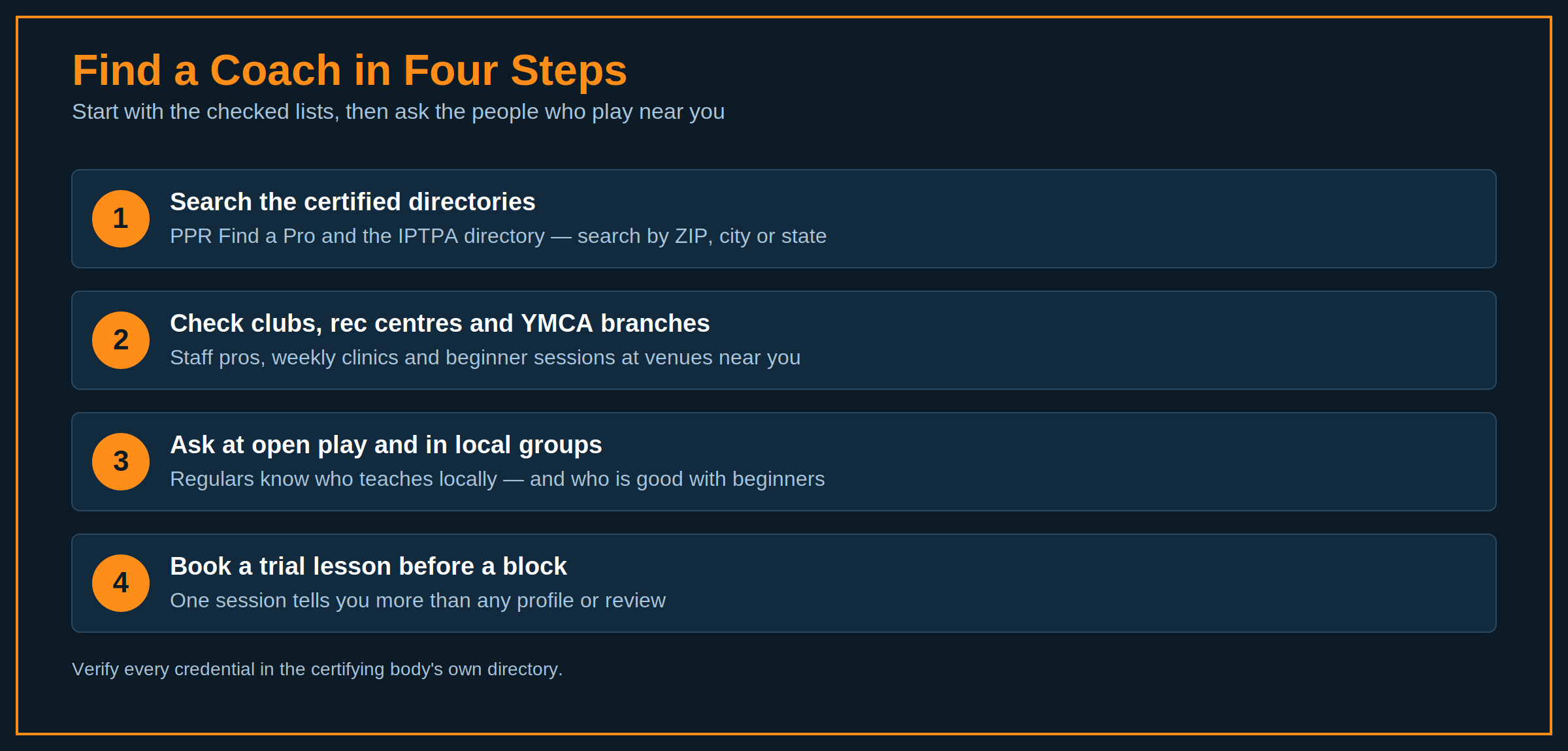
Start with the certification directories
The most reliable starting point is a directory run by a certification body, because every name on it has passed that body’s teaching assessment.
The Professional Pickleball Registry (PPR) runs a Find a Pro directory at pprpickleball.org, searchable by name, city, state or ZIP code, with a radius defaulting to 25 miles. PPR is one of USA Pickleball’s official partners, alongside Pickleball Coaching International (PCI) and the Racquet Sports Professionals Association (RSPA).
The International Pickleball Teaching Professional Association (IPTPA) runs its own directory of certified professionals and rating specialists, showing each level — Level I for beginners, Level II for beginner through intermediate players — and telling you to always verify a coach’s active status. IPTPA is independent, not a USA Pickleball partner, founded in 2015. Check both: a good local coach may hold one credential and not the other.
Use Places2Play to find the places that teach
Places2Play is USA Pickleball’s court directory, searchable by location on an interactive map, with filters for indoor or outdoor, public or private, and other tags. Its listings carry event details, including clinics. Use it to find the venues first, then check each venue’s own page or phone number for lessons.
A listing tells you a place exists, not that a coach is teaching there this week. Our guide to pickleball near you covers the same directory in more detail.
Ask your club, recreation centre or YMCA
Many coaches teach through a venue rather than advertising on their own. Ask the front desk or the session organiser who teaches there — clubs often have a staff pro or a regular visiting coach. YMCA branches in several states run pickleball classes and clinics, and parks departments often run low-cost introductory sessions.
Search Google Maps, marketplaces and open play
Search “pickleball lessons near me” in Google Maps to spot clubs, facilities and coaches with reviews and hours. Treat a listing as a lead, not a verdict: cross-check any coach against a certification directory.
Coach marketplaces list individual coaches with profiles, reviews and booking by location — CoachUp, for example, carries private pickleball coach listings in US cities. The same vetting applies.
The most underrated channel is the court itself. Regulars at open play know who teaches locally and who is good with beginners — go to a session and ask between games. Our first-day open play guide explains how those sessions work, and local Facebook groups work the same way at a distance: ask for recommendations, say your level, and favour names from players who took the lessons.
| Channel | Best for | What you get | Watch out for |
|---|---|---|---|
| PPR Find a Pro | Certified coaches near you | Search by ZIP, city or state | Not every local coach is listed |
| IPTPA directory | Certified coaches and rating specialists | Levels and active status shown | Independent body, not a USA Pickleball partner |
| Places2Play | Finding venues that teach | Map of courts and clubs, with clinic listings | Listings can be out of date; call ahead |
| Club, rec centre or YMCA | Trying a coach cheaply | Staff pros, weekly clinics | Schedules vary by branch |
| Google Maps | Spotting what is nearby | Reviews, photos, hours | Reviews may be thin or about the venue |
| Coach marketplace | Comparing coaches side by side | Profiles, reviews, booking | A playing rating is not proof of teaching skill |
| Open play and local groups | Honest recommendations | Names from players who took the lessons | Anecdotal; verify the credential |
How to Vet a Coach
Five checks separate a coach who can teach from a good player who happens to give lessons.
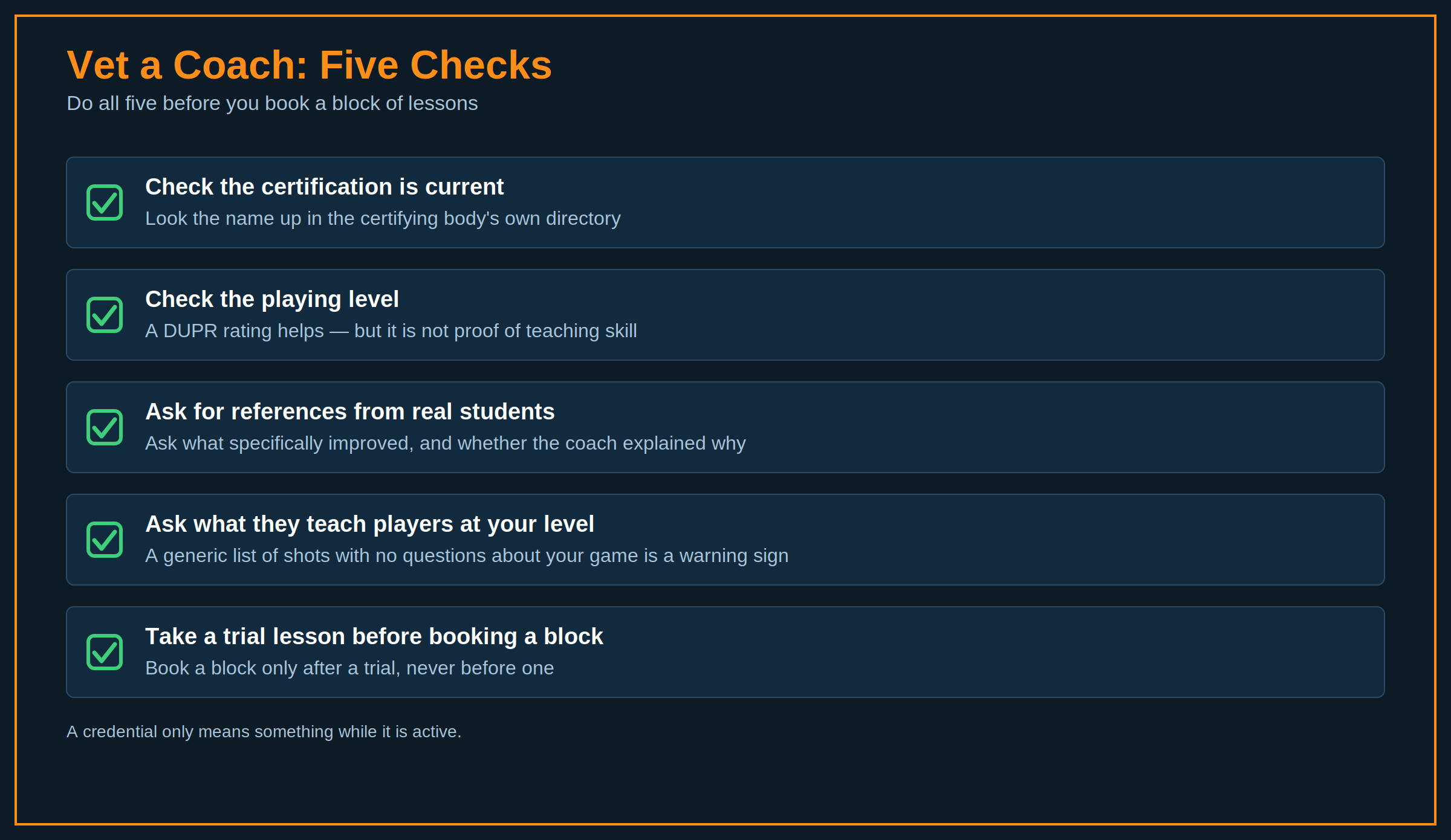
Check the certification — and that it is current. Ask which body certified them and at what level, then look the name up in that body’s directory. PPR, PCI and RSPA are USA Pickleball’s official partners; IPTPA runs its own separate pathway. A credential only means something while it is active.
Check the playing level, but do not stop there. A coach should play well above the level they teach. A DUPR rating, where the coach has one, is a useful check — our guides explain what DUPR is and what counts as a good DUPR rating. But playing well and teaching well are different skills: a 5.0 who cannot explain a dink is less useful to a beginner than a 4.0 coach who can.
Ask for references. A coach who teaches regularly should be able to point you to current or former students, or to reviews that mention actual teaching. Ask what specifically improved, and whether the coach explained why. Vague praise tells you little; specifics tell you a lot.
Ask what they teach players at your level. A good coach has a plan for beginners that looks different from a plan for intermediates. Ask how they would approach your game. If the answer is a generic list of shots, keep looking.
Take a trial lesson before committing. One session tells you more than any profile. Book a block only after a trial, never before one.
What a Good First Lesson Should Look Like
It should start with a warm-up and a short conversation, not with a basket of balls. The coach should ask about your experience, any injuries, and what you want to improve, then watch a few rallies before prescribing anything.
Our warm-ups and cool-downs guide explains why a warm-up matters, and our common injuries guide is worth reading if you are returning from one. Then comes assessment, usually simple rallies and a few specific shots.
A good coach watches your grip, ready position and footwork before touching your swing — footwork is often the real problem behind a shot that feels broken, as our footwork and agility drills show. The middle should focus on one or two things, not ten: a clear explanation, a demonstration, then drills with feedback after each repetition.
It should end with live play, even a few points, so you can try the new skill in a real rally — and with homework: one or two drills to practise before the next session. If you leave without knowing what to practise, the lesson was entertainment, not coaching.
Red Flags Worth Walking Away From
A coach who will not say which body certified them, or whose name does not appear in that body’s directory, is a red flag. So is one who promises a specific rating jump in a set number of lessons — no honest coach can guarantee that, as our pickleball ratings hub explains.
Watch the lesson itself, too. A coach who spends the hour playing against you instead of teaching you is selling a hitting partner, not a lesson. A coach who gives only praise, or only criticism, is not coaching either — you need both, tied to something specific you did.
Finally, trust the fit: if the manner, pace or explanations do not work for you after a fair trial, try someone else.
The Short Version
Start with the certification directories — PPR’s Find a Pro and IPTPA’s directory — then check the clubs, rec centres and YMCA branches near you, and ask at open play. Vet any name: confirm the certification is current, check the playing level, ask for references, and take a trial lesson first. A good first lesson assesses before it prescribes, works on one or two things, and ends with homework.
Frequently Asked Questions
Where is the best place to find a pickleball coach?
Start with the certification directories: PPR’s Find a Pro, searchable by ZIP code, city or state, and IPTPA’s directory. Then check your local club, recreation centre or YMCA, and ask at open play.
How do I know if a pickleball coach is certified?
Ask which body certified them and at what level, then look the name up in that body’s directory. PPR, Pickleball Coaching International and the RSPA are USA Pickleball’s official partners. IPTPA runs a separate pathway, and its directory shows each level and active status.
What should I ask a pickleball coach before booking?
Ask what certification they hold and whether it is current, what level of player they usually teach, and how they would approach your game. Ask for a reference, and whether you can take a trial lesson first.
How much does a pickleball lesson cost?
There is no standard price. Private lessons, small-group lessons and clinics are priced differently, and prices vary by coach, city and venue. Ask the coach or venue directly.
Should I take private lessons or join a group clinic?
Take private lessons if you want undivided attention and a plan built around your game, or a specific problem fixed. Join a group lesson or clinic if you want lower cost per person and a low-commitment way to try a coach.
What should a first pickleball lesson include?
A warm-up and a conversation about your experience and goals, then an assessment from a few rallies. The main part should focus on one or two skills, with explanation, demonstration and drills with feedback. It should end with live play and homework.

Shoaib is the publisher of Pickleball Card. He oversees the site’s guides to pickleball rules, ratings, strategy and gear, all researched from primary sources — the USA Pickleball Rulebook, DUPR and manufacturer documentation — and updated as the game changes.