There is no single number for what a pickleball coach makes. A private lesson can pay $50 an hour or $150, and a facility head coach’s package can be a $50,000 salary or $200,000 of mostly lesson income.
The best-documented figure comes from TeachMe.To, a lesson-booking marketplace. Its data, published 5 November 2026, covers 566 coaches with at least one paid booking between October 2025 and October 2026.
Those coaches keep a median of $50 an hour; the middle half keep $40 to $60. That is the take-home rate the coach sets; students pay more, because the lesson price includes booking fees.
Hourly Rates by Format
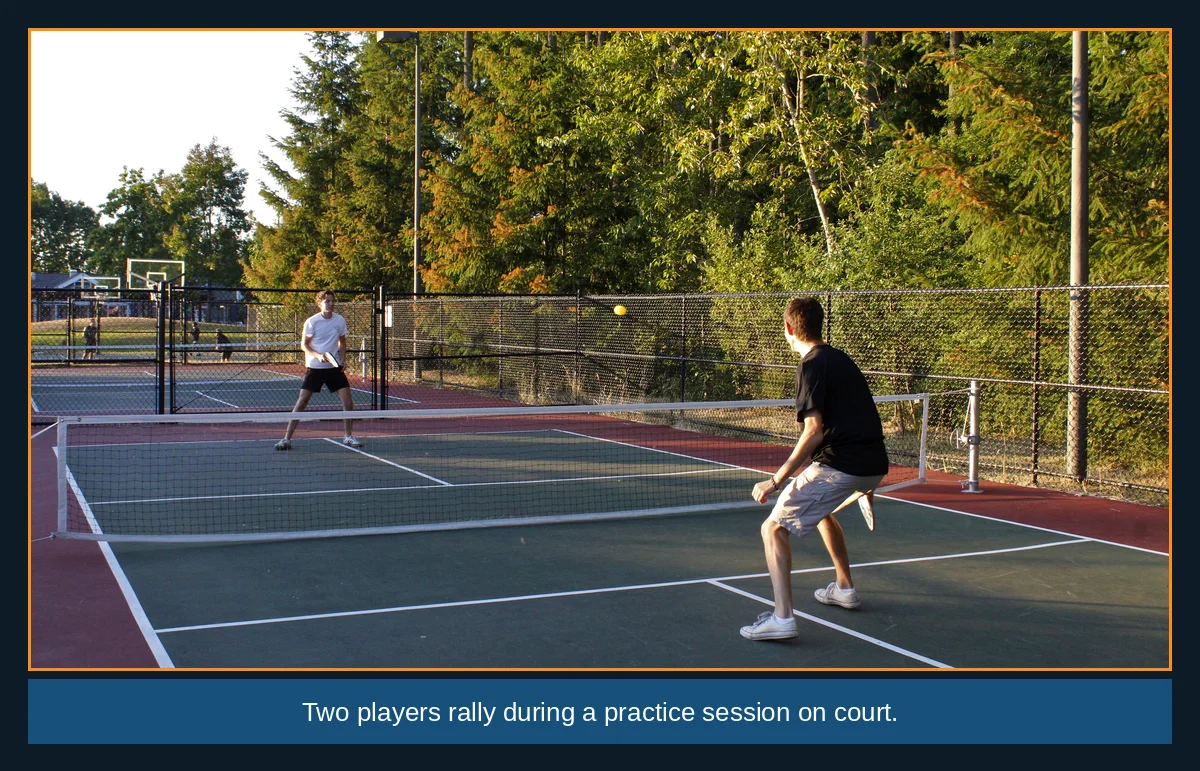
The format matters more than the coach: a private lesson, a group clinic and a parks-department class are three different jobs with three different pay structures.
| Format | Typical coach pay | What it means |
|---|---|---|
| Private lesson, independent | $40–$60 an hour, median $50 | Take-home rate set by the coach; middle half of 566 coaches |
| Private lesson, certified | $60–$150 an hour | Two guides; top end in major metros |
| Group clinic, parks or rec | $25–$50 an hour to the coach | The facility keeps the rest of the per-student fee |
| Group clinic, private club | $50–$90 an hour to the coach | Higher fees and a bigger coach share |
| Group lesson, per player | $10–$30 per player, per hour | TeachMe.To, for groups of 4–8 players |
| Pro-level coaching, 4.5+ players | $150–$300 an hour | Best Pickleball Camps, with a reputation |
| Travelling clinic coach | $400–$1,000 a day plus travel | Destination camps |
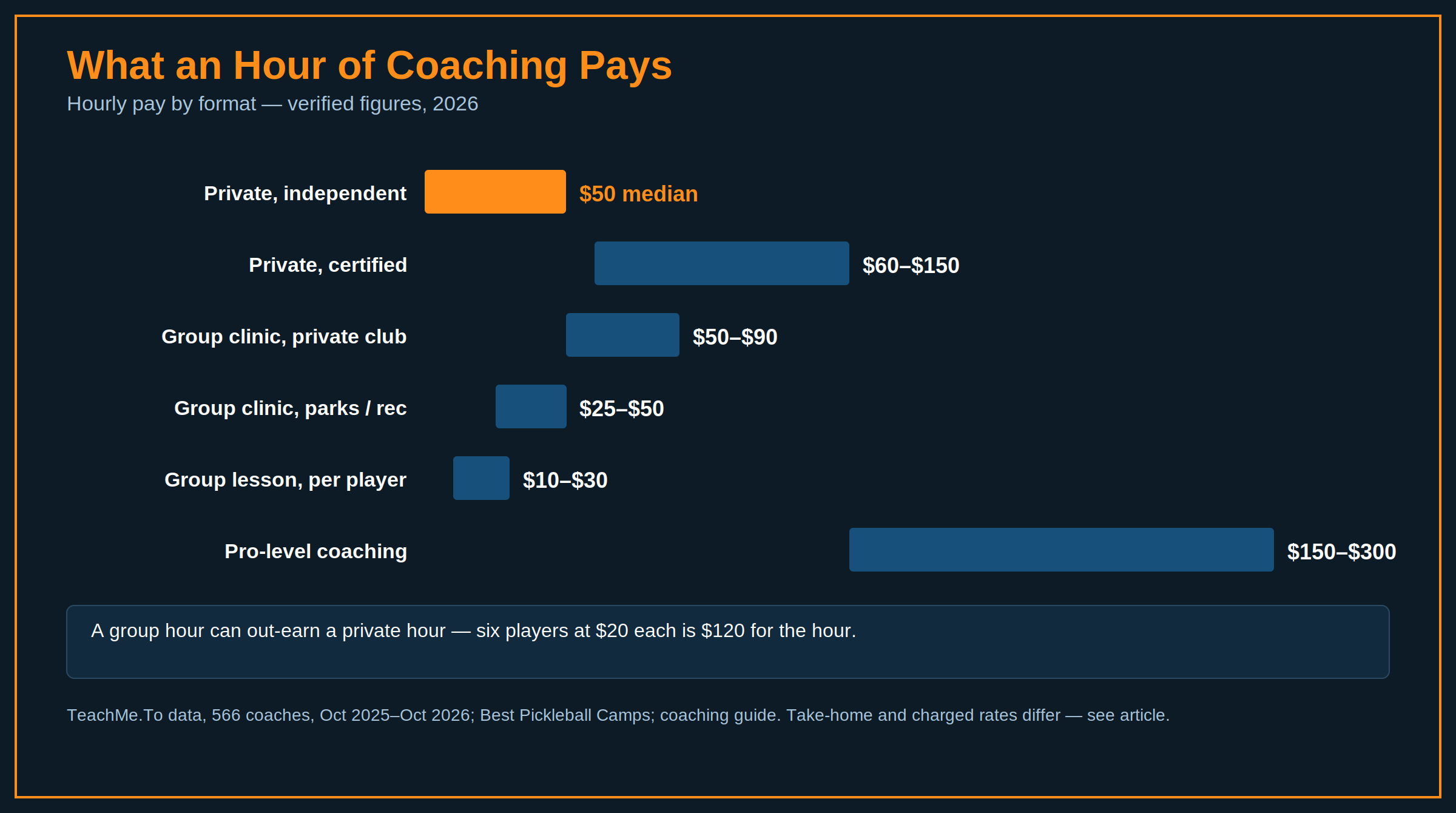
The private ranges disagree for a reason: TeachMe.To’s $40 to $60 is a take-home rate set by mostly independent coaches, while $60 to $150 is a charged rate for certified coaches in bigger cities.
Group teaching is where the hourly rate multiplies: four to eight players at $10 to $30 each beats most private rates — but only when the places are filled. An empty group slot earns nothing.
Why the Same Hour Pays So Differently
Four things move the rate: where you teach, what certification you hold, who your students are, and whether you work for yourself or for a facility.
Location is the biggest factor: TeachMe.To’s city figures show a $30 gap between the top and bottom metros it reports.
Coaches in the San Francisco Bay Area take home a median of $75 an hour, and in Los Angeles $65. In Miami the median is $55, and in Phoenix $45. Those city figures come from small samples — 17 coaches in the Bay Area, 30 in Los Angeles, 28 in Miami and 18 in Phoenix — so treat them as a guide to the gap.
Certification is next: facilities that hire coaches usually prefer or require a certified coach, and certified coaches can charge more. The two main US bodies are PPR and IPTPA — PPR is a USA Pickleball official partner; IPTPA is independent.
A PPR Level 1 workshop costs $197, plus PPR and USA Pickleball memberships. IPTPA Level I costs $390 in the United States, Canada and England, including insurance, or $320 elsewhere (first-year dues may add $140 — its pages disagree).
Playing level is the third factor. Best Pickleball Camps puts pro-level coaching, with 4.5+ players, at $150 to $300 an hour once a coach has a reputation. Our guides to what a good DUPR rating is and what DUPR is explain the 4.5 level.
The fourth factor is who finds the students. An independent coach sets the rate and keeps it, but finds every student and books every court. A facility coach gets students sent to them, for less per hour.
Salaried Jobs vs Working for Yourself
The employed route looks very different. Job postings for a Pickleball Pro at Life Time pay the higher of $15 an hour or the local minimum wage, plus 40% of eligible on-court revenue. A Senior Pro there is listed at $25 an hour plus the same 40% share.
That explains why job-board averages look so low next to lesson rates: ZipRecruiter’s data puts a Pickleball Instructor at an average of $49,145 a year. Those are employed-role averages, not what an independent coach charges.
The head-coach figures need the most care. Best Pickleball Camps reports a facility head coach salary of $50,000 to $85,000. The International Association of Pickleball and Padel Facilities puts a head coach with a full teaching calendar at $130,000 to $200,000 a year in total compensation.
Both can be true. The first figure is a base salary.
The second is total compensation, and the report says most of it comes from lesson revenue rather than guaranteed pay. A head coach who fills courts earns far more than the base salary — and carries the risk if bookings fall away.
For scale, the Bureau of Labor Statistics puts the median annual wage for all coaches and scouts, every sport, at $47,320 in May 2025.
The Monthly Maths
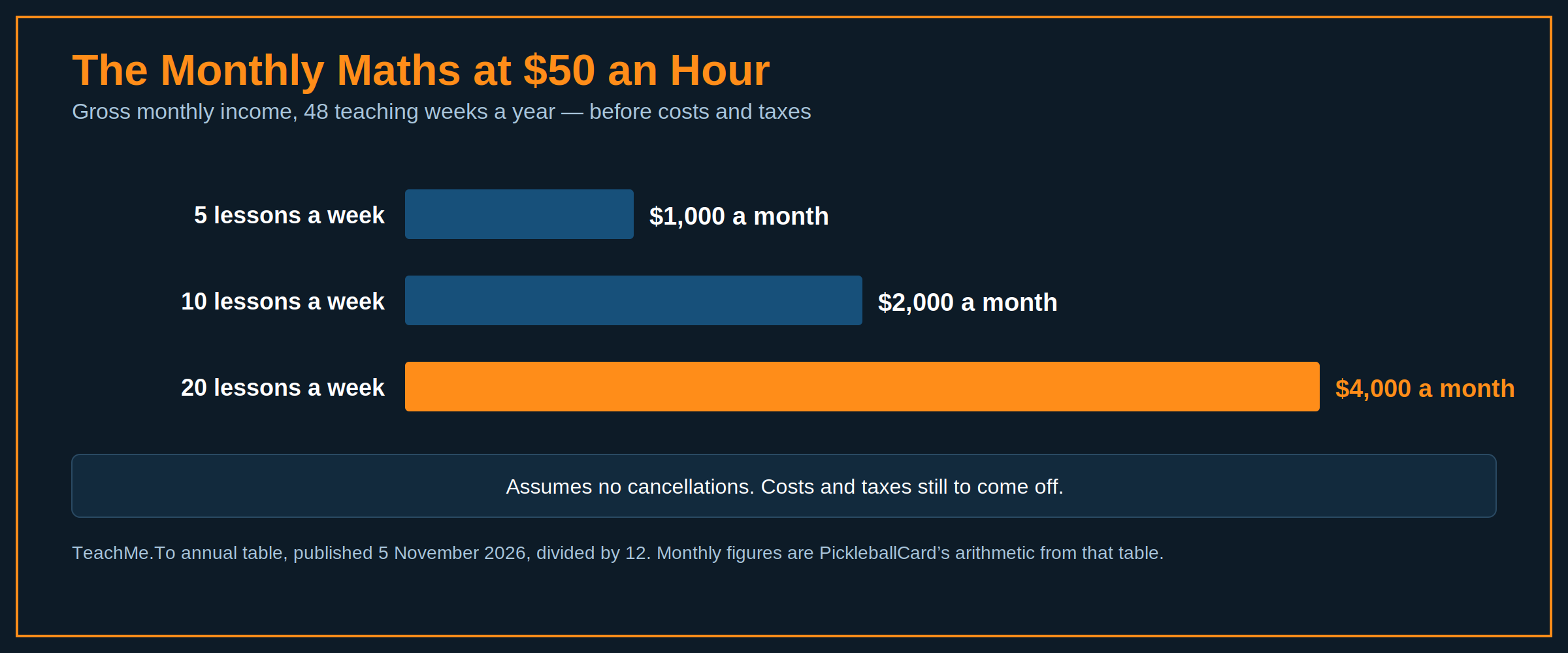
Hourly rates only become an income when multiplied by hours taught. TeachMe.To’s table does that over 48 working weeks, before costs and taxes.
At $50 an hour, five lessons a week grosses about $12,000 a year. Ten lessons a week grosses about $24,000. Twenty lessons a week grosses about $48,000.
Over twelve months, that is roughly $1,000 a month for five lessons a week, $2,000 for ten, and $4,000 for twenty — at $50 an hour, before costs and taxes, assuming 48 teaching weeks with no cancellations.
A full-time coach teaches more than twenty hours a week, but not every working hour is paid. One coaching guide puts a working full-time coach at 25 to 35 teaching hours a week, and its annual estimate is $60,000 to $150,000 in good markets and $40,000 to $80,000 in mid-tier markets — the guide’s own estimates, not measured data.
What Coaching Costs the Coach
Gross pay is not take-home pay: four costs come up in every source, and each one eats into the hourly rate.
Certification is the first cost. A PPR Level 1 workshop is $197, plus PPR and USA Pickleball memberships.
IPTPA Level I is $390 in the United States, including insurance (first-year dues may add $140); Level II is a further $200.
Platform fees are the second. TeachMe.To’s own guide says the platform charges a 20% commission on each lesson booked through it, plus a one-time matchmaking fee. The $50 median is the rate the coach sets as take-home; students pay more because the lesson price includes booking fees.
Court hire is the third. One pricing guide puts court rental at $10 to $40 an hour, varying by city, indoor or outdoor courts, and peak or off-peak times.
A coach who pays for the court keeps the lesson fee minus that hire cost. A coach employed by a facility does not pay it at all.
Insurance is the fourth: PPR membership includes basic liability insurance, rising to $8 million of personal liability cover once certified with Safe Play approval.
IPTPA Level I includes insurance access in the United States, Canada and England; other independent coaches need a separate policy.
Then there is the unpaid work: preparing sessions, scheduling and marketing. Our guides to pickleball warm-ups and cool-downs and footwork and agility drills show how much preparation a good session takes.
Injury is a cost too: a coach who cannot get on court cannot earn. Any coach teaching beginners should know the pickleball rules and how to play pickleball cold, and our guide to common pickleball injuries covers what to watch for.
The Short Version
A typical independent pickleball coach takes home about $50 an hour for a private lesson, with the middle half of coaches on TeachMe.To’s marketplace at $40 to $60. Group teaching can pay $120 an hour when the group is full.
Ten lessons a week at $50 an hour grosses about $24,000 a year over 48 weeks, before costs and taxes. A full-time coach with a full diary can gross far more — but the top figures depend on lesson income that is never guaranteed.
If you are thinking about coaching, start with your own city’s maths and hours. Check pickleball near me for local courts, try a first day at open play, and read our doubles strategy and pickleball for kids guides. Our guide to how much pickleball pros make covers the playing side of pay.
Frequently Asked Questions
How much do pickleball coaches make per hour?
A typical independent coach takes home a median of $50 an hour, per TeachMe.To’s data on 566 coaches, with the middle half at $40 to $60. Certified coaches report $60 to $150 an hour for private lessons.
How much do pickleball coaches make a year?
It depends on hours taught: at $50 an hour over 48 weeks, ten lessons a week grosses about $24,000 a year and twenty about $48,000, before costs and taxes.
Do pickleball coaches make more privately or at a club?
Private coaching pays more per hour — a median of $50 take-home independently, and $60 to $150 for certified coaches. Club roles pay less, or a base wage plus a share of lesson revenue, such as $15 an hour plus 40% of on-court revenue. The trade-off is steadiness: the club finds the students.
How much does it cost to become a certified pickleball coach?
A PPR Level 1 workshop costs $197, plus PPR and USA Pickleball memberships. IPTPA Level I costs $390 in the United States, Canada and England, including insurance, or $320 elsewhere (first-year dues may add $140 — its pages disagree).
Can you make a living coaching pickleball full-time?
Yes, in a good market with a full diary — but it is a business, not a salary. Twenty lessons a week at $50 an hour grosses about $48,000 a year over 48 weeks, before costs and taxes.
What is the highest-paid pickleball coaching job?
The highest figure reported is a head coach with a full teaching calendar at $130,000 to $200,000 a year in total compensation, per the International Association of Pickleball and Padel Facilities’ first compensation report. Most of that is lesson revenue, not base salary — the reported base salary is $50,000 to $85,000.

Shoaib is the publisher of Pickleball Card. He oversees the site’s guides to pickleball rules, ratings, strategy and gear, all researched from primary sources — the USA Pickleball Rulebook, DUPR and manufacturer documentation — and updated as the game changes.