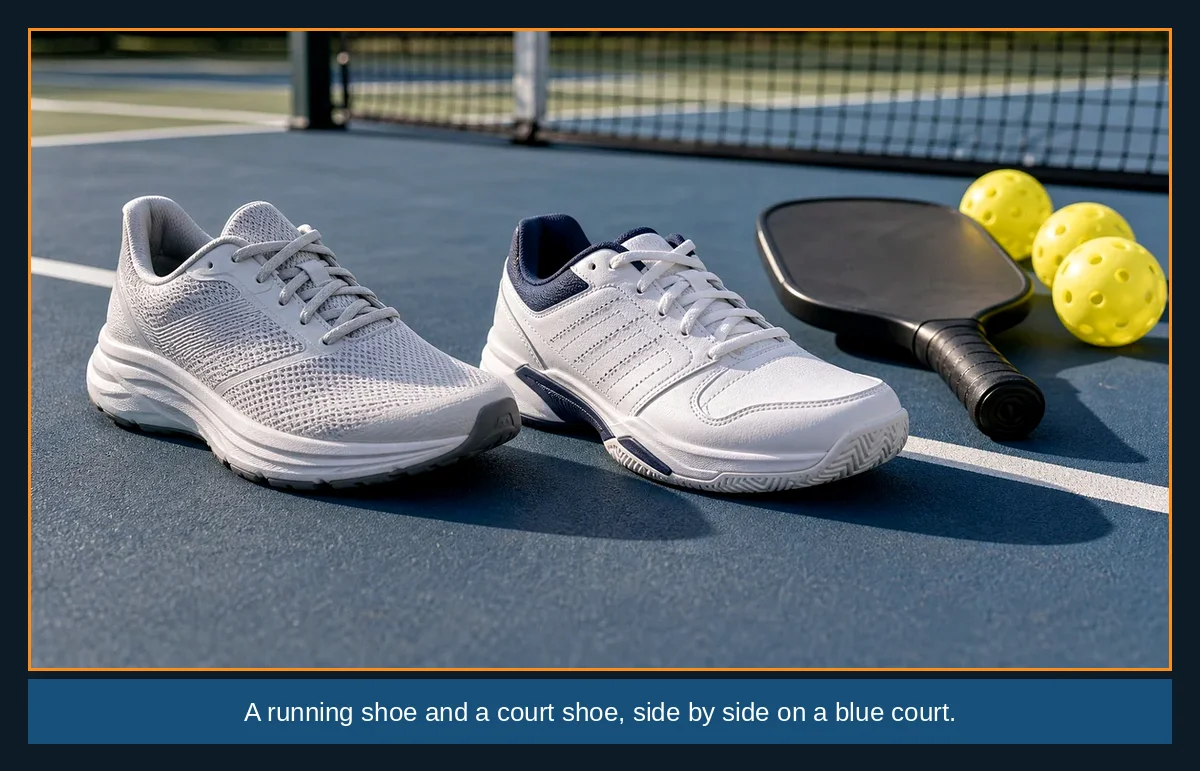
A pickleball shoe is not a running shoe with a different label. Pickleball moves sideways: split steps, lunges, hard stops and quick recoveries. The wrong shoe shows up fast — a running shoe’s soft, high heel rolls under you on a lateral cut, and a worn-out tread slides on a dusty gym floor.
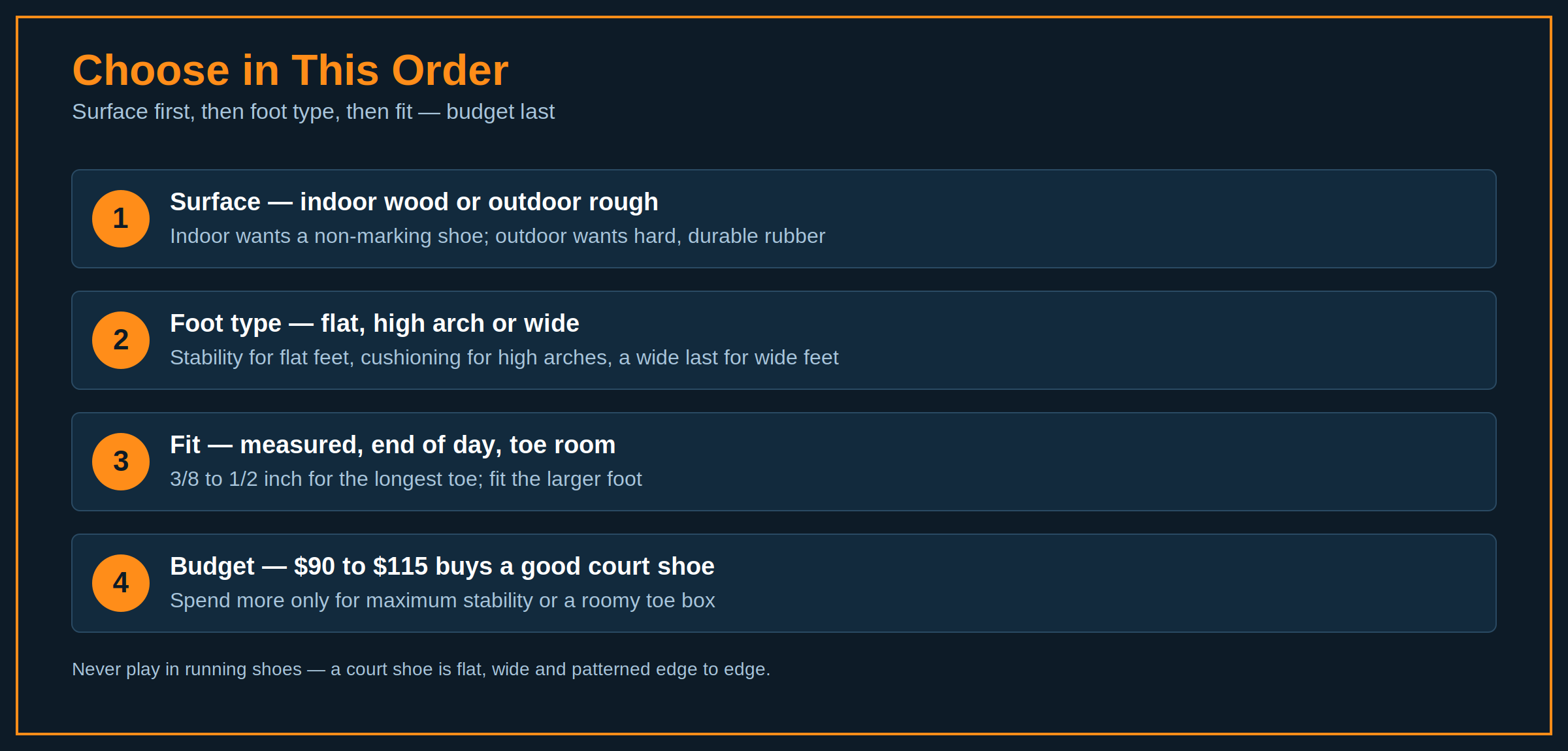
Choose in this order: surface first, then foot type, then fit, then budget. Every model here was checked against its maker’s own site on 28 November 2026; every price below is its list price unless stated otherwise.
Start With the Surface
Indoor and outdoor courts punish shoes in different ways. An indoor gym floor is smooth wood or vinyl, and a dark outsole that marks the floor will get you banned from the hall. An outdoor court is rough painted concrete: it grips well, but it grinds soft rubber down fast.
Indoor players should look for a shoe the maker describes for indoor play, with a non-marking outsole. ASICS describes its Gel-Renma 2 as a good choice for indoor sports players. Skechers’ Goodyear Gold compound outsole is built for controlled slides specifically on the pickleball court surface, and it is non-marking.
Outdoor players should prioritise outsole durability over softness. Look for a maker that names the rubber: K-Swiss fits its Express Light with an Aosta rubber outsole and a DragGuard for lasting durability, and Skechers’ Goodyear compound is the same idea. If you play both, buy for the outdoor court.
Then Match the Shoe to Your Foot
Once the surface is settled, your feet decide the model. Three foot types drive three different answers.
Flat feet and overpronation need stability: a shoe that resists twisting when you push sideways. ASICS builds this in with TRUSSTIC technology in the midsole of its pickleball models, including the Gel-Renma 2 and the Gel-Dedicate 9 Pickleball, and with DYNAWALL in its Gel-Resolution X, which extends into the heel for added stability. SQAIRZ takes the same approach with an external TPU stability plate in its XRZ2.
High arches need cushioning first, because the arch itself absorbs less shock. ASICS pairs its GEL cushioning with FF BLAST PLUS foam in the Gel-Resolution X, and Skechers uses ULTRA GO foam in the Viper Court Pro 2.0. Either beats a thin, flat court shoe.
Wide feet need a wide last, not just a bigger size. Sizing up gives you length you do not need and a heel that slips. The Gel-Resolution X comes in a wide version, the Viper Court Pro 2.0 is listed in wide, and the K-Swiss Express Light comes in a 2E wide at the same $115 list price.
The American Academy of Orthopaedic Surgeons advises choosing shoes with wide insteps, broad toe boxes, soft soles and plenty of stability.
Fit: The Check No Spec Sheet Replaces
No technology list tells you whether a shoe fits your foot. Try the shoe on in the socks you play in, at the end of the day when your feet are at their largest. The AAOS also advises having your feet measured regularly, because the size of your feet changes as you grow older, and fitting shoes to the larger foot when the two differ.
Leave 3/8 to 1/2 inch of space between your longest toe and the end of the shoe, and check that the ball of your foot sits in the widest part of the shoe. Walk in the shoe before you buy it, on a hard surface if you can. Do not buy a shoe that feels too tight and expect it to stretch.
Sizing varies between brands, so judge the shoe by how it fits, not by the number inside it. ASICS notes that the Gel-Resolution X fits differently from its predecessor: men may prefer sizing down a half size, while women may prefer sizing up a half size.
Stability, Cushioning and Weight: What to Trade Off
Stability is the one to protect first. Pickleball is a cutting sport, and the American Academy of Orthopaedic Surgeons lists shoes that do not provide enough foot and ankle support, and shoes with slippery soles, among the risk factors for ankle sprains.
A shoe with a stiffened midfoot — a plate, a cage or a shank — resists the sideways twist that rolls an ankle. Our common pickleball injuries hub explains what happens when that support is missing, and our warm-ups and cool-downs guide covers the ankle-strengthening work that pairs with it.
Cushioning matters most if you play long sessions or have sore knees — but look for it paired with a stability feature in the same shoe, not on its own. Soft foam that compresses sideways gives you nothing on a hard cut.
Weight matters least, and it is the figure makers publish least. ASICS and Skechers do not publish weights for the models in this guide, so no weight comparison is offered here. A heavier shoe with real lateral support beats a light shoe that rolls.
Do not play pickleball in running shoes: they are built for straight-line motion, with a high, soft heel and a flexible forefoot, and on a lateral cut they tip. A court shoe is flat, wide and patterned edge to edge.
If you are new to the game, our how to play pickleball guide and our first day at open play guide both assume you are wearing one.
What the Money Buys
Court shoes run from about $80 to about $165 at list price. The table below uses list prices from each maker’s own site, checked 28 November 2026. Sale prices move constantly — both brands were running Black Friday promotions on that date — so treat the list price as the stable comparison.
| Model | Type | List price | Best for |
|---|---|---|---|
| Skechers Viper Court Rally | Dedicated pickleball | $80* | Budget comfort, roomy Relaxed Fit |
| ASICS Gel-Dedicate 9 Pickleball | Dedicated pickleball | $90 | Versatile all-rounder, men’s standard width |
| ASICS Game FF Pickleball | Dedicated pickleball | $90–$100 | Budget ASICS option |
| ASICS Gel-Renma 2 | Dedicated pickleball | $100 | Indoor play, stability on a budget |
| Skechers Viper Court Pro 2.0 | Dedicated pickleball | $115 | Cushioning plus Arch Fit support |
| K-Swiss Express Light Pickleball (original) | Dedicated pickleball | $115 | Light, stable, wide 2E at the same price |
| Selkirk CourtStrike Pro 3.0 | Dedicated pickleball | $127.99 | Outsole durability, 6-month sole warranty |
| SQAIRZ XRZ2 | Dedicated pickleball | $155.71 | Roomy toe box, maximum stability |
| ASICS Gel-Resolution X | Tennis crossover | $160–$165 | Maximum stability, wide version available |
* The Rally’s $80 is a retailer list price, not a price read on Skechers’ own US site on 28 November 2026.
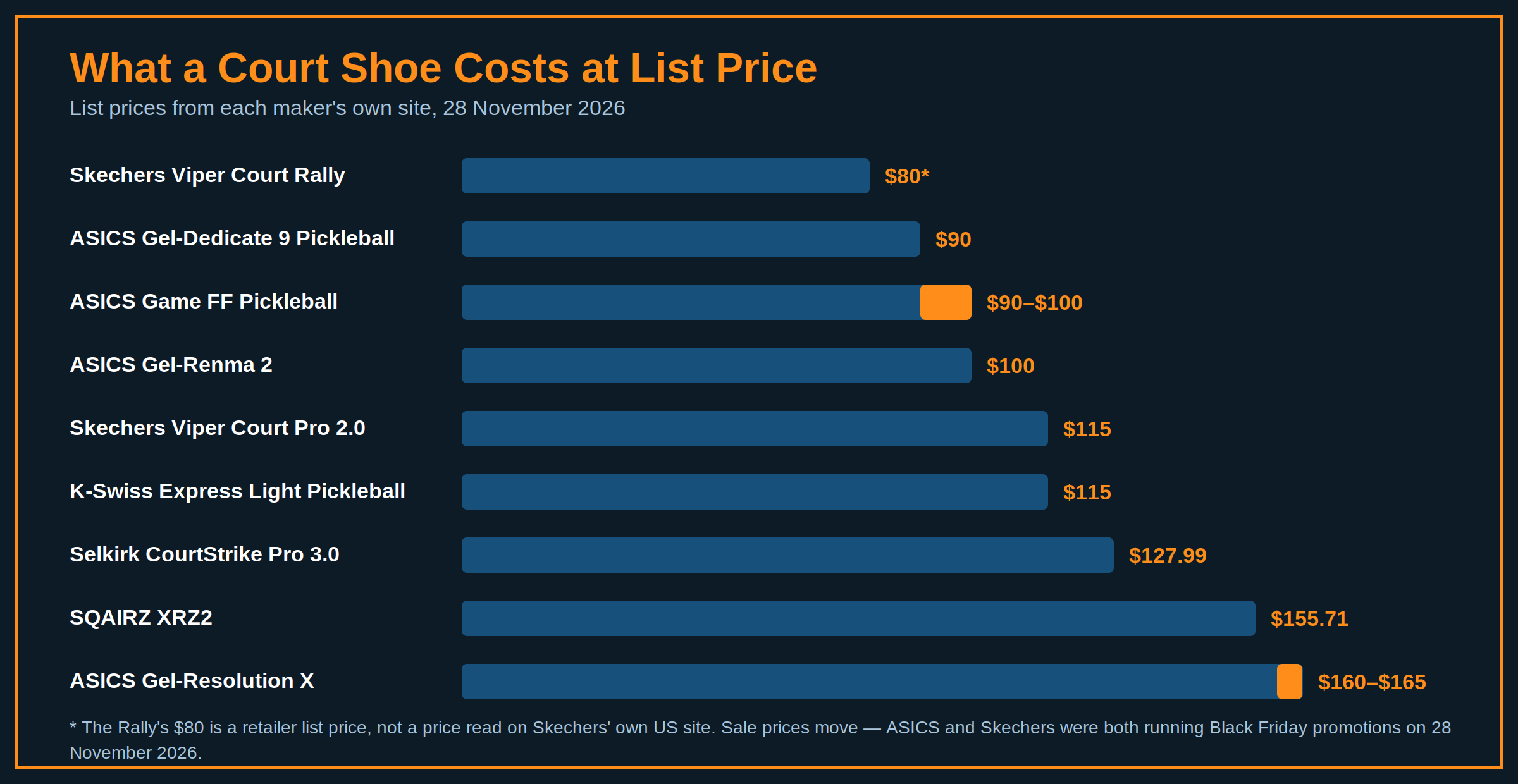
Two things stand out. First, every shoe in the table is a dedicated pickleball shoe except the Gel-Resolution X, a tennis shoe that pickleball players have adopted — ASICS lists it under tennis, not pickleball, and its predecessor, the Gel-Resolution 9, no longer appears on ASICS’ US site at all. Retailers still list the 9 at $149.95 to $164.95; the X is the current model.
Second, the gap between the cheapest real court shoe and the most expensive is about $85 — less than the cost of one private lesson. Our best pickleball shoes guide lists the site’s current main-list picks, and our pickleball near me guide explains how to find courts and clubs where you can try shoes on. Our pickleball for kids guide covers junior sizes.
The Short Version
Start with your surface: indoor wood wants a non-marking shoe, outdoor concrete wants hard, durable rubber. Then match your foot: stability for flat feet, cushioning for high arches, a wide last for wide feet. Then fit it properly — measured, at the end of the day.
Spend $90 to $115 for a good dedicated pickleball shoe. Spend more only if you need maximum stability or a roomy toe box, and never play in running shoes.
Replace a pair when the tread goes smooth under the ball of the foot or the midsole stops springing back — both happen before the shoe looks worn out. Once the shoes are sorted, our footwork and agility drills guide is the next step.
Frequently Asked Questions
Should I wear running shoes for pickleball?
No. Running shoes are built for straight-line motion, with a high, soft heel and a flexible forefoot, and they tip on lateral cuts. A court shoe is flat, wide and patterned edge to edge, and the AAOS lists shoes without enough support, and shoes with slippery soles, among the risk factors for ankle sprains.
What is the best pickleball shoe for indoor courts?
ASICS describes its Gel-Renma 2 as a good choice for indoor sports players. Its list price is $100 on ASICS’ own site, checked 28 November 2026.
What is the best pickleball shoe for outdoor courts?
Prioritise outsole durability: rough outdoor concrete grinds soft rubber down fast. Look for a maker that names the rubber — K-Swiss fits the Express Light with an Aosta rubber outsole and DragGuard, and Skechers uses a Goodyear Gold compound outsole.
Do I need a wide pickleball shoe?
If your toes feel pinched, your forefoot spills over the sole, or you have bunions, yes — buy a wide last rather than sizing up in a standard shoe. The Gel-Resolution X comes in a wide version, the Viper Court Pro 2.0 is listed in wide, and the K-Swiss Express Light comes in a 2E wide at the same $115 list price.
How should pickleball shoes fit?
Try them on at the end of the day, in your playing socks, with both feet measured and the larger foot fitted. Leave 3/8 to 1/2 inch between your longest toe and the end of the shoe, and check that the ball of your foot sits in the widest part of the shoe. Do not buy a shoe that feels too tight and expect it to stretch.
How much should I spend on pickleball shoes?
A good dedicated pickleball shoe lists at $90 to $115 — the ASICS Gel-Dedicate 9 Pickleball at $90, the Gel-Renma 2 at $100, the Skechers Viper Court Pro 2.0 and the K-Swiss Express Light at $115. Spend more only for maximum stability or a roomy toe box.

Shoaib is the publisher of Pickleball Card. He oversees the site’s guides to pickleball rules, ratings, strategy and gear, all researched from primary sources — the USA Pickleball Rulebook, DUPR and manufacturer documentation — and updated as the game changes.