Look at the feet at any open-play session and you will see the same mistake: good players, in running shoes, shuffling sideways at the kitchen line.
Running shoes are not bad shoes — they are the wrong shoes for this game. Pickleball is played in short bursts on a 20-by-44-foot court, and a shoe built for running forward supports none of that.
The Short Answer
Wear a court shoe, not a running shoe — the consistent advice of the doctors and foot-health bodies who have written about this.
A Houston Methodist sports medicine physician puts it plainly: shoes designed for tennis or pickleball can significantly decrease the risk of injury, because they provide better side-to-side support and court traction, decreasing the risk of ankle sprains and Achilles injuries.
An orthopaedic surgeon in Arizona is blunter still: wear court shoes made for side-to-side movement — not running shoes, not sandals. A second Houston Methodist doctor agrees: running shoes are not ideal; court shoes provide the lateral support the game needs.
Why Pickleball Moves Sideways
Running is a straight line: land on the heel, roll forward, push off the toes. Pickleball almost never asks you to do that.
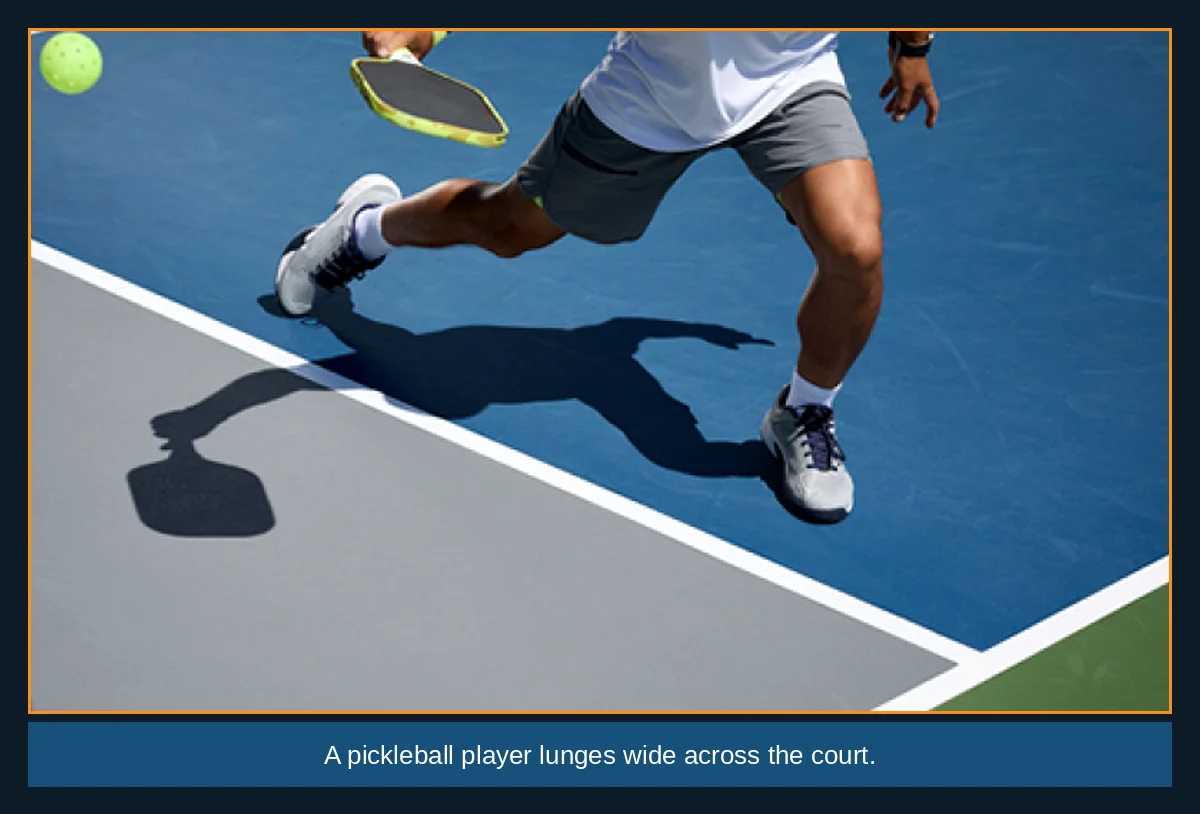
A pickleball point is short, sharp moves in every direction: a shuffle along the kitchen line, a lunge for a dink, a split step, a sudden stop, a pivot to chase a lob. A Houston Methodist sports medicine doctor describes safe footwork as small, quick strides, getting your body behind the ball — and warns that reaching from a poor position, mixing rotation with a sudden burst, stresses calves, Achilles tendons, hamstrings and knees.
The first push is the dangerous moment: most pickleball injuries happen right as a movement starts, when a player has to change direction in a hurry.
That first push is a hard shove off one side to go the other way, loading the ankle sideways — the direction a running shoe is not built to handle. Our footwork and agility drills guide covers the movement patterns behind that load.
What a Court Shoe Does Differently
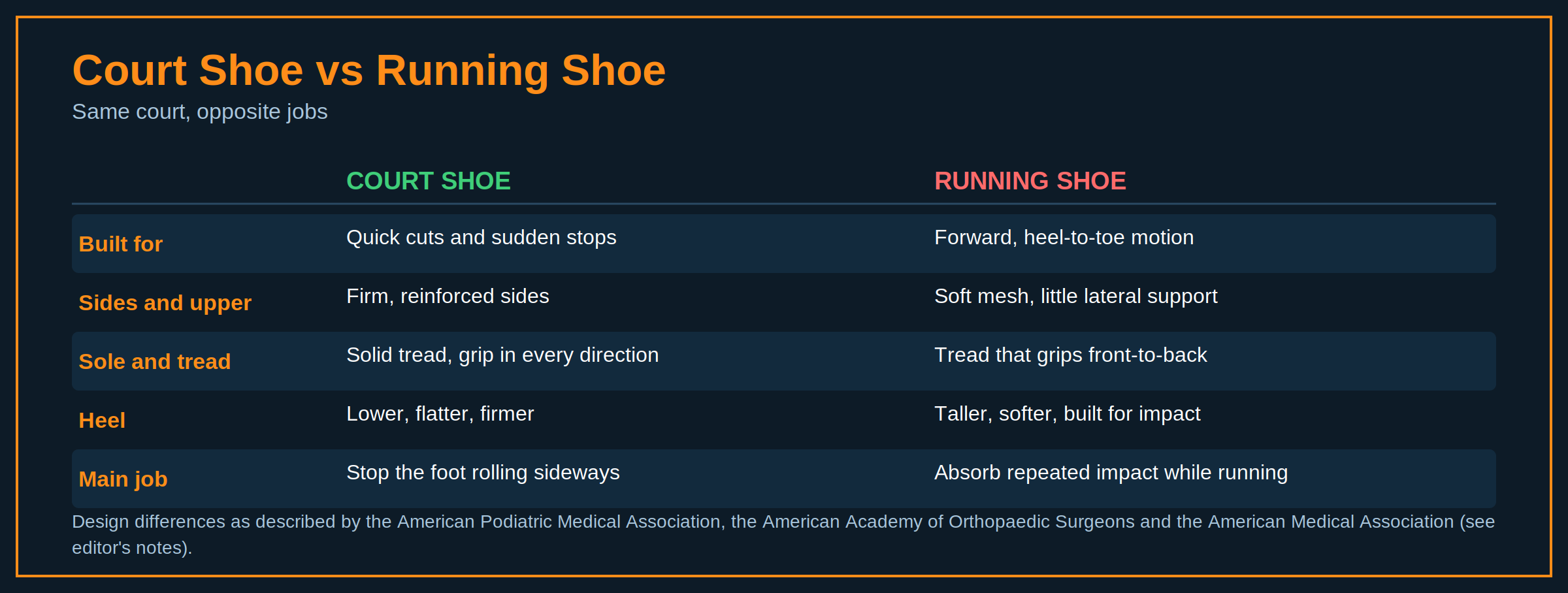
The two look similar from across the net. Up close, nearly everything is different — they are built for opposite jobs.
| Feature | Court shoe | Running shoe |
|---|---|---|
| Built for | Quick cuts and sudden stops | Forward, heel-to-toe motion |
| Sides and upper | Firm, reinforced sides | Soft mesh, little lateral support |
| Sole and tread | Solid tread, grip in every direction | Tread that grips front-to-back |
| Heel | Lower, flatter, firmer | Taller, softer, built for impact |
| Main job | Stop the foot rolling sideways | Absorb repeated impact while running |
The foot-health case is direct. The American Podiatric Medical Association states that running shoes are made for high-impact forward motion and should not be used for sports with lateral movement; the American Academy of Orthopaedic Surgeons describes court shoes as having a solid tread and providing stability in all directions. A sports medicine physician told the American Medical Association in July 2026 that tennis shoes have firmer outsoles for cutting and pivoting, while a running shoe likely has more cushioning but less support on lateral movements — and that, most importantly, a shoe should be comfortable.
The Heel-Drop Difference
Heel drop is the height difference between a shoe’s heel and forefoot — the easiest way to feel the difference between the two kinds of shoe.
Running shoes are built with a higher heel drop, because extra cushioning under the heel absorbs the impact of landing on it again and again. A podiatry guide puts traditional running shoes at a 10–12mm drop. That height is useful on a run and a liability on a court: push sideways on a tall, soft heel and the shoe rolls, and the ankle goes with it.
Court shoes sit lower and flatter. A pickleball shoe maker describes its pickleball shoes as having a thinner sole than a tennis shoe, built for quick movements. A lower shoe gives your ankle less leverage to roll, and a firmer heel gives it something solid to push against.
What Can Go Wrong
The injury doctors worry about most is the ankle sprain: quick side-to-side moves can roll the ankle, and the standard prevention advice is to wear court shoes made for side-to-side movement, not running shoes.
The numbers are sobering: a 2026 Sports Health study estimated emergency-department pickleball injuries rose from 1,313 in 2014 to 24,461 in 2023, mostly affecting people aged 60 to 79. That rise tracks the sport’s growth, and the study does not blame footwear — it counts all injuries, only those serious enough to reach an emergency department. No study has measured how many a different shoe would have prevented.
What the doctors agree on is the mechanism: a running shoe’s soft, tall heel and flexible sides let the foot roll inside the shoe under a sideways load, and the ankle and knee absorb the redirect.
A court shoe’s firm sides, wide base and solid tread are built to stop that roll before it starts. Our common pickleball injuries hub explains ankle sprains, and our warm-ups and cool-downs guide prepares ankles and calves before play.
When Running Shoes Are Acceptable
Running shoes are fine in exactly two situations, and neither is a game.
Walking to the court. Wear running shoes for the walk, then change at the court. It also protects the court shoe’s tread from asphalt and grit.
Your very first session. If you have never played and are trying the game once, running shoes will not ruin the day — play gently, stay near the kitchen line, and do not chase lobs; our how to play pickleball guide covers the basics. Then buy court shoes before your second session: our best pickleball shoes guide has picks at every price, including seven under $100.
What decides it is frequency: playing a sport at least two to three times a week calls for a sport-specific shoe. Once pickleball is a habit, running shoes are no longer a stopgap — they are the wrong equipment. And never backpedal for a lob, whatever shoe you wear — turn and shuffle back, or let the ball go.
How to Tell Whether a Shoe Is a Court Shoe
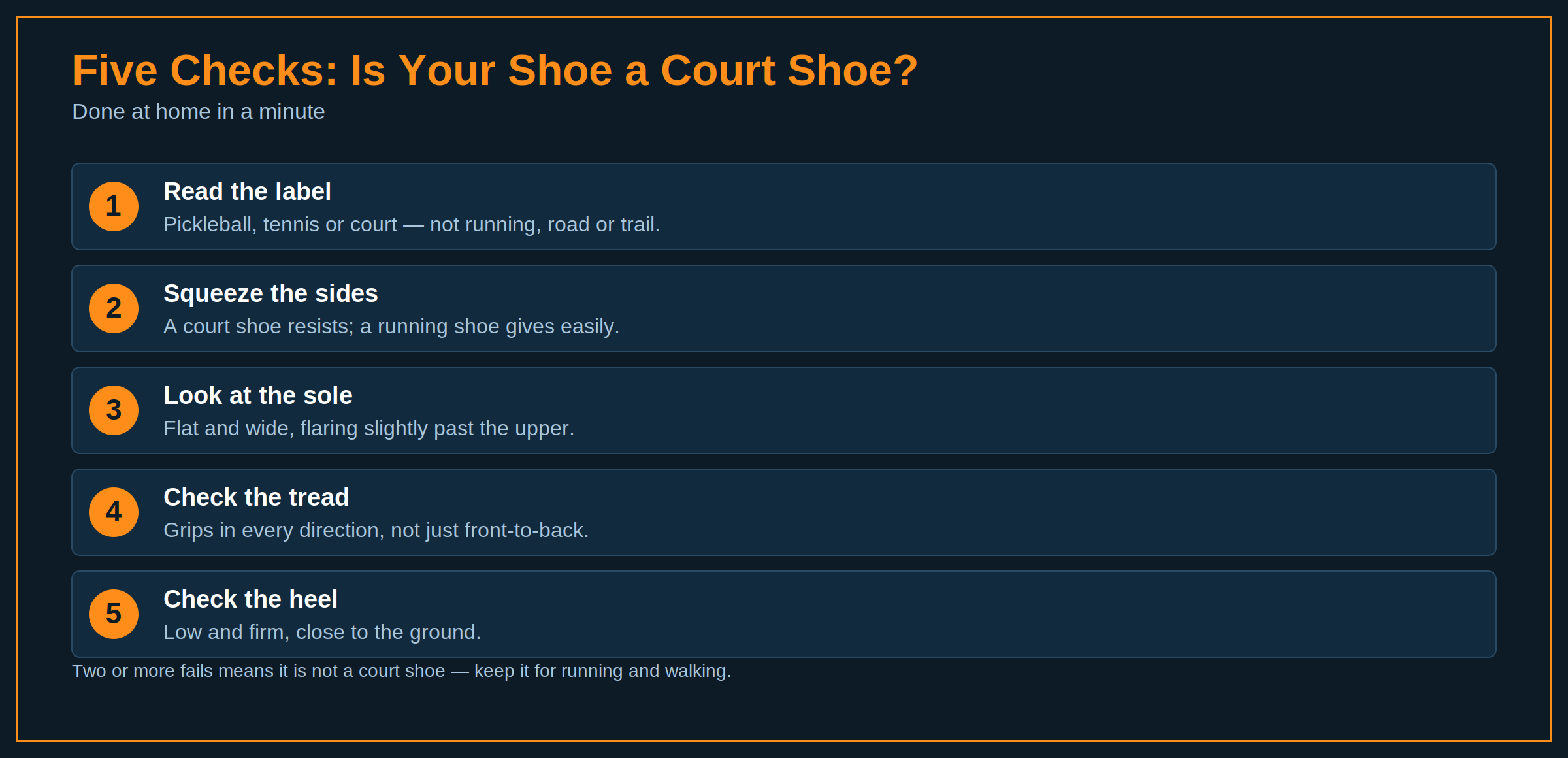
Five checks, done at home in a minute, settle it.
1. Read the label. A court shoe says pickleball, tennis or court on the box, tongue or maker’s page; a running shoe says running, road or trail. If the label says running, it is a running shoe.
2. Squeeze the sides. Press the sides hard with your thumb: a court shoe resists, its sides built up and reinforced to hold your foot on hard cuts, while a running shoe gives easily, because its upper is mostly breathable mesh.
3. Look at the sole. A court shoe has a flat, wide sole flaring slightly past the upper — a stable base to push from. A running shoe has a narrower base with a thick, soft heel high off the ground.
4. Check the tread. A court shoe’s tread grips in every direction — usually a herringbone or multi-directional pattern. A running shoe’s tread grips front-to-back, with deeper lugs for forward push-off — our indoor vs outdoor pickleball guide explains which sole suits which surface.
5. Check the heel. Put the shoe on a table and look from behind: a court shoe’s heel is low and firm, close to the ground, while a running shoe’s heel is tall and soft, built to absorb impact rather than resist roll.
Fail two or more checks and it is not a court shoe — keep it for running and walking, and buy a court shoe for pickleball. Our best pickleball court shoes guide explains the options, and our wide feet and plantar fasciitis guides cover fit and support. For younger players, our pickleball for kids guide covers starting ages and first shoes.
The Short Version
Pickleball moves sideways; running shoes are built to move forward. A court shoe’s firm sides, solid tread and low heel hold your foot on hard cuts; a running shoe’s tall, soft heel and flexible mesh let it roll.
Doctors who treat pickleball injuries agree: wear a court shoe, not a running shoe. Running shoes are fine for the walk to the court and a first taster session — and once you play two or three times a week, a sport-specific shoe is not optional.
Frequently Asked Questions
Can you play pickleball in running shoes?
You can, but do not make a habit of it. The American Podiatric Medical Association states that running shoes are made for high-impact forward motion and should not be used for sports with lateral movement. A court shoe’s firm sides and solid tread protect your ankles on the sideways stops the game demands.
Are tennis shoes OK for pickleball?
Yes. A pickleball shoe maker calls tennis shoes the best option if you do not wear a pickleball-specific shoe, because both sports use similar side-to-side movements, and tennis shoes are built for them.
What is the difference between pickleball shoes and tennis shoes?
They are close cousins, not twins. A pickleball shoe maker explains that pickleball shoes have a thinner sole, a flexible upper, a wider fit and less weight than tennis shoes, with tread for gym floors as well as outdoor courts. A tennis shoe is heavier because it needs extra rubber for abrasive courts.
Do I need pickleball-specific shoes, or will any court shoe do?
Any real court shoe is a big step up from a running shoe. A pickleball-specific shoe is best, built for the sport’s short, sharp movements on a small court — but a tennis, volleyball or basketball court shoe is acceptable, especially when starting out.
Can I wear running shoes to walk to the court?
Yes — the best use for them. Wear running shoes for the walk, then change into court shoes at the court. It also keeps grit off the court shoe’s tread, which helps it grip and last longer.
How do I know when to replace my court shoes?
Check them every few months. Replace a pair when the tread is smooth, the sides have gone soft, or your foot slides inside the shoe on hard stops. Outdoor concrete wears a sole out far faster than a gym floor.

Shoaib is the publisher of Pickleball Card. He oversees the site’s guides to pickleball rules, ratings, strategy and gear, all researched from primary sources — the USA Pickleball Rulebook, DUPR and manufacturer documentation — and updated as the game changes.