• Skip to primary navigation
  • Skip to main content
  • Skip to primary sidebar

Pickleballcard

All About Pickleball Gears

  • About Pickleball
    • How To Play Pickleball
    • Pickleball Rules
    • Pickleball Kitchen Rules
    • Serving Rules
    • Pickleball Ratings
    • Pickleball Tips
    • Pickleball History
  • Pickleball Shoes
    • Best Pickleball Shoes
    • Best Pickleball Shoes For Men
    • Best Pickleball Shoes For Women
  • Pickleball Paddles
    • Best Pickleball Paddles
    • Elongated Pickleball Paddles
    • Graphite Pickleball Paddles
    • Onix Pickleball Paddles
    • Pickleball Paddles for Women
    • Pickleball Paddles For Spin
  • Vs
    • Pickleball Vs Tennis
    • Paddle Tennis Vs Pickleball
    • Indoor Vs Outdoor Pickleball

Pickleball Terminology | Pickleball Terms and Definitions

May 1, 2024 by Sadaf Awan Leave a Comment

Read a detailed article with information on some pickleball terminologies so you understand the game better.

Pickleball is a well-known sport that people of all ages and genders play. This game is a combination of three different games played on the court. People often get confused about the terminologies used by professionals. I spent a week learning the terms used in pickleball when I was new to the game.
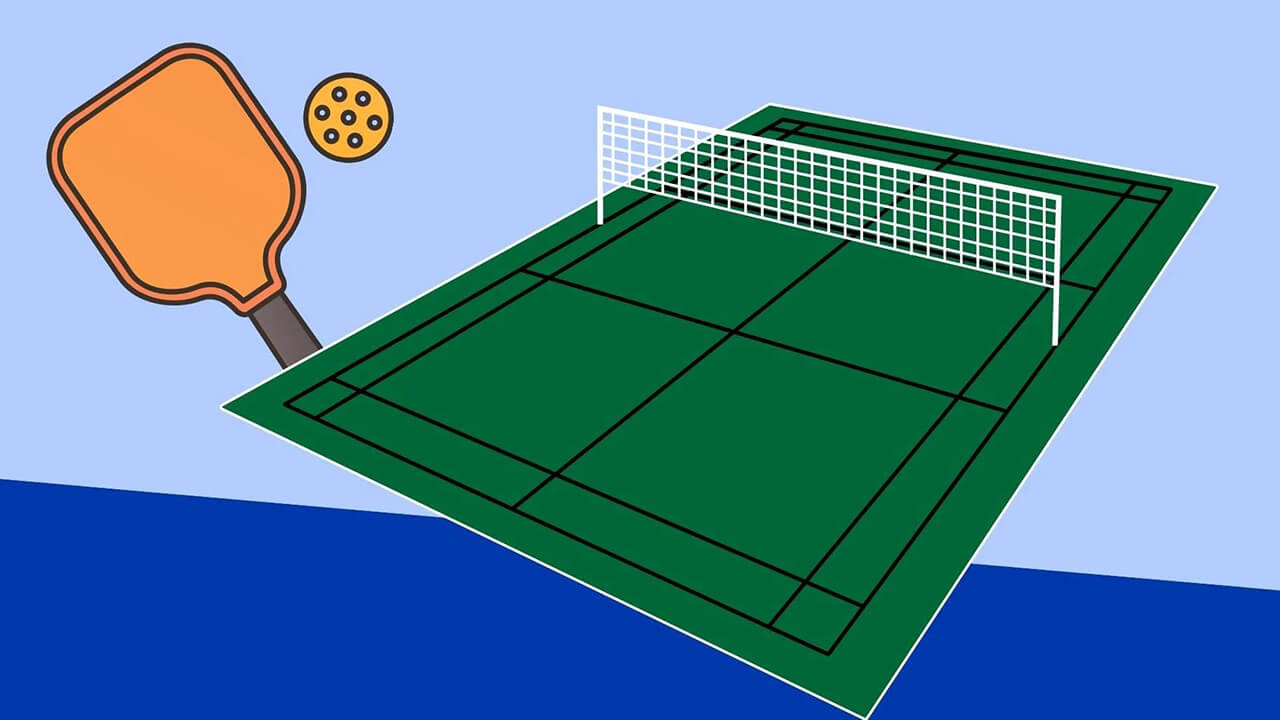
Pickleball Terms and Definitions

You can scroll down to read a detailed article on pickleball vocabulary words. All the important pickleball phrases are mentioned so you know them before watching your next pickleball match on the court. This will help you understand the game better and enjoy it more. I hope people who are interested in playing the game can take advantage of the article and make use of the information given below.

Pickleball Terminology

Pickleball is a famous and fast-growing game in all parts of the United States of America because it is physically accommodating. Pickleball is a good way to exercise and bond with other players. When compared to other court games, pickleball is new, so most of the terminologies are not known by people. I have listed a few terminologies below that people should know to understand the game. Keep on reading the article to increase your knowledge about the game.

1. Pickleball Singles/Skinny Singles

As evident by the name, Pickleball singles or skinny singles involve only two players in the game. One player has to stand on each side of the court, which is equally divided by a net. The players do not have a teammate to depend upon. Hence skinny singles are not liked by most professional players because it can be exhausting.

2. Pickleball Doubles

Pickleball doubles involve four players in the game as they are playing as a team. Each team has two players, and they stand on each side of the court. Most players like this setting because they have a partner to rely on. Pickleball doubles help the players to interact and socialize with each other. Hence pickleball singles and pickleball doubles almost have the same rules, but the strategies are different.

3. Paddle

People often confuse pickleball with tennis or badminton and use the same terms for it as well. The racket used in pickleball is called a paddle. It shouldn’t be called a racket. All the players use the paddle to hit the ball to make shots. Every player has a different playing style, but it is a rule to hit the ball when the paddle is placed below the waist area.

4. Ball

The players use two types of balls in pickleball. They can either use a Wiffle ball or a plastic ball that has some holes on the entire surface. The Wiffle ball is used in softball or basketball but now is being used by pickleball players too. It is assumed that it helps in scoring points against the competitors in the game. Indoor and outdoor pickleball balls are two types of balls used in pickleball.

Pickleball Terms and Definitions

I have explained the basic terms for pickleball above that should not only be known by the players. People who are sitting in the audience should also be aware of these terminologies to understand the game better. The less common terms and pickleball definitions that players use are stated below. This pickleball lingo or terms will help you understand the conversation of professional players as well.

1. Ace

An ace is a term that is used in the game when the ball is not returned by the player standing on the opposite side of the court. The player who serves the ball will get the point because the ball touches the court after getting the first bounce. It is basically missed and gives a point to the other team.

2. Serve

Serve is an that kicks off a pickleball rally. All serves must be hit below the waist, keeping your feet behind the baseline.

3. Approach Shot

This term is very common and is used when the ball is hit by the paddle when it is already moving in a forward motion. An approach shot is made to get closer to the net. This can be taken as an offense because the players hit the ball while it is moving near the opponent’s side of the court.

4. Baseline

You might be aware of the term baseline because it is commonly used in almost all the games played on the court. The baseline in pickleball is the ending line of the court on each side. If the court is of the maximum size, the baseline would be 32 feet on each side. Whereas if the pickleball court is 44 feet, the baseline will be at 22 feet.

5. Backcourt

It might be clear by the name as the backcourt is the area near the baseline on a pickleball court. This can be approximately 20 feet and is not mostly used by the players. It is difficult to hit the ball from the backcourt, so the players do not usually occupy it. However, if playing pickleball doubles, one of the players might stand in the backcourt area.

6. Bounce It

This term is mostly used in pickleball doubles because it is used as a signal not to hit the ball. One team member shouts at the other team member not to hit the ball with the paddle so it can go off the boundary. This is an advantage as the team will gain a point against their opponents in the game.

7. Backspin

The backspin is used by the players when they swing the arm in the backward direction before the paddle hits the ball. This motion helps in hitting the ball at high speed in the opposite direction. It will help the ball bounce on the ground so the opponent might miss the pickleball shot. This is done very smartly because the player can end up making a mistake.

8. Carry

This is a common term used by pickleball players, and the action is performed by moving the ball in the same direction as the paddle. The ball does not bounce on the ground and moves in the forward direction when hit by the paddle during the game. This pickleball shot is commonly used by players who have a fast playing style.

9. Centerline

The centerline is the area near the pickleball net and is present at 15 feet on each side of the court. This is present between the non-volley area and the baseline. The court is divided equally by the centerline and is the most used area by the players. Even if the players are playing alone or in a team, this area is commonly used.

10. Cross Court

It is a simple term that is used when the players hit the ball diagonally. As a result, the ball will land on the opponent’s side of the court. This shot is mostly played by the players when they are playing pickleball singles. The opponent will have to cover the entire side of the court, so the chances of missing the shot are more.

11. Dead Ball

This term is commonly used in the game when any of the players commit a fault. It is done when the paddle has struck the ball, and it is declared to be a fault. The ball that commits a fault is called a dead ball by everyone present on the court. This will result in a point to the opposite team who hasn’t committed a fault.

12. Drop Spin

This shot is played by professional players in which the ball lands near the net on the opponent’s side of the court. It helps in scoring a point because the opponent isn’t able to hit the ball when it lands in the non-volley zone. The beginners or the new players cannot play this shot because they might end up hitting the ball on the net.

13. Falafel

The term falafel is used when the player makes a shot with no power and falls right next to the net. This can be offensive because the players standing on the opposite won’t be able to hit back. Falafel is also termed as a short shot that is hit with less or no power.

14. Foot And Non-Volley Fault

The foot fault is done by the players when they touch the baseline before hitting the ball with the paddle during the game. Whereas a non-volley foot fault is committed when the players touch the non-volley area other than the baseline. These faults result in a point for the opposite team because you fail to hit the ball.

15. Groundstroke

This term is used when the players hit the ball right after it bounces on the ground. It is a common term used by players when playing the game. This playing style helps the players to make the ball fall on the other side of the net. It is an advantage as the ball will land on the opponent’s side, and you won’t commit a fault. Forehand and backhand are two famous groundstroke shots in pickleball.

16. Kitchen

As mentioned above, the kitchen is another term used for a non-volley zone that is present near the center area. It covers almost 7 feet, and the players are not allowed to make a shot when standing in the pickleball kitchen. Hence it is a term used interchangeably for the non-volley area by professionals mostly.

17. Lob

A lob is a term that is used for a fast shot that usually passes over the head of the opponent’s head. The main reason for making this shot is that the ball falls near the baseline of the opposite side of the court, so the opponent can’t go back and hit the ball within a few seconds.

18. Mixed Doubles

The basic terms such as pickleball singles, and doubles have been explained above. Mixed doubles mean that the team consists of players of the opposite gender. It means that one team has a male and a female player playing the match together. This is a common pickleball terminology for beginners but might not be known by most people who are newbies.

19. Passing Shot

The passing shot is quite similar to the ground shot, but it is made with the intention that the opponent will not be able to hit the ball when it lands on his side of the court. This is the strategy behind making the passing shot, and the term is actually self-explanatory as well. The ball is hit from a distance so the chances of missing are more than being hit by the opponent.

20. Poach

A poach is a term used for crossing over the boundary or leaving your space to hit the ball. This is done during pickleball doubles because the players have a team. They come in front of each other to hit the ball so the opposite team does not gain a point.

21. Shadowing

The term shadowing is used when the players have agreed to maintain a distance of at least 10 to 12 feet between one another. This is opposite to poaching and is good as both the players cover each side of the court.

22. Two Bounce Volley

The two-bounce valley is a term that is used when both teams hit a ball after it hits the ground. After two consecutive shots, any of the teams can volley the ball. Hence, this term is not known by common people as it is something done between the matches.

23. Pickler

Pickler is often a casual nickname used within the community to refer to someone who plays or enjoys the sport of pickleball. It’s a playful term that combines “pickleball” with “player.”

24. Grip

Pickleball paddle grip is the manner in which a player holds the paddle. There are three main grip types: continental, eastern, and western.

25. Nasty Nelson

Nasty Nelson is named for Timothy Nelson, which means when a serve intentionally hits the non-receiving opponent player closest to the net, resulting in a fault for the receiving team.

26. Volley

Volley is hitting the ball with a paddle out of the air before it bounces.

27. Half Volley

A groundstroke ball bounces but doesn’t reach maximum height before being hit.

28. Stacking

Stacking is a strategy in pickleball doubles where both players line up or stack on the same side of the court before a serve or return. After hitting the ball, each player shifts again to their desired position.

29. Smash

A smash or overhead smash is a power shot that is player-made when a ball is higher than the player’s head in a downward position, specifically toward a player’s feet or body where it can’t be easily returned. The shot is used in response of Lob shot.

30. No Man’s Land Or Transition Zone

A tricky area in the midcourt between the baseline and the non-volley line is also known as the transition zone. Players can legally enter the transition zone anytime but can’t hit the ball in the air.

31. Erne

Erne is a shot taken by a player who is out of the court in the Out-Of-Bound area to the left or right of the sidelines. Erne is named after the inventor Erne Perry.

32. Dink Shot

A soft return shot that drops in the opponent player’s non-volley zone is called a dink.

33. Hinder

A hinder in pickleball is an interruption during a game that affects the play, like external interference or a safety concern. When a hinder occurs, the point is typically paused and replayed to maintain fair play.

34. Let

In pickleball, a “let” happens when a serve touches the net but still lands in the correct service area. The “Let” may also refer to a rally that must be replayed for any solid reason.

35. Rally

The rally is a continuous play that occurs before the fault and after the serve.

36. Forehand Shot

A forehand shot in pickleball is a stroke made on the same side of the body as the paddle-holding hand.

37. Backhand Shot

A backhand shot in pickleball is executed on the opposite side of the player’s dominant hand holding the paddle.

38. Third Shot Drop

In pickleball, the third shot drop is a strategic shot played softly over the net into the opponent’s kitchen, following the serve and return serve.

39. Drive Shot

A drive shot in pickleball is a powerful, flat stroke aimed at generating speed and keeping the ball low travel from midcourt to backcourt.

40. Topspin

In pickleball, topspin refers to the forward rotation of the ball, with low to high motion, resulting in the ball’s spin.

People Also Ask

What Does Falafel Mean In Pickleball?

Falafel is a term used for making short shots that end up near the court but on the opposite side of the court. This term is mostly used in pickleball singles or skinny singles.

Why Is The Kitchen Called A Kitchen In Pickleball?

The non-volley zone is also called a kitchen, but there is no specific reason behind using this term. This term was borrowed from shuffleboard and is used in pickleball now.

What Can You Not Do In Pickleball?

There are rules for playing pickleball, just like the other games played on the court. The most known rule is that the players cannot enter the kitchen and pass the baseline area.

What Is A Chop In Pickleball?

Backspin is also called a slice or chop in pickleball. The spin is achieved by applying a high or low motion to the ball, which results in the ball spinning in the other direction. Another term related to backspin is called backswing when a player moves the paddle in a backward direction in preparation for the next move.

What Is A Bert In Pickleball?

A Bert shot is the same as Erne in pickleball. Bert means taking an Erne shot from your teammate’s side of the court rather than your own. Bert is an advanced shot. A Bert shot involves a player that crosses the court by avoiding the non-volley zone and hitting the ball at the net to the opponent player’s feet.

What Is A Volley In Pickleball?

A volley in pickleball is a shot that is hit without letting the ball bounce on the court. It is executed in the air, often near the net, and requires good timing and precision. This technique can add an aggressive element to the game and is used to put opponents on the defensive.

What Is An ATP In Pickleball?

ATP in pickleball refers to the “Around the Post” shot, a legal play where the ball is hit around the net post, outside the court boundaries, but still lands within the court’s boundary lines. It is an advanced technique that can surprise opponents and is often used to bypass a player at the net.

What Are Some Funny Pickleball Terms?

Most pickleball terms and phrases are official, but some are just pickleball slang that becomes popular with time. These funny pickleball terms or sayings include Falafel, Flapjack, Kitchen, Pickle, Pickled, Pickledome, Pickler, Volley llama, Beer Bracket, Retirement, Golden Pickle, and Banger.

Conclusion

A detailed article with some pickleball terminologies is given so you understand the game better. All these terms will increase your knowledge related to this game. Even if you are a newbie or plan on playing pickleball, you can read the article thoroughly to understand the basics before stepping onto the court.  The information shared in the article above will also help people to differentiate between the games that are similar to pickleball.


Other Related Posts:
  • Best Pickleball Shoes
  • Pickleball Skill Level Chart
  • Indoor Vs Outdoor Pickleball
  • Best Pickleball Tips
  • What Are The Best Shoes For Outdoor Pickleball?

 

Author Profile Picture Of Sadaf Awan
Sadaf Awan

The writer is a biologist by profession but has a spark for writing and giving life to her words. She’s been in the field for the last 4 years and has so many achievements in her name. She loves to write about sports. Her recent experiences are in niches like football, pickleball, baseball, golf, car racing, tennis, table tennis, etc.
Filed Under: About Pickleball

10 Best Pickleball Books In 2024

May 1, 2024 by Jeena Noven Leave a Comment

Pickleball, a sport that is an amalgamation of tennis, badminton, and table tennis, has become one of the fastest-growing games in America. The reason why the game is gaining popularity is because of its simple-to-play method and no age, height, or gender restrictions. To learn pickleball, you need to play it, but gathering knowledge regarding techniques can help you become a champion.

In my opinion, playing a game is not enough; one should also read pickleball strategy books related to it to get more and more knowledge. In this way, we can explore the expert side of those techniques we are using in our daily routine, plus discover the hidden techniques the professional players and coaches teach players while training. So, come with me to break down the best pickleball books that will make you an expert in the game.

Best Pickleball Books

IMAGE PRODUCT RATING PRICE
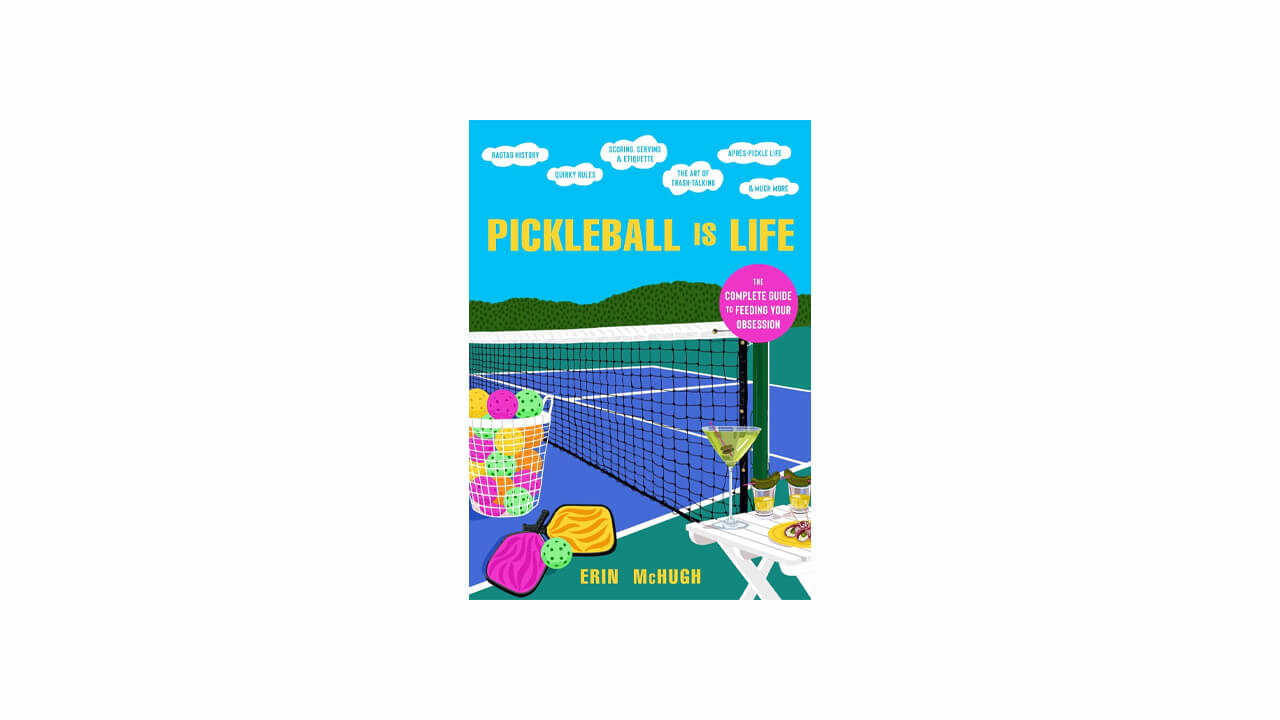
Pickleball Is Life Pickleball Is Life

  • Features: English Language, 160 Pages, Includes Info Graphs And Illustrations
  • Benefits: Focus On Etiquette Tips, DIY Court, Obscure Rules, And Pointers
9.8
Check on Amazon
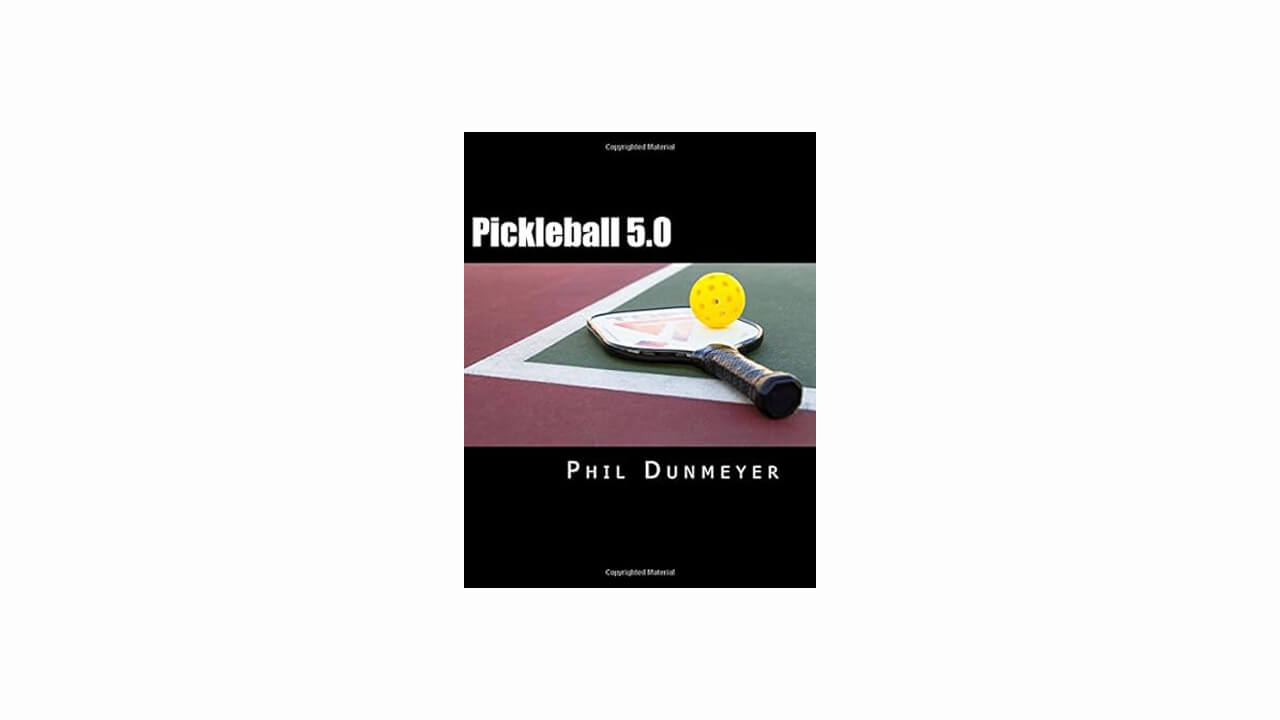
Pickleball 5.0 Pickleball 5.0

  • Features: English Language, 268 Pages, Includes Teaching And Instructional Ideas
  • Benefits: Focus On Pickleball Play And Strategies
9.7
Check on Amazon
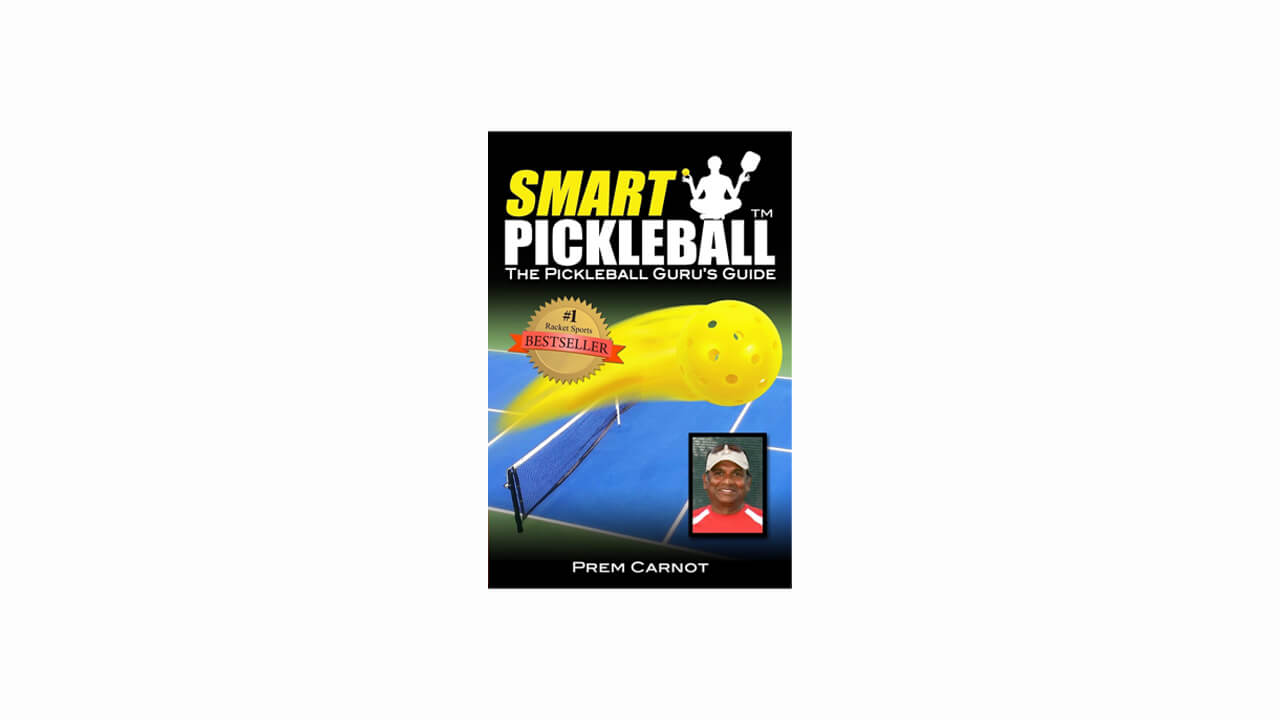
Smart Pickleball Smart Pickleball

  • Features: English Language, 166 Pages, Includes Diagrams, Drills, And A Captivating Allegorical Message
  • Benefits: Focus On Drills, Strategies & Shots
9.6
Check on Amazon
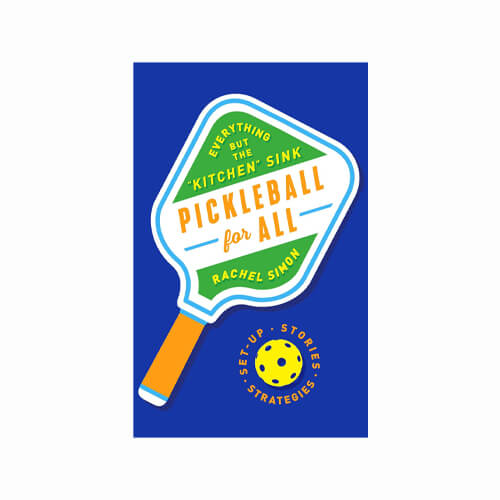
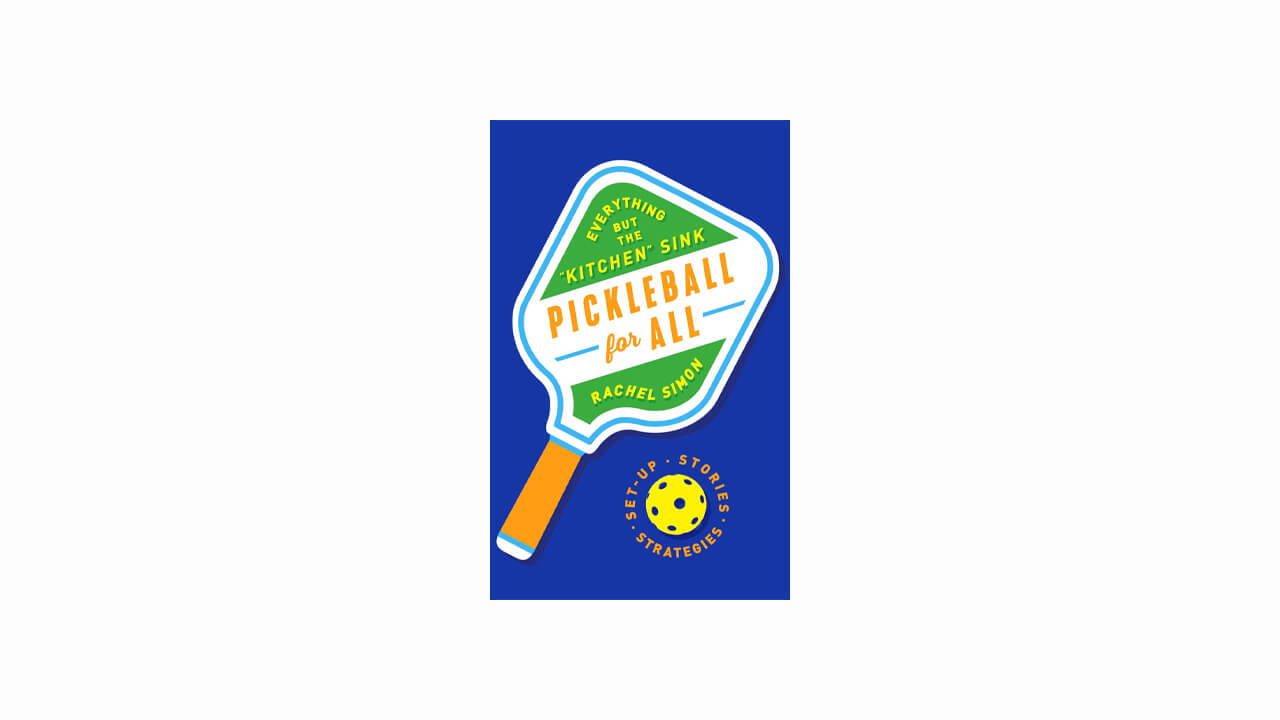
Pickleball For All Pickleball For All

  • Features: English Language, 208 Pages, Includes Court Instructions, Rules And Playing Tips
  • Benefits: Focus On Scoring, Gameplay, And Equipment
9.5
Check on Amazon
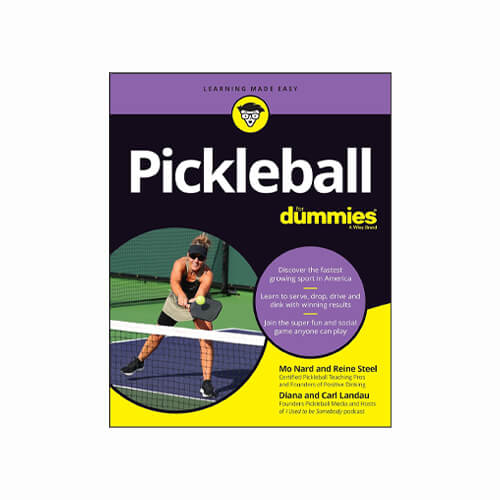
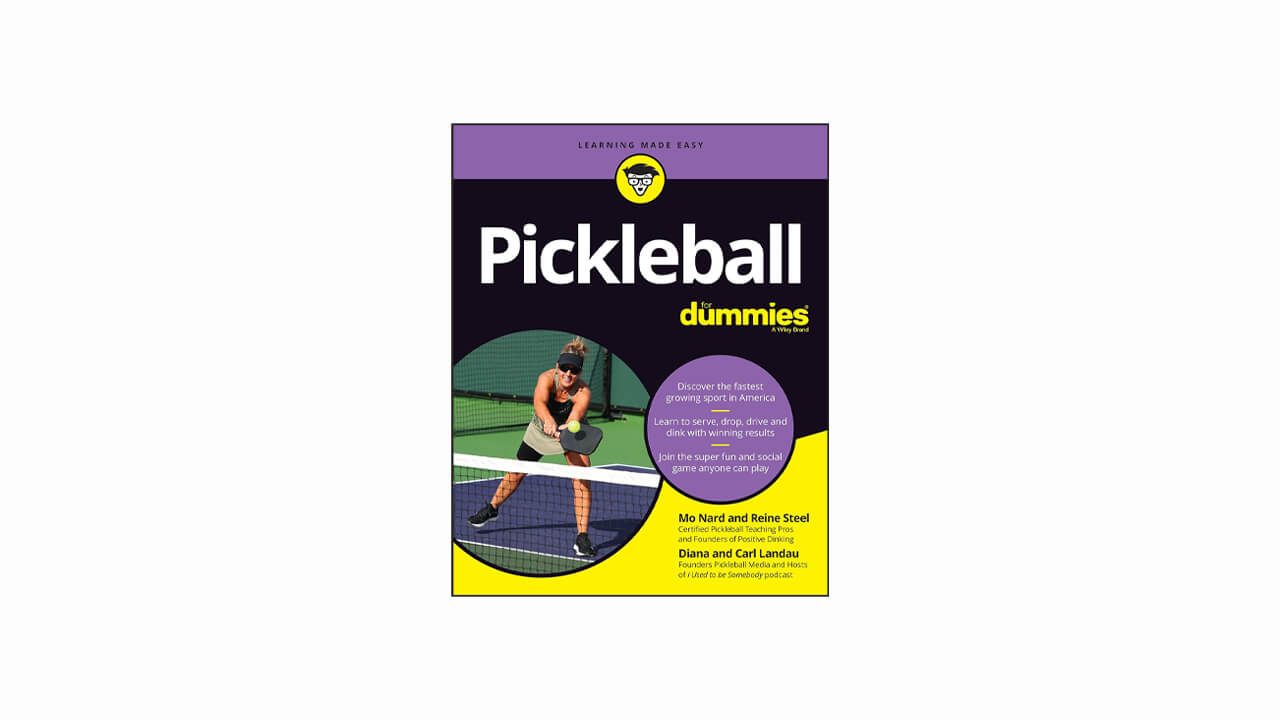
Pickleball For Dummies Pickleball For Dummies

  • Features: English Language, 448 Pages, Includes Tips And Tricks, Club Guide And Game Fundamentals
  • Benefits: Focus On Scoring, Serving, Dinking, And Places To Play
9.3
Check on Amazon
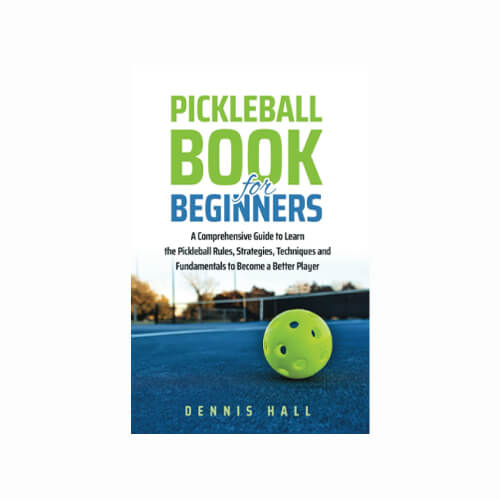
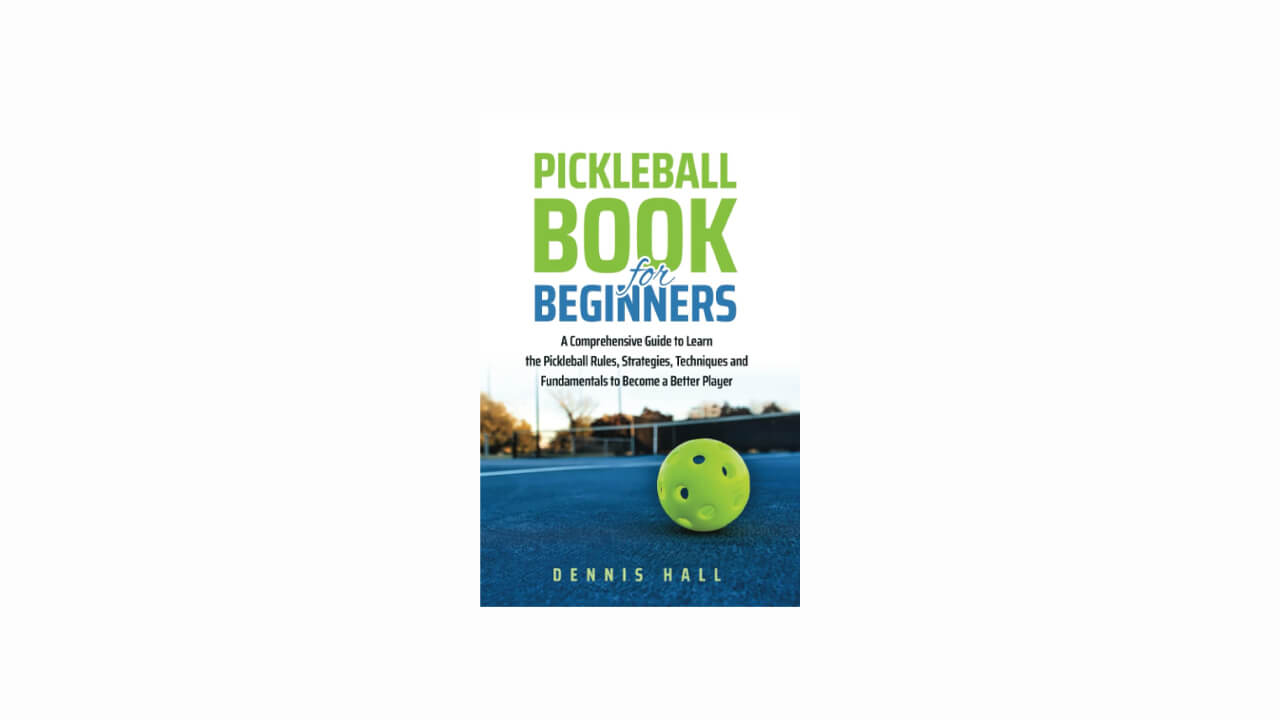
Pickleball Book For Beginners Pickleball Book For Beginners

  • Features: English Language, 106 Pages, Includes Graphs, Data And Game Rules
  • Benefits: Focus On Doubles Play, Mental Training, Gamesmanship, And Offensive And Defensive Strategy
8.9
Check on Amazon
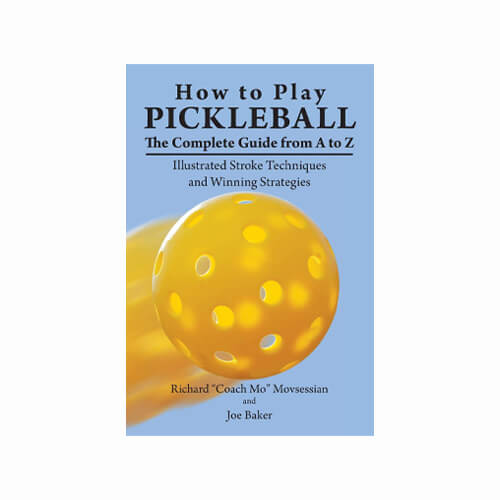
How To Play Pickleball How To Play Pickleball

  • Features: English Language, 246 Pages, Includes Photographs And Diagrams
  • Benefits: Focus On Shot Techniques, Player Movement, And Player Positioning
9.5
Check on Amazon
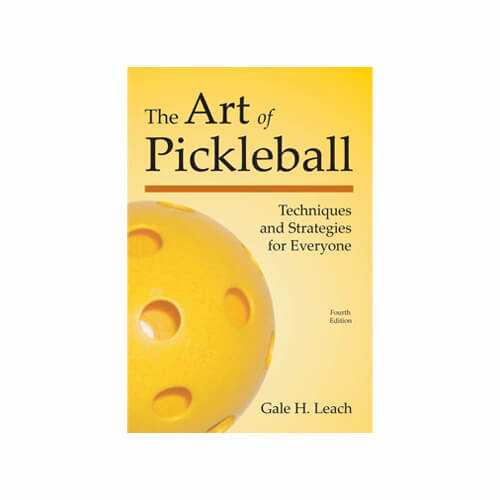
The Art Of Pickleball The Art Of Pickleball

  • Features: English Language, 295 Pages, Includes Numerous Photos, Illustrations, And Diagrams
  • Benefits: Focus On Winning Strategies For Singles And Doubles
8.7
Check on Amazon
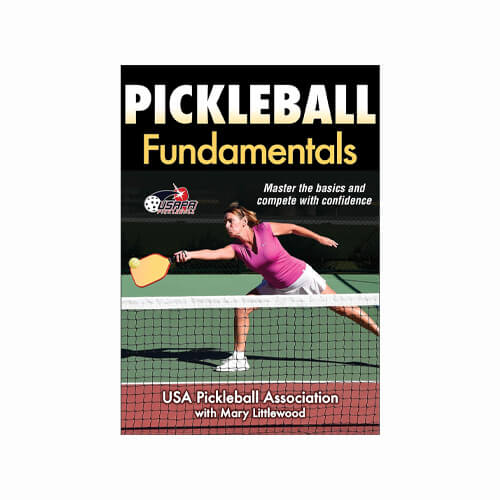
Pickleball Fundamentals Pickleball Fundamentals

  • Features: English Language, 176 Pages, Includes Pictures Or Diagrams
  • Benefits: Focus On Groundstroke, Serve And Return, Volley, Dink, Lob, Overhead Smash, And Drop
9.1
Check on Amazon
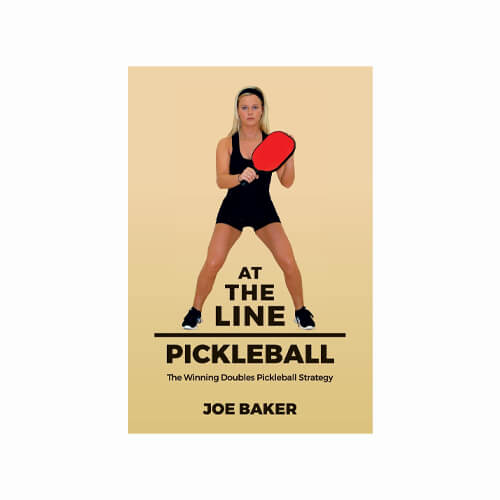
At The Line Pickleball At The Line Pickleball

  • Features: English Language, 159 Pages, Includes Quizzes, Chapter Tests And Illustrations
  • Benefits: Focus On Dinking Targets, Ball Striking Technique, And His Winning Philosophy
8.8
Check on Amazon

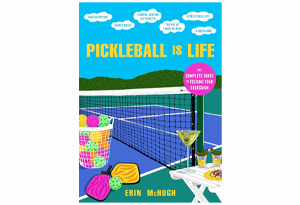
1. Pickleball Is Life: The Complete Guide To Feeding Your Obsession

Features

  • 160 pages
  • Author Erin McHugh
  • Cultural insight
  • Visual infographics

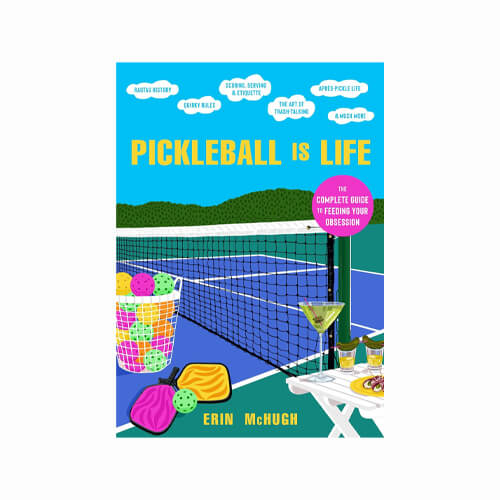
The first book that changed my life was Pickleball Is Life. It is such an interesting piece of art that I cannot explain it here. The thing I noticed is that the author has explained all the complexities in an entirely simple language that a novice can effortlessly understand.

Pickleball Is Life

Second, Erin McHugh writes in a fantastic way that one does not feel that he is reading a book but feels like someone is talking to the reader. The book is divided into 9 chapters: the history of pickleball and the equipment you should use to play the game, and the last one is Pickleball is Life.

The purpose is to address all the critical information in multiple chapters so that even a layman who reads it can become something more than a beginner player. I appreciate the simple collection of words and the visual graphics to make things easier and easier to understand for a reader. This book is a piece of art from all aspects.

Pros

  • Increase social interaction
  • Provides comprehensive details
  • Celebrity appeal

Cons

  • Too short

Can you imagine that Leonardo DiCaprio, the movie star, said words regarding this book because the author interviewed him, and he also mentioned it in the book? That is because of his love for pickleball and his experience regarding the game. Everything is available in this book; read this one of the best pickleball books and become an expert.

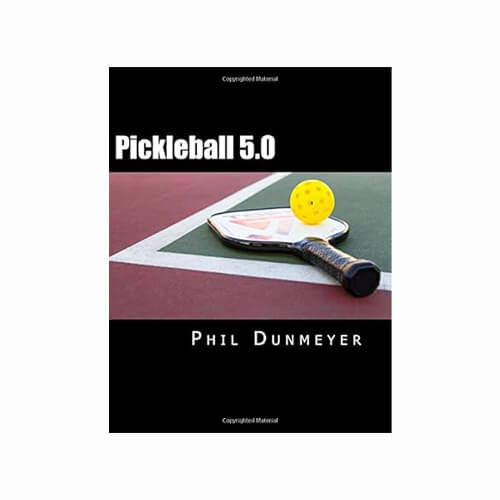
2. Pickleball 5.0: A Journey From 2.0 To 5.0

Features

  • Concise writing style
  • Skill enhancement
  • Author Phil Dunmeyer
  • Pages 268

Over 20 years, our beloved coach and certified instructor, Phil Dunmeyer, wrote a masterpiece that has changed the lives of millions of pickleball players. He is one of those people who have both abilities: a perfect body with a sound mind; he plays well, and he writes awesomely.

Pickleball 5.0

I love this book because the author uses simple language to explain complicated techniques. He describes how one can play well by learning two to three strokes, and then he addresses the techniques he has discovered throughout his lifetime.

The book is divided into 12 chapters, from the basics of pickleball to pickleball at a higher level and the book’s conclusion. The author focuses on the physical health of the players and urges them to invest in their bodies and build a tough mindset because nothing can make you a winner except these two things.

Pros

  • Interesting stories
  • Interviews with professional players
  • Technique mastery

Cons

  • Boring title

It is one of the best pickleball books for beginners that can change your mentality within a few weeks. The author is an expert at helping people discover their true sports selves and polish their pickleball skills. Once you start reading it, you will be unable to stop yourself.

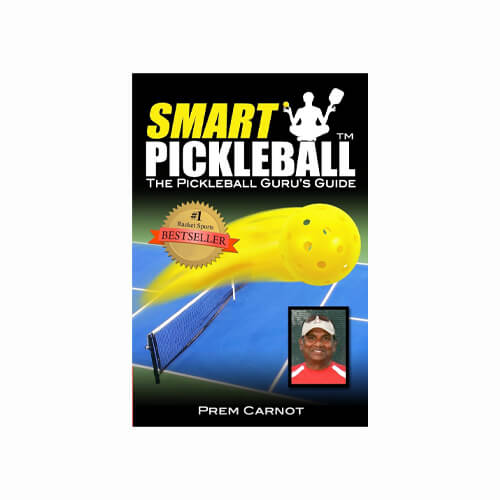
3. Smart Pickleball: The Pickleball Guru’s Guide

Features

  • In-depth expertise
  • Unique teaching style
  • Listening length 3 hours 55 minutes
  • Practice advises

Another book that is worth reading is Smart Pickleball: The Pickleball Guru’s Guide, probably the best book on developing a rigid mindset. The thing I like in this book is that the author addresses that pickleball is not all about the physical game, but it also requires your psychic energy to win the game.

Smart Pickleball

Basically, the author says that playing smart instead of playing hard will help you win the game without putting in more effort. This author addresses different techniques to trick the opponent mentally and pressure the opponent instead of hitting the pickleball ball with full strength or jumping more in the game.

I love how Prem Carnot teaches because his way of telling complicated things is entirely different. After reading these books on pickleball, I understood what is the difference between us and professional players. They play mind games, and we focus on the speed or length of the shots.

Pros

  • Easy to understand
  • Engaging quotes
  • Simple language

Cons

  • Author centric

If something insists you bring a change in your traditional ways, then nothing can stop you from becoming unstoppable. This book has a quality that you will feel a change in yourself when you finish reading it. So why should one not read it as soon as possible and see the positive self-change?

4. Pickleball For All: Everything But The “Kitchen” Sink

Features

  • Pages 208
  • Comprehensive overview
  • Celebrity endorsement
  • Simple to follow steps guides

Being a reader and sports lover, I know the worth of a book that genuinely leads its readers to a path where they meet success. The purpose of reading sports books is not to get enjoyment but to improve sports skills. In this quest, a book that can help you see the path to success is Pickleball for All: Everything but the “Kitchen” Sink.

Pickleball For All

It is one of the best pickleball strategy books, which is written in a traditional plus modern way. Basically, the book teaches about pickleball, simply addressing the terminologies. In this way, it promotes pickleball culture and helps the audience without making things complicated.

The line that still makes me smile as I recall the book is of the author, Rachel Simon. “ Pickleball is a game easy to learn and difficult to master.” The author informs about the game’s complexities in such a witty way that one feels like he is reading a wisdom book. Lastly, the book is only 208 pages, so you can finish it in a week if you read 60 pages daily.

Pros

  • Witty language
  • Traditional teaching style
  • Deep research

Cons

  • Author bias

We cannot experience multiple realities without reading the minds of others, and reading a book is equal to reading a new mind. This book is not only for pickleball fans but for all of those who want to gain more and more knowledge. So, bring this one of the best pickleball books and enjoy reading.

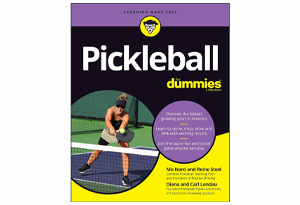
5. Pickleball For Dummies: Pickleball Made Easy

Features

  • Understanding rules
  • Finding courts
  • The social side of pickleball
  • Page 448

It is important to mention a formal book that leads everything about the game from the first day of pickleball on Earth to the current day. Therefore, I am presenting my favorite study, Pickleball For Dummies, known for the basics of the sport.

Pickleball For Dummies

The thing I like about this book is that it is a masterpiece covering all the areas of pickleball, from finding courts to understanding the rules and ethics of the game. It addresses all possible scenarios of pickleball in the future, plus the book addresses that the game is about to become part of the Olympics.

There are a lot of things mentioned in the book beyond our understanding regarding pickleball in this hardcover of 448 pages. Furthermore, the book is written by multiple pickleball experts, with Reine Steel and Mo Nard at the top of the list of pickleball experts.

Pros

  • Detailed work
  • All about the game
  • For all levels of players

Cons

  • Formal writing style

Sometimes, we do not need to polish our bodies but improve our knowledge of the sport. Pickleball For Dummies teaches the same thing: how we can use mental toughness in daily life to conquer the courts and become champions of the leagues.

6. Pickleball Book For Beginners: Mastering The Game Of Pickleball

Features

  • Pages 106
  • Author Dennis Hall
  • Coaching insights
  • Mental training

Dennis Hall has changed millions of lives with his powerful words and exceptional way of writing. His book of 106 pages is a complete guide on how to play pickleball to the mental training for pickleball in which he addresses that mental training is as essential as physical training.

Pickleball Book For Beginners

The purpose of this book is to teach readers how to build a healthy body and sound mind to defeat opponents. He instructs that pickleball is a game to win but also a way to socialize, make new friends, and exercise without much effort by playing pickleball. This is the best gift for beginner players.

His coaching insights are the best way to become a pickleball beast. If you are a beginner and unable to improve your pickleball skills, then it is a wise decision to read this book. I finished it within a day and reread it multiple times; however, you can also become successful by getting this masterpiece.

Pros

  • Teaches teamwork
  • Explores the fun side of pickleball
  • Engaging stories

Cons

  • Short book

As a professional pickleball player, I know how influential this book is for beginners. I wonder if I read it at the beginning of my career and if I could perform better and acquire this position sooner than now. Do not miss the chance to read this one of the best pickleball books.

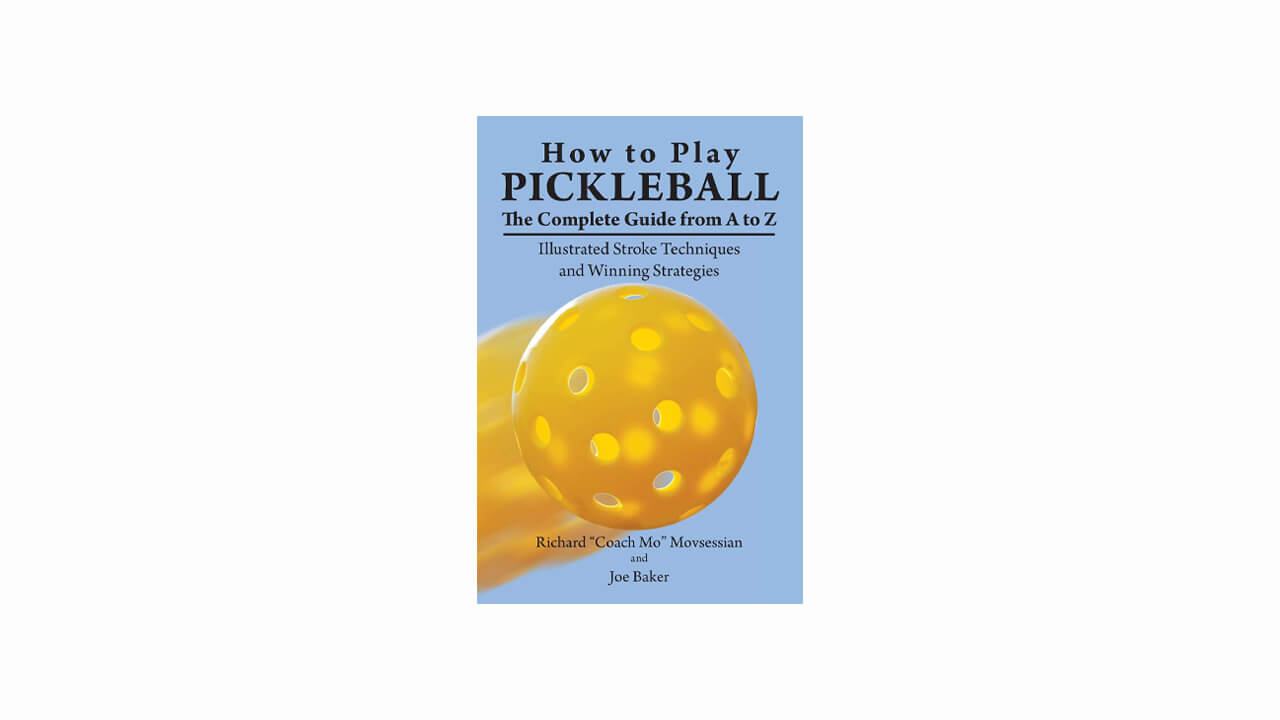
7. How To Play Pickleball: The Complete Guide From A to Z

Features

  • For all skill levels
  • Pages 246
  • Rule explanation
  • Advanced Coaching

The guide is incomplete without mentioning a book known for techniques and strokes. I am talking about How to Play Pickleball: The Complete Guide from A to Z. This book covers all the aspects and tells everything related to pickleball. It starts with history, and the ending has exciting stories.

How To Play Pickleball

I am mentioning this book for two major reasons. First, it is perfect for beginners to learn the fundamentals of pickleball. Second, the authors have conducted comprehensive research before writing the book.

I have been playing pickleball for years, and when someone asks me for tips and techniques, I recommend this book. The remarkable thing is that the book is for all levels of people, from beginner to intermediate and advanced pickleball players. The book is short; you can finish reading it within a few days.

Pros

  • Smart delivery
  • Focus on basics
  • Effective addressing style

Cons

  • Limited techniques are mentioned

Some people think they have been playing for years, so they do not need improvement as they know everything about the game. That is not true because I also had the same beliefs before reading this hardcover, but this one of the best pickleball books changed my mentality, made me a favorite player, and insisted I improve till the last day of my career.

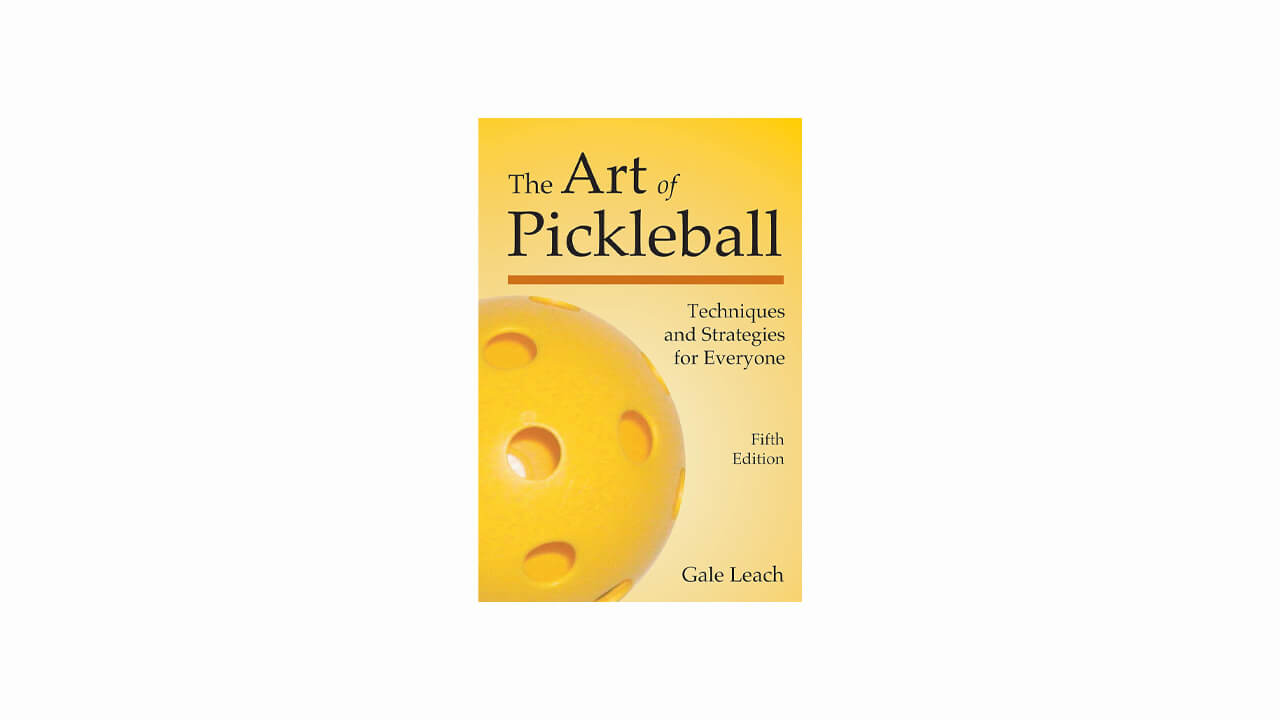
8. The Art Of Pickleball: Techniques And Strategies For Everyone

Features

  • Tournament preparation
  • Paddle guidance
  • Infographics
  • Pages 295

In the beginning, I used to play pickleball randomly with the players for fun, but later, I discovered that the urge to play this game never ended, so I selected pickleball as a career. However, because of fear of rejection, I did not give auditions to the pickleball clubs. At that time, I found this book from a library that insisted I get a club pass.

The Art Of Pickleball

The book is a comprehensive work on how to play pickleball to build a pickleball network and a career in pickleball. The book addresses all dimensions of the players, their development, the passion to improve more, and the enthusiasm a player requires to become the world’s best.

The book is a bit longer than the traditional pickleball books, but it presents a complete guide from day one to the last day of the national award. This book focuses on using efficient equipment to win the game, as the author instructs that choosing the best paddle guarantees success.

Pros

  • Latest researches
  • Interesting writing style
  • Social enhancement

Cons

  • Lengthy

Choosing what to read this week is your choice, but if that reading can also help you become a famous personality, it is called luck crafting. To become lucky, you have to find an opportunity to prove yourself, and this book can show you how to avail yourself of opportunities.

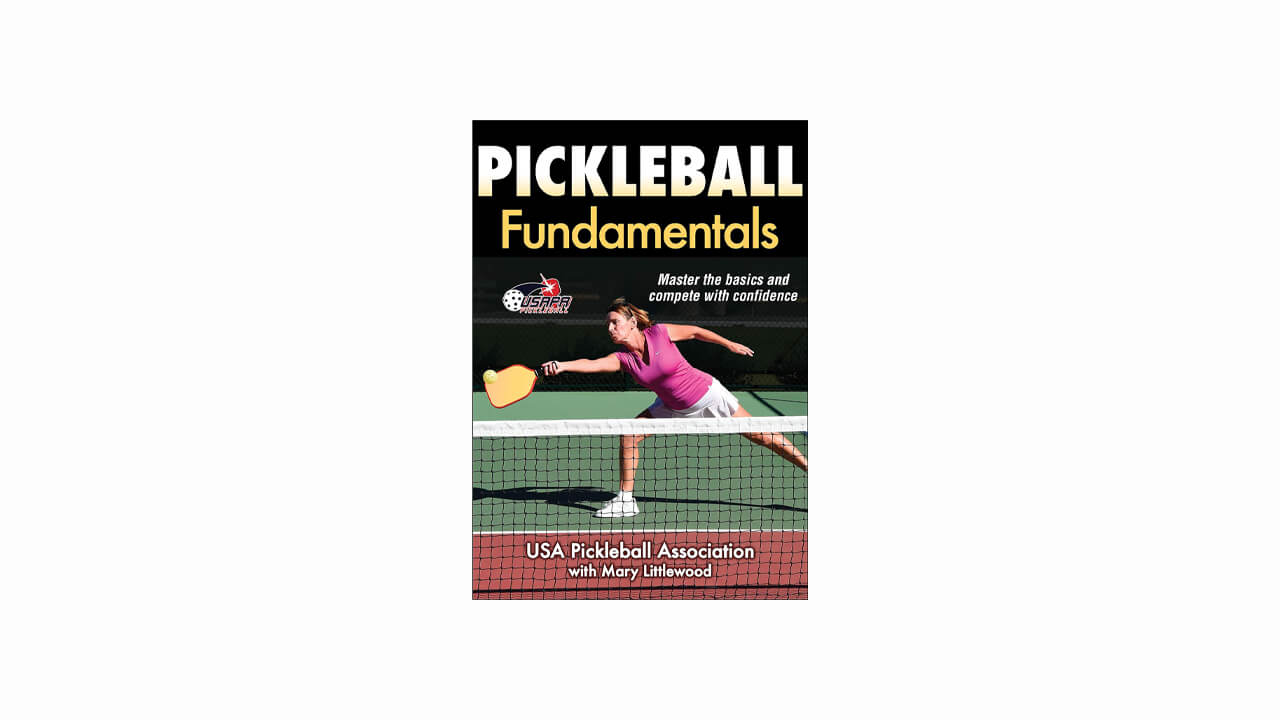
9. Pickleball Fundamentals: Familiarize Yourself With The Fundamentals

Features

  • Visual guide
  • Rules and ethics
  • Beginner focused
  • Pages 176

My second last recommendation for beginners is a book with all the pickleball basics, the Pickleball Fundamentals. The book is designed for people who have just started playing pickleball and are struggling to learn the rules and principles of the sport.

Pickleball Fundamentals

The book starts with the court dimensions and the types of paddles and takes the reader to the court positioning strategies. This book presents an overview of smart pickleball strategies and enables the reader to focus on planning and smart gaming rather than hard hits.

Further, the book encourages players to start practice again who have lost self-esteem because of failure. Actually, the main aim of this book is to associate the reader with practice and teach him the significance of practicing pickleball; it states that the more you practice, the better you perform.

Pros

  • Simple language
  • Fewer terminologies
  • Experienced author

Cons

  • Only for beginners

Playing pickleball is not difficult until you have knowledge related to the basics of pickleball. The game is indeed simple to play, but when it comes to the tournaments and leagues, all tiny complexities matter to the players. So do not take risks and bring this one of the best pickleball books to rock the court.

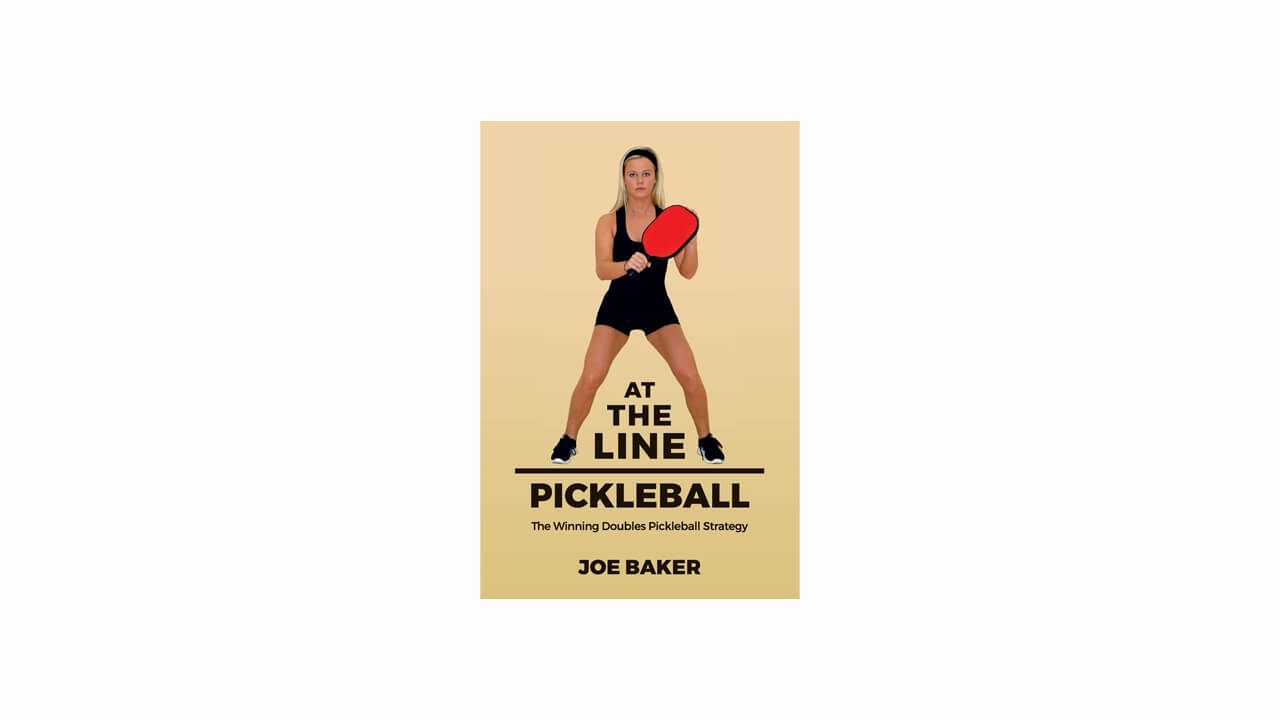
10. At The Line Pickleball: The Winning Doubles Pickleball Strategy

Features

  • Teaches teamwork
  • Diagrams and infographics
  • Dinking strategies
  • Pages 159

The last book that can positively change your life is the At the Line Pickleball: The Winning Doubles Pickleball Strategy. The pickleball rules book is for all levels of pickleball players, but it is ideal for doubles. The book focuses on the double player’s strategies.

At The Line Pickleball

From the beginning to the end, Joe Baker informs its readers how they can change the game by changing their strategies. The best technique I often use in my matches is “use the middle of the court” and “stay together and communicate more between players.”

I have seen that the teams with no teamwork always lose the match, whereas if you see a perfect team, it indicates that they will win the game. Joe Baker teaches the same by addressing how teamwork can help you win the game more easily.

Pros

  • Deep research
  • Concise work
  • Beginner friendly

Cons

  • Focus on strategies on doubles only

The book teaches that pickleball is not a game in which the team in front of you is your opponent but a way to enjoy life. He addresses that pickleball is more like fun rather than a die-try game. Anyhow, bring this best pickleball book and start enjoying the game.

Frequently Asked Question

What Is The Best Way To Learn Pickleball?

The best way to learn pickleball is by watching tutorials, reading related books, and joining an apprenticeship of the senior player.

Is It Hard To Be Good At Pickleball?

No, pickleball is not a hard game; it is the most simple to play game. A player enjoys the game more than the urge to defeat the other person.

How To Get Better At Pickleball?

Improving your pickleball skills involves a blend of practice and strategy. Focus on refining your serve and return shots and dinks. Work on positioning and improve footwork to enhance your ability to reach and return shots effectively. Also, communication with your partner and practicing mindfulness will help your pickleball game.

Final Thoughts

Pickleball has emerged as the fastest-growing sport all around the world, and in America, the game has proved that it has more following than others. If you are interested in playing pickleball but have no idea how it works, reading a book on the topic can help you gather essential information.

That’s why I mentioned the best books on pickleball. Read them and become an expert; however, if you are confused about picking one, then see my two favorites:

  1. Pickleball Is Life addresses how one should focus on polishing skills and what are the best ways to improve pickleball.
  2. Pickleball For Dummies informs about everything from the use of paddles to teamwork and the rules of pickleball in a formal language.
  3. At The Line Pickleball is an excellent choice if you want to learn the best pickleball strategy used by top players for winning doubles.
EDITOR’S CHOICE
Pickleball Is Life
Pickleball Is Life


  • Best For Tips, Court Rules, And Etiquettes
  • Best For All-Age Players
  • Written By Erin McHugh
Check On Amazon
PREMIUM PICK
Pickleball For Dummies


  • Best For Scoring, Serving, And Dinking
  • Best For All-Age Players
  • Written By Carl Landau And Mo Nard
Check On Amazon
BUDGET PICK
At The Line Pickleball


  • Best For Dinking, Ball Striking, And Game Philosophy
  • Best For All-Age Players
  • Written By Joe Baker
Check On Amazon


Other Related Posts:
  • Best Shoes For Pickleball
  • Tennis Vs Pickleball
  • Pickleball Rating Chart
  • Best Pickleball Ball Machines
  • Best Portable Pickleball Nets


Jeena Noven, Pickleballcard Author
Jeena Noven

I, Jeena Noven, am a renowned pickleball expert and author with over 10 years of experience playing and coaching the sport. My passion and extensive knowledge of pickleball has made me a leading authority in the game, particularly in the field of footwear. I have written countless articles for https://pickleballcard.com/, a website dedicated to pickleball, sharing my insights and expertise on the best shoes for the sport. Through personal testing and reviewing countless different brands and styles, I have developed a deep understanding of the technical aspects of shoe design that make them suitable for the demands of pickleball. In my articles, I provide valuable information for both beginner and advanced players, covering everything from the basics of shoe fit and support, to advanced tips for maximizing performance on the court. As a dedicated pickleball player and expert in footwear, I am a valuable resource for players of all levels. My articles are not only informative but also engaging, making them a must-read for anyone looking to improve their pickleball game. I am constantly researching new products and trends in the industry and my readers can always count on me to provide the most up-to-date and accurate information on the best pickleball shoes available.

Filed Under: About Pickleball

Serving Rules In Pickleball | How To Serve In Pickleball?

May 1, 2024 by Sadaf Awan Leave a Comment

Serving Rules In Pickleball

Pickleball has its recognition on its own. Those familiar with its playing activity might know its rules and regulations significantly. It might be difficult for beginners to understand the scoring and serving factors.

They are not tough to get in, but the players find it hard because they are at fault and accept it. Slow and steady, they reach out when they are skillful in the playing action and efficient enough to keep an eye on serving and scoring points.

To provide you with a thorough understanding in a very comprehensive way, here we are going to elaborate on Serving Rules in Pickleball. So before featuring the playing action, you might be familiar with the serving rules.

Pickleball Serving Rules

These rules will be beneficial for making you proficient in professional playing activities. To cover most of the aspects regarding serving rules in pickleball for beginners, let’s find out the details below;

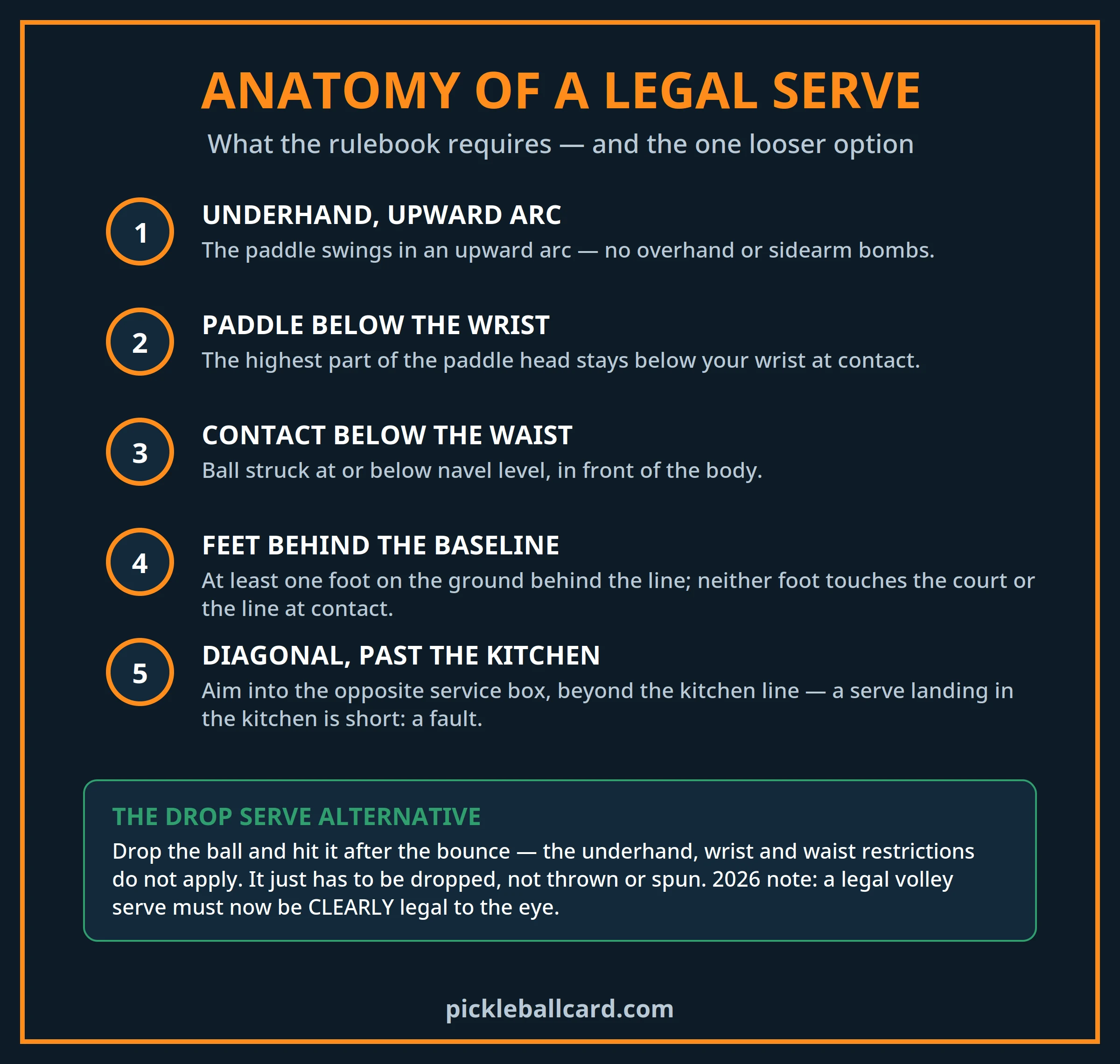
Anatomy of a legal pickleball serve: underhand arc, paddle below the wrist, contact below the waist
The five requirements of a legal volley serve — plus the drop serve alternative.

How to Serve in Pickleball?

The serving rule in pickleball is unique from other games, requiring keen precision and accuracy to pass it over. To serve the ball;

  • The layer must accompany the correct position. The team member will decide the player’s position on the court for service, whether they are playing as a single or double. Moreover, the player also gets the position per the scoring points on the board. One side with more points over the table is called the chance to serve first.
  • The next task is all the scores. You, the player, must call the pickleball score before serving the ball. It is essential. Otherwise, it will be counted as a fault.
  • Once the score is called out, calm down and take a deep breath. T is significant before shooting a free throw. It also helps you to maintain your serving angle.
  • Regarding free throws, it is never allowed to drop the ball harshly. Also, please do not throw it up to wing it entirely; refer it to the opposite side with full support and confidence.
  • Afterward, the next task is the paddle movement. Swing your paddle stick under the head. Make contact between the paddle and ball, so both are straight in front of your body.
  • This swig is the ultimate point when the ball will move ahead apart from you. It should have a smooth but strong flow towards the opposite side.
  • They will swing it back toward you once it reaches the opponent’s side. The whole process takes seconds or more if you are proficient.
  • You might be quicker and more active enough to deal with the situation without stressing yourself.

This is the complete serving process. But this process differentiates between the single and double serving of the players. In a single serving, both sides have only one player. They are playing individually. But then dual perspective has a team strength and plays togetherly to cope with the serving.

Pickleball Single Serving Rules

The singles serving rule is a crucial point to get into for understanding. In this rule, every player on the server points the ball until the side loses one point on the scoreboard. To fulfill the turns, players switch positions after every serving.

Moreover, before serving the ball, have a call-out score. Moreover, you will benefit from the right side of your score points even in the number. But the serving will be from the left side of the issues are odd in numbers.

Pickleball Doubles Serving Rules

As in doubles, a completely manageable team exists on both sides, and players are not lying individually. So, every player on the serving side can legally pickleball serve the ball before passing the serving opportunity to the opponent team.

The serving begins from the right side of the side, always for serving rules in pickleball doubles. The ball starts passing to the players from the right side downward. In this way, each team player gets an equal chance to respond to the serving.

It is a bit difficult to understand the player because every player on the team is lined with different standing positions and has a different responding attitude. It isn’t straightforward to decide which layer goes first. So, the best way to get a comprehensive understanding is to seek the guidance of a pro player.

Pickleball Serve Rules

Apart from the rule justification, there are different types of serves. These types are beneficial in deciding the working of the players. Moreover, this factor will limit the confusion about the pickleball doubles serving rules. Through these types of recognition, a satisfactory answer will be found for Who will start serving.

Types of Servers

Serving is one of the essential horizons of playing pickleball because the scoring board activity depends upon the serving activity. At the same time, the whole of the serving instinct depends upon the server.

From deeper analysis, we find that there are three major types of service.

  • High Soft Serve

The high-soft serve is the point at which you hit a high circular segment, specifically into the court side of the opponent. This service can be utilized at any level, from fledgling to 5.0. For more detailed depth, you can research pickleball levels.

It is very versatile, and you will find a ton of assortment with this service, making it extraordinary for changing the game’s speed. Also, with this, you can keep your rival under stress. You can point your high-delicate service to the back or front of the service region. This can be utilized and helpful to put your rival in action, get them out of position, and set up your next shot.

  • Power Serve

The power serve has a low, quick, and more profound impact on the opponent’s court. To stir it up, you can go for the front head corner. The front head corner is also striking; you can directly power strike the serve onto your opponent. The power serves are more powerful to pull off than the high-soft serve. But still, it is a fundamental service if you want to improve your game in terms of being a beginner.

  • Soft Angle Serve

The soft-angle serve is the last one of the three fundamental serves. This type is the mixture of the other two types and is used to stir up the game’s work. This shot drops or serves the ball close to the kitchen line and the sideline.

Indeed, the bouncing would take the ball beyond the court. The soft-angle serve is the most troublesome of the three fundamental serves because the objective is to hold back nothing but power.

The double-bounce rule is always worth considering to keep all these services in angle and compensate for the discrimination in serving. The government implies that;

Double-Bouncing Rule

This rule is very significant and has vital importance in pickleball. It tends to balance the neutrality of the ball over the court for both sides. This bouncing rule is specially lined with the pickleball drop serve governments.

According to this, the ball serving from the server’s side and the opposite side must be a groundstroke. This ground stroke will keep the whole game in precise action. Moreover, during this ground stroke, the ball must bounce once before returning to the opponent.

In this way, the passage and return cycle continues until one scores a point. Once the return is completed, the player can volley the ball. You must heat the ball before turning it to the ground in the volley zone. But if the ground bouncing continues without restriction, it will not be counted as a volley. The empire will consider its groundstroke throughout.

Pickleball Drop Serve Rules

Apart from the discussion above, you must remember the three rules to serving in pickleball; it will help you do justice with your gaming action.

  • The pickleball serving must comprise only upward motion stunts on average rule discussion level.
  • While serving the ball, the paddle movement should be aligned. It makes contact with your ball right below your waist level.
  • To maintain this position, hold the paddle so that the head of the paddle is already in the line below your waist level.

Rather than having a lot of chances, you will be allowed to shoot the ball for once. This is the legal pickleball serving implementation for the overall consideration.

People Also Ask

What Is The Two-Shot Rule In Pickleball?

When the ball is served, the receiving team must let it bounce before returning, and the serving team must let it bounce before returning; thus, it becomes two bounces or two shots in pickleball.

What Is The No Volley Zone In Pickleball?

Along the pickleball net, the 7-foot area on both sides of the court is called a non-volley zone or pickleball kitchen zone. Volleying is prohibited within the kitchen or non-volley zone.

What Is The Starting Score Of A Doubles Pickleball Game?

The starting score of a pickleball double is Zero, Zero, Two. This means the receiving team will get a serve when the serving team commits a fault. These numbers will apply for that service turn only.

When Do You Switch Sides In Pickleball?

After the first game, the players will switch sides. If time is short, the game is played for up to 15 points. In serving, the first serve is made from the right side, but after the first score, the players switch their sides, and the server initiates the next serve from the left side.

How To Serve In Pickleball For Beginners?

As a beginner pickleball player, you must learn 3 basic serving rules. First, You can’t touch the baseline. Second, you must hit the ball by the following volley or drop serve conditions. Third, you should hit the quadrant diagonal by never landing in a non-volley zone.

Does The Ball Have To Bounce In Pickleball?

No, the ball doesn’t have to bounce in pickleball. In pickleball, you have to hit the ball in the air before letting it bounce, called a volley. You should be careful while volleying and keep your feet behind from the non-volley zone.

Who Serves First In Pickleball Doubles?

In pickleball doubles, either of two losers serves first or two winners serve first, but the first serve must take place from the right-hand side. After the first serve, the receiving team will continue to serve, until they make a fault. The team that serves to start the game will only get one serve.

How Do You Determine Which Side Serves First In Pickleball?

Players on the right side of the court serve first to the opposite side in pickleball. After scoring a point, players move to the left side of the court. This applies to both singles and doubles pickleball.

What Changed in the 2026 Serving Rules

The 2026 USA Pickleball rulebook tightened how the volley serve is judged. The serve has always had to be an underhand motion with the paddle below the wrist and contact below the waist — the updated wording now stresses that this must be clearly the case, which gives referees (and honest opponents) a firmer basis for calling a borderline serve. Spin got clarified too: spin imparted by the paddle at contact is fine, but spinning the ball with your fingers before contact to add extra rotation is not. If your serve lives near the line on either rule, the safe fix is the drop serve: bounce the ball and hit it after the bounce, with none of the volley-serve restrictions applying. It has been fully legal for years and remains the most repeatable serve for developing players. See also how scoring works in rally scoring and the full how to play pickleball guide.

Conclusion

Serving rules in Pickleball always ask for practice by the players. It won’t allow you to go for the same shot repeatedly. Once you get the essential drop serve rule, playing on the serving side would be elementary.


Other Related Posts:
  • Pickleball Tips
  • Pickleball History
  • Best Shoes For Pickleball
  • Different Terminology Of Pickleball
  • Portable Vs Permanent Pickleball Net


Author Profile Picture Of Sadaf Awan
Sadaf Awan

The writer is a biologist by profession but has a spark for writing and giving life to her words. She’s been in the field for the last 4 years and has so many achievements in her name. She loves to write about sports. Her recent experiences are in niches like football, pickleball, baseball, golf, car racing, tennis, table tennis, etc.
Filed Under: About Pickleball

Pickleball Machine Drills To Improve Your Game

April 30, 2024 by Jeena Noven Leave a Comment

Explore how we can use a pickleball practice machine for training and learn methods to drill beginner, intermediate, and advanced-level shots.

Beginners frequently complain that they cannot find pickleball practice partners but now the training has become easy as one can use the pickleball practice machine. It is a tireless couch that helps you train and improve muscle memory for pickleball. Practice is the only way to transform from a beginner to an advanced player, but practice partners are not available 24/7.

On the other hand, you can use the practicing machine that can help you increase the level of your game and make you an efficient pickleball player. Being a pickleball coach, I can understand the problems most pickleball players face but pickleball machine drills can pave the way to success. Come with me to explore techniques, strategies, and drills to improve your level in pickleball with the help of a training machine.

Why Do You Need A Pickleball Machine?

There are various reasons why you need to purchase and use a pickleball machine. Firstly, it is a tireless coach that can help you practice whether it is midnight or early in the morning.

You can use the machine to practice anytime based on your routine. The majority of people complain that they do not play pickleball because they cannot invest additional time in the beginning to learn the game.

But you do not need to spare hours from your busy routine as you can use pickleball practice machines to learn basic tactics. Secondly, it can reduce the cost of hiring a coach and joining a club. Couches charge hundreds of bucks monthly to train beginners as well as they give limited time but if you have a pickleball practice machine, you do not need to manage the budget as well as you can use it for hours.

Thirdly, you can change the settings of your machine according to your level. Let’s say, you are a beginner who started playing pickleball for the first time; therefore, you are hesitating to use the paddle in the group of advanced pickleball players or the presence of your coach. But if you have a machine, you can practice in the back of your house, train yourself alone in the beginning, and change the difficulty level to increase the intensity, speed, and height of the ball.

How To Use Pickleball Machine For Drill?

Practice machine makes life easy by eliminating the need for a practice partner. The purpose of the machine is to improve the level of the player by allowing him to practice for hours. We can use the machine as a beginner as well as intermediate and advanced players can use it.

How Does Practice Machine Work? The machine is designed in a way that feeds the ball to throw it towards the player. It fires the ball at a certain speed, and trajectory, and with a consistent rhythm. There are further types of practice machines such as oscillating and programmable machines which we can use for various purposes.

Pickleball Machine Drills For Beginners

As I have mentioned above, all levels of players can use the machine for practice. Some experts object to beginners using a practice machine because they think that at the start of a game learning, we should play with human partners rather than machines. They say that machines have limited strategies and maneuvering plans while others claim that machines are good for learning the basics of pickleball.

It is true that machines have limited strategies and cannot maneuver like humans but still, we can use machines to learn pickleball. Beginners can learn basics such as forehand drills, backhand, and groundstrokes or dink shots. Let’s explore how to use machines to learn beginner-level techniques.

Forehand Drive

Forehand is a fundamental shot in pickleball often used at the beginning of the game just like tennis. Practicing forehand is the most important part of a beginner’s quest to learn pickleball. You can use a pickleball practice machine to drill the forehand dive, all you need is to set the machine next to the net in front of you.

Do not set the machine at the end of the court, always set it in the middle of the baseline for effective results. Once you are done with the placement, change the feeding setting at two-second intervals so you can effortlessly play the ball one after another. In my opinion, a two-second interval is ideal for beginners but if you still find it difficult to play then increase the interval duration.

Pickleball Forehand Drive

Grip the paddle with balanced force and slightly bend your knees then prepare yourself to hit the ball. Your focus plays an important role in the game; therefore, be attentive as the machine starts firing the ball. First start learning to hit the ball with the sweet spot of the paddle in a particular direction then change direction and start playing spinning shots.

Backhand Drive

Another shot that can transform you from a beginner to an advanced player is the backhand drive, one of the most played shots in pickleball. In the beginning, it is very difficult to play the backhand shot but one can improve by persistently practicing. Backhand is a dink volley shot that can spin the ball at high speed and is hard to catch for an opponent.

To learn backhand you need to place the machine in the middle of the baseline and set it at the two-second interval. Backhand is difficult to play for beginners but if you successfully learn it, you can use it not only for volley but in the middle of the game. You need to prepare yourself after setting the place and interval duration.

Pickleball Backhand Drive

Grip the paddle with both hands like holding a tennis racket, your dominant hand should be lower and tight while the second one is on the top of the bevel to control the paddle’s movement. Bend the knees slightly and hit the ball with maximum strength so that it goes high in the air on the opponent’s side. Practice hitting the ball without spinning and once you have learned the basics then use spinning.

Dink Shot

The above two are used in the middle but widely played at the beginning of the game. However, a shot that can be used in the middle or at the end of the match is a dinking shot which will not only make you a winner but also enable you to identify the weaknesses of the opponent. We can use a pickleball machine to learn the dink shots.

Set the machine in the middle of the baseline and change the ball fire speed to moderate. Start with the moderate-speed fire and then increase the speed when you think that you can handle the moderate-speed coming balls.

Intervals are also important to practice the dink shot so change the duration to 4 or 6 seconds in the beginning then shorten the intervals over time. Another factor you should notice while adjusting the settings is changing the elevation to low.

Grip the paddle softly, bend down your knees, and keep your focus on the ball. Hit the ball with minimum power so that it crosses your kitchen area and lands right after the net of your opponent. Keep the ball’s speed and height slow as well as target the cross-court side to conquer the kitchen area of your opponent.

Pickleball Machine Drills For Intermediate

Intermediate players can also get benefits by using the pickleball practice machine. Mostly, intermediate players are familiar with the forehand, backhand drives, and dink shots but they face a tough time playing the defensive and offensive lobs. Additionally, they can use a practice machine to drill the angle shots, now come with me to learn intermediate machine drills.

Lobs

Lobs are the high shots we can play to take the ball to the opponent’s side and land it in the middle of the baseline. Lobs are very useful if you play them smartly. There are two types of jobs you can learn with the help of a pickleball practicing machine: the offensive and defensive lob.

Offensive Lob

A heightened and deep delivery in cross-court direction targeting the end of the court to take the ball above the opponent’s head. Place the machine on the baseline on the other side of the net and change elevation to high, speed to fast, and duration to 3-second intervals. Use your paddle in a way that hits the ball up in the air at the maximum trajectory and in a cross-court direction then land it deep in your opponent’s area.

Defensive Lob

The purpose of an offensive lob is to make it difficult for the opponent to play the game while a defensive lob is played when we are losing control over the game. Follow the same instructions I mentioned in the Offensive Lob section, and hold the paddle softly. Hit the ball in an upward direction but with less force compared to the offensive lob and take the ball to the end of the baseline of your opponent’s area.

Angle Shots

Angle shots are as significant as the volley, dink, and lobs. Intermediate pickleball players focus on controlling the speed and the height of the ball but very few of them are familiar with the fact that angle plays a more pivotal role compared to speed and height. There is a list of the angle shots but all require similar practice.

  • Cross Court Shot: Set the machine in the middle of the line and change speed to moderate then practice hitting the ball in your opposite or diagonal direction.
  • Straight Line Shot: Set the machine in the middle of the baseline and increase the speed of the ball to high then practice hitting the ball straight in a line with moderate speed and desired elevation.
  • Drop Shot: Set the machine in the middle of the baseline and increase speed, decrease the height of the ball then practice landing the ball right after the kitchen area of your opponent while maintaining moderate force.

Pickleball Machine Drills For Advanced Players

Advanced players efficiently play all kinds of shots, lobs, and dives in various directions, maintaining speed, height, and angle. But they should practice deceptive shots, spin, and strategic dives. They can use a pickleball practice machine to drill these shots.

Deceptive Shots

We can turn any shot into a deceptive one by changing the body’s posture, position, and gripping style to hold the paddle. A deceptive shot is used to trick the opponent by portraying to him that you are about to miss the shot but unexpectedly hit the ball with proper strategy.

Learning deceptive shots is a long-term process in which you need to master position, posture, gripping, and strategy-making. Most professional and advanced players plan the entire game, identifying the weaknesses of the opponent and then launching deceptive shots based on the opponent’s downside.

Not all kinds of deceptive shots are useful as some players are good at detecting the deceptive and a normal shot while others require time to process the return so launch a shot based on all these conditions. You can practice by placing the machine in the middle of the baseline and adjusting the speed, elevation, and angles.

Your pickleball skills play a significant role in launching a deceptive shot but the expressions and body posture is more important. It is the body language that indirectly conveys to us the type of shot our opponent intends to play and if he can fake his body language, we cannot assess the incoming shot. Therefore work on your body language rather than polishing skills.

What Kind Of Machine Should You Use?

When it comes to the practice machine, we have two major choices: The Lobster pickleball machine and the Spinshot pickleball machine. Each is useful in its way but used for various purposes.

The Lobster machine drills are for the players interested in consistency and control. More precisely, these machines are for beginners and intermediate players while Spinshot machines are for advanced and professional pickleball players.

Lobster Pickleball Machine Drills

A Lobster Machine is perfect if you just started playing pickleball. These are simple-to-use machines designed for beginners who are drilling fundamental pickleball shots. The Lobster machine is used for learning consistency and control.

It has various futuristic features including oscillation and programming. The oscillation feature enables the machine to start firing the ball in a direction and change the angle or direction with each shot. The feature is very useful for beginners who are training to hit the ball while moving from one end to another.

Programming is a feature that helps you design the entire game with the machine. You can set the angles, elevation, speed, and intensity of the shots. Once you program the Lobster machine to fire according to certain instructions, it will throw balls following the program.

Spinshot Pickleball Machine Drills

If you are familiar with all kinds of fundamental shots, you can use the Spinshot Pickleball Machine. It is designed for advanced and professional-level players who lack the skills of topspin, backspin, and deceptive shots. The Spinshot pickleball machine has upgraded software compared to the Lobster machine.

Users can customize all kinds of features such as pace, trajectory, angles, flexibility, spin, and placement. It also offers upgraded oscillating and programming features compared to the Lobster machine.

It can throw the ball in various directions from left, right, or in the middle without letting the player know the ball’s next direction. Anyhow, you can choose one of them based on your game level and requirements.

Frequently Asked Questions

What Is The Maintenance Of A Pickleball Tutor?

A pickleball machine does not require maintenance like other sports, such as tennis or football tutor machines. However, the user should regularly clean the internal ball-throwing wheel for desired results if he uses the machine daily.

Can You Practice Pickleball At Home?

Yes, you can practice at home by using a pickleball machine. The machine does not require more room nor is it complicated to use. It is designed in a way that all levels of players can use it if they do not have a practice partner or cannot visit a court daily.

How Long Does A Lobster Battery Last?

The battery duration depends on multiple reasons, such as the way you use it, overall battery quality, or your game style. However, the average recorded duration is 3 to 4 hours.

Final Thoughts

Talent alone does not make someone a winner unless he works on polishing his skills and learning new techniques and tactics. Pickleball is a simple game for those who know how to play it, but it can become a nightmare if they visit the court without proper practice. The major problem people face is that their practice partners are not available 24/7, as well as coaches or trainers charge hundreds of bucks for 1 or 2 hours of training.

If you also have similar problems then I advise you to get a pickleball training machine and start drilling the shots. I have explained everything about pickleball machines and how you can use them for drilling. Whether you are a beginner or a professional player, you need to practice properly with dedication and repeat each shot again and again to learn it perfectly, so get a machine and start working on yourself.


Other Related Posts:
  • Best Pickleball Shoes
  • Rally Scoring Pickleball
  • Pickleball History
  • Is Pickleball In The Olympics?
  • Best Pickleball Shirts


Jeena Noven, Pickleballcard Author
Jeena Noven

I, Jeena Noven, am a renowned pickleball expert and author with over 10 years of experience playing and coaching the sport. My passion and extensive knowledge of pickleball has made me a leading authority in the game, particularly in the field of footwear. I have written countless articles for https://pickleballcard.com/, a website dedicated to pickleball, sharing my insights and expertise on the best shoes for the sport. Through personal testing and reviewing countless different brands and styles, I have developed a deep understanding of the technical aspects of shoe design that make them suitable for the demands of pickleball. In my articles, I provide valuable information for both beginner and advanced players, covering everything from the basics of shoe fit and support, to advanced tips for maximizing performance on the court. As a dedicated pickleball player and expert in footwear, I am a valuable resource for players of all levels. My articles are not only informative but also engaging, making them a must-read for anyone looking to improve their pickleball game. I am constantly researching new products and trends in the industry and my readers can always count on me to provide the most up-to-date and accurate information on the best pickleball shoes available.

Filed Under: About Pickleball

7 Pickleball Dinking Strategies To Win The Game

April 28, 2024 by Jeena Noven Leave a Comment

Explore simple pickleball dinking shot strategies and dinking drills as well as see how to play pickleball shots effectively.

Pickleball has become one of the fastest-growing games in America due to its simple rules and entertaining nature. People take it as a fun game; additionally, it is a low-impact activity so aged people, slightly disabled, and young all can play it. Pickleball enthusiasts find ways to trick their opponents, use strategies, such as dink shots or hard shots as well as plan the entire game to win the match.

Pickleball is an easy-to-play game, but if your opponent is more skilled compared to you, the chances are high that he wins the match. Therefore, you should learn the strategies of pickleball, such as dink shot methods, dinking drills, and rules of the game so you can also leave your opponent astonished when the match finishes. If you want to become undefeatable then follow my lead to learn the dinking strategies of pickleball.

What Is A Dink Shot?

The majority of beginners find pickleball terms hard to understand such as dinking, volley zone, kitchen, etc. Dinking is a soft short used in pickleball to take the ball to the other side of the net. It is not as simple as it seems because one has to plan the placement, pace, and consequences of the shot.

Dinking requires a slight swing that you can execute by brushing your paddle on the back of the ball. It also requires accuracy because if you imperfectly hit the ball, your opponent can get a chance to hit it back on a spot where you cannot approach it. In short, dinking is a complex soft short that requires a considerable amount of planning before execution.

What Is The Purpose Of Dink Shot?

People often ask about the purpose of a dink shot because it is a soft delivery that your opponent can play effortlessly so why is it required? Dinking is a strategic short that can affect the pace of the game and help you plan further strategies. For example, you are on the court with your opponent, both are highly confident about the victory and the game is getting faster as it advances.

A fast-paced ball comes toward you and you hit it softly instead of attacking with full power. Your action will certainly slow down the pace of the game and your opponent who was expecting a quick attack will be confused to anticipate the slow-paced ball near the non-volley zone. As well, it will also help you plan further strategies as the game is slow now, you can plan whether you need to be attacking or defensive.

Furthermore, a dink shot is used when a player is losing control over the non-volley zone of the opponent. If you continuously focus on the dinking shots, you can push the opponent near the baseline and leave him with no choice except to hit the ball from the end of the court. Lastly, it helps you test the patience of the opponent and if you use dinking shots efficiently, you can bring down the stamina of your opponent.

Slow Vs Fast Paced Games

Beginners often underestimate the importance of dink shots while advanced and professional players are familiar with the fact that dinking can make them win within minutes. Beginners focus on fast-paced games and consider that playing pickleball at a high pace can transform them into advanced players. But the best pickleball player is one who can control the court whether the game is fast or slow.

Additionally, a fast game is simple to play if you compare it with a slow-paced match. Because we cannot implement strategies except a few in fast-paced games but we can make the slow-paced game complicated so we should rely upon dink and soft shots compared to attacking deliveries. Let’s begin understanding how to use dink shots.

Pickleball Dinking Drills

The posture you acquire, the way you grab the pickleball paddle and your focus can shape the effectiveness of a dink shot. Therefore, it is highly recommended that one acquire the perfect position, grip the paddle in the right way, and focus on the ball as well as on the opponent.

Positioning

Bend your knees slightly and acquire a balanced stance when the opponent is about to hit the ball. The majority of the players reveal their further strategies of the game by acquiring a position before it is required. So you should prepare right before you intend to hit the ball softly so the opponent cannot assess your next move.

Let’s say you planned that as your opponent starts attacking with fast-paced shots, you will immediately give the ball a soft touch to trick him. As your opponent attacks, you also hit the ball at a fast pace but acquire the position right after you hit the ball and when your opponent hits it back with strength, you give it a slight touch.

Gripping

Grip plays a pivotal role when it comes to a dink shot because it determines the accuracy, position, pace, and swing. If you are playing a fast-paced game then grip your paddle tight, but dinking requires a soft grip; therefore, slightly loosen your grip to maintain the control. Keep your paddle facing your body and try to hit the ball with the sweet spot of your paddle to get the desired results.

Pickleball Dinking Strategies

1. Placement

Dinking is a simple way to trick the opponent by launching a soft shot but it does not mean that we should execute dinks whenever we want. Instead, we should use the dink short very smartly so the opponent is unable to anticipate the ball’s position. For this, you need to identify the weakness of your opponent and then dink the ball in that direction.

The majority of the players are right-hand oriented so they face a hard time hitting the ball on their left side. If you want to make it more interesting, then you can dink the ball on the left side of the player with a balanced force.

Its height should stay low and go near the baseline of the opponent’s side. In this way, you are not only limiting the activity of your opponent but also getting enough time to prepare yourself for another strategic hit.

Pickleball court is designed in a way that players require more energy to hit the ball on the sidelines. So if you are planning a dink, you can hit it in the direction of the sidelines. In my opinion, you should hit straight but brush the paddle on the back of the ball so it swings in the direction of the sideline, and as a result, your opponent will fail to hit the ball.

In case you cannot find a weakness of your opponent then I will advise you to target his feet. Hitting a ball coming towards feet is not only difficult but also troublesome as one loses balance while spotting the ball’s direction. Try to force your opponent to hit upward and then target the feet.

2. Changing Angles

Angles can make you a winner, and a tough player and if you understand their use, you can defeat anyone. Usually, people do not focus on the angle at which they hit the ball but it can determine the fate of the game. Mindlessly hitting the ball without considering the importance of the angle can result in your defeat.

3. Cross Court Angle

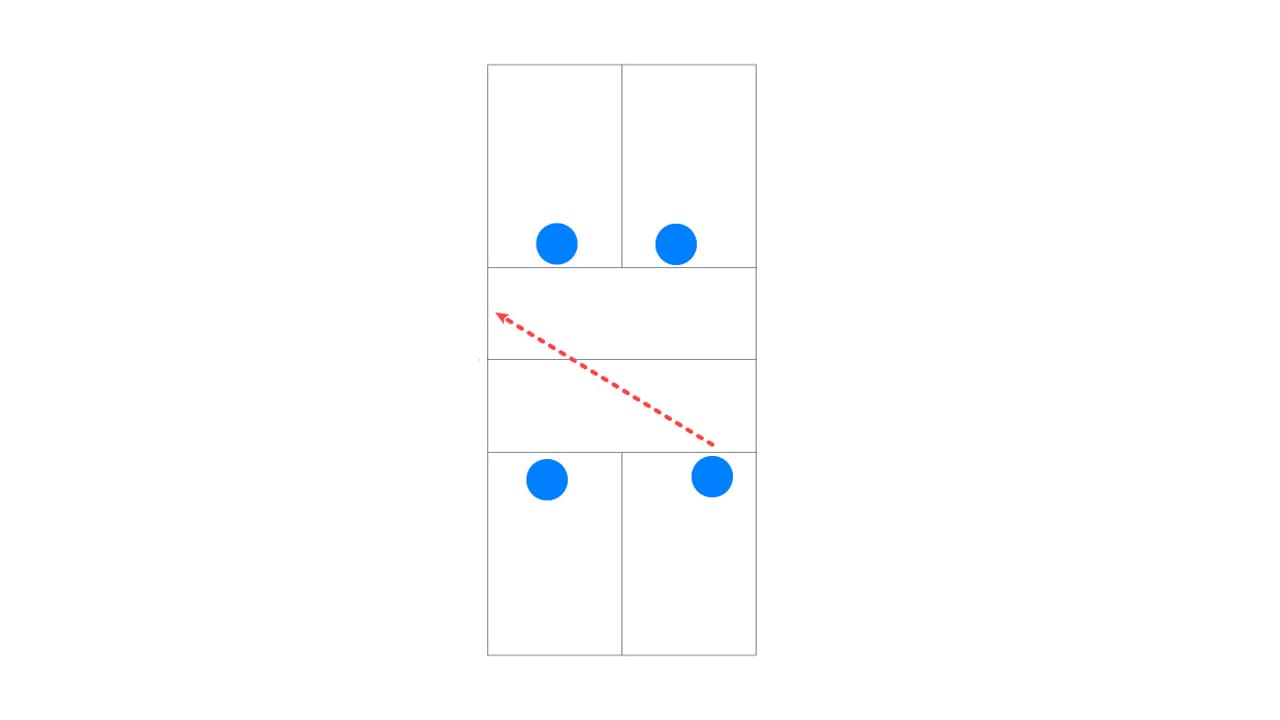
Instead of hitting the ball in the same direction one after another, you should hit it in a direction that is opposite to you. For example, your stance is in the right sideline of the court so you can hit in the left direction towards the baseline, keeping the ball height low and speed at slow. Cross-court angle dink shots are useful because they force the opponent to cover a large distance from one position to another in a diagonal line.

Cross Court Dink
Cross Court Dink

Cross-court angle dink shots are very useful if your opponent is playing fast and you launch a slow-paced shot in the middle of the game. It helps you create openings because the opponent requires you to hit the ball after approaching in the opposite direction and as a result, you can exploit the gap created by your opponent. It also helps to affect the stamina of the opponent.

4. Straight-Line Dinks

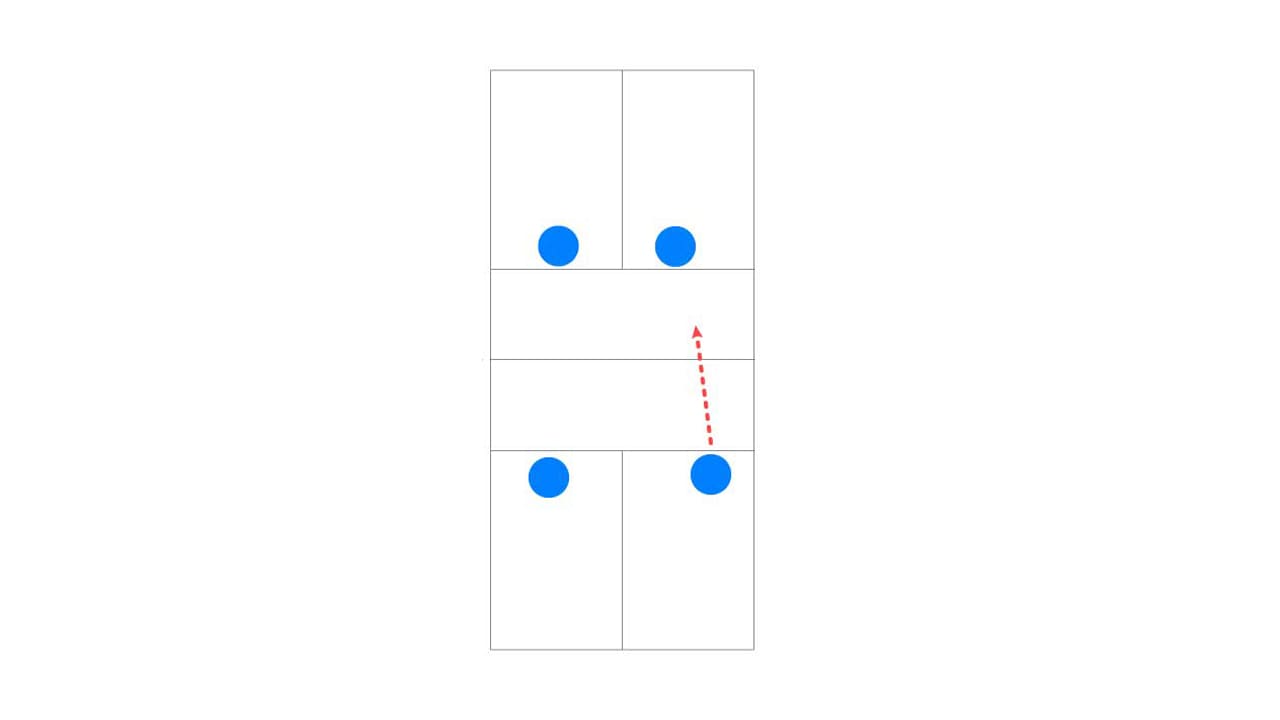
Straight-line dink shot is very simple to play, that’s why majority of the beginners do not use it but they should know that it is more crucial compared to the cross-court dink shot. The purpose of a straight-line dink shot is not to trick the opponent or to slow down the pace of the game but to gain control over the non-volley zone.

Straight-Line Dinks
Straight-Line Dinks

If a player loses control over his non-volley zone, he can lose the game but we can use straight-line dink shots to neutralize the speed of the game and gain the area of non-volley. All you need is to hit the ball in the same direction at a low pace and height so the game goes slower and you gain control over the area.

5. Determining Height

Strategies should be changed as the match progresses; therefore we cannot say that one should always keep the height of the ball low in all conditions. Sometimes, the weakness of an opponent is the heighted shot and he can effortlessly play the low shot. Majority of the pickleball players consider that a dink shot always has a low trajectory but this is not true.

A dink shot is not extraordinarily heightened, nor is it very low but balanced. However, a dink shot is low compared to the average pickleball shot and we can increase the height of the ball based on the conditions. If you hit the ball in the same manner one after another, you cannot win the game; therefore you need to change the height and hit mixed shots.

6. Alter Speed

A pickleball player always keeps the ball in control by maintaining its speed. Whether you are an active player or you like passive or slow games, you need to learn the art of controlling the speed. Controlling and maintaining speed does not mean that a player always hits the ball with the same force he used in the previous shots but it means one should be efficient enough to decrease or increase the speed of the ball.

A dink shot is always slower than the average shot. Some people consider that a fast, low-height hit is also a dink shot but the fact is the opposite. However, one should always change the speed of the ball with each hit to keep the game challenging for the opponent.

If you hit the ball with the same force, your opponent will understand the weakness and return the ball in a way that you will be unable to approach it; therefore, always alter the speed of the ball with the passage of time and conditions. Then comes the space, timing, and flow of the ball that should be changed with speed.

The rhythm of the game is very important to control the court, it involves the space, time, and flow of the match. If you play pickleball with the same rhythm, you can lose the match. The purpose of a dink shot is to change the rhythm, it is a way to alter the speed, flow of the match, and timing.

7. Tricky Shots

Pickleball seems simple but when it comes to the tricky shots, it is one of the most interesting games in the world. Some people consider that pickleball requires only physical energy but they ignore the fact that one also needs high mental activity to win the match. It is the only game in which you can win if you know how to execute a deceptive shot.

You can practice fake dinks by learning how to portray yourself as you are preparing to hit the ball with full force but in the end, you touch the ball softly. You also need to learn the fake posture of a dink shot in which you convey an indirect message through your posture that you will launch a dink shot but hit the ball with full force and at a maximum height.

Moreover, you should learn how to spin the ball in the left and right direction. Spinning is not difficult to practice as one has to brush the paddle on the back of the ball in a way that changes the direction when it hits the ground. Without spin, you cannot make a difference, but it is simpler to trick the opponent if you practice spin.

Spinning makes it harder for an opponent to anticipate the direction of the ball after it bounces. You can use backspin in which the ball rotates backside when it bounces on the court, you can also practice topspin in which you can change the direction of the ball from low to high.

How To Hit Dink Shot Effectively?

The only way that can help you use dink shots effectively is by practicing. Mostly, beginners do not focus on the practice and try to use complex shots on the court in the middle of a match but it cannot make you an efficient pickleball player. If you want to become an extraordinary player then use pickleball shots smartly.

As a coach, I frequently advise my trainees to learn a unique shot for a specific timeframe. For example, if you are learning a cross-court dink shot, you need to practice it for more than 2 weeks to become efficient. Once you consider that you have practiced enough and can play the specific shot on the court then advance forward learning a new unique shot.

Frequently Asked Questions

What Is A Dink Shot?

A dink shot is a soft shot to land the ball near the non-volley zone of the opponent so he cannot approach it and if he does then he cannot play it efficiently. A dink shot should be slow and have low height compared to an average pickleball shot.

What Is The Best Way To Dink Pickleball?

The best way to dink the ball is to hit it in a way that it softly approaches the non-volley zone of the opponent. The best dink is not a low shot but when we dink over the net above a foot.

Why Is There So Much Dinking In Pickleball?

There are various reasons why people use dink shots as some use it to control the game while others launch dink shots to trick the opponent. It is a useful shot that’s why there is so much dinking in pickleball.

Final Words

Pickleball is one of the most popular games in America, promoted by clubs and communities due to its low-impact activity and entertaining nature. The game is simple to play compared to others, such as tennis or squash but we can use tricks and techniques to make it a bit complex and interesting to enjoy it more. There are several techniques and strategies we can use like dink shots to trick the opponent and win the game.

Dink shots are very useful for controlling the game, managing the speed, maintaining the rhythm, and neutralizing the match. A dink shot is not as simple as it seems because one has to plan a proper strategy to launch and react after the opponent’s delivery. I have explained everything about dink shots, positioning, timing, flow, speed, and other strategies so now follow my guidelines and become an undefeatable player.


Other Related Posts:
  • Pickleball Dinking Mistakes
  • Pickleball Rally Scoring
  • Lob Shot In Pickleball
  • Best Pickleball Serves
  • Pickleball 3rd Shot Drop


Jeena Noven, Pickleballcard Author
Jeena Noven

I, Jeena Noven, am a renowned pickleball expert and author with over 10 years of experience playing and coaching the sport. My passion and extensive knowledge of pickleball has made me a leading authority in the game, particularly in the field of footwear. I have written countless articles for https://pickleballcard.com/, a website dedicated to pickleball, sharing my insights and expertise on the best shoes for the sport. Through personal testing and reviewing countless different brands and styles, I have developed a deep understanding of the technical aspects of shoe design that make them suitable for the demands of pickleball. In my articles, I provide valuable information for both beginner and advanced players, covering everything from the basics of shoe fit and support, to advanced tips for maximizing performance on the court. As a dedicated pickleball player and expert in footwear, I am a valuable resource for players of all levels. My articles are not only informative but also engaging, making them a must-read for anyone looking to improve their pickleball game. I am constantly researching new products and trends in the industry and my readers can always count on me to provide the most up-to-date and accurate information on the best pickleball shoes available.

Filed Under: About Pickleball

  • « Go to Previous Page
  • Page 1
  • Interim pages omitted …
  • Page 7
  • Page 8
  • Page 9
  • Page 10
  • Page 11
  • Interim pages omitted …
  • Page 15
  • Go to Next Page »

Latest Posts

  • How To Build A Backyard Pickleball Court?
  • Pickleball Ratings | Pickleball Rating Chart
  • Where To Play Pickleball In New York?
  • Best Pickleball Courts To Play Pickleball In Atlanta
  • Best Pickleball Courts To Play Pickleball In San Francisco
  • Best Pickleball Courts To Play Pickleball In Los Angeles
  • Who Are The Famous Pickleball Players In The World?
  • Can You Play Pickleball In The Rain?
  • What Is The Best Material For Pickleball Paddle?
  • Tempest Wave Pro Pickleball Paddle Review
  • About
  • Privacy Policy
  • Terms And Conditions
  • Affiliate Disclosure

COPYRIGHT © 2024 · Pickleballcard.COM, ALL RIGHTS RESERVED.

PICKLEBALLCARD.COM IS A PARTICIPANT IN THE AMAZON SERVICES LLC ASSOCIATES PROGRAM, AN AFFILIATE ADVERTISING PROGRAM DESIGNED TO PROVIDE A MEANS FOR SITES TO EARN ADVERTISING FEES BY ADVERTISING AND LINKING TO AMAZON.COM. AMAZON, THE AMAZON LOGO, AMAZONSUPPLY, AND THE AMAZONSUPPLY LOGO ARE TRADEMARKS OF AMAZON.COM, INC. OR ITS AFFILIATES. AS AN AMAZON ASSOCIATE WE EARN AFFILIATE COMMISSIONS FROM QUALIFYING PURCHASES.