• Skip to primary navigation
  • Skip to main content
  • Skip to primary sidebar

Pickleballcard

All About Pickleball Gears

  • About Pickleball
    • How To Play Pickleball
    • Pickleball Rules
    • Pickleball Kitchen Rules
    • Serving Rules
    • Pickleball Ratings
    • Pickleball Tips
    • Pickleball History
  • Pickleball Shoes
    • Best Pickleball Shoes
    • Best Pickleball Shoes For Men
    • Best Pickleball Shoes For Women
  • Pickleball Paddles
    • Best Pickleball Paddles
    • Elongated Pickleball Paddles
    • Graphite Pickleball Paddles
    • Onix Pickleball Paddles
    • Pickleball Paddles for Women
    • Pickleball Paddles For Spin
  • Vs
    • Pickleball Vs Tennis
    • Paddle Tennis Vs Pickleball
    • Indoor Vs Outdoor Pickleball

Pickleball Etiquette: The Unwritten Rules Every Player Should Know

October 13, 2026 by shoaib

Pickleball etiquette is mostly not in the rulebook. It is the social code that keeps open play friendly: announce the score before every serve, give your opponents the benefit of the doubt on close line calls, call faults on yourself, rotate fairly when courts are busy, do not coach a partner who did not ask, and finish every game at the net with a paddle tap. None of that will appear as a fault in an officiated match — but break it often enough at your local courts and you will stop getting invited into good games.

This guide separates what is actually backed by USA Pickleball from what is pure social custom, so you know which norms are close to rules and which are simply how considerate players behave. It covers score calling, line calls, open-play rotation, body shots, coaching, targeting, and how a game should end — with a do and don’t checklist you can use before your next session.

Key Takeaways

  • Announce the full score loudly before every serve — server score, receiver score, and server number in doubles. It prevents most mid-game score arguments before they start.
  • Close line calls go to your opponents. Only call a ball out when you see it clearly and are certain; if you are unsure, it is in.
  • Call faults on yourself and your partner as soon as they happen — foot faults, non-volley zone faults, and a ball that clipped you on its way out included.
  • At busy courts, rotate fairly. Use the paddle queue, come off after a game when others are waiting, and never rearrange the queue to move friends up.
  • Offer coaching only when it is asked for. Unsolicited advice mid-game is the fastest way to annoy a partner, however good the tip is.
  • End every game at the net. A paddle tap and a genuine thank-you, win or lose, is the sport’s handshake.

Written vs Unwritten: What Is Actually Official?

Pickleball has two layers. The first is the Official Rulebook — serves, faults, scoring and line-call procedures that referees can enforce. The second is etiquette: shared expectations that no referee will call, but that every regular player recognises.

USA Pickleball bridges the two with its Sportsmanship Guide. The guide presents pickleball as a fun, competitive and highly social sport built on respect, fair play and graciousness in winning and losing, and it is explicit that the Official Rules take precedence over the guide wherever they overlap. That distinction is the honest way to teach etiquette: some norms below — benefit of the doubt on line calls, calling faults on yourself, rotating fairly in social play, and providing coaching only when requested — are directly backed by that guide. Others — a raised paddle after a lucky net cord, or a brief apology for an unintentional body shot — are widely accepted custom with no official text behind them.

Why does the distinction matter? Because a player who claims an unwritten norm is “a rule” will lose credibility in the first argument that follows. Know which is which, follow both, and correct others gently — if at all.

Before and During the Game

Introduce Yourself and Start Clean

If you do not know the other players, introduce yourself before the first serve. It takes ten seconds, it makes later disagreements far less personal, and it is one of the courtesy basics USA Pickleball lists first. The same spirit covers language and behaviour: no foul language aimed at anyone, no denigrating comments about a partner’s miss or an opponent’s level, and a willingness to accommodate players with adaptive needs where you reasonably can.

Warm Up With Courtesy, Not Winners

A warm-up is for both sides to find their touch, not for practising your hardest drive at a player who is still stretching. Dink cooperatively, feed balls your opponents can actually hit, and keep the warm-up short when courts are busy and a queue is watching. If you arrive mid-session, do not expect a long personal warm-up while three paddles are already waiting.

Announce the Score — Every Serve, Out Loud

Before every serve, call the full score clearly enough for the receiving team to hear: your score, their score, and — in doubles — whether you are server one or server two. Do it before you start your motion, not during it, so an opponent who disagrees can stop you before the rally begins.

This is partly etiquette and partly practical rulebook hygiene. Most score disputes are not cheating; they are two teams honestly remembering different numbers because nobody stated the score out loud for six rallies. A clear call makes the score a shared fact. If you are new to the numbering itself, our guide to how to play pickleball explains the three-number call and the rest of the basics in order.

Line Calls and Faults: Where Etiquette Meets the Rulebook

Give the Benefit of the Doubt — Every Time

The core principle is simple: opponents make the calls on their own end of the court, and any ball you cannot call out with certainty is in. Call your own shot out if you clearly see it out. If you are unsure, play it as in — or, in social play, ask your opponents what they saw and accept their answer graciously if you defer the call to them.

If you question an opponent’s call, do it respectfully and once. Arguing a line call in a recreational game almost never changes the call; it reliably changes the mood. Our dedicated guide to the official rules for line calls in pickleball covers the formal line-calling code, including what happens when partners disagree, in full.

Correct Your Own Partner Promptly

If your partner calls a ball out and you clearly saw it in, say so straight away. That feels awkward the first time — you are overruling the person on your own team — but it is exactly what good sportsmanship requires, and experienced players respect it. In doubles, partner disagreement on a line call resolves in favour of the opponents in any case, so correcting a wrong call costs you nothing you were entitled to keep.

Call Faults on Yourself

Serve with a foot on the baseline, step into the non-volley zone on a volley, or feel a ball clip your shirt on its way long? Call it on yourself as soon as it happens, whether or not anyone else noticed. Watch your partner’s feet for service and kitchen foot faults too, and accept an opponent’s fault call graciously rather than litigating it. Honest self-calling is the single behaviour that most quickly earns a new player a reputation as someone worth playing with. For what counts as a fault in the first place, see our explainer on what is a fault in pickleball.

Replays Are for Genuine Hinders

Claim a replay when something genuinely prevented your team from playing the ball — a ball rolling in from another court is the classic case. Do not treat a replay as a way to erase a rally you simply lost, or to renegotiate a close line call you disliked. In recreational play, replaying a truly disputed point by agreement is common and friendly; in officiated play, the rulebook procedure governs, so do not promise a replay format that a tournament will not allow.

Open-Play Rotation: The Paddle Queue Explained

Open play is where etiquette is tested most, because nobody owns the court. Local systems vary, but the shared principles are consistent — and USA Pickleball’s guide backs them directly for social play: rotate on and off fairly, follow local practice, do not jump ahead of others who are waiting, and be ready when your turn comes.

Situation What good etiquette looks like
You arrive and courts are full Put your paddle in the queue / next-up rack in order. Do not place it ahead of paddles already waiting.
Your game finishes and others are waiting Come off. All four players leave and re-queue unless the local system says otherwise.
Winners-stay format Winners may stay for the locally agreed number of games — commonly two — then split or come off, as that venue does it. Follow the local norm, not your preference.
You want to play with a friend in the queue Move yourself back to their position. Never move them — or anyone else — forward past waiting players.
Your turn is coming up Be present, paddle in hand, ready to step on. A queue should never have to hunt for its fourth player.
Levels are mixed Mix in willingly for some games. Splitting courts by level is fine where a venue offers it; refusing ever to play down is not.

Two queue tricks deserve naming because everyone recognises them: calling a lower score than the real one, and quietly starting a second game, both to avoid leaving a court. Do not do either. If you must cross behind an active court, wait until play has stopped, then cross quickly as a single group so you disrupt that game as little as possible.

Balls on Court, Body Shots and Net Cords

Call “Ball On” — Loudly and Immediately

When your ball rolls onto another court, warn those players at once with a loud “ball” call if anyone could step on it or be hit. Stop play on your own court when a stray ball enters it. When a ball strays onto your court and play has stopped, make eye contact with the right person and roll or toss it back without disrupting neighbouring games. If a loose ball is rolling harmlessly behind another court, wait until their point ends rather than interrupting it to retrieve yours.

Do Not Walk Behind a Live Rally

Never walk behind or across a court while a rally is in progress — to fetch a ball, reach a bench, or take a shortcut. Wait for the point to finish. It is a safety rule as much as a courtesy: a player backpedalling for a lob cannot see you.

Body Shots and Net Cords: The Brief Apology

Pickleball is played close to the net, and balls will hit bodies. An unintentional body shot needs only a quick raised paddle or a short “sorry” — then move on; over-apologising slows the game as much as not apologising at all. The same gesture covers a lucky net-cord winner: a brief acknowledgement that fortune, not skill, won that point. What etiquette does forbid is intent and excess: do not slam the ball directly at a player when an open-court winner was available, and never throw a paddle or strike a ball in anger.

Coaching, Targeting and Playing Down: The Three Fastest Ways to Break the Code

No Unsolicited Coaching

Provide coaching and advice only when it is requested. That applies to opponents and, just as much, to your partner. A partner who has just missed three backhands does not need a technical lecture between rallies; they need a simple “next one” and a partner who stays positive. Avoid criticism and negative non-verbal communication — the sigh, the stare, the paddle dropped in disgust all count, and everyone on court reads them. If you genuinely see something helpful, ask once, between games: “Want a thought on that return?” Accept no for an answer.

Do Not Freeze Out the Weaker Player — or Hunt Them Relentlessly

In social play, be kind as the stronger player: avoid hitting excessively to the weaker player, and do not make a beginner the target of every hard shot just because it produces easy points. Freezing a newer player out of every rally is the mirror-image offence — they paid for court time too, and a game they never touch the ball in teaches them nothing except not to come back.

Be plain about the exception: competitive and tournament play is different. In a rated or tournament match, playing your best strategy — including directing more balls at the opponent you judge weaker — is normal competitive play, and nobody owes an apology for it. Etiquette governs how you treat people, not whether you try to win a match that counts.

Playing Up and Playing Down

Be willing, sometimes, to play with less-skilled players; every regular was carried through early games by someone who did the same. And if you want to join a stronger group, ask nicely rather than demanding a place or inserting your paddle into their rotation uninvited. Both directions of generosity keep a club’s open play alive.

Ending the Game: The Paddle Tap

At the end of every game, meet the other players at the net and acknowledge them positively — in practice, the paddle tap over the net tape, accompanied by a simple “good game” or thanks. In officiated matches, thank the referee as well. Do it after a heavy loss exactly as after a win; graciousness in losing is half of the sportsmanship standard, not an optional extra for good days.

Walk off promptly when others are waiting, take your water bottle and towel with you, and leave the court as you found it. If a genuine disagreement happened during the game, the net is the place for a short, friendly reset — not for reopening the argument point by point.

Pickleball Etiquette Checklist: Do and Don’t

Do Don’t
Introduce yourself to players you do not know Walk onto a court mid-rally or behind a live game
Announce the full score before every serve Start your serve motion before calling the score
Call a ball out only when you see it clearly and are certain Call a close ball out and resolve doubt in your own favour
Correct your partner’s wrong call promptly Argue an opponent’s call repeatedly
Call foot, kitchen and body-clip faults on yourself Stay silent about a fault only you noticed
Queue your paddle in order and come off when others wait Rearrange the queue, jump ahead, or start a quiet second game
Call “ball on” immediately and return stray balls with eye contact Chase your ball onto another court during their rally
Apologise briefly for body shots and lucky net cords Slam at a player’s body when the open court was available
Coach only when asked; encourage your partner Lecture, sigh at, or criticise a partner mid-game
Include the weaker player in social rallies Freeze a beginner out — or target them on every shot
Finish at the net with a paddle tap, win or lose Leave the court without acknowledging your opponents
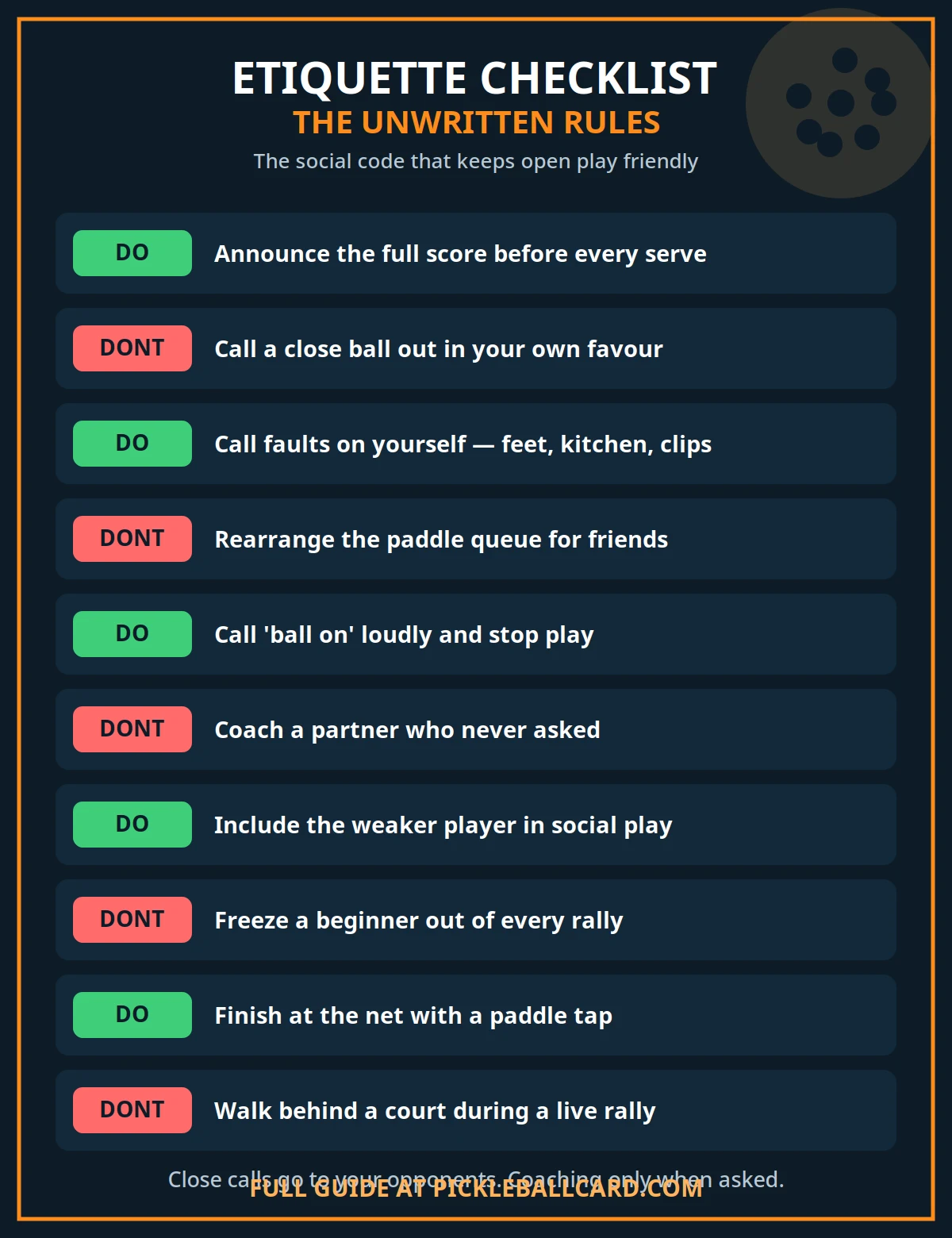
Pickleball etiquette do and don't checklist — score calling, line calls, rotation, body shots and the paddle tap
Pickleball etiquette at a glance: the do and don’t checklist.

Frequently Asked Questions

Is announcing the score a rule or just etiquette?

Both layers touch it. The scoring rules require the score to be called before the serve in organised play, and etiquette adds the practical standard: call it loudly, completely — including the server number in doubles — and before you begin your motion, so anyone who disagrees can speak before the rally starts.

What should I do if my partner makes a bad line call?

Correct it promptly and plainly: “I saw that in — their point.” USA Pickleball’s sportsmanship guidance expects exactly that, and partner disagreement resolves in the opponents’ favour under the line-call code in any case. Do it without blame; your partner may simply have had a worse angle than you.

Can I ask my opponents to replay a disputed point?

In recreational play, yes — offering to replay a genuinely disputed point is a friendly, widely accepted solution when nobody is certain. In officiated or tournament play, follow the rulebook procedure instead: replays are for genuine hinders and the specific situations the rules define, not a general remedy for disagreement.

Is it rude to hit most shots at the weaker player?

In social and open play, yes — repeatedly targeting the weaker player, or slamming directly at them, breaks the expectation that everyone gets a real game. In competitive, rated or tournament play, directing shots strategically is normal and expected. The setting, not the shot itself, decides which standard applies.

How long can winners stay on court at open play?

There is no universal number — it is set by local practice. Common systems are four-on/four-off when courts are full, or winners staying for a set number of games (often two) before splitting or coming off. Read the venue’s posted system, watch what regulars do, and follow that rather than assuming a right to stay on.

What do I do when a ball rolls onto our court mid-rally?

Stop play and call it — a loose ball on court is a safety issue first and a hinder second. Return the ball to the correct player with eye contact once play has stopped, then replay the interrupted rally. If the ball is yours and it rolls behind another court without endangering anyone, wait for their point to end before retrieving it.

The Bottom Line

Pickleball etiquette comes down to a short list practised consistently: call the score, give close calls away, own your faults, share the courts fairly, keep advice for when it is wanted, include everyone in social games, and shake it out at the net afterwards. Much of that is backed directly by USA Pickleball’s own sportsmanship guidance; the rest is the custom that makes strangers welcome at open play. Master those habits and you will be invited into better games than any single shot could earn you — because in a sport this social, how you play matters almost as much as how well you play.

Sources: USA Pickleball, Essential Sportsmanship Guide for USA Pickleball Players and the Official Rules of Pickleball hub. Where this article describes a norm as social custom rather than official guidance, it is presented as convention, not as a rule.

shoaib
shoaib

Shoaib is the publisher of Pickleball Card. He oversees the site’s guides to pickleball rules, ratings, strategy and gear, all researched from primary sources — the USA Pickleball Rulebook, DUPR and manufacturer documentation — and updated as the game changes.
pickleballcard.com

Filed Under: About Pickleball

Why Did My DUPR Rating Drop After a Win?

October 12, 2026 by shoaib

You won. You shook hands, logged the score — and your DUPR rating went down. It feels like a bug, but under DUPR’s current algorithm it is usually the system working exactly as designed. DUPR does not reward wins on their own. Before every match it works out the score it expects from the ratings of everyone on court. If your team scores more than that expectation, your rating rises. If you score less than expected, your rating falls — even if less still turned out to be enough to win the game.

That single idea explains almost every confusing rating move players are seeing now: the narrow win that costs you points, the close loss that gains you points, and the partner whose number moved by a different amount from yours in the very same match. This guide works through each case with concrete scorelines, explains why DUPR changed the system this way, and sets out what actually makes a rating climb.

Key Takeaways

  • DUPR is a measurement, not a reward. A win can earn a medal or a better seed, but the rating only tracks how you performed compared with what your current rating predicted.
  • Margin against expectation is what moves you. Beat a much weaker team 11–8 when the system expected 11–3, and you have underperformed — your rating can dip while theirs rises.
  • You can go up in a loss. Push a stronger opponent far closer than expected and the system reads that as evidence you are better than your number.
  • One match never defines a rating. DUPR builds the number from your full body of results; well-established ratings move less per match than new or inactive ones.
  • Playing down is no longer a climbing strategy. Under the old approach any win lifted you; now routine wins over weaker players can hold you back unless you win by at least the expected margin.

The Short Answer: You Scored Less Than DUPR Expected

Think of every rated match as a prediction test. DUPR lines up the four ratings in a doubles game (or the two in singles), calculates the scoreline those ratings imply, and then compares reality with the forecast. Win 11–3 when 11–3 was expected and you have confirmed your rating — a small rise, or almost no change. Win only 11–9 in the same matchup and the evidence points the other way: either you are slightly weaker than your number suggests, or your opponents are slightly stronger than theirs. The system nudges both ratings toward each other so the next prediction starts closer to the truth.

Nothing in that logic requires you to have played badly. An 11–9 win is still a win, your opponents may have played the game of their month, and a couple of net cords may have gone against you. DUPR is not judging effort or fairness in a single afternoon — it is updating a statistical estimate, and it expects those one-off effects to cancel out across many matches.

How DUPR Actually Decides: Expected Score Explained

Three steps sit behind every rating change:

  1. Pre-match ratings set the expectation. The bigger the rating gap between the teams, the bigger the expected winning margin. A 4.5 pair facing a 3.5 pair is expected to win comfortably; two evenly matched pairs are expected to trade points to a close finish.
  2. The actual score is compared with the expectation. Points scored matter, not just the final W or L. That is why 11–2 and 11–9 against the same opponents can move a rating in opposite directions.
  3. Ratings adjust toward the new evidence. Overperform and you rise; underperform and you fall. DUPR says updates now land almost immediately after a result is entered, and you can see the effect match by match rather than waiting for a weekly recalculation.

If you are still working out where the number itself comes from, our full guide to pickleball ratings and the rating chart covers the skill levels behind DUPR, self-ratings and tournament ratings side by side.

Expected vs Actual: Four Scenarios That Explain Everything

Scenario Expected score Actual score What happens to the favourite’s rating Why
Strong favourite wins narrowly Win 11–3 Win 11–8 Down Won, but scored five fewer points than predicted — underperformance
Favourite wins, but closer than predicted (DUPR’s own example) Win 11–5 Win 11–9 Down slightly Both ratings move closer together so the next forecast is more accurate
Underdog loses narrowly (singles, 3.5 vs 4.0) Lose 5–11 Lose 9–11 Up The underdog scored four more points than expected — overperformance in defeat
Favourite wins as predicted or better Win 11–3 Win 11–3 or 11–1 Up Met or beat the expectation — the rating is confirmed or improved

The first three rows follow worked examples DUPR itself has published to explain the update. The fourth row is the same logic run in reverse, included as an illustration.

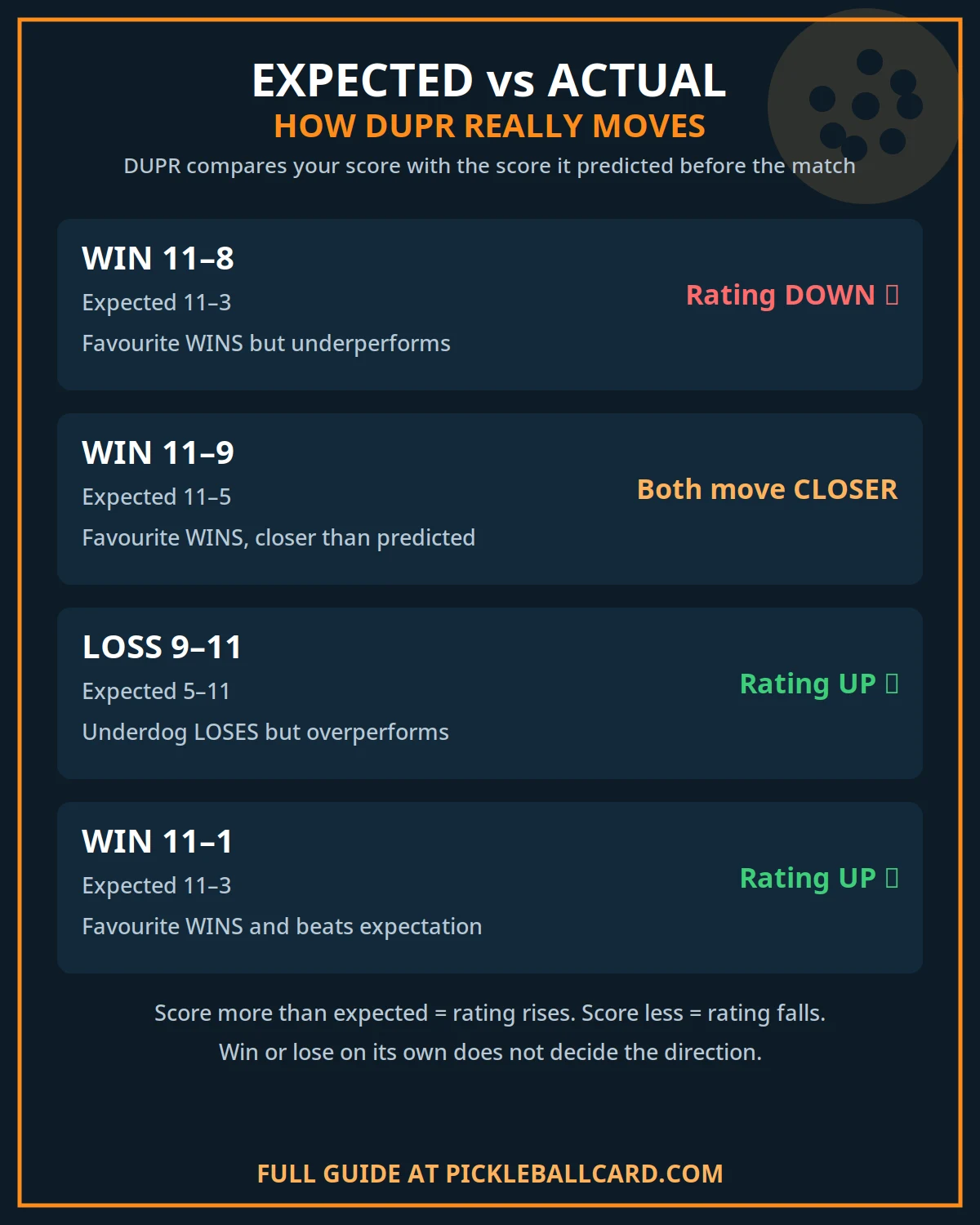
DUPR expected vs actual score infographic — how winning by less than the expected margin can lower your rating

Expected vs actual: the margin against DUPR’s prediction — not the win itself — is what moves your rating.

Read the table once and most “strange” rating moves stop being strange. The result column in the app — win or loss — is only half the story. The other half, the margin against expectation, is the half that moves the number.

Why Did My Partner’s Rating Move Differently From Mine?

Partners share a scoreline but not a rating history, so identical matches routinely produce different movements. Four factors drive the difference:

  • Different starting ratings. If you are the higher-rated player on your team, the expectation placed on the team leans more heavily on you — and an underperformance is charged more to the player the system thought would carry the result.
  • Different reliability. Alongside the rating, DUPR tracks a Reliability Score — a measure of how established and current the number is. More matches, more recent matches, and a wider mix of partners and opponents all raise it. High-reliability players see smaller shifts per match; newer or less active players see bigger swings from the same result.
  • Different match volume. A rating built on hundreds of logged games barely moves on one result. A rating built on a handful of games is still calibrating, and every new scoreline carries more weight.
  • Singles and doubles are separate. DUPR keeps singles and doubles ratings apart because the two formats test different skills. A doubles result does nothing to your singles number, however dramatic it felt.

So if your partner dropped 0.03 and you dropped 0.01 from the same win, neither figure is a mistake. You simply brought different histories into the same match.

Why DUPR Designed It This Way

Two problems with the old win-always-rises approach pushed DUPR to change. The first is inflation: if winners can only rise and losers are protected from falling in the “wrong” result, the whole rating pool drifts upward over time and a 4.0 stops meaning the same thing from one season or one region to the next. Moving one side up and the other down in each match keeps the overall distribution stable.

The second is playing down. When any win lifted a rating, the safest way to climb was to beat weaker players repeatedly — while players who tested themselves against stronger competition were punished for narrow losses that actually proved their level. Rating performance against expectation reverses both incentives: routine wins over weaker opponents stop paying, and competitive losses against stronger opponents start counting in your favour. DUPR’s stated aim throughout is accuracy — a number that predicts future results as closely as possible, for seeding, bracketing and level-based play.

When a Drop After a Win Is Normal — and When to Check the Entry

Almost certainly normal if:

  • You were clear favourites and won by less than a comfortable margin.
  • Your Reliability Score is low, or you have few logged matches — early ratings swing more.
  • Your opponents were rated well below you, even if they played above their usual level on the day.
  • The drop is small. Established ratings typically move in hundredths, not tenths, on a single match.

Worth checking if:

  • The score in the app does not match the score you actually played — a transposed 11–6 entered as 6–11 flips the entire calculation.
  • A match was validated that you did not play, was a friendly hit-around rather than a competitive game, or was entered under the wrong format (singles vs doubles).
  • Your rating moved by an unusually large amount despite a long, active match history.

DUPR offers a rating-review request route for results you believe are wrong, so a genuine data error is fixable — start by confirming the entered score with everyone who played before querying the movement itself. And keep the basics straight when you log games yourself: our guide to how to score in pickleball runs through the scoring calls that feed those entries.

How to Make Your Rating Actually Go Up

There is no loophole, and DUPR is blunt about that — but the new system does reward specific habits:

  1. Play at or above your level. Matches against players near or above your rating are where overperformance is possible in both wins and losses. Matches far below your level demand near-perfection just to stand still.
  2. Compete for every point. Because margin matters, easing off at 9–2 or going through the motions in a losing cause now has a rating cost. The last three points of a lost game can be the difference between a drop and a rise.
  3. Build reliability. Log matches regularly, across varied partners and opponents, in leagues, clubs and tournaments that record results. A higher Reliability Score steadies the number and makes each result count as it should.
  4. Log enough matches. A thin match history is the most common reason players feel mis-rated. More recorded games give the system the evidence it needs to place you correctly.
  5. Get better — it is still the main route. The algorithm is trying to predict your typical performance, not your best day. Consistent improvement, repeated across matches, is what moves the needle permanently.

Three Myths the Update Retired

“A win always raises your rating.” That was the old behaviour, and older club guides and PDFs still state it as an absolute rule. Under the current algorithm it is simply false — performance against expectation decides the direction.

“Playing down is an easy way to climb.” It was, once. Now a favourite who wins narrowly can slide, and DUPR expects some previously inflated ratings to settle downward as players keep logging matches under the new model. That settling is a correction, not a penalty.

“One match wrecked my rating.” DUPR’s position is that a single result never defines a rating. Conditions cut both ways over a season — the wind, the net cords and the off day that hurt you on Saturday help you on another. If your number truly reflects your level, a dip after one underperformance is followed by rises when you perform to it again. New to rated play entirely? Start with how to play pickleball, then get some logged matches in before judging the number.

Frequently Asked Questions

Can my DUPR rating go up after a loss?

Yes. If you score more points than the system expected — for example losing 9–11 to a player it predicted would beat you 11–5 — you overperformed, and your rating can rise despite the loss.

Does the winning margin really matter in DUPR?

Yes — it is the core of the current model. DUPR compares the actual score with the expected score derived from pre-match ratings, so an 11–2 win and an 11–9 win over the same opponents can move your rating in opposite directions.

Why did my rating drop more than my partner’s in the same match?

Because you brought different histories into it. Starting rating, Reliability Score and total logged matches all shape how much one result moves a player, so partners routinely see different changes from an identical scoreline.

Do singles and doubles results affect each other?

No. DUPR maintains separate singles and doubles ratings because the formats test different skills. Only doubles results move your doubles rating, and vice versa.

How long does it take for a DUPR rating to stabilise?

There is no fixed official match count, and you should be wary of any site that quotes one as a DUPR rule. In practice, ratings settle as match volume, recency and variety of opponents build your Reliability Score — the more representative games you log, the smaller the swing from any single result.

What can I do if a result was entered incorrectly?

First confirm the entered score, format and players with everyone involved — a wrong scoreline is the most common cause of a “wrong” rating move. If the entry itself is incorrect, DUPR provides a rating-review request process for exactly that situation.

The Bottom Line

A drop after a win is not DUPR punishing success. It is the system saying: “You won that match by less than a player of your rating should have — so your rating needs a small correction, and your opponents deserve a small one upward.” Win by the margin your rating predicts (or better), compete for every point when you are losing, play opponents who test you, and log enough matches for your reliability to grow — and the number will follow your game instead of confusing you after it.

Know your band first: the pickleball rating estimator gives you a chart-based self-rating in about two minutes, so you can judge whether a DUPR move matches your actual level.

shoaib
shoaib

Shoaib is the publisher of Pickleball Card. He oversees the site’s guides to pickleball rules, ratings, strategy and gear, all researched from primary sources — the USA Pickleball Rulebook, DUPR and manufacturer documentation — and updated as the game changes.

pickleballcard.com

Filed Under: Ratings & Competition

2026 Pickleball Rule Changes: Every New Rule Explained (With Rule Numbers)

October 11, 2026 by shoaib

USA Pickleball rewrote the rulebook for 2026 — and it is a bigger update than most players realise. Of the 114 changes proposed, 42 were approved or approved with amendments, the entire book was reorganised and renumbered, and several rules that change how rallies are actually won and lost took effect on January 1, 2026. If you are still quoting rule numbers from the 2025 book (4.A.7 for the serve, 6.C.7 for line calls), those numbers no longer exist.

This guide covers every 2026 change that affects your game, with the official new rule numbers so you can check each one in the rulebook yourself. Most summaries online skip the rule numbers and miss half the changes — here is the complete picture.

Key Takeaways

  • The rally-scoring “freeze” is gone (Rule 14.A.2) — in rally scoring, the receiving team can now win the game on a rally win.
  • Serves must now be clearly legal (Rules 7.C.1–7.C.3) — borderline volley serves no longer get the benefit of the doubt.
  • Spin applied with the paddle at contact is expressly legal (Rule 7.B.2) — only spinning the ball on the release is banned.
  • Line calls must be prompt (Rule 8.F.3) — the old “any time before the next serve” delay window has been closed.
  • Spectators must not be consulted on any call (Rule 8.J) — “should not” became “must not.”
  • A new paddle spin-rate test arrives October 1, 2026 — newly certified paddles must measure 2,100 RPM or less.

The 2026 Changes at a Glance

Change 2025 Rule 2026 Rule What is different
Rally-scoring freeze removed 4.F.1 14.A.2 Receiving team can win the game on a rally win
Game can be won on a technical foul 12.B.1.c 4.B First team to the winning point wins — however the point is scored
Serve must be “clearly” legal 4.A.7 7.C.1–7.C.3 “Clearly” added to all three volley-serve tests
Serve spin clarified 4.A.5 7.B.2 Paddle spin at contact is legal; release spin is not
Prompt line calls 6.C.7 8.F / 8.F.3 No more waiting until the next serve to call “out”
Spectators and calls 13.C.2.a 8.J “Should not be consulted” is now “must not be consulted”
Partner disagreement on a call 6.C.8 8.H “Doubt” is now called “conflict” — the call is still “in”
Wrong-score challenges 4.K 6.F–6.F.4 Fixed outcomes: replay, fault, or the result stands
Time-out signalling 10.A.3 21.A.2 Time-outs must be called by voice and/or hand signal
Penalties before the match 13.G.3.e 22.A Referees can penalise behaviour before the first serve
Extra ball during a rally 7.N 24.B A visible or dropped spare ball is now an explicit fault
Double and triple hits 11.A 10.D Triple hits in one motion are legal; two-player hits are a fault
Net-post winner 11.K 10.C.5 Bounce in, then touch the post — the hitter wins the rally
Wheelchair & adaptive play Scattered Section 25 Adaptive standing and hybrid doubles consolidated
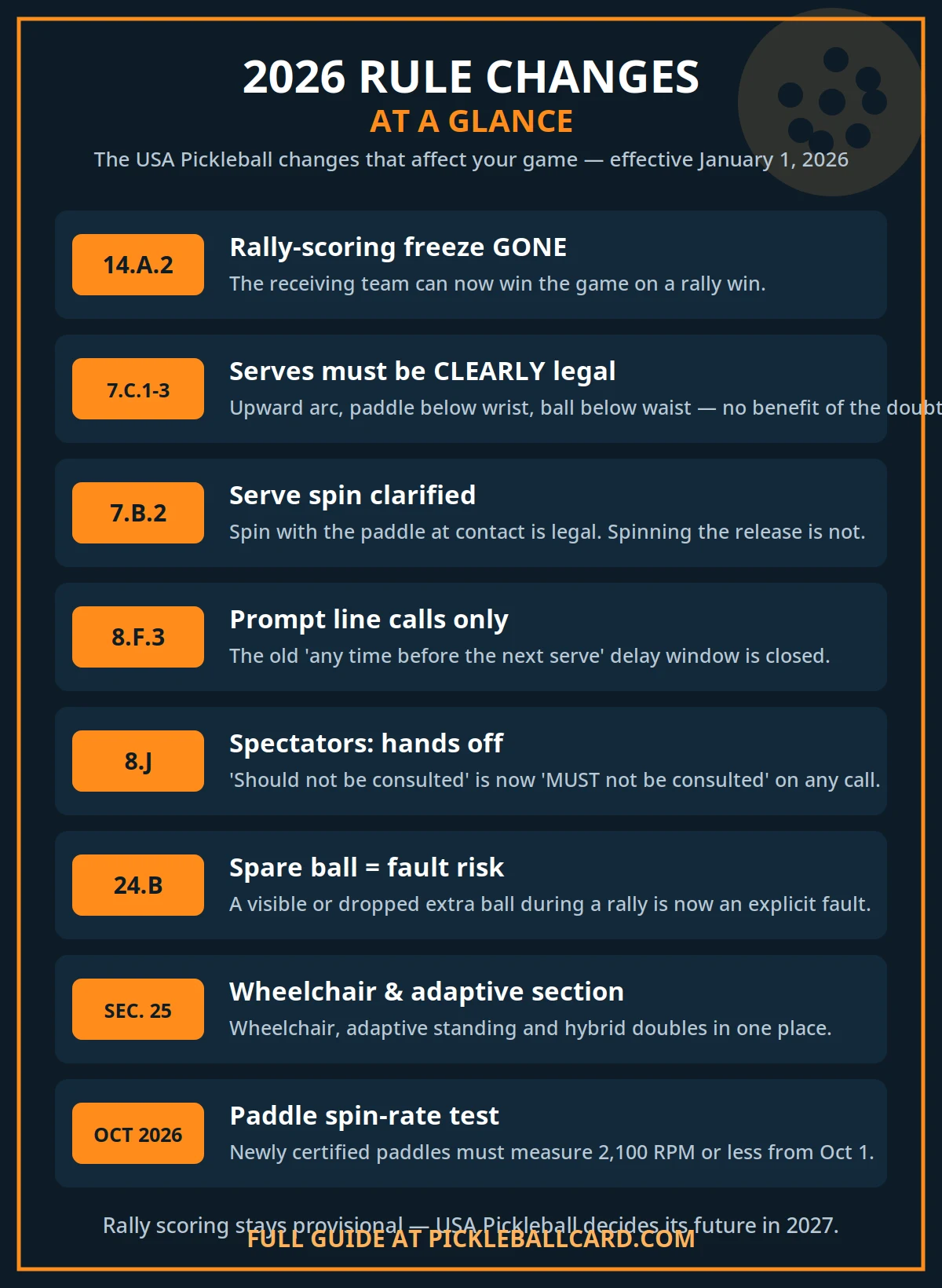
Infographic: 2026 pickleball rule changes at a glance — rally scoring freeze removed (Rule 14.A.2), serves must be clearly legal (Rule 7.C), prompt line calls (Rule 8.F.3), spectators must not be consulted (Rule 8.J), serve spin clarified (Rule 7.B.2), spare ball fault (Rule 24.B), wheelchair and adaptive play in Section 25, and a 2,100 RPM paddle spin test from October 2026
The 2026 pickleball rule changes at a glance — every change is explained in full below, with its official rule number.

Scoring Changes

The Rally-Scoring “Freeze” Is Gone (Rules 14.A.2 and 15.C.2)

This is the headline change of 2026. Under the old provisional rule, a rally-scoring game could only be won by the serving team — if the receiving team reached game point, the score effectively froze until they won a rally on their own serve. Rule 14.A.2 now states simply that a point is scored by the player or team that wins each rally, with no exception at game point. If the receiving team has game point and wins the rally, the game is over.

Two things have not changed. Rally scoring is still a provisional format under Rule 15.C.2 — traditional side-out scoring remains the standard, rally scoring is a Tournament Director’s option, and it still cannot be used in double-elimination doubles events, 2026 Golden Ticket events or the 2026 National Championships. And the format’s long-term future is undecided: USA Pickleball will decide in 2027 whether to make rally scoring permanent, extend the trial, or drop it. For the full breakdown of how the format works, see our guide to rally scoring in pickleball.

A Game Can Now Be Won on a Technical Foul (Rule 4.B)

The 2025 book said the game-winning point could only be scored by the serving player or team. Rule 4.B replaces that with a simple principle: the first player or team to score the winning point wins the game. USA Pickleball’s own example shows why it matters — if the receiving team sits on game point and the serving team is assessed a technical foul, the point awarded for the foul wins the game for the receiving team, without them serving a single ball.

Serve Rule Changes

Your Volley Serve Must Now Be “Clearly” Legal (Rules 7.C.1–7.C.3)

The three volley-serve tests are the same as before — the paddle moving in an upward arc, the top of the paddle head below the wrist, and contact below the waist. What changed is one word, added to all three tests: clearly. The paddle must move in a clear upward arc (7.C.1), the paddle head must clearly stay below the wrist (7.C.2), and the ball must clearly be struck at or below waist level (7.C.3).

USA Pickleball says the word was added to make the rule “stronger and more enforceable” — and the practical effect in officiated matches is real: a serve that is merely arguable no longer gets the benefit of the doubt, and can be called a fault. If your volley serve lives anywhere near the limits, 2026 is the year to give yourself margin. Our full breakdown of the pickleball serving rules covers both serve types in detail.

Spin on the Serve: What Is Actually Legal Now (Rule 7.B.2)

This is the change players get wrong most often — USA Pickleball calls it one of the most misunderstood rules in the book. The old wording banned imparting spin “with any part of the body or the paddle” on the release, which many players read as banning paddle spin altogether. Rule 7.B.2 now draws the line precisely:

  • Illegal: manipulating or spinning the ball with your hand, fingers or paddle before contact — the release itself. The “chainsaw” finger-spin serve stays banned.
  • Legal: applying spin with the paddle at the moment of contact. The rule now says so in plain words: “Spin may be applied to the ball upon contact by the paddle.”

So a brushing, cut or topspin motion as you strike the ball is fine. Spinning the ball out of your hand as you let it go is not.

The Drop Serve Is Untouched

None of the three “clearly” tests apply to the drop serve, which is governed by its own release rules (Rule 7.D) and is unchanged for 2026. If your volley serve keeps drawing questions under the stricter standard, the drop serve remains the simplest legal alternative — let the ball bounce, then hit it however you like.

Line Calls and On-Court Conduct

Line Calls Must Be Prompt — the Delay Window Is Closed (Rules 8.F and 8.F.3)

Previously, a player who failed to return a ball could wait — calling “out,” appealing, or asking the opponents — at any point up until the next serve. That window invited gamesmanship and referee complications, and for 2026 it is gone. Under Rule 8.F, an “out” call must be signalled promptly, by voice, hand signal, or both. Rule 8.F.3 sets the timing: if you play the ball, your call must come before your opponent hits it or the ball becomes dead; if you do not play it, a prompt call still counts even if the ball dies first — but a slow call no longer does. USA Pickleball does add a common-sense note: a ball that is clearly and unquestionably out should never be ruled “in” just because nobody made a formal call. See our guide to pickleball line calls for how line-calling etiquette and the rules fit together.

Spectators Must Not Be Consulted (Rule 8.J)

One word changed, and it matters: spectators must not be consulted on any call — the 2025 “should not” was only a recommendation. In an unofficiated match you can now summon the Head Referee or Tournament Director if an opponent keeps asking the crowd; in an officiated match, the referee can back the rule with a verbal warning, a technical warning or a technical foul.

“Doubt” Is Now “Conflict” (Rule 8.H)

When doubles partners disagree on a line call, the outcome is unchanged — the ball is “in.” What changed is the language: partner disagreement is now formally called a conflict rather than “doubt,” a deliberate wording change to reflect that the partners actively disagree.

Wrong-Score Challenges Have Fixed Outcomes (Rules 6.F–6.F.4)

Challenging the score mid-rally used to end in argument. The 2026 rules spell out every case. Stop before the return of serve is hit and the score really is wrong, and the rally is replayed with the correct score (6.F.1). Stop play to challenge a score that was actually correct, and it is a fault (6.F.2). Stop after the return of serve, and it is also a fault (6.F.3). If the rally finishes, its result stands and the score is corrected before the next serve (6.F.4). Knowing the score — and calling it correctly — just became a competitive skill; our how to score in pickleball guide covers the scoring system end to end.

Match Play, Time-Outs and Penalties

Time-Outs Must Be Clearly Signalled (Rule 21.A.2)

Calling “time-out” under your breath as you walk off no longer counts. A time-out must now be called audibly by voice or visibly by hand signal (or both), directed at your opponents and the referee. Call one after the serve has been hit and it is a fault; ask without any audible or visible signal and you risk a verbal or technical warning for delay of game. USA Pickleball’s summary is blunt: players may not leave the playing area without clearly calling a time-out.

Penalties Can Start Before the Match (Rule 22.A)

Referees can now assess warnings and penalties any time players are in the vicinity of the court — including during warm-ups and the pre-match briefing, and for behaviour on the way to the court. The old rule covered conduct “at the court” once play was around the corner; the 2026 version makes the referee’s authority explicit from the moment you arrive.

Stronger Ejection and Forfeit Rules (Rules 22.L and 22.I.1)

The Tournament Director’s power to eject a player or expel them from the venue now expressly covers injurious paddle or ball abuse and physical violence causing injury (22.L.2), and flagrant behaviour including damage to venue property (22.L.5) — before, during or after play, with no need to prove intent. Separately, Rule 22.I.1 makes aggressively striking or throwing a ball or paddle in anger that hits someone or damages property an automatic match forfeit.

Rescinding a Challenge or Medical Time-Out Now Costs You (Rules 20.J.1 and 21.C.4)

Two “free delay” tactics were closed off. Withdraw a request for the Head Referee after it has been acknowledged, and your team is charged a standard time-out — or a technical foul if you have none left (20.J.1). Rescind a medical time-out after officials have been called but before they arrive, and the same pricing applies: a standard time-out is charged, or a technical foul if none remain (21.C.4).

Your Partner Can Play On Alone After a Retirement (Rule 21.C.9)

If a doubles player cannot continue after the 15-minute medical time-out, the match is a retirement for that player — but under the new rule, the partner may choose to play on alone under the normal rules. The retired player must leave the court and cannot return to that match; the remaining players keep their positions and rotation, and serves aimed at the retired player’s court must still land in the correct service box.

Rally Rules You Might Miss

A Spare Ball in Your Pocket Is Now an Explicit Fault Risk (Rule 24.B)

Carrying a second ball is still allowed — but under Rule 24.B it must stay out of your opponent’s sight and in your possession. If a carried ball becomes visible during a live rally, or drops onto the playing surface, Rule 24.B.1 makes it a fault against you. The safest 2026 habit: leave the spare ball at the net post.

Triple Hits Are Legal — Two-Player Hits Are Not (Rule 10.D)

The double-hit rule was widened: a ball can now be hit more than once — a double, triple or even greater multi-hit — provided the stroke is one continuous, single-direction motion by one player (10.D, 10.D.1). The flip side is now written down too: if you and your partner both hit the ball to return it, that is a fault (10.D.2). Carrying the ball remains a fault, as before.

The Net-Post Winner, Clarified (Rule 10.C.5)

If a ball crosses the net, bounces in your opponent’s court, and then — carried by spin or wind — touches the net post, the rally belongs to the player who hit the shot: the receiver failed to return a ball that had already bounced in. Rule 10.C.5 frames it as a fault on the player who did not make the return. A ball that hits a permanent object on the fly, before bouncing in, is still dead against the hitter.

Tournament small print: round robins gained a fifth tiebreaker — most total points scored across all matches (Rule 15.B.4.f) — and line judges’ “blocked” signal now obliges the referee to make or canvass the call immediately (Rule 19.H).

Wheelchair and Adaptive Play Get Their Own Section (Section 25)

One of the most substantial structural changes of 2026 is also the easiest to miss: wheelchair and adaptive rules were pulled out of the scattered corners of the old book and consolidated into a dedicated Section 25. Wheelchair play (25.A) now sits in one place — the wheelchair is part of the player’s body, the large rear wheels are treated like a standing player’s legs for serving and kitchen faults, the two-bounce allowance is spelled out, and power wheelchairs are permitted (player-controlled, maximum 10 mph). Our dedicated guide to wheelchair pickleball covers how wheelchair pickleball works.

New for 2026, Adaptive Standing Play (25.B) formally covers players with a permanent physical disability who play without a wheelchair: prosthetics, braces and crutches are allowed and count as part of the body, and eligible players with significant mobility impairments may use a two-bounce allowance, declared before the match. Hybrid Doubles (25.C) — one wheelchair player and one standing player per team — is now a defined format in its own right.

Equipment Changes for 2026: The Paddle Spin Test

Equipment standards are not part of the rulebook itself — they live in USA Pickleball’s separate Equipment Standards Manual — but 2026 brings the biggest equipment change in years. From October 1, 2026, every paddle submitted for USA Pickleball certification must pass a new Spin Rate Test: a measured spin rate of 2,100 RPM or less, calculated from camera footage using an instrumented test ball. Paddles certified before that date under the existing surface-roughness and friction tests remain approved, but anything new must meet the spin cap.

Two more equipment points for 2026: USA Pickleball has launched on-site paddle field testing at Golden Ticket events (friction, deflection and weight/balance checks, with passing paddles receiving an RFID sticker), and the PBCoR “trampoline effect” limit in force for 2026 is 0.43 (tightened from 0.44 in November 2025) — paddles that exceed it can be removed from the Approved Paddle List, including models that were legal when bought. If you are shopping this year, our guide to how to choose a pickleball paddle explains what to check before you buy.

What These Changes Mean for Your Game

If you play recreationally: the changes you will actually feel are the prompt line call (call it when you see it, not after a chat), the spectator rule (the crowd no longer gets a vote), and the serve-spin clarification — your brushing topspin serve was probably always fine, but spinning the ball out of your hand on the release never was. If you play in a group that uses rally scoring, game point just got simpler: win the rally, win the game.

If you play tournaments: build margin into your volley serve before a referee does it for you, signal your time-outs like you mean them, and know that conduct rules now run from the warm-up to the car park. Tournament players should also note the rescinded-challenge and medical time-out pricing, the new round-robin tiebreaker, and — before buying a new paddle late in 2026 — the October spin-rate deadline.

Frequently Asked Questions

What are the biggest pickleball rule changes for 2026?

The changes most players will notice are the removal of the rally-scoring “freeze” (Rule 14.A.2), the new “clearly legal” standard for volley serves (Rules 7.C.1–7.C.3), prompt-only line calls (Rule 8.F.3), the ban on consulting spectators (Rule 8.J), and the clarification that paddle spin at contact on the serve is legal (Rule 7.B.2).

When did the 2026 pickleball rules take effect?

The 2026 USA Pickleball rules took effect on January 1, 2026. The change document was published on December 17, 2025, so players and officials had the full list of changes before the new rules came into force.

Is rally scoring now the official scoring format?

No. Rally scoring remains a provisional, optional format for 2026 (Rule 15.C.2) that a Tournament Director may choose; traditional side-out scoring is still the standard. USA Pickleball will decide in 2027 whether rally scoring becomes permanent, stays provisional, or is discontinued.

Can you put spin on a pickleball serve in 2026?

Yes — with the paddle. Rule 7.B.2 expressly allows spin applied to the ball upon contact by the paddle. What remains illegal is spinning or manipulating the ball on the release, before contact, including the “chainsaw” finger-spin serve.

Is the drop serve affected by the new serve rules?

No. The three “clearly” tests (Rules 7.C.1–7.C.3) apply only to the volley serve. The drop serve is governed by its own release rules (Rule 7.D) and is unchanged for 2026.

Do the 2026 rule changes apply to casual games?

The rulebook governs sanctioned play, and referees only enforce it in officiated matches — nobody can assess a technical foul in your Saturday game. But most organised recreational play follows the USA Pickleball rulebook by agreement, and the practical changes (prompt line calls, no spectator calls, serve-spin legality) are worth adopting in any game that wants to stay friendly.

The Bottom Line

The 2026 update is less about new ways to play and more about removing grey areas: serves that are clearly legal or a fault, line calls made on the spot, spectators out of the decision, and a scoring format that no longer freezes at game point. Learn the half-dozen changes in the table at the top of this page and you are ahead of most players — and if you run into a rule nobody can settle, the official sources below are the final word. New to the game entirely? Start with our guide on how to play pickleball, then come back to this page before your first tournament.

shoaib
shoaib

Shoaib is the publisher of Pickleball Card. He oversees the site’s guides to pickleball rules, ratings, strategy and gear, all researched from primary sources — the USA Pickleball Rulebook, DUPR and manufacturer documentation — and updated as the game changes.

pickleballcard.com

Filed Under: About Pickleball

  • « Go to Previous Page
  • Page 1
  • Interim pages omitted …
  • Page 9
  • Page 10
  • Page 11

Latest Posts

  • Skinny Singles Pickleball: Rules, Court Setup & Strategy
  • Quiet Pickleball Paddles & Noise Rules
  • Tournament Balls: Franklin X-40 Vs Onix Dura Fast 40
  • Games Like Pickleball: Badminton, Racquetball, Tennis, Padel And More
  • Drills for Beginners in Pickleball: Dinks, Serves, Volleys and Drops
  • Timeout Rules in Pickleball: Standard, Medical and Between-Game Timeouts
  • Pickleball Safety And Eye Protection
  • What To Wear To Play Pickleball: Shoes, Clothes, And Court Essentials
  • Pickleball Statistics: Participation, Growth, And The Numbers That Matter
  • Paddle Generations Explained: From Thermoformed To Foam (Gen 2, Gen 3, Gen 4)
  • About
  • Privacy Policy
  • Terms And Conditions
  • Affiliate Disclosure

COPYRIGHT © 2026 · Pickleballcard.COM, ALL RIGHTS RESERVED.

PICKLEBALLCARD.COM IS A PARTICIPANT IN THE AMAZON SERVICES LLC ASSOCIATES PROGRAM, AN AFFILIATE ADVERTISING PROGRAM DESIGNED TO PROVIDE A MEANS FOR SITES TO EARN ADVERTISING FEES BY ADVERTISING AND LINKING TO AMAZON.COM. AMAZON, THE AMAZON LOGO, AMAZONSUPPLY, AND THE AMAZONSUPPLY LOGO ARE TRADEMARKS OF AMAZON.COM, INC. OR ITS AFFILIATES. AS AN AMAZON ASSOCIATE WE EARN AFFILIATE COMMISSIONS FROM QUALIFYING PURCHASES.