It is one of the strangest sights in pickleball. You hit a soft, spinning shot that clears the net, lands in your opponent’s court — and then, instead of bouncing toward them, the ball screws back toward the net, climbs over it, and drops on your side again. Nobody touched it. Both teams stare. Someone laughs and asks the only question that matters: who wins that rally?
The answer feels backwards until you understand the principle underneath it, and then it becomes one of the easiest calls in the game. This guide gives you the short answer first, then the full ruling, the one legal way your opponent can still save the point, the mistakes that turn a save into a fault, and a set of worked scenarios you can use the next time it happens at your courts — because with modern spin paddles and a windy day, it will.
Key Takeaways
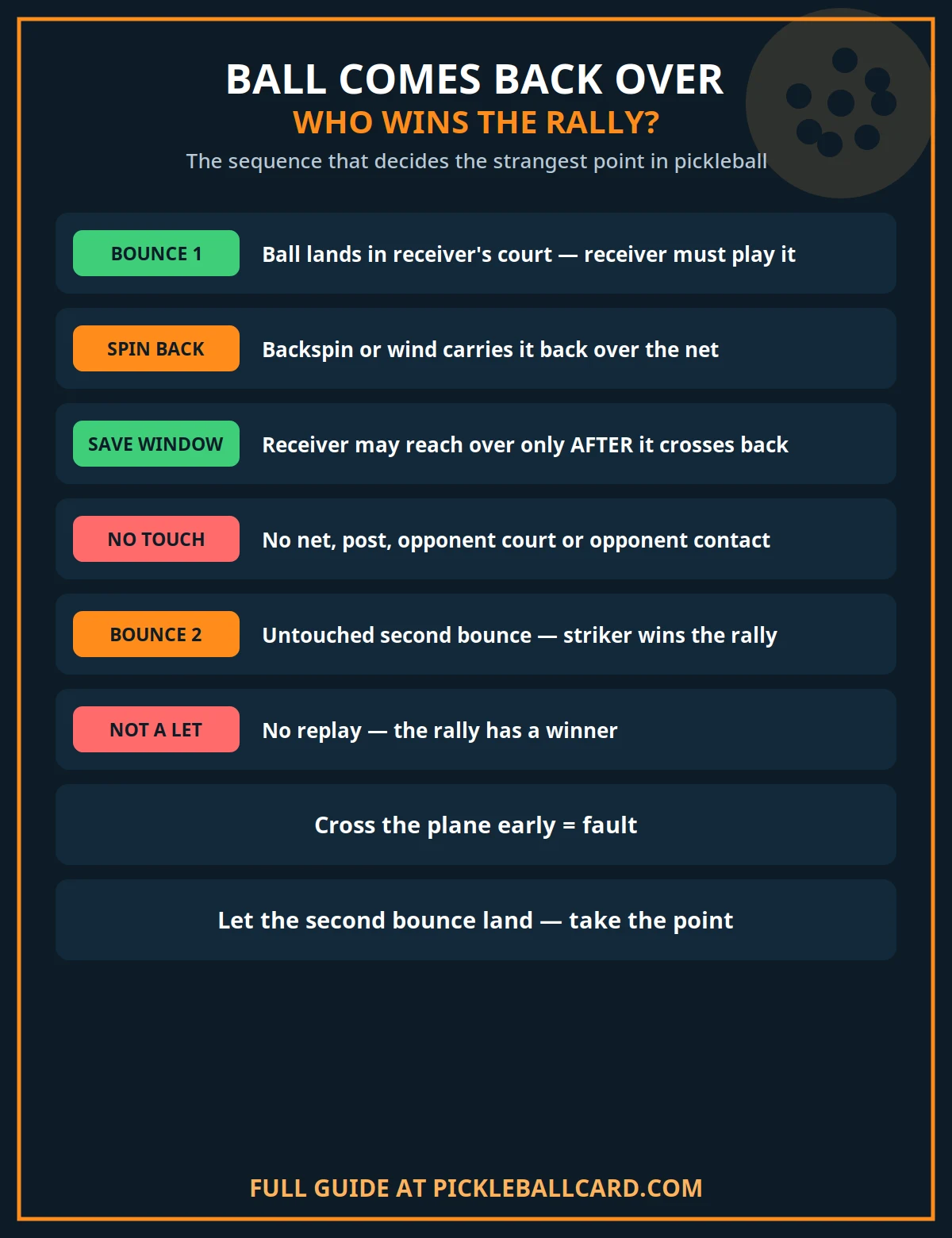
- The player who hit the shot wins the rally if the ball bounces in the opponent’s court, comes back over the net untouched, and bounces a second time on the striker’s side.
- It is not a let and it is not replayed. The rally has a winner under the USA Pickleball Official Rules — the receiving side simply failed to play a ball that bounced in their court.
- The receiving player does get one extraordinary chance to save it: after the ball has crossed back over the plane of the net, they may reach over, under or around the net to hit it.
- That save has strict conditions. Crossing the plane before the ball comes back, touching the net system, or touching the opponent’s court or the opponent while the ball is live is a fault.
- Backspin and wind are the two causes. A heavily cut dink or drop near the net, or a gust pushing a high ball back, are the usual setups.
- Do not chase the ball onto the wrong side early. Wait for it to cross back to you — patience is literally written into the ruling.
The Short Answer: Who Wins?
The striking player — the person who hit the ball over in the first place — wins the rally.
Think about what the receiving team was required to do. The ball crossed the net legally and bounced in their court. From that bounce, it was their ball to play, exactly like any other shot. If a normal ball bounces in your court and then bounces a second time, you lose the rally. A ball that spins back over the net is treated on the same principle: if it goes on to bounce a second time without you touching it, the rally is over and the other side wins it — the only difference is that the second bounce happens back on the striker’s side of the net, which is why it looks so odd.
That is why the common first guesses are both wrong. It is not a replay, because nobody was hindered and no rule was broken. And the receiving team does not win for “not missing” — they did miss, in the only way this particular ball allows: by letting a ball that landed in their court escape back over the net unplayed.
The Rules Behind the Ruling, in Plain Language
The USA Pickleball Official Rules cover this scenario in the rules about the plane of the net and dead balls. Paraphrased into plain language, three ideas combine to produce the result:
- A ball that bounces back is still live after the first bounce. The first bounce in the receiver’s court does not end anything. The rally continues while the ball travels back toward — and over — the net.
- The receiver gets a special permission. Normally a player may not reach across the plane of the net to hit a ball. For this one situation, once the ball has crossed back over the plane to the striker’s side, the receiver may cross that plane — over the net, under it, or around the post — to play the ball.
- If nobody plays it, the second bounce decides it. When the returned ball bounces for a second time untouched, the rally ends in favour of the player who struck the original shot.
Those three ideas also explain the fault lines that come with the save attempt, which are covered in the next section. For the wider set of ways a rally can be lost, see our guide to what is a fault in pickleball.
The One Legal Save: Reaching Over After It Crosses Back
This is the part most rec players do not know, and it turns a freak point into a highlight. If you are the receiving player and you read the backspin early, you do not have to stand and watch your point drift back over the net. You may follow it and hit it — but only under a strict sequence:
- Wait until the ball itself has crossed back over the plane of the net to the striker’s side. Your paddle, hand, body, clothing — anything you are wearing or carrying — must not cross that plane before the ball does. Crossing early is a fault, even if you then make clean contact.
- Reach over, go under, or go around the post. All three routes are allowed for this specific ball. The most practical in a real rally is a controlled reach over the net or a step around the post, similar to the body control an Erne demands.
- Touch nothing you may not touch. While the ball is still in play you must not touch the net, the posts or any part of the net system, the opponent’s court surface, or the opponent. Any of those contacts is a fault and hands the rally to the striking side anyway.
- Hit it somewhere legal. Your save still has to be a legal shot into the opponent’s court. In practice players simply tap or push the ball down into the court in front of them — a small, controlled contact, not a swing. A big swing is how net contact happens.
Notice the timing trap: the ball is moving away from your side while spinning back, so by the time it has legally crossed back, it is usually dropping low on the far side. The save is real, but it is a read-and-react play, not a routine shot. You need to recognise the spin as the ball bounces in your court — that first bounce, kicking back toward the net instead of forward, is your cue to move.
What Counts as Crossing Too Early?
The plane of the net is an imaginary flat sheet rising from the net and extending beyond the posts. For ordinary shots, your follow-through may cross that plane after you have hit a ball on your own side. For this save, the order is reversed and strict: the ball crosses first, then you may. A paddle drifting over the net while the ball is still on your side — for example, hovering in anticipation — is a fault if it crosses the plane before the ball does. Keep your paddle back, move your feet first, and reach only once the ball is visibly on its way back over.
Scenario Table: You Make the Call
| Scenario | Ruling | Why |
|---|---|---|
| Your cut dink lands in the kitchen, spins back over the net and bounces on your side, untouched | You win the rally | The receivers let a ball that bounced in their court bounce a second time unplayed |
| Same shot, but a receiver reaches over after the ball crosses back and taps it into your court | Rally continues / receiver’s shot counts | The special permission applies once the ball has crossed back over the plane |
| A receiver reaches over the net before the ball has crossed back and hits it | Fault on the receiver — striking side wins | Crossing the plane before the ball comes back is not allowed |
| A receiver makes the save attempt but brushes the net or a post with paddle, body or clothing | Fault on the receiver — striking side wins | Touching the net system while the ball is live is a fault |
| A receiver steps around the post to save it and their momentum carries them onto the opponent’s court while the ball is live | Fault on the receiver | Touching the opponent’s court during a live ball is a fault |
| A high ball is blown back over the net by wind before it ever bounces | Rally is still live — play it | It has not bounced in the receiver’s court, so the back-over scenario has not begun; the receiver can volley or play it normally as it returns, subject to the usual net-plane rules |
| The ball bounces in the receiver’s court, spins back, and hits the net on its way back and drops | Striking side wins | The receiver still failed to play a ball that bounced in their court; the ball is dead without a legal return |
| The ball bounces twice in the receiver’s court before spinning anywhere | Striking side wins | An ordinary double bounce — the spin afterwards is irrelevant |
How This Actually Happens: Backspin and Wind
The Backspin Version
A pickleball is light and hollow, so a sharply cut shot — a sliced dink, a chopped drop, or a defensive slice hit with an open face and a downward brushing motion — can leave the paddle spinning backwards fast enough that its bounce reverses its travel. The setup is almost always the same: the shot is soft, it lands close to the net on the other side, and the spin has very little forward momentum to fight. The closer to the net it lands and the softer it is, the more likely the bounce-back becomes. This is also why it happens most in the kitchen: short court, soft shot, maximum spin-to-speed ratio.
The Wind Version
Outdoors, a gust can do the same job without any spin at all. A high, slow ball — a lob or a popped-up dink on a blustery day — crosses the net, bounces, and is then pushed back over by the wind before the receiver plays it. The ruling is identical: wind aid is named in the same rule as backspin, because the situation the rule governs is the ball’s movement, not its cause. Our coverage of the 2026 pickleball rule changes is a useful reminder that these edge-case rulings are reviewed every year — and this one has survived because the underlying principle, “play the ball that bounced in your court,” never changes.
Playing It Well: Advice for Both Sides
If You Hit the Spinning Shot
- Do not celebrate early. Until the second bounce, a sharp receiver can legally reach over and kill your “winner” into your own court. Stay ready, paddle up, and expect the tap-back.
- Do not touch the returning ball on your side before it bounces — unless you are sure of the call. If the ball comes back over and you volley it out of the air, you have played a live ball and the rally continues on your shot’s merits. The free win only arrives with the untouched second bounce. The disciplined play, when the ball is clearly spinning back untouched, is often to let it bounce.
- Never reach back over to “help” it. Anything you do that touches the ball on the opponent’s side outside the narrow save permission — which belongs to the receiver, not to you — risks a fault. Let the geometry finish the point.
If You Are Receiving It
- Read the first bounce. A ball that checks, stops or kicks back toward the net after bouncing is telling you what happens next. That read is your only real warning.
- Move your feet before your paddle. Step toward the net or around the post early, keep the paddle on your side, and reach only after the ball crosses back.
- Make the save boring. A short push or tap down into the court beats a hero swing that clips the tape. The shot’s value is survival, not style.
- In doubles, call it. “Mine — coming back!” tells your partner not to drift across and not to assume the point is over. Silent teams lose this point twice: once on the spin, once on the confusion.
How This Differs From Similar Situations
Versus a net-cord ball: a ball that clips the net and drops in is simply a live ball that must be played before a second bounce in the same court. No plane-crossing permission is created, because the ball never returns over the net.
Versus a ball blown out or in by wind before bouncing: wind affecting a ball in flight changes where it lands, not who must play it. The back-over ruling only starts once the ball has actually bounced in the receiver’s court and then returned.
Versus line-call disputes: the bounce-back does not change who calls what. The first bounce still has to be in — if that first bounce was out, the rally was already over in the receiver’s favour and nothing that happens afterwards matters. If your group disagrees about that first bounce, resolve it the normal way described in our guide to the official rules for line calls in pickleball: the receiving side calls balls on its side, and genuine doubt goes in favour of the opponent.
Frequently Asked Questions
If the ball comes back over the net untouched, who wins the rally?
The player who hit the shot wins. The ball bounced in the receiving court’s side, the receivers were obliged to play it, and it then bounced a second time — back on the striker’s side — without being touched. That unplayed second bounce ends the rally in the striker’s favour.
Is a ball that spins back over the net a let or a replay?
No. There is no let for this situation in current pickleball. Let serves were removed from the game years ago, and a rally ball that bounces back over the net has a definite ruling and a definite winner. Play continues only if the receiver makes the legal reach-over save described above.
Can I reach over the net to hit a ball that is spinning back?
Yes, in this one situation — but only after the ball has crossed back over the plane of the net to the striker’s side, and only if you do not touch the net system, the opponent’s court or the opponent while the ball is live. Crossing the plane before the ball does, or touching any of those things, is a fault.
What if the ball comes back over the net in the air, without bouncing first?
Then the specific bounce-back scenario has not happened, because the rule is built around a ball that has bounced in the receiver’s court. A ball blown back in flight is still live and can be played under the normal rules — for example as a volley by the receiving side if it returns to a playable position — with the normal restrictions on crossing the plane of the net.
Does this ruling apply on the serve?
In principle the same dead-ball logic would apply to any rally ball, including a serve that somehow bounced in the correct service court and spun back untouched — but a serve must also satisfy all the serving rules, and a serve spinning back over the net before a second bounce would still leave the receiving side obliged to play a ball that bounced in. In practice it is vanishingly rare on a serve, which is deeper and faster than the soft kitchen shots that produce this in rallies.
Can my partner make the reach-over save instead of me?
Yes. The permission belongs to the receiving side, not to one named player. In doubles, whichever receiver can get to the ball legally — feet moving early, paddle crossing only after the ball — may play it. Call it clearly so you do not both cross or both freeze.
The Bottom Line
When a pickleball comes back over the net without being touched, the player who hit it wins the rally — provided it bounced in the opponent’s court first and then bounces a second time unplayed. It is not a let, it is not a replay, and it is not the receiver’s point for staying out of the way. Receivers get one narrow, exciting escape: read the spin, move early, wait until the ball has crossed back over the plane of the net, and then reach over, under or around to tap it back without touching the net system or the opponent’s court. Everyone else should do the hardest thing in this situation — nothing. Let the second bounce land, and take the point the rulebook has already given you.
Sources: USA Pickleball, Official Rules (plane of the net and dead-ball rulings). Rulings are summarised in plain language in this article; no competitor content is linked or reproduced.

Shoaib is the publisher of Pickleball Card. He oversees the site’s guides to pickleball rules, ratings, strategy and gear, all researched from primary sources — the USA Pickleball Rulebook, DUPR and manufacturer documentation — and updated as the game changes.