• Skip to primary navigation
  • Skip to main content
  • Skip to primary sidebar

Pickleballcard

All About Pickleball Gears

  • About Pickleball
    • How To Play Pickleball
    • Pickleball Rules
    • Pickleball Kitchen Rules
    • Serving Rules
    • Pickleball Ratings
    • Pickleball Tips
    • Pickleball History
  • Pickleball Shoes
    • Best Pickleball Shoes
    • Best Pickleball Shoes For Men
    • Best Pickleball Shoes For Women
  • Pickleball Paddles
    • Best Pickleball Paddles
    • Elongated Pickleball Paddles
    • Graphite Pickleball Paddles
    • Onix Pickleball Paddles
    • Pickleball Paddles for Women
    • Pickleball Paddles For Spin
  • Vs
    • Pickleball Vs Tennis
    • Paddle Tennis Vs Pickleball
    • Indoor Vs Outdoor Pickleball

Your First Pickleball Tournament: What to Expect and What to Bring

October 21, 2026 by shoaib

Your first pickleball tournament will feel nothing like open play. There is a check-in desk, a bracket, long waits, sudden matches, and strangers who warm up like professionals.

None of that means you are not ready. It means tournament day runs on its own system, and the system is learnable before you arrive.

This guide walks through the whole experience: choosing an event, entering the right division, every format, the day itself, and what to bring.

Key Takeaways

  • Start small and local. A one-day club or local event teaches the system without the cost and pressure of a large national tournament.
  • Enter honestly at your level. Your first event is for learning the format. Playing in the right bracket gives you close matches and useful feedback.
  • Most first events use round robin or double elimination. Both guarantee more than one match, so one bad game never ends your day.
  • Tournament day is mostly waiting. Bring food, water, layers and patience. Matches arrive in clusters, often with little warning.
  • Rules are stricter than open play. Approved paddles, called scores, timeout limits and, at some events, referees all apply from game one.
  • Judge the day by lessons, not medals. You will learn more about your real level in one tournament than in months of casual games.

The Short Answer: What a First Tournament Feels Like

Expect a full day built around short bursts of play. You check in early, warm up when a court opens, then wait for your bracket to be called.

When your match is called, everything speeds up. Games are scored formally, the next match is already waiting, and there is little time to dwell.

Between matches you go back to waiting: watching, eating, stretching and tracking the bracket. That rhythm, not the standard of play, surprises first-timers most.

Step 1: Choose the Right First Tournament

Pick an event close to home. Sleeping in your own bed and driving thirty minutes removes travel stress from a day that already has enough variables.

Pick a small or mid-sized event. Fields are friendlier, schedules run closer to time, and organisers have more patience for first-timer questions.

Pick one event, not three. Enter a single doubles division first. Adding singles and mixed doubles on debut usually means exhaustion, not extra value.

Read the event page carefully before paying. It states the format, the ball, the scoring, the refund policy and whether matches are refereed or self-officiated.

If anything is unclear, email the tournament director. Asking before you enter is normal, and directors answer first-timer questions every single week.

Step 2: Enter the Right Division — Skill, Age and Event Type

Divisions are split by skill level, often by age as well. You enter the bracket that matches your honest current level, not your best day.

If you have a rating, use it. If you do not, self-rate conservatively using the level descriptions on our pickleball ratings guide.

New tournament players commonly belong in the 2.5 or 3.0 bracket. Winning easily in open play against the same friends does not make you a 3.5.

Playing up sounds brave and usually backfires. You get few rallies, little feedback and a short day. Playing down is unfair to the field and teaches nothing.

Sanctioned events require a USA Pickleball membership and an approved paddle. Local unsanctioned events are often more relaxed, which is another reason to start there.

Choose your partner for communication, not just skill. A calm partner who talks between points is worth more than a stronger partner who goes silent.

The Formats, Explained in Plain Language

Format How it works What it means for you
Round robin Every team plays every other team in the group Most matches, no early exit — the friendliest first format
Double elimination A loss drops you into a second bracket; a second loss ends your day One bad match is survivable; you can still reach the final
Single elimination with consolation A loss ends your title run; consolation games decide bronze Shorter day; every early match carries real pressure
Pool play into playoffs Round robin pools seed a single or double elimination playoff A long day: group games first, knockout games after

The USA Pickleball rulebook recognises these formats for sanctioned play. The tournament director chooses which one your event uses, so check before you register.

Round Robin: The Best First Format

In a round robin, you play everyone in your group. The winner is decided by matches won, with head-to-head results breaking the first tie.

If teams are still level, point differential decides. That is why every point matters, even in a match you are clearly losing.

Games are often shorter here: one game to 11, or one game to 15, especially in larger groups. Shorter games reward a fast start.

Double Elimination: Two Lives

Lose once and you drop into the consolation, or opportunity, bracket. Lose there and you are finished. Win it and you can still play for gold.

The consolation winner must beat the unbeaten finalist, then win a further tiebreak game to 15. It is a long road back, but it exists.

For a first-timer, the safety net matters psychologically. A nervous opening loss does not end your tournament in the first hour.

Scoring You Will Actually See

Standard tournament scoring options include best two of three games to 11. You will also see one game to 15 or 21 in faster formats.

Every format is win by two, except some team events that finish win by one. Confirm your event’s scoring on the information page.

If scoring itself still feels shaky, revisit how to play pickleball before the event. Tournament day is a bad classroom for basics.
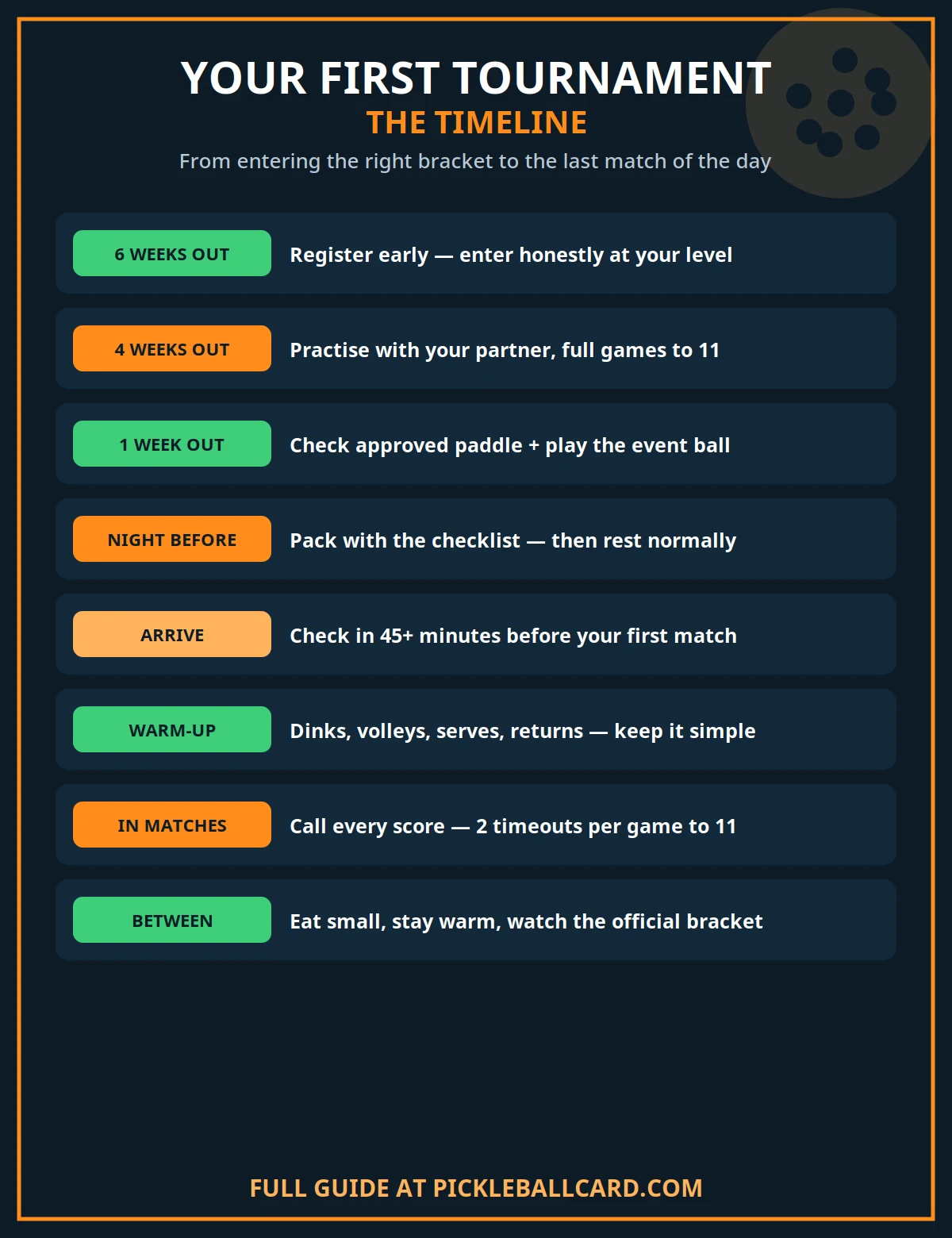
First pickleball tournament timeline — from registration to the last match
Your first tournament timeline — from registration to the last match of the day.

Your Preparation Timeline

Four to Six Weeks Before

Register early. Popular beginner brackets fill first, and late entries often land on a waitlist that only moves when someone withdraws.

Lock in your partner and practise together. Play full games to 11, call the score aloud, and practise starting both serving and receiving.

Play against strangers at least twice. Tournament opponents do not know your habits, and that unfamiliarity is exactly what you need to rehearse.

One to Two Weeks Before

Check your paddle is on the USA Pickleball approved list if your event is sanctioned. Check grips, edge guards and spare gear at the same time.

Play one session using the tournament ball. Balls differ in pace and bounce, and adjusting during the warm-up on the day is too late.

Agree a simple game plan with your partner: who takes middle balls, who calls shots, and what you do when you fall behind early.

The Night Before

Pack using the checklist below, then stop thinking about gear. Lay out clothes, charge your phone and check the drive and parking.

Eat normally and sleep normally. Tournament eve is not the moment for a new diet, new shoes or a radical technique change.

Tournament Day, Hour by Hour

Check-In

Arrive at least forty-five minutes before your first match. Check in at the desk, confirm your bracket and court, and get your player packet.

Listen for how matches will be called: a loudspeaker, a text alert or a desk announcement. Missing a call can mean a forfeit.

Starting servers in doubles may be given a band or marker to wear. Put it on immediately; it settles correct-server questions before they start.

Warm-Up Reality

Warm-up courts are scarce and shared. Expect ten busy minutes, not a private practice session, and share the court generously.

Warm up the shots that matter: dinks, volleys, serves and returns. Skip trick shots. You are preparing your feet and eyes, not entertaining anyone.

On court before a match, the warm-up is brief and formal. Use it to check the ball, the wind and the court surface.

During Matches

Call the score loudly before every serve, every time. In self-officiated matches this habit prevents most disputes before they can begin.

You are responsible for line calls on your side, with the benefit of any doubt going to your opponents. Refereed matches change that job, not the principle.

Our guide to pickleball etiquette and unwritten rules covers the sportsmanship standard. Tournaments test it harder than open play ever does.

Know your timeouts. Each team gets two one-minute timeouts per game to 11 or 15. Use one to reset; never save both for later.

Between games you get up to two minutes. In a deciding game to 11, teams change ends at six points, with up to a minute to switch.

Between Matches: The Long Middle of the Day

Bring a chair, shade and something to do. Waits of an hour or more are normal, especially while other brackets clear the courts.

Eat small and often. A heavy lunch sits badly before an afternoon match; steady snacks and water keep your energy flat and usable.

Stay loosely warm. Walk, stretch gently and hit a few balls when a court frees up, rather than sitting still for ninety minutes.

Watch the bracket, not the rumours. Schedules slip; the official desk and the official bracket are the only sources worth trusting.

What to Bring: The Complete Checklist

Category Bring Why
Play Your paddle plus a backup paddle A cracked frame or dead grip should not end your day
Play Court shoes, spare socks, spare shirt Long days on hard courts punish feet and soak clothing
Fuel Water bottle plus electrolytes Venue supplies run out; cramps end more days than opponents do
Fuel Snacks you already know agree with you Tournament day is no place to experiment with food
Comfort Chair, hat, sunscreen, towel, layers You will spend most of the day off court, often outdoors
Care Tape, plasters, pain relief you normally use Small problems stay small only if you can treat them
Admin Phone, charger, ID, membership details if required Brackets, alerts and check-in all run through your phone

Nerves: What Everyone Feels and What Helps

Everyone is nervous in a first tournament, including the team that looks ice-cold. Hands shake, serves tighten and simple balls get careful. That is normal physiology.

Shrink the target. Judge yourself on routines, not results: breathe before serving, call the score, move your feet, and communicate after every point.

Play your ordinary game. Tournaments punish invented shots. The player who wins a first event is rarely the flashiest; they are the most consistent.

Expect one bad game. Reset rules help: towel off, agree one simple adjustment with your partner, and play the next game point by point.

Remember why you entered. A first tournament is market research on your own game. The medal, if it comes, is a bonus.

Five Mistakes First-Timers Make

  1. Entering too high. An honest bracket gives close matches. A vanity bracket gives a short, silent day and almost no useful feedback.
  2. Arriving at start time. Check-in, parking and warm-up all take longer than expected. Early is calm; on time is already rushed.
  3. Changing equipment that week. A new paddle, grip or shoe needs practice hours first. Debut familiar gear, not shopping.
  4. Ignoring the waits. Players eat too little, sit too long and cool down completely. Manage the hours between matches like part of the event.
  5. Arguing line calls. Benefit of the doubt goes to your opponents. Win the next point instead of re-litigating the last one.

Frequently Asked Questions

Do I need a rating to enter my first pickleball tournament?

No. Most events let first-timers self-rate. Choose the bracket that matches your honest level, using published level descriptions, and expect the rating system to catch up quickly.

Do I need a USA Pickleball membership?

For sanctioned events, yes. Membership is required and your paddle must be approved. Many local and club events are unsanctioned and more flexible, so check the event page.

How many matches will I play?

It depends on the format. Round robin guarantees a game against every team in your group. Double elimination guarantees at least two matches. Single elimination guarantees one.

How long does a tournament day last?

Plan for most of a day. Your bracket may finish in three hours or run past six, depending on field size, courts and schedule delays.

What if I lose my first match?

In double elimination you drop into the second bracket and keep playing. In round robin there is no elimination at all. Only pure single elimination ends your run.

Should I play singles or doubles first?

Doubles, for most people. It is the most common format, shares the workload, and a partner makes the system, the waits and the nerves easier to handle.

The Bottom Line

A first tournament is a system to learn, not a verdict on your talent. Choose a small local event, enter honestly, and prepare for the waiting.

Learn the format before you arrive, pack for the whole day, call every score, and treat every match as information about your real game.

Walk away with a list: what held up, what broke down, and what to practise next. That list, not the result, is the real prize.

Sources: USA Pickleball, Official Rules — tournament formats, standard scoring options and timeout rules in the current rulebook.

This guide is original; no competitor content is linked or reproduced.

shoaib
shoaib

Shoaib is the publisher of Pickleball Card. He oversees the site’s guides to pickleball rules, ratings, strategy and gear, all researched from primary sources — the USA Pickleball Rulebook, DUPR and manufacturer documentation — and updated as the game changes.
pickleballcard.com

Filed Under: Ratings & Competition

What Is Major League Pickleball? MLP Format and DreamBreaker Explained

October 20, 2026 by shoaib

Major League Pickleball — MLP — is professional pickleball played as a team sport. Cities have teams, teams draft players, and matches are decided by a singles tiebreak with a name of its own.

It looks nothing like a normal tournament bracket. Four doubles games come first, every game counts, and a 2-2 tie triggers the DreamBreaker.

This guide explains the whole format in plain language: the teams, the match structure, the hybrid scoring, the DreamBreaker, the season and the playoffs.

Key Takeaways

  • MLP is a coed team league. Hometown teams of men and women compete together, rather than players entering events as individual pairs.
  • Every match has four games. Women’s doubles, men’s doubles and two mixed doubles games, each worth a point toward the match.
  • A 2-2 tie goes to a DreamBreaker. A singles tiebreak to 21 under rally scoring, with teammates rotating in every four points.
  • Scoring is hybrid in 2026. Doubles games use side-out scoring to 11, win by two. Only the DreamBreaker uses rally scoring.
  • All four games are always played. Even a 3-0 lead finishes the fourth game, because results feed standings and tiebreakers.
  • The season builds to playoffs. Regular-season standings points decide which twelve teams reach the 2026 MLP Playoffs.

The Short Answer

Major League Pickleball is the sport’s team league, launched in 2021. Franchises draft rosters of professional men and women and play coed team matches.

Each match is four doubles games. Win three and you win the match. Split them 2-2 and a DreamBreaker singles tiebreak decides it.

Think of it as pickleball rebuilt for team drama: short games, constant pressure, and a tiebreak format you will not see in any ordinary tournament.

What Exactly Is Major League Pickleball?

MLP launched in 2021 as a deliberate break from pickleball’s usual structure, where pairs enter tournaments together and play only for themselves.

Here, the league’s own description is a coed team league with some of the most influential team owners in professional sports behind its franchises.

The official site counts 20 hometown teams and more than 100 of the top-ranked professional players competing across the season.

Teams carry city or regional identities, so fans support a franchise through a whole season instead of following a pair from event to event.

That team layer is the point. Mixed doubles is not a side event in MLP — it is half the match, and roster balance wins titles.

If you are new to the pro game, our profiles of famous Pickleball players introduce many of the stars who headline MLP rosters.

A Brief History of the League

MLP was founded in 2021, when pickleball’s growth was obvious but its professional side still ran on individual tournament entries.

The founding idea was borrowed from other American sports: franchises, a draft, team owners and a championship — structures fans already knew how to follow.

The format experimented early. Earlier seasons used rally scoring to 21 across the doubles games, a faster but less traditional look.

The league later settled on its hybrid model: familiar side-out doubles games, with rally scoring kept for the DreamBreaker where it creates most drama.

Sponsorship and team values grew with the sport around it, and by 2026 the calendar had settled into a compact May-to-August season.

The history matters for one practical reason: when you read older MLP explainers, check the date. The scoring format has genuinely changed since they were written.

How an MLP Match Works, Step by Step

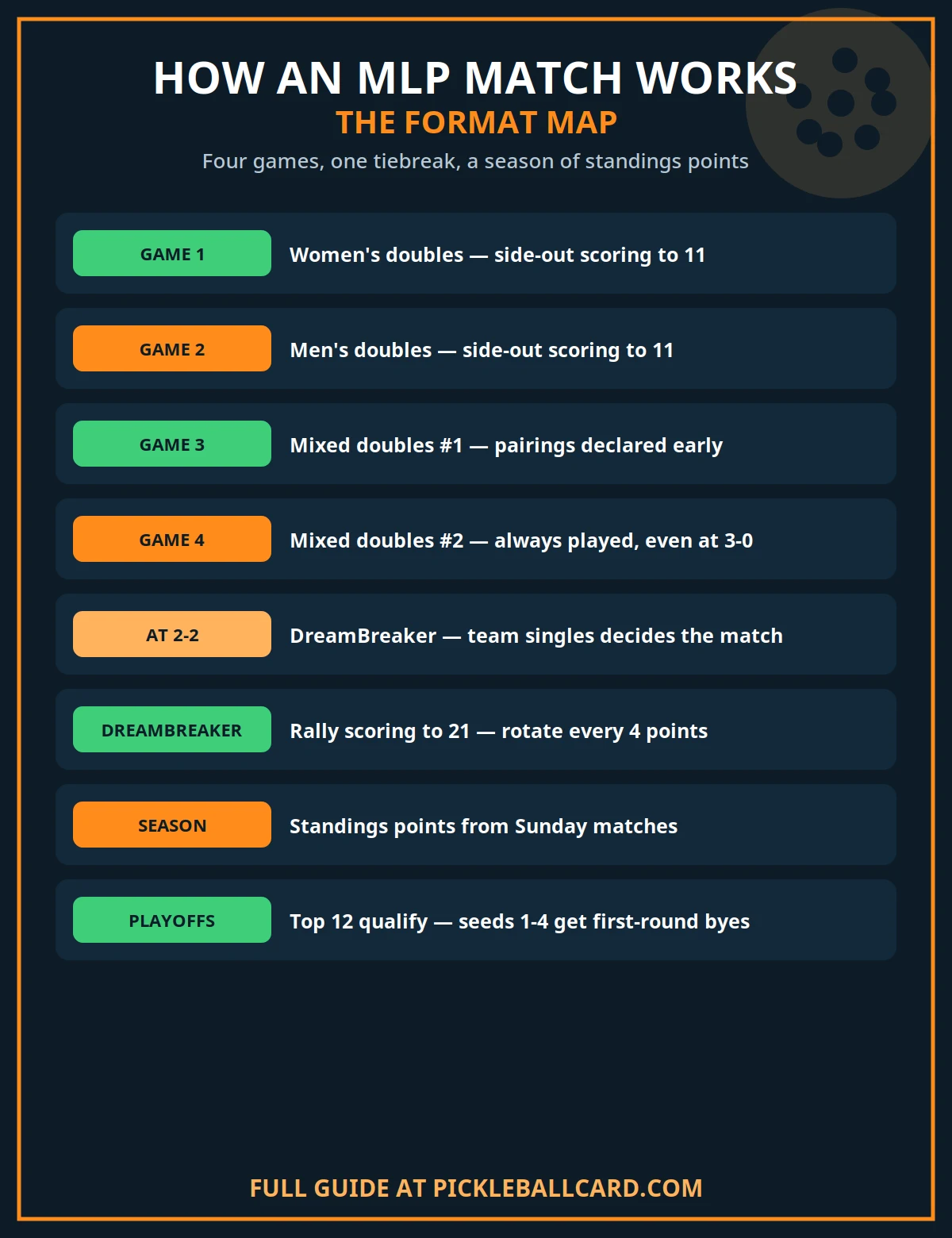
  1. Women’s doubles. The two women on each roster open the match. One game, one point for the winner.
  2. Men’s doubles. The men’s pairing follows, again for one match point.
  3. Mixed doubles, game one. Each team fields a mixed pairing — usually its first-choice combination.
  4. Mixed doubles, game two. The remaining mixed combination plays the fourth game. New pairings, fresh matchups, same stakes.
  5. DreamBreaker, if needed. At 2-2, the match goes to the singles tiebreak explained below. At 3-1 or 4-0, the match is already decided.

Notice the design: gender doubles test each squad’s depth, and the two mixed games test its combinations. A team cannot hide a weak pairing anywhere.

All four games are played even when a team leads 3-0. The extra game still matters for game records and the tiebreakers used in group standings.

Lineups matter before a ball is hit. Teams declare their pairings in advance, and choosing which mixed combination plays first is a genuine tactical decision.

The Hybrid Scoring System, Explained

Game type Scoring system Played to Key detail
Women’s doubles Side-out scoring 11, win by 2 Only the serving team scores, as in traditional pickleball
Men’s doubles Side-out scoring 11, win by 2 Same format as the women’s game
Mixed doubles (both games) Side-out scoring 11, win by 2 Pairings are declared before the match
DreamBreaker singles Rally scoring 21, win by 2 Every rally scores; players rotate every 4 points; the game must be won on serve at the end

Older guides describe MLP as rally scoring to 21 for everything. That was true in earlier seasons, but it is not the current doubles format.

For 2026, the league confirms side-out scoring for the gender and mixed doubles games, played to 11 with a winning margin of two.

Rally scoring survives where it works best: the DreamBreaker, where every rally scoring keeps the tiebreak fast and constantly tense.

If traditional scoring itself is new to you, our guide to pickleball ratings sits alongside scoring explainers that cover the recreational game.

The DreamBreaker: MLP’s Signature Tiebreak

The DreamBreaker is a team singles game played to 21 under rally scoring. It only appears when a match is tied 2-2 after the four doubles games.

Every player takes part. Teammates rotate through the singles matchup in a set order, switching out every four points, so no one player carries the tiebreak alone.

Because scoring is rally-based, the score moves on every rally. A small lead can vanish in a minute, which is why crowds love it.

Two details raise the pressure further. Teams change ends partway through, and at the end the game must be won while serving — a freeze at game point.

Strategically, the rotation order is a chess move. Coaches try to land their strongest singles players on the most favourable stretches of the rotation.

It is also the only singles most MLP fans watch. Doubles specialists suddenly have to cover a full court alone, with their whole team courtside.

How an MLP match works infographic — four doubles games, the DreamBreaker at 2-2, standings points and playoffs
How an MLP match works: four games, a DreamBreaker at 2-2, and the road to the playoffs.

Teams, Drafts and Rosters

MLP rosters are built through a draft. Teams select from a pool of available professionals rather than simply signing any pair they like.

Each roster combines men’s and women’s players, because the format needs both: gender doubles pairs plus two different mixed combinations in every match.

Recent seasons expanded rosters beyond the starting four, giving teams bench options. Starting lineups are declared before each match day, so depth is used, not wasted.

That structure rewards general managers as much as players. Drafting a strong third or fourth option can decide a DreamBreaker months later.

For fans, the draft creates an off-season story normal tournaments never have: rebuilds, steals, and rosters that look completely different each year.

The Season and the Road to the Playoffs

The 2026 calendar features 13 events in total: nine regular-season events, a mid-season tournament and three weekends of playoffs, running from May to August.

At each regular-season event, 11 teams take part. They split into groups and play round robin from Thursday to Saturday.

The top teams in each group advance to Sunday. Sunday’s head-to-head matches are where teams earn the standings points that shape their season.

Across the season, standings points also reward how a match was won, so a DreamBreaker victory and a regulation victory are not quite equal.

The top 12 teams in the final standings qualify for the 2026 MLP Playoffs, seeded one through twelve.

Seeds one to four receive first-round byes and start at the quarterfinals in Newport Beach. Seeds five to twelve open the playoffs in Dallas.

The four quarterfinal winners advance to the semifinals in New York City, and the two semifinal winners meet in the finals, also in New York.

A Worked Example: One Match, Start to Finish

Imagine two teams level on talent. The women’s doubles game goes to Team A, 11-8. Team B answers in the men’s game, 11-9. The match is 1-1.

Team A’s first mixed pairing wins the third game, 11-7. Team B now needs the fourth game simply to survive — and gets it, 12-10. The match is 2-2.

Everything now rests on the DreamBreaker. Six players per side rotate through singles rallies, four points at a time, every rally scoring toward 21.

Team B’s rotation order proves smarter: its strongest singles player lands the closing stretch, and Team B takes the DreamBreaker 21-18 — and the match with it.

Under the standings system, that DreamBreaker win is worth slightly less than a 3-1 regulation win. Winning well matters, not just winning.

A Quick MLP Glossary

Term What it means
MLPlay The league’s own name for its team match format and rules
DreamBreaker The rally-scored singles tiebreak to 21 that decides a 2-2 match
Regulation win Winning the match 3-1 or 4-0, without needing a DreamBreaker
Side-out scoring Traditional pickleball scoring: only the serving team can win points
Rally scoring Every rally produces a point, whoever served
Standings points Season points earned from match results, used to seed the playoffs
Freeze At DreamBreaker game point, the leading team must win the final point on its own serve

MLP vs a Regular Pickleball Tournament

Feature Major League Pickleball Regular pro tournament
Who competes City-based teams with drafted rosters Individual pairs enter together
Match structure Four team games: women’s, men’s, two mixed Separate draws for each event
Mixed doubles Half of every match, always One event among several
Scoring Side-out to 11 in doubles; rally-scored DreamBreaker to 21 Usually side-out to 11, best of three games
Tiebreak DreamBreaker team singles A deciding third game in the same format
Season story Standings, drafts, playoffs, a champion team Each event stands alone

The contrast explains MLP’s appeal. A normal tournament crowns pairs. MLP crowns a team — and gives fans a table to argue about all season.

It also sits inside a bigger story: record crowds and new fans keep arriving, as we cover in why pickleball is so popular.

Why Players and Fans Like the Format

Players get something rare in pickleball: teammates. Bench energy, shared game plans and a season-long identity are normal in other sports and novel here.

Fans get short, legible matches. Four games, one point each, a possible tiebreak — a newcomer understands the stakes within five minutes of watching.

Mixed doubles benefits most. In MLP it is never an afterthought: it decides matches every week, and its best players become genuine stars.

And the DreamBreaker gives the league a highlight format of its own — the clip new fans share first when they discover the league.

How to Watch and Follow MLP

Start with the league’s own site and schedule, which publish each event’s team matchups in advance so you can preview the pairings.

Pick a hometown team early. Following one roster through the standings race makes the group stage and Sunday points far easier to care about.

When you watch a match, track the mixed pairings. Which combination a team saves for the fourth game often reveals its whole strategy.

If a DreamBreaker starts, watch the rotation order instead of the ball for a few points. The matchup chess is the format’s hidden game.

Three Misconceptions to Drop

First, MLP is not the only pro pickleball. Tour events for individual pairs run alongside it, and most MLP players compete in both worlds.

Second, the DreamBreaker is not regular singles. It is a rotating team tiebreak, and a player may only face two or three opponents across it.

Third, a 3-0 lead does not end the match early. The fourth game is always played, because game records feed the standings tiebreakers.

Frequently Asked Questions

What does MLP stand for?

Major League Pickleball. It is a coed professional team league — presented by DoorDash in recent seasons — where city-based franchises compete across a season of events.

What is a DreamBreaker in pickleball?

MLP’s singles tiebreak, played when a team match is tied 2-2. It uses rally scoring to 21, win by two, with teammates rotating in every four points.

How many games are in an MLP match?

Four: women’s doubles, men’s doubles and two mixed doubles games. Each game is worth one point, all four are always played, and 2-2 triggers the DreamBreaker.

Does MLP use rally scoring?

Only in the DreamBreaker. In 2026 the doubles games use traditional side-out scoring to 11, win by two — older all-rally-scoring descriptions are out of date.

How are MLP teams formed?

Through a draft from a pool of professional players. Rosters combine men and women, expanded beyond four players in recent seasons, with starting lineups declared before match days.

How many teams make the MLP playoffs?

Twelve in 2026. They are seeded by regular-season standings points, with the top four seeds receiving byes into the quarterfinals.

The Bottom Line

Major League Pickleball turns an individual sport into a team season: drafted rosters, four-game matches, standings points and a playoff bracket.

Its two inventions are what to remember — mixed doubles as half of every match, and the DreamBreaker singles tiebreak when everything is level.

Watch one full match, ideally one that reaches a DreamBreaker. After that, the format explains itself better than any guide can.

Sources: Major League Pickleball, The ABC’s of MLP (2026 format, season and playoffs); USA Pickleball, Official Rules for traditional side-out scoring.

This explainer is original; no competitor content is linked or reproduced.

shoaib
shoaib

Shoaib is the publisher of Pickleball Card. He oversees the site’s guides to pickleball rules, ratings, strategy and gear, all researched from primary sources — the USA Pickleball Rulebook, DUPR and manufacturer documentation — and updated as the game changes.
pickleballcard.com

Filed Under: Ratings & Competition

Padel vs Pickleball: What’s the Difference (and Which Should You Try?)

October 20, 2026 by shoaib

Padel and pickleball look like cousins. Both use a solid paddle, both are played on a small court, and both are growing fast.

They are not the same sport. One is played inside glass walls. The other has a no-volley zone called the kitchen. Almost everything else follows from those two facts.

This guide compares them properly: courts, rackets, balls, serves, scoring, rally style, learning curve, cost and availability — so you can pick the right one first.

Key Takeaways

  • The walls are the headline. Padel is enclosed, and the ball stays live off the glass. Pickleball is open, and a ball out is out.
  • Padel courts are bigger. Padel is 20 by 10 metres. Pickleball is 44 by 20 feet — about 13.41 by 6.10 metres.
  • Scoring is completely different. Padel copies tennis: 15, 30, 40, games and sets. Pickleball plays to 11, win by two.
  • Padel is doubles only. Official padel is always pairs. Pickleball is played as singles and doubles, with doubles most common.
  • Pickleball is easier to start. Most beginners rally in minutes. Padel’s wall play takes longer to read and trust.
  • Neither replaces the other. Plenty of players enjoy both. They simply reward different skills, as this comparison shows.

The Short Answer

Choose padel if you want an enclosed, doubles-only game where rebounds off glass keep rallies alive and positioning matters as much as power.

Choose pickleball if you want the quickest route into a racket sport: a smaller open court, a slower plastic ball, and games you can learn in one session.

If you can, try both. One session of each tells you more than any comparison table — but the table below is a good place to start.

Padel vs Pickleball at a Glance

Feature Padel Pickleball
Invented 1969, Acapulco, Mexico 1965, Bainbridge Island, Washington, USA
Court size 20 m x 10 m, enclosed 44 ft x 20 ft (13.41 m x 6.10 m), open
Walls Glass and mesh, in play after a bounce None — the ball is dead once it leaves the court
Net height 0.88 m at centre, 0.92 m at sides 34 in at centre, 36 in at sidelines
Racket / paddle Solid, perforated, up to 45.5 cm long, wrist cord required Solid, smooth-faced paddle, larger and usually lighter
Ball Pressurised rubber, similar to a low-pressure tennis ball Hollow plastic ball with holes
Format Doubles only in official play Singles and doubles
Serve Underhand, after a bounce, at or below waist, two attempts Underhand, diagonal, one attempt; volley or drop serve
Signature rule Play the ball off your own glass after it bounces No volleys inside the 7 ft kitchen (non-volley zone)
Scoring Tennis scoring: points, games, sets, tiebreak at 6-6 To 11, win by 2; only the serving side scores in traditional scoring
Typical rally Longer, with rebounds and resets off the glass Shorter court, soft dink exchanges at the kitchen line

Every figure in this table comes from the two governing bodies: the International Padel Federation (FIP) for padel and USA Pickleball for pickleball.

Two Sports, Two Births — Only Four Years Apart

Pickleball came first, in 1965 on Bainbridge Island near Seattle. Families improvised a game with table-tennis paddles, a perforated plastic ball and a badminton court.

Padel followed in 1969 in Acapulco, Mexico. Enrique Corcuera built an enclosed court on his property, adding walls so the ball stayed in play longer.

From there they travelled differently. Padel spread through Spain, then Europe and Latin America. Pickleball spread through American schools, parks and retirement communities, then everywhere.

That history explains today’s map. Padel courts are easy to find in much of Europe. Pickleball courts are easy to find across the United States.

The Court: Enclosed Glass Box vs Open Court

A padel court measures 20 metres long and 10 metres wide, fully enclosed. Back walls rise to 4 metres in total — glass topped with mesh.

The glass is not decoration. After the ball bounces on your side, it may hit your glass and you can still play it. That one rule rebuilds the whole sport.

A pickleball court measures 44 feet long and 20 feet wide, with no enclosure. If a shot misses the lines, the rally simply ends.

Pickleball’s defining feature sits at the net instead: the kitchen, a 7-foot non-volley zone on each side where you may not hit the ball in the air.

Why the Court Size Matters

Padel’s court is roughly twice pickleball’s playing area, shared by four players in doubles. There is more ground to cover and more angles to defend.

Pickleball’s smaller court is why beginners succeed so quickly. Less distance means shorter swings, slower decisions and rallies that start almost immediately.

It also explains court supply. Several pickleball courts fit inside one tennis court, and lines can be taped onto existing surfaces in minutes.

The Racket and the Ball

A padel racket is solid but perforated, with holes drilled through the face. It has no strings, a short handle and a mandatory wrist cord.

FIP rules cap it at 45.5 cm long, 26 cm wide and 38 mm thick. Most weigh noticeably more than a pickleball paddle.

A pickleball paddle is also solid, but its face is smooth rather than perforated. It is wider than a padel racket and usually lighter in the hand.

The balls differ even more. A padel ball is a pressurised rubber ball, much like a slightly softer tennis ball, 6.35 to 6.77 cm across.

A pickleball is hollow plastic with holes. It flies slower, bounces lower and loses pace quickly, which is exactly why the game stays controllable for beginners.

The Serve: Similar Shape, Different Details

Both serves are underhand and diagonal, which surprises tennis players expecting an overhead weapon. Neither sport lets you win cheap points with the serve alone.

In padel, you bounce the ball behind the service line and strike it at or below waist height. You get two attempts, as in tennis.

The serve must land in the service box and bounce before touching any wall. Hitting the mesh fence on a serve is a fault.

In pickleball, the server strikes the ball in the air or uses a drop serve, contacting it below the waist. There is only one serve attempt.

Pickleball then adds its famous two-bounce rule: the serve and the return must both bounce before anyone may volley. Our guide to how to play pickleball walks through the full sequence.

Scoring and Match Format

If you know tennis scoring, you already know padel scoring. Points run 15, 30, 40 and game, with deuce and advantage, and sets go to six games.

A tiebreak decides a set at 6-6. Matches are normally best of three sets, so a close padel match can run well past an hour.

Pickleball scoring is its own language. Games go to 11 points, win by two, and in traditional scoring only the serving side can score.

Doubles adds the three-number call — server’s score, receiver’s score, server number — which sounds confusing for one game and then becomes automatic.

Games are short. A typical recreational pickleball game lasts ten to twenty minutes, so groups rotate courts and mix partners far more often than in padel.

How a Rally Actually Feels

Padel: Patience, Walls and Angles

Beginners panic when a shot passes them in padel. Experienced players let it go, turn, and play the rebound off the back glass instead.

That single habit transforms defence. Shots that would be clean winners elsewhere come back, so points are built patiently until a real opening appears.

Net position still matters — the attacking pair wants the net — but the walls give the defending pair time and options no open court offers.

Pickleball: The Soft Game at the Kitchen

Pickleball rallies funnel toward the kitchen line. Because volleys are banned inside the zone, players trade soft dinks just over the net, waiting for a ball to attack.

Power matters, but placement and patience matter more at most levels. A hard shot from a bad position usually comes back harder.

The result is a game of small margins played close together, which is why pickleball feels social even when it gets fiercely competitive.

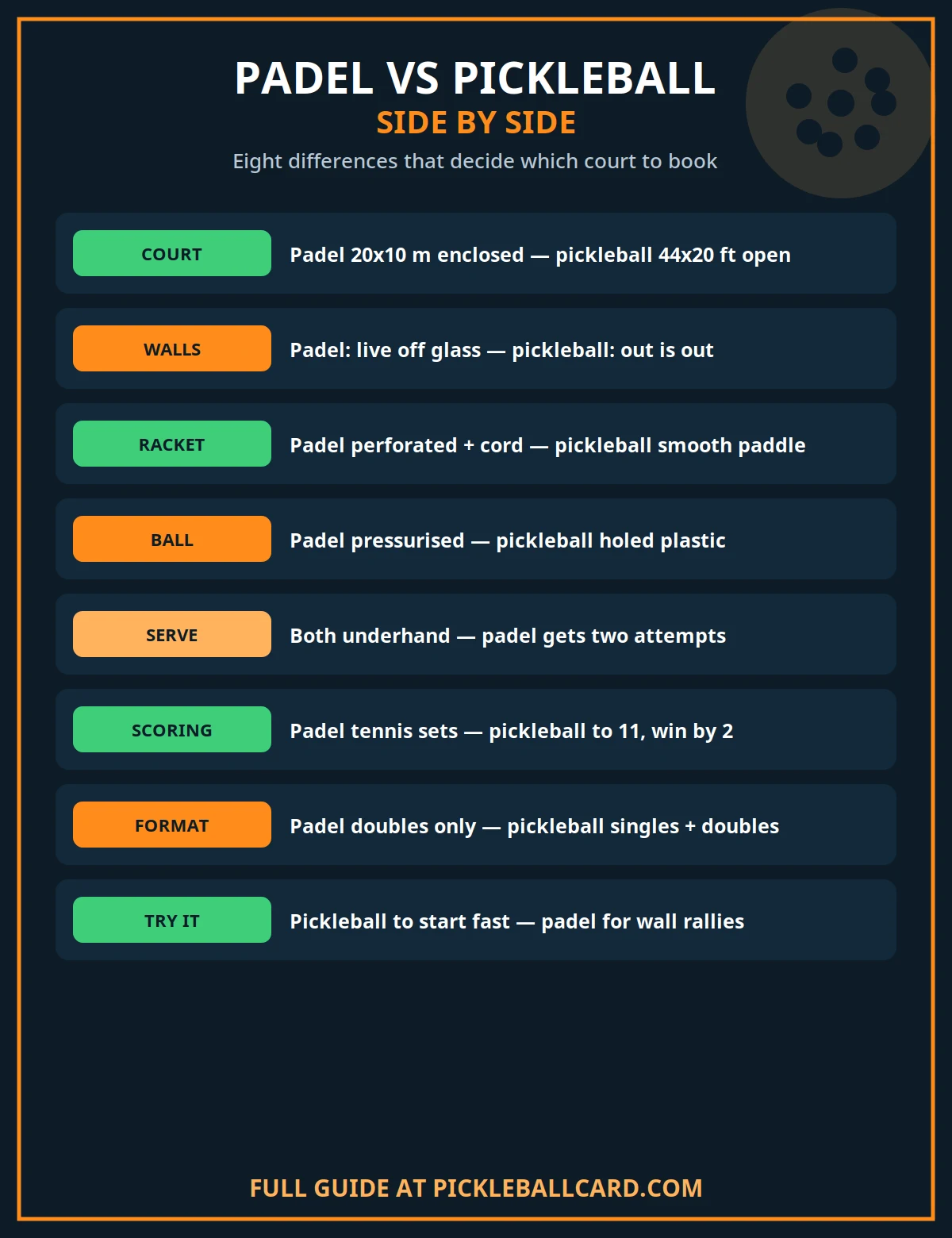
Padel vs pickleball side-by-side comparison infographic covering court, walls, racket, ball, serve, scoring and format
Padel vs pickleball side by side: the eight differences that matter.

Learning Curve and Physical Demand

Pickleball has the gentler on-ramp. The court is small, the ball is slow, and the underhand serve is easy to land from the first try.

Most new players hold a real rally in their first session. Reaching a decent club level still takes work, but the first fun arrives immediately.

Padel asks more at the start. The basics are friendly, but reading rebounds, using the glass and coordinating with a partner add a second learning curve.

Physically, padel usually demands more running and longer rallies on a bigger court. Pickleball’s doubles game, played mostly near the kitchen, is kinder on the legs.

Neither sport is contact or high-impact by design. As with any new activity, build up gradually and stop if something hurts rather than playing through it.

Cost and Availability

Pickleball’s entry cost is low: an inexpensive paddle, a few balls and a public court, which is often free. Indoor centres charge modest court or session fees.

Padel needs a purpose-built enclosed court, so play usually means booking a club court by the hour and splitting the cost four ways.

Padel rackets also tend to cost more than starter pickleball paddles, and balls lose pressure and need replacing regularly, like tennis balls.

Availability may decide for you. In much of the US, pickleball is the easy find. In Spain and much of Europe, padel courts are the easy find.

Which Should You Try? A Simple Guide

If this sounds like you… Try first Why
You want fun in your very first session Pickleball Small court, slow ball, rallies from minute one
You love tennis or squash and want a new twist Padel Familiar scoring, plus walls that reward squash-style thinking
You mostly play with family across ages Pickleball Gentle doubles game grandparents and grandchildren share well
You want a workout with long, tactical rallies Padel Bigger court, rebounds and longer points ask more of your legs
You want singles as well as doubles Pickleball Singles is a normal format; official padel is doubles only
Your local club is full of glass courts Padel Play what your area actually offers, with a ready community

Already Play One? Switching Is Easier Than Starting Fresh

Pickleball players moving to padel keep their net game and soft hands. The work is learning to let the ball pass and trust the glass behind you.

Padel players moving to pickleball keep their patience and angles. The work is unlearning the walls — and respecting the kitchen, where volleys are simply illegal.

Both groups share one trap: treating the new sport as a smaller version of the old one. Give the different scoring and signature rule a few sessions.

Do not confuse padel with paddle tennis, either. They are separate sports again — our comparison of paddle tennis vs pickleball untangles that older American game.

And if tennis is your reference point, our guide to pickleball vs tennis covers the other comparison most new players ask about.

What the Two Sports Share

For all their differences, padel and pickleball were built on the same idea: make a racket game that ordinary people can enjoy quickly.

Both use a solid-faced implement with no strings. Both serve underhand and diagonally. Both are normally played as doubles, at the net, by mixed-age groups.

Both also reward the same virtues: positioning over raw power, patience in defence, and a partner you communicate with on every single point.

That shared DNA is why so many players cross over happily, and why clubs increasingly offer both sports side by side.

Your First Session in Each Sport: What to Expect

A first pickleball session usually starts with five minutes of explanation: the kitchen, the two-bounce rule and the three-number score call.

Then you play. Expect short rallies, lots of laughter at missed dinks, and a real game — with real points — inside half an hour.

A first padel session starts with the serve mechanics and one safety habit: always wear the wrist cord, and never turn your back carelessly near the glass.

Then you play, more slowly. Your first rebounds off the glass will feel accidental. By the second session, you will start using them on purpose.

Bring court shoes to either sport. Running shoes grip poorly on sideways moves, which both games use constantly, and court shoes protect your ankles.

Frequently Asked Questions

Is padel harder than pickleball?

For most beginners, yes at the start. Pickleball’s smaller court and slower ball produce rallies immediately, while padel adds wall rebounds that take sessions to read confidently.

Can you play padel as singles?

Not in official competition. FIP padel is a doubles sport, played two against two. Narrower singles courts exist for practice, but the real game is always pairs.

Why does padel have walls?

The enclosed court was there from the sport’s invention in 1969. The glass keeps the ball in play after a bounce, extending rallies and adding angles open courts cannot offer.

Is a padel racket the same as a pickleball paddle?

No. A padel racket is perforated, thicker and usually heavier, with a wrist cord and strict size limits. A pickleball paddle has a smooth face and a larger, lighter shape.

Which sport is better exercise?

Both are solid workouts. Padel doubles usually covers more ground with longer rallies, while pickleball singles is surprisingly demanding. Pickleball doubles is the gentlest option of the three.

Which is more popular?

It depends where you stand. Pickleball dominates in the United States, while padel is the bigger game across Spain, much of Europe and Latin America. Both are still growing quickly.

The Bottom Line

Padel is the enclosed, doubles-only, tennis-scored game where the glass is part of the rally. Pickleball is the open, kitchen-centred game scored to 11.

Pickleball wins on accessibility, cost and singles play. Padel wins on rally length, angles and that unique second chance off the back wall.

The best answer is the court near you with people you like. Book one session of each if you can — then you will know.

Sources: International Padel Federation, FIP Rules of Padel; USA Pickleball, Official Rules and Rules hub.

This comparison is original; no competitor content is linked or reproduced.

shoaib
shoaib

Shoaib is the publisher of Pickleball Card. He oversees the site’s guides to pickleball rules, ratings, strategy and gear, all researched from primary sources — the USA Pickleball Rulebook, DUPR and manufacturer documentation — and updated as the game changes.
pickleballcard.com

Filed Under: About Pickleball

Pickleball for Kids: What Age to Start and How to Teach It

October 19, 2026 by shoaib

Parents usually ask the same first question about kids and pickleball: what age should my child start?

The honest answer is that birthdays matter less than readiness. A child who can hold a paddle, track a slow ball and copy a simple game is ready to begin.

This guide gives parents the full picture: readiness signs, what to expect at each age, the right equipment, a first-session teaching plan, and how to keep it safe and fun.

Key Takeaways

  • There is no official minimum age. USA Pickleball runs junior competition for under-18s, but starting is about readiness, not rules.
  • Simple play can start around 5–6. Short paddle games and easy rallies suit most children at that stage.
  • Full rules land around 8–10. Scoring, the kitchen rule and real games make sense once attention and coordination catch up.
  • Light paddle, small grip, court shoes. Junior-sized equipment prevents the bad habits an adult paddle teaches small arms.
  • Fun first, technique second. Games, not drills, are how children under ten actually learn a sport.
  • Keep sessions short. Twenty to forty minutes of quality play beats an hour that ends in frustration.

The Short Answer

Most children can try simple pickleball play around age five or six: bouncing a ball on a paddle, dinking games, and short rallies with an adult feeding easy balls.

Between six and eight, children can learn simplified games with a real serve and simple scoring. Between eight and ten, most are ready for the full rules.

USA Pickleball’s junior pathway then takes over for keen players, with tournament age groups of 12 and under, 13–14 and 15–16 in its junior events.

Readiness Beats Age: The Signs to Look For

Age ranges are averages. Your child is ready for a first session when most of these are true:

  • They can hold a paddle comfortably with one hand and swing it without it dragging on the ground.
  • They can track a rolling or gently tossed ball and make contact more often than they miss completely.
  • They can copy a simple rule — wait for the bounce, hit it back over — and remember it for a few minutes.
  • They can share a court safely, stopping when someone says stop and keeping distance from other swinging paddles.
  • They are asking to play. Interest is the readiness sign that predicts everything else.

If only some signs are there, start anyway — just start smaller. Balloon-style paddle games in the garden build exactly the tracking skills the list describes.

What to Expect at Each Age

Age What works What to skip for now
4–5 Paddle-and-ball play: bouncing, balancing, rolling target games, very short sessions Rules, scoring, real games, any correction-heavy coaching
6–8 Dinking games, underhand serve practice, simplified rallies, first simple scoring Kitchen faults, long matches, competitive pressure
9–12 Full rules and scoring, doubles with family, beginner clinics, first junior events Adult open-play intensity, heavy adult paddles
13+ Regular games, lessons, USA Pickleball junior tournaments in their age group Nothing structural — progression is now about interest and coaching

Children develop at wildly different speeds. A coordinated seven-year-old may out-rally a cautious ten-year-old, and both are completely normal.

Use the table as a menu, not a test. Move your child to the next stage when the current one feels easy and still fun.

Why Pickleball Works So Well for Kids

Pickleball succeeds with children for the same reason it succeeds with grandparents: success arrives quickly. The court is small, the ball is slow, and rallies start on day one.

That early success matters. Children stick with activities where they feel competent, and pickleball delivers competence faster than almost any other racket sport.

Skills It Builds Without Feeling Like Training

Hand-eye coordination is the obvious one: tracking, timing and striking a moving ball, hundreds of times an hour, inside games children chose to play.

Footwork and balance develop the same way. Short shuffles, stops, turns and reaches are built into every rally, no cones or drills required.

Scoring quietly teaches arithmetic and memory. Keeping score aloud — server number, side, points — is genuine mental exercise dressed as part of the game.

Doubles adds teamwork and communication. Children learn to call balls, share space, encourage a partner and lose a point without melting down.

A Rare Sport the Whole Family Can Share

Pickleball’s handicap is built in: adults can dial their pace down and children can still play real rallies against them, on the same court, in the same game.

That makes it one of very few sports where grandparents, parents and children genuinely play together rather than taking turns watching each other.

Equipment: Light, Small and Simple

  • Paddle: a junior paddle — lighter than an adult model, with a shorter, smaller grip that fits a child’s hand. An adult paddle teaches wristy, strained technique.
  • Balls: standard pickleballs are fine on court. For the youngest beginners at home, a softer foam ball slows everything down and saves the furniture.
  • Shoes: court shoes or trainers with good grip and sideways support. Avoid chunky running shoes that catch and tip on lateral moves.
  • Eye protection: worth wearing from the start, especially in doubles. A deflected ball at close range is the sport’s main eye risk.
  • Water and sun kit: a filled bottle, hat and sunscreen for outdoor courts. Children overheat faster than they realise.

Borrow before you buy where you can. Many clubs and recreation centres lend junior paddles, and USA Pickleball’s youth provider network exists partly to lower this equipment barrier.

Make the Court Smaller and the Rules Simpler

Shrink the Playing Area

Young children do not need a full court. Play dinking games inside the kitchen and service box, where rallies are short, contact is constant and success comes quickly.

Move the serve closer too. Let a young child serve from inside the baseline, or even mid-court, until the motion works; move them back as it strengthens.

Every modification has one job: more successful hits per minute. Success is what brings a child back tomorrow.

Teach Rules in Layers

Teach only three things first: hit the ball over the net, let it bounce once on each side at the start of a rally, and serve underhand diagonally.

Add the kitchen rule as a simple picture — “you can step in the kitchen, but you cannot hit the ball out of the air while standing there” — once volleys begin.

Scoring comes last, and adults can call it aloud for weeks. Our full guide to how to play pickleball is the parent reference when your child is ready for the complete rule set.

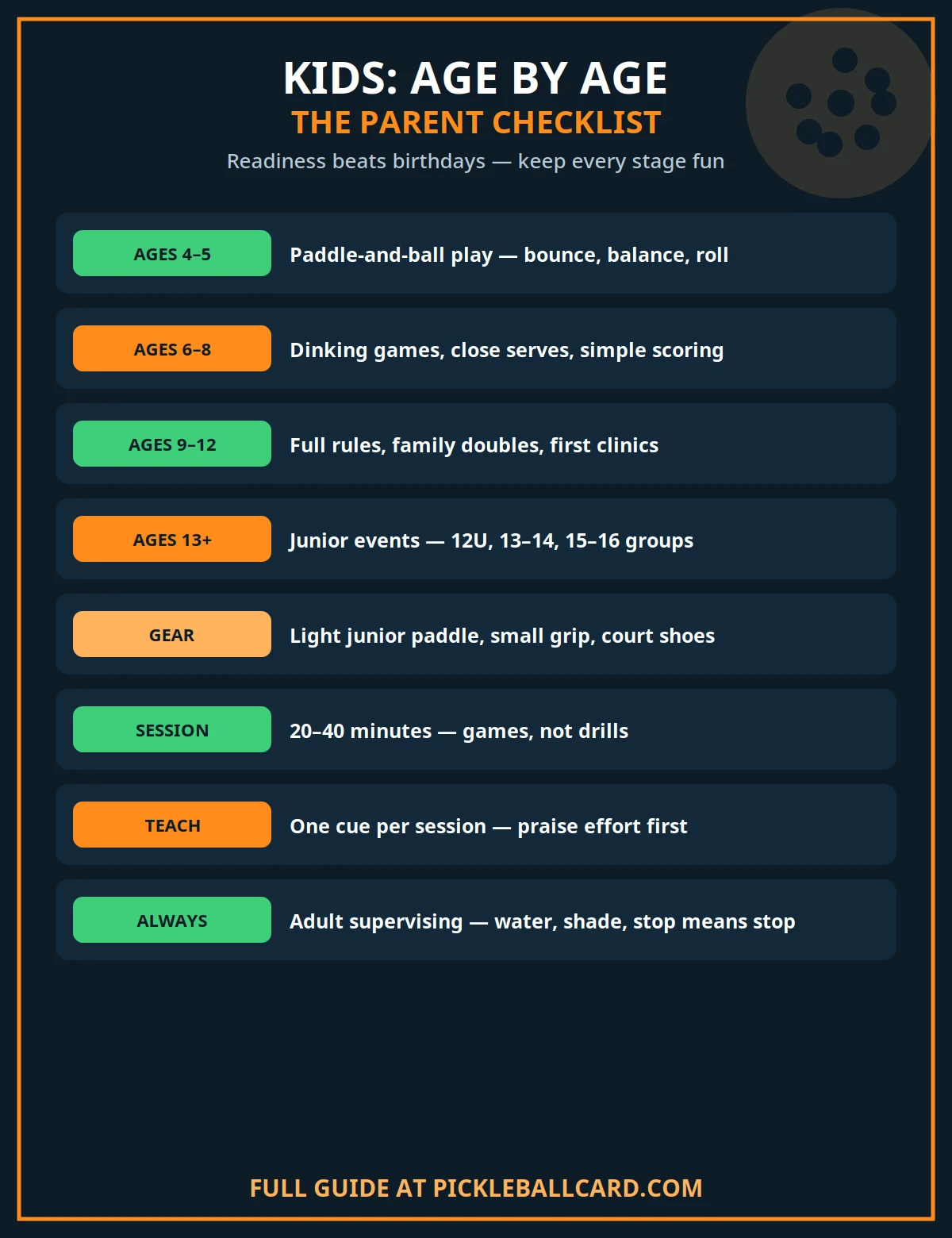
Age-by-age checklist for kids pickleball from ages 4-5 play to junior events, gear, session length and supervision
Kids pickleball, age by age: the parent checklist.

Your Child’s First Session: A 30-Minute Plan

  1. Ball familiarity (5 minutes). Bounce the ball on the paddle, walk while balancing it, roll it to targets. No net, no pressure, lots of contact.
  2. Dinking game (5 minutes). Stand either side of the net inside the kitchen area. Count cooperative rallies together and chase your record, not a winner.
  3. First serves (5 minutes). Serve underhand from close range at a big target. Celebrate any serve that lands in the box; ignore the rest.
  4. Rally game (10 minutes). Play gentle rallies where the adult feeds playable balls. Score cooperatively: one point for every rally of five shots or more.
  5. Fun finisher (5 minutes). End with the game they liked most, on a success. Always stop while they are still asking for more.

Notice what is missing: technique lectures. One tiny cue per session — “watch the ball onto the paddle” is plenty — is all a young beginner can use.

Safety for Young Players

  • Supervision: an adult on court or courtside for every session involving young children, with a clear rule that play stops when the adult calls stop.
  • Spacing: teach the paddle-distance rule early — never swing within reach of another player, and call “ball on court” and stop when a stray ball rolls in.
  • Hydration and heat: scheduled water breaks, shade between games, and shorter sessions on hot days. Children do not self-pace reliably.
  • Lessons and coaches: for organised instruction, choose programs through schools, parks departments or recognised youth providers, and ask about coach certification and background checks.
  • Effort and pain: children should finish tired and happy, not sore. Recurring wrist, elbow or knee pain means stop and get it checked.

The CDC recommends that children and adolescents aged 6 to 17 get at least 60 minutes of moderate-to-vigorous physical activity daily, in activities that are varied, age-appropriate and enjoyable.

Pickleball fits that guidance well precisely because children experience it as play. The broader benefits are covered in our guide to the health benefits of pickleball.

Keeping It Fun (Which Is the Whole Point)

Children quit sports that feel like tests. Keep score cooperatively, play parents-versus-kids games with the adults handicapped, and let the child invent one silly rule per session.

Praise effort and specific things — “you watched that ball all the way in” — rather than results. Confidence in young players grows from noticed competence.

Sportsmanship is a pickleball gift worth teaching early: call lines fairly, tap paddles, and thank your partner. Our guide to pickleball etiquette and its unwritten rules is written for adults, but every habit in it starts here.

If a child wants competition, follow that interest rather than manufacturing it. Junior clinics and USA Pickleball junior events are built to be encouraging first and competitive second.

A Simple Progression From First Hit to First Event

Stage one is the garden or driveway: paddle games, bounce challenges and a parent feeding balls. Most children live happily here for months.

Stage two is the court with family: simplified games, real serves from a closer line, and scoring called aloud by an adult.

Stage three is a beginner clinic or youth session, where your child plays with other children at the same level and learns from a coach.

Stage four, only for children who ask for it, is a junior event. USA Pickleball’s junior divisions are co-ed, age-banded and designed as an encouraging first taste of competition.

There is no deadline on any stage. A child who stays at stage two for two years and loves it has not fallen behind anyone.

Finding Lessons and Junior Programs

Start local: school PE programs, parks and recreation departments, YMCAs and Boys & Girls Clubs increasingly run youth pickleball, often with loaner equipment.

USA Pickleball supports this through its Youth Pickleball Provider resources for schools and community organisations, including a youth playbook, activity cards and activity plans written separately for ages 8–12 and 13–18.

For a ready competitor, USA Pickleball’s junior divisions at select Golden Ticket Tournaments offer co-ed singles and doubles in the 12-and-under, 13–14 and 15–16 age groups.

Ask any program three questions: What is the coach-to-child ratio? Are coaches certified and background-checked? And how much of the session is games versus drills? Good programs answer all three happily.

Common Mistakes Parents Make

Mistake Why it backfires Better approach
Starting with an adult paddle Weight and grip size strain small wrists and teach wristy technique Borrow or buy a light junior paddle with a small grip
Teaching every rule on day one Overload kills the fun before the first rally Layer the rules: bounce, underhand serve, kitchen, scoring last
Long, drill-heavy sessions Children learn through games; boredom ends the experiment Twenty to forty minutes, mostly cooperative games
Correcting every shot Constant correction makes children afraid to swing One simple cue per session, praise effort specifically
Adults playing at full pace Overwhelmed children stop moving toward the ball Feed playable balls, dial pace down, handicap yourself
Skipping water and shade breaks Children overheat and fade without noticing Schedule breaks; do not wait for complaints

Frequently Asked Questions

What is the best age for a child to start pickleball?

There is no official minimum. Most children can enjoy simple paddle-and-ball play at five or six, simplified games at six to eight, and full rules and scoring somewhere around eight to ten.

Can kids use an adult pickleball paddle?

Briefly, for a first try, yes. For regular play, no: adult paddles are heavier with larger grips, which strains small wrists and teaches poor technique. A light junior paddle is the right tool.

Is pickleball safe for children?

It is a non-contact sport with a light plastic ball and a small court, which makes it one of the gentler racket sports. The main precautions are supervision, court shoes, eye protection in doubles, hydration and sensible session lengths.

How long should a child’s pickleball session be?

Twenty to forty minutes for young beginners, including games and breaks. Older children who are enjoying themselves can play longer, with regular water breaks and an adult watching for fatigue.

Do kids need lessons to start pickleball?

No. A parent, the plan in this article and a borrowed paddle are enough to start. Lessons and clinics become valuable once a child is keen, wants proper technique, or is heading toward junior events.

Can parents and kids play pickleball together?

Yes — it is one of the sport’s real strengths. Adults simply dial back pace, feed playable balls, and play doubles together. Few sports let three generations share one competitive court.

The Bottom Line

Start when your child shows the readiness signs, not when a birthday arrives: paddle in hand at five or six, simplified games soon after, full rules by around eight to ten.

Give them a light junior paddle, a smaller court, layered rules and short, game-filled sessions, and pickleball becomes what it should be for a child — play that happens to build skills.

Then let their interest set the pace. For some children it stays a family game; for others, USA Pickleball’s junior pathway is waiting when they are ready.

Sources: USA Pickleball, Junior and Youth Pickleball and Pickleball Educator Resources; CDC, Physical Activity Guidelines for School-Aged Children and Adolescents.

Coaching content in this article is original; no competitor content is linked or reproduced.

shoaib
shoaib

Shoaib is the publisher of Pickleball Card. He oversees the site’s guides to pickleball rules, ratings, strategy and gear, all researched from primary sources — the USA Pickleball Rulebook, DUPR and manufacturer documentation — and updated as the game changes.

pickleballcard.com

Filed Under: About Pickleball

Pickleball Tips for Seniors: Play Smarter, Move Less, Win More

October 19, 2026 by shoaib

The best senior pickleball players are rarely the fastest people on court. They are the calmest.

They stand in the right place early, keep the ball low, target the middle, and let impatient opponents donate the errors.

This guide is the senior game as one system: start safely, win position, play soft, move safely, and manage your session like part of the match.

Key Takeaways

  • Position beats speed. Arriving at the kitchen line early removes most of the running younger players rely on.
  • Deep serve, deeper return. Depth buys you walking time instead of sprinting time on every single rally.
  • The soft game is your power game. Dinks, drops and resets force opponents to hit up, where your put-away waits.
  • Never backpedal for a lob. Turn and run, or let it bounce. One point is never worth a fall.
  • Target feet and the middle. Low balls to the middle cause confusion and pop-ups without any extra swing speed.
  • Manage the session, not just the rally. Warm up, pace yourself, hydrate, and take rest days seriously.

The Short Answer

Play doubles, get to the kitchen line behind a deep return, and stay there. Keep the ball low, aim at feet and the middle, and be patient.

Most recreational points end on errors, not winners. The senior advantage is simple: experienced players make fewer of them, and recognise patterns sooner.

Add three safety habits — a real warm-up, no backpedalling, sensible session length — and the same game that wins points also protects your body.

Before You Play: Start Safely

Health note: this article is general information for recreational players, not medical advice. If you have a heart condition, joint replacement, balance problem or any new pain, talk to your doctor or physiotherapist before playing, and follow their guidance over anything here.

The CDC recommends that adults 65 and older build toward at least 150 minutes of moderate aerobic activity each week, plus muscle-strengthening activity on two days and regular balance work.

Pickleball can contribute to the aerobic part of that week. It does not replace strength and balance work, which matter just as much for staying on court.

The CDC also stresses that some activity is better than none, and that you should be as active as your abilities and conditions allow. Start where you are.

For the broader picture, our guide to the health benefits of pickleball covers what regular play does for heart, mood and mobility.

Warm Up Like It Counts

Arrive ten minutes early. Walk the court, swing gently, hit easy dinks, and only then start a game.

Cold muscles and cold joints are where most senior strains begin. The first game of the day should feel like part of the warm-up, not a final.

Our routine of stretches and warm-up exercises for pickleball takes a few minutes and covers shoulders, calves, hips and ankles.

Positioning Beats Speed

Win the Kitchen Line, Then Refuse to Leave It

The non-volley zone line is the strongest address in pickleball. From there you cut off angles, volley balls at opponents’ feet, and shrink the court you must defend.

Getting there calmly is a skill. Move forward behind shots that push opponents back, stop and split-step as they swing, then continue.

Once established, slide sideways with your partner like a connected wall. Most senior points are won by the pair that holds the line longest.

Stand Where the Next Ball Is Going

Anticipation is free court coverage. Watch your opponents’ paddle angle and habits for three rallies, and you will start moving before the ball is hit.

Favour the middle with your positioning. The middle is the most attacked target in doubles, and covering it removes the easiest ball your opponents own.

Call the middle balls out loud. A simple “mine” or “yours” prevents both the collisions and the silent gaps that cost senior pairs points.

The Soft Game Is Your Power Game

Dink With a Purpose

A good dink lands softly in the kitchen and bounces low. Hit enough of them and your opponent must eventually lift one — that lift is your real attacking ball.

Move opponents side to side with patient cross-court dinks. Every extra step they take is energy spent and balance loaned to you.

Resist the speed-up from below net height. From low balls, power mostly produces errors or easy counters back at your feet.

Reset Instead of Swinging Bigger

When a hard ball arrives at your body or feet, block it softly into the kitchen instead of swinging back. That reset turns their attack into a neutral rally.

Loosen your grip and let the paddle absorb the pace. A soft hand is a trainable skill, and it is the highest-value one for senior players.

Players who reset well become miserable to attack. Bangers stop driving at the person who keeps quietly handing the ball back at their shoelaces.

Drop the Third Shot

After your serve, a soft third shot that arcs into the kitchen lets your pair walk to the line together instead of being pinned back by a drive.

The drop does not need to be perfect. It needs to be low enough that the return must be hit upward, buying your steps.

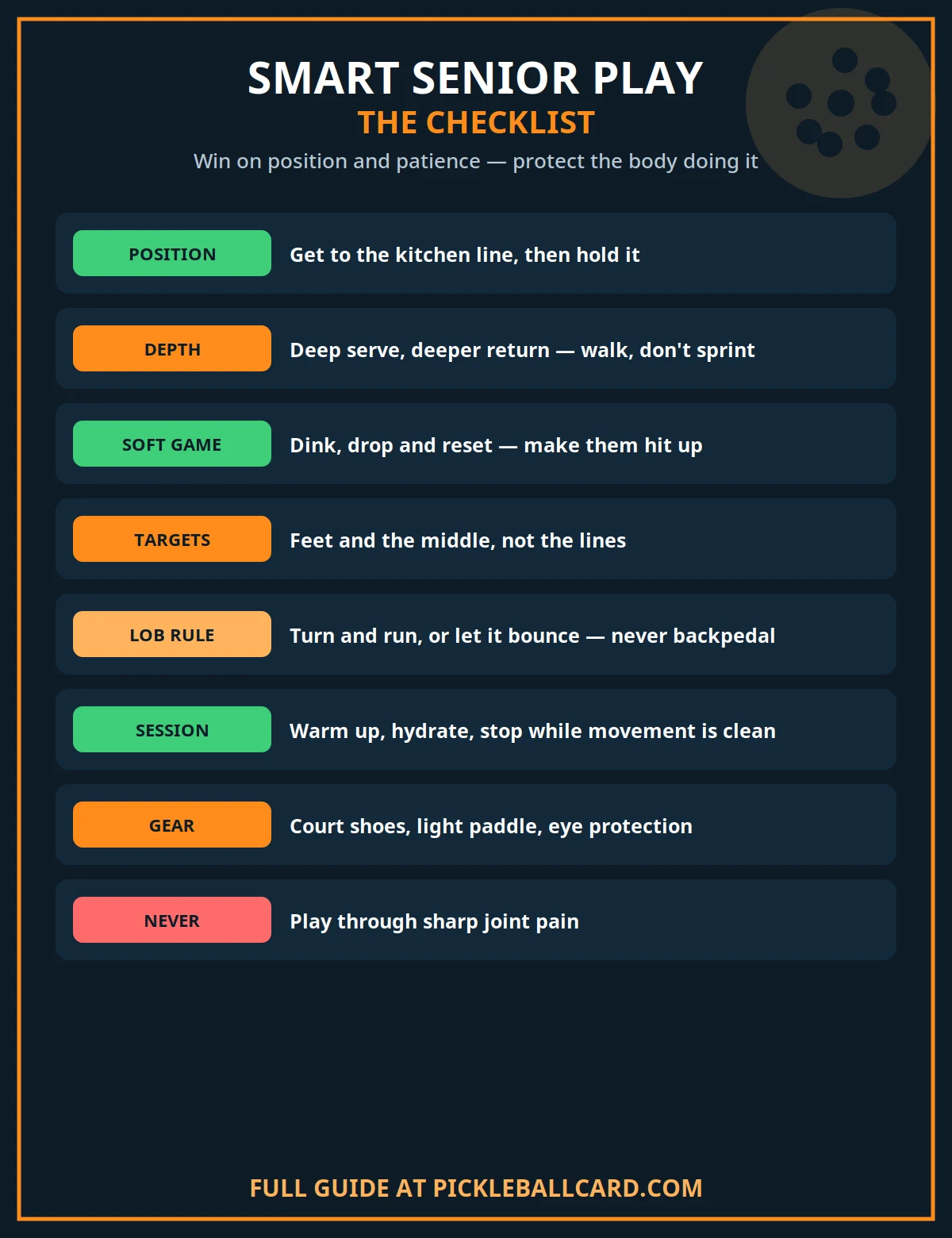
Checklist of smart senior pickleball play: position, depth, soft game, targets, lob rule, session, gear
The smart senior play checklist.

Serve and Return: Depth Buys Time

A deep serve pushes returners behind the baseline and slows their approach. Aim for the back third of the service box, with margin for error.

The return matters even more. Return deep, ideally to the weaker backhand side, then move forward behind it while the ball is still travelling.

That one habit — deep return, immediate walk forward — is the closest thing senior pickleball has to a cheat code. It converts defence into position every rally.

Vary serve placement occasionally to the wide corner. The point is not the ace; it is making the returner take one extra step before hitting.

Footwork That Protects Your Body

Never Backpedal

Backpedalling is how falls happen. When a lob goes over your head, turn your shoulders, run back sideways-on, and play the ball after it bounces if needed.

If you cannot get there safely, let it go. Conceding one lob costs a point; chasing it badly can cost a season.

Stand a half-step off the kitchen line if lobs trouble you. That small cushion turns an emergency sprint into a comfortable turn and run.

Small Steps, Early Split

Shuffle sideways rather than crossing your feet in fast exchanges. Small adjustment steps keep your balance centred and your knees out of twisting trouble.

Split-step — a small hop landing balanced — as your opponent contacts the ball. Flat feet are stuck feet, at any age.

Wear proper court shoes with lateral support, not running shoes. Running shoes are built to tip you forward; pickleball moves you sideways.

Shot Selection: Feet, Middle, Patience

Aim at feet, not at lines. A low ball at an opponent’s shoes forces an awkward lift, and lifts are what experienced players put away.

The middle is the safest attacking target in doubles. It is the longest court over the lowest part of the net, and it tests partner communication.

Use one well-timed lob per game against a team crowding the line. Even when it does not win the point, it changes where they stand afterwards.

Above all, count errors honestly. If your last three speed-ups missed, the pattern is the message: return to dinks, drops and resets until the rally tilts.

Playing Younger and Harder-Hitting Opponents

Take pace off everything. Younger players feed on speed; a slow, low, patient game removes the ball they want and hands them the ball they mishit.

Keep returns and resets away from their forehand drive. Most hard hitters are far less dangerous hitting a backhand from below the net.

Slow the game between points too. Use your full time, towel off, and set your feet. Rhythm belongs to whoever refuses to be hurried.

Manage the Session, Not Just the Rally

Habit Why it matters Simple standard
Warm-up Cold tissue strains more easily Ten minutes of walking, swings and easy dinks
Session length Fatigue wrecks footwork before it wrecks shots Stop while your movement is still clean
Hydration Dehydration slows reactions and recovery Drink before you feel thirsty, every changeover
Rest days Adaptation happens between sessions Alternate hard days with light or off days
Pain signals Small aches become layoffs when ignored Sharp or joint pain ends the session, full stop

Build playing time gradually across weeks, not across one enthusiastic Saturday. Your second month should be bigger than your first week, not your second day.

Cool down with a short walk and gentle stretching. It takes five minutes and tomorrow’s stiffness will be noticeably less for it.

Sore elbow or forearm after sessions? Read our guide to pickleball elbow prevention early — grip size, swing habits and load are usually fixable.

Find Games at Your Level

Open play is where senior pickleball lives, and choosing the right session matters as much as choosing the right paddle.

Most venues run beginner and intermediate sessions, and many run senior-specific court times. Start one level below where you think you belong; moving up is a pleasant errand.

Level-matched games are safer games. Wild mismatches produce lunging, scrambling and frustration on one side, and boredom on the other.

Tell new partners your level and any movement limits honestly. “I do not chase lobs” is useful information, not an apology.

Be the Partner Everyone Wants

Rotate willingly, encourage beginners, and keep games moving. Reputation travels fast in a senior playing community, and good partners get invited back.

Share the middle shots generously early in a partnership. Trust built in game one pays out for the rest of the session.

Build a Weekly Rhythm That Lasts

Two or three sessions a week suits most senior players starting out. That rhythm leaves recovery days between court days, which is when fitness actually improves.

Add the CDC’s other two ingredients around your pickleball: muscle-strengthening activity on two days a week, and regular balance practice.

Neither needs a gym membership. Sit-to-stands, heel raises, wall push-ups and heel-to-toe walking cover both, in your own hallway, in ten minutes.

Keep one session a week light — drilling, dinking games or social play. Not every court day should be a tournament in disguise.

Track your weeks honestly for the first month. If Tuesdays after Monday sessions feel heavy, your schedule — not your toughness — needs adjusting.

Gear That Helps Senior Players

  • Paddle: a light-to-midweight paddle you can manoeuvre without gripping hard. Excess weight and a too-small grip both make your forearm do the work.
  • Shoes: genuine court shoes with sideways support and a durable outsole. This is the single most protective purchase a senior player makes.
  • Eye protection: a deflected ball at the kitchen line arrives faster than anyone’s blink. Lightweight protective eyewear is cheap insurance.
  • Sun and heat kit: hat, sunscreen and water for outdoor play. Heat tolerance drops quietly with age; plan for it instead of discovering it.

Common Senior Mistakes

Mistake Cost Fix
Staying back after the return Kitchen line — and the rally — conceded Return deep, then walk forward immediately
Backpedalling for lobs Falls and wrist injuries Turn, run, or let it bounce
Speeding up low balls Errors and easy counters Reset and dink until the ball sits up
Swinging big from the shoulder Elbow and shoulder strain Compact swing, loose grip, let placement score
Playing through sharp pain Weeks off instead of one day off Stop, ice, and get checked if it persists
Skipping the warm-up First-game strains Ten easy minutes before the first serve

A Simple Pre-Session Checklist

  1. Arrive early. Ten minutes for walking, mobility and easy dinks before any game starts.
  2. Check your kit. Court shoes tied, eyewear on, water bottle full, hat if you are outdoors.
  3. Pick your partners’ plan. Agree who takes the middle before the first serve, not during the first argument.
  4. Set a session limit. Decide your finish time now, while you are fresh and honest.
  5. Finish with a cool-down. Walk, stretch gently, and note anything that aches for next time.

Frequently Asked Questions

Is pickleball safe for seniors?

For most healthy older adults, yes — it is a moderate, social, stop-start sport on a small court. It is not risk-free: falls and strains happen, which is why warm-ups, court shoes and no backpedalling matter.

What is the best age to start pickleball as a senior?

There is no cut-off. People start in their sixties, seventies and beyond. Start with doubles, beginner sessions and shorter playing blocks, and build up over several weeks.

How long should a senior play pickleball in one session?

Let movement quality decide. Many senior players do well with 60 to 120 minutes including breaks, stopping while footwork is still clean rather than when exhaustion forces it.

Is singles or doubles better for senior players?

Doubles, for almost everyone. A partner halves your court, doubles adds the social side, and the running load is far more manageable than in singles.

What paddle weight suits senior players?

Generally a light-to-midweight paddle that you can move quickly without squeezing the grip. If your elbow or shoulder aches after play, paddle weight and grip size are the first things to check.

Can senior players beat younger, faster opponents?

Regularly. The small court limits raw speed, and recreational games are decided by errors. Placement, patience, deep returns and a stubborn soft game close the athletic gap quickly.

The Bottom Line

Senior pickleball rewards the player who moves early instead of fast: deep serve, deeper return, a calm walk to the kitchen line, and a soft game played at opponents’ feet.

Protect that game with the unglamorous habits — warm up, never backpedal, wear court shoes, pace the session, and respect pain early.

Do those things and age stops being the story of your matches. Your positioning, patterns and patience become the story instead.

Sources: CDC, Older Adult Activity: An Overview (150 minutes weekly, muscle-strengthening and balance guidance) and USA Pickleball, Official Rules (non-volley zone and serve rules). Coaching content in this article is original; no competitor content is linked or reproduced.

shoaib
shoaib

Shoaib is the publisher of Pickleball Card. He oversees the site’s guides to pickleball rules, ratings, strategy and gear, all researched from primary sources — the USA Pickleball Rulebook, DUPR and manufacturer documentation — and updated as the game changes.

pickleballcard.com

Filed Under: About Pickleball

  • « Go to Previous Page
  • Page 1
  • Interim pages omitted …
  • Page 6
  • Page 7
  • Page 8
  • Page 9
  • Page 10
  • Page 11
  • Go to Next Page »

Latest Posts

  • Skinny Singles Pickleball: Rules, Court Setup & Strategy
  • Quiet Pickleball Paddles & Noise Rules
  • Tournament Balls: Franklin X-40 Vs Onix Dura Fast 40
  • Games Like Pickleball: Badminton, Racquetball, Tennis, Padel And More
  • Drills for Beginners in Pickleball: Dinks, Serves, Volleys and Drops
  • Timeout Rules in Pickleball: Standard, Medical and Between-Game Timeouts
  • Pickleball Safety And Eye Protection
  • What To Wear To Play Pickleball: Shoes, Clothes, And Court Essentials
  • Pickleball Statistics: Participation, Growth, And The Numbers That Matter
  • Paddle Generations Explained: From Thermoformed To Foam (Gen 2, Gen 3, Gen 4)
  • About
  • Privacy Policy
  • Terms And Conditions
  • Affiliate Disclosure

COPYRIGHT © 2026 · Pickleballcard.COM, ALL RIGHTS RESERVED.

PICKLEBALLCARD.COM IS A PARTICIPANT IN THE AMAZON SERVICES LLC ASSOCIATES PROGRAM, AN AFFILIATE ADVERTISING PROGRAM DESIGNED TO PROVIDE A MEANS FOR SITES TO EARN ADVERTISING FEES BY ADVERTISING AND LINKING TO AMAZON.COM. AMAZON, THE AMAZON LOGO, AMAZONSUPPLY, AND THE AMAZONSUPPLY LOGO ARE TRADEMARKS OF AMAZON.COM, INC. OR ITS AFFILIATES. AS AN AMAZON ASSOCIATE WE EARN AFFILIATE COMMISSIONS FROM QUALIFYING PURCHASES.